
Angle of Complex Number Calculator
Angle of Complex Number Calculator (Argument & Modulus)
Find the angle (argument) and modulus of a complex number a + bi — free, in your browser, nothing uploaded. The angle is given in both degrees and radians, and the working shows the reference angle and the quadrant adjustment, which is where hand calculations most often go wrong.
A complex number like −1 + i is a point on a map: one step west, one step north. Two numbers describe that point completely — how far it is from the origin, and in which direction. The distance is the modulus, and the direction, measured as an angle from the positive real axis, is the argument. An angle of complex number calculator finds both, and the calculator at the top of this page shows the part of the working that actually causes trouble: the quadrant adjustment. Because the trap in this calculation is famous — press the ordinary inverse-tangent button on b/a and for half the complex plane you get an angle pointing in exactly the opposite direction. The tool avoids that by reasoning quadrant by quadrant, and it displays its reasoning, so you can follow it, check it, and learn the pattern that hand calculation needs.
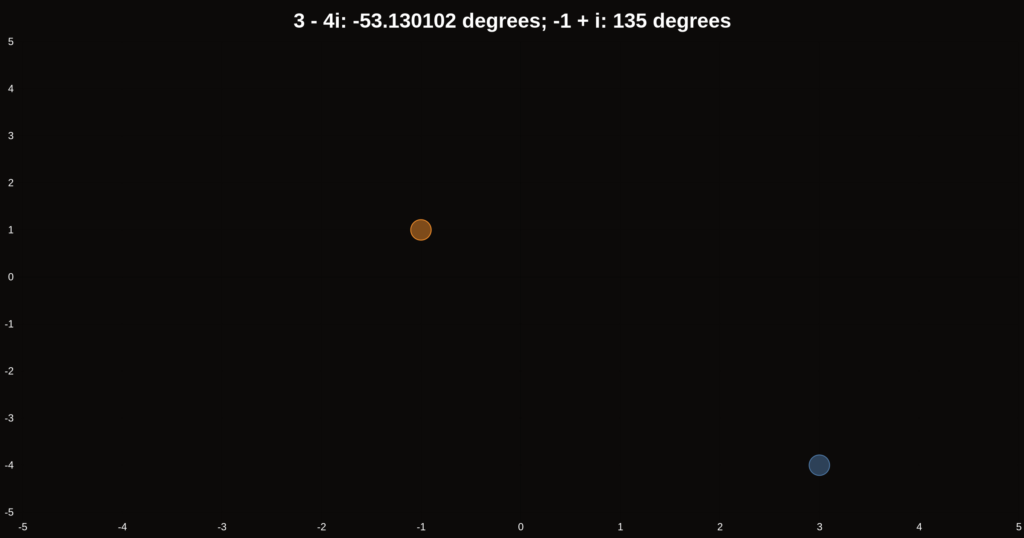
Direct answer: For 3 – 4i, the angle is -53.130102 degrees, and for -1 + i, it is 135 degrees.
For −1 + i, the answers are modulus √2 ≈ 1.414214 and angle 135 degrees, or 2.356194 radians. The naive button-press gives atan(1 / −1) = atan(−1) = −45 degrees, which points south-east — the opposite quadrant entirely. Nothing about the arithmetic is wrong; atan simply cannot see the signs of a and b separately, because the ratio b/a throws that information away (−1/1 and 1/−1 have the same ratio). Recovering the true angle from the reference angle plus the quadrant is the whole craft of this calculation, and it is what the steps in this tool lay out for every input.
What the Angle and Modulus of a Complex Number Are
Write a complex number as z = a + bi, where a is the real part and b is the imaginary part. Plotted on the complex plane (the Argand diagram), z is the point (a, b): a along the horizontal real axis, b along the vertical imaginary axis. The modulus, written |z|, is the straight-line distance from the origin to that point, and Pythagoras gives it directly: |z| = √(a² + b²). The argument, written arg(z), is the angle between the positive real axis and the line from the origin to the point, measured anticlockwise, in degrees or radians. Together, modulus and argument are the polar coordinates of the point, and they rebuild the number completely: z = |z| × (cos θ + i sin θ), the polar form.
The argument is not unique until a range is chosen, because adding a full turn changes nothing about direction: 135°, 135° + 360° = 495°, and 135° − 360° = −225° all point the same way. The standard choice, and the one this calculator reports, is the principal argument, the unique value in the range −180° to +180° (or −π to +π in radians). When a textbook writes Arg(z) with a capital A, it usually means exactly this principal value. Being explicit about the range matters whenever angles are added or compared — in signal processing, control systems, and AC circuit analysis, all heavy users of complex angles, a phase that jumps from +179° to −179° is continuous rotation, not a 358° leap, and tools that report principal values make that visible.
Finding the argument by hand is a three-step routine, and the calculator’s output follows it line for line. First, compute the reference angle, the acute angle the point makes with the horizontal axis: α = atan(|b / a|), always between 0° and 90°. Second, identify the quadrant from the signs of a and b. Third, convert: first quadrant (a > 0, b > 0), the argument is α; second quadrant (a < 0, b > 0), it is 180° − α; third quadrant (a < 0, b < 0), it is −(180° − α) in principal-value terms, equivalently 180° + α before wrapping into range; fourth quadrant (a > 0, b < 0), it is −α. The points on the axes are special cases: a = 0 with b > 0 gives exactly 90°, a = 0 with b < 0 gives −90°, b = 0 with a < 0 gives 180°, and 0 + 0i has no angle at all — a point at the origin has no direction, and the tool says so instead of inventing one.
How to Use the Calculator
Using the tool takes a few seconds. Follow these steps:
- Enter the real part a. For the number −1 + i, a is −1.
- Enter the imaginary part b, the number multiplying i. For −1 + i, b is 1. Enter just the number — type 1, not “i” or “1i”.
- Press “Calculate Angle & Modulus”.
- Read the angle in degrees and radians, the modulus, the polar form, and the step-by-step working: modulus first, then reference angle, then the quadrant reasoning.
If your number is written in a form like 3 − 4i, then a = 3 and b = −4 (the minus sign belongs to b). If it is written as a pure imaginary number like 5i, then a = 0 and b = 5. If it is a plain real number like −7, then a = −7 and b = 0, and its angle is 180°, which surprises people the first time and then makes complete sense on the diagram: the point sits on the negative real axis, pointing in the 180° direction.
Worked Examples
Example 1: −1 + i, the live test
Enter a = −1, b = 1. Modulus: √((−1)² + 1²) = √2 = 1.414214. Reference angle: atan(|1 / −1|) = atan(1) = 45.000000°. Quadrant: a is negative and b is positive, so the point is in the second quadrant, and the argument is 180° − 45° = 135.000000°. In radians, 135° × π / 180 = 2.356194, which is 3π/4 exactly. Polar form: z = 1.414214 × (cos 135° + i sin 135°). Verify backwards: cos 135° = −√2/2 ≈ −0.707107, times the modulus 1.414214 gives −1.000000 = a; sin 135° = +0.707107, times the modulus gives +1.000000 = b. The angle and modulus rebuild the number, which is the test every polar conversion should pass.
Example 2: 3 − 4i, the friendly triangle
Enter a = 3, b = −4. Modulus: √(9 + 16) = √25 = 5 exactly — the 3-4-5 triangle in disguise. Reference angle: atan(4/3) ≈ 53.130102°. Quadrant: a positive, b negative — fourth quadrant — so the argument is −53.130102°, or −0.927295 radians. The negative sign is not a nuisance; it records that the point lies below the real axis. In degrees-and-wrapping terms the same direction is 306.869898°, but the principal value is the negative one, and the tool reports the principal value.
Example 3: −2 − 2i, the third quadrant
Enter a = −2, b = −2. Modulus: √(4 + 4) = √8 = 2.828427. Reference angle: atan(1) = 45°. Quadrant: both parts negative — third quadrant — so the principal argument is −(180° − 45°) = −135.000000°, or −2.356194 radians. This example is the atan trap in its sharpest form: b/a = (−2)/(−2) = 1, and atan(1) = 45°, which is wrong by 180°. The ratio is positive, as it also is in the first quadrant, and nothing in the ratio alone can distinguish north-east from south-west. Only the separate signs of a and b can, which is why the quadrant step is a step and not a footnote.
Example 4: On the axes
Enter a = 0, b = 5: modulus 5, angle exactly 90°. Enter a = 0, b = −5: modulus 5, angle exactly −90°. Enter a = −7, b = 0: modulus 7, angle exactly 180°. These axis cases need no reference angle — there is no triangle to speak of — and the tool handles them as the special cases they are, rather than dividing by a zero a. Enter a = 0, b = 0 and the tool refuses, correctly: 0 + 0i is the origin, the one point with no direction, and reporting any angle for it would be a fabrication.
Why the Argument Matters
Polar form earns its keep when complex numbers are multiplied, divided, or raised to powers — operations that are fiddly in a + bi form and transparent in polar form. Multiply two complex numbers and their moduli multiply while their arguments add; divide and the arguments subtract; raise to the power n and the argument multiplies by n (De Moivre’s theorem), which is how roots of complex numbers are found: the n roots of a number are spread evenly around a circle, separated by 360°/n. None of that machinery runs without reliable arguments, and all of it inherits the quadrant trap if the arguments are computed carelessly — a root-finding calculation with one angle out by 180° puts roots in entirely wrong places.
The applications follow the mathematics. In electrical engineering, alternating voltages and currents are phasors — complex numbers whose modulus is an amplitude and whose argument is a phase angle — and impedance itself is complex, with an argument that says whether a circuit behaves more like a resistor, an inductor, or a capacitor. In signal processing, the Fourier transform outputs complex numbers bin by bin, and the argument spectrum (the phase) carries half the information about the signal; discarding it audibly mangles reconstructed audio. In control theory, stability margins are read off how a system’s phase angle behaves. In each field the pattern is the same: the modulus says how much, the argument says which way or how late, and both are needed.
A Quick Way to Check Any Answer
Every modulus-and-argument answer carries its own test, and it takes ten seconds: multiply back. Compute |z| × cos θ and you should recover a; compute |z| × sin θ and you should recover b. Run it on the live test: 1.414214 × cos 135° = 1.414214 × (−0.707107) ≈ −1.000000, and 1.414214 × sin 135° ≈ +1.000000 — the original −1 + i, rebuilt. The check catches the atan trap instantly, because a wrong-by-180° angle rebuilds −a and −b instead: both signs flipped, the number negated. It also catches swapped parts (entering a where b belongs rebuilds the mirror-image number) and degree/radian mix-ups (the rebuild lands somewhere unrelated). Teachers set this conversion in exams precisely because the check exists; a candidate who multiplies back never hands in a second-quadrant answer for a fourth-quadrant number. The tool prints the polar form in its output precisely so this check can be run on its own results, and it is worth running on any answer, from any source, before the angle is used downstream.
Common Mistakes
The first common mistake is the atan trap itself: computing atan(b/a) and stopping, which gives a wrong-by-180° answer for every point with a < 0. The function designed to avoid it is atan2(b, a), which takes the parts separately, and it is what this tool’s quadrant logic mirrors in visible steps. The second mistake is entering the sign wrongly: for 3 − 4i, b is −4, and entering 4 moves the point across the axis and changes the answer’s sign. The third is mixing degrees and radians mid-problem — 2.356194 is radians for 135°, and feeding it into a degree-mode formula garbles everything downstream. The fourth is treating the argument as unique: −225° and 135° are the same direction, and a comparison that forgets the wrap will flag equal angles as different. The fifth is asking for the angle of 0 + 0i, which has none. The sixth is rounding the modulus early: build the polar form from a rounded |z| and the rebuilt a and b drift, as anyone who checks Example 1 backwards with 1.41 instead of 1.414214 will see.
Limits: What This Tool Does and Does Not Do
This tool computes the modulus and the principal argument — in degrees and radians — for a single complex number a + bi with finite real inputs, showing the modulus calculation, the reference angle, and the quadrant adjustment as its steps. It does not accept input already in polar or exponential form, it does not multiply, divide, or find roots of complex numbers (it supplies the angles those operations need), and it does not report non-principal arguments, though any of them can be had by adding or subtracting 360° as many times as you like. For the zero number it reports that the angle is undefined, because it is. Within its scope, values are shown to six decimal places, every step is computed from the a and b you entered, and the polar form it prints can be multiplied back out to recover your number exactly, up to the rounding of the display.
Privacy: Your Numbers Stay in Your Browser
Every number you enter into this angle of complex number calculator stays in your browser. Nothing is uploaded to a server, nothing is stored, and there is no account to create. The calculation runs entirely on your own device. Closing the page removes your inputs, and no one else sees them. This browser-only design is the same principle behind the other free tools on Your Smart Kit: a simple tool that does one job well, keeps your data private, and gives an answer you can check.
Frequently Asked Questions
What is the argument of a complex number?
It is the angle between the positive real axis and the line from the origin to the point a + bi on the complex plane, measured anticlockwise. The principal argument is the one between −180° and +180°. For −1 + i it is 135°, or 2.356194 radians.
What is the modulus of a complex number?
It is the distance from the origin to the point: |a + bi| = √(a² + b²). For −1 + i, that is √2 ≈ 1.414214; for 3 − 4i it is exactly 5.
Why does atan(b/a) give the wrong angle?
Because the ratio b/a loses the separate signs of a and b. Points in the first and third quadrants share the same positive ratio, as do points in the second and fourth with negative ratios, so atan alone is off by 180° for half the plane. The quadrant must be checked separately, as this tool’s steps do.
Should the angle be in degrees or radians?
Both are correct; they are the same angle in different units, converted by multiplying degrees by π/180. Mathematics and physics usually work in radians, engineering readouts often in degrees, and this tool shows both.
What is the angle of a negative real number like −7?
180°. The point (−7, 0) lies on the negative real axis, pointing in the 180° direction from the origin, with modulus 7.
What is the angle of 0 + 0i?
Undefined. The origin has no direction, and the tool says so rather than inventing an angle.
Related Tools on Your Smart Kit
If you found the angle of complex number calculator useful, you may also like the other free calculators on Your Smart Kit, including the cosh calculator for the hyperbolic functions that complex exponentials connect to, the Euler phi function calculator for number theory counts, and the geometry calculator for angles and lengths in ordinary triangles. Each runs in your browser, free, with no sign-up, and each is built on the same principle: a simple tool that does one job well, keeps your data private, and gives an answer you can check. Try the angle of complex number calculator at the top of this page with −1 + i, follow its quadrant step, and then test yourself on a third-quadrant number before you look at the answer.
How do I fix the quadrant for 3 – 4i?
Use atan2, not atan alone. For 3 – 4i, the reference angle is atan(4 / 3) = 53.130102 degrees, and because the point is in the fourth quadrant, the signed angle is -53.130102 degrees, or -0.927295 radians. A plain atan(-4 / 3) happens to give the same value here, but only because the fourth quadrant and the first quadrant share that ratio; for -1 + i, plain atan gives -45 degrees, which is wrong by 180 degrees.
Why is the angle for -1 + i exactly 135 degrees?
Because -1 + i sits on the diagonal of the second quadrant, at equal distance west and north from the origin. Its modulus is root 2, about 1.414214, its reference angle is atan(1 / 1) = 45 degrees, and the second-quadrant rule gives 180 degrees minus 45 degrees = 135 degrees, or 2.356194 radians. Any point with a = -b in the second quadrant gives the same 135-degree angle, whatever its size.
What changes if I swap a and b?
Swapping a and b reflects the point across the diagonal line y = x, and the angle changes in a way that is not a simple sign flip. For example, -1 + i at 135 degrees becomes 1 – i at -45 degrees when the parts are swapped, because the point moves from the second quadrant to the fourth. Always re-read a as the horizontal part and b as the vertical part after any swap, rather than reusing the first angle.
Quick-reference table for the live tests
| Input entered | Modulus | Angle in degrees | Angle in radians |
|---|---|---|---|
| 3, -4 | 5 | -53.130102 | -0.927295 |
| -1, 1 | 1.414214 | 135 | 2.356194 |
Worked example with the live test figures
Find the angle and modulus for 3 – 4i. Step 1: modulus = root(3 squared + (-4) squared) = root(9 + 16) = 5. Step 2: reference angle = atan(4 / 3) = 53.130102 degrees. Step 3: fourth quadrant, so the signed angle is -53.130102 degrees, or -0.927295 radians. Polar form: 5 times (cos -53.130102 degrees + i sin -53.130102 degrees). For a different single-input function, see the Cosh Calculator and the Euler Phi Function Calculator.