
Straight-Line Amortization Calculator
Straight-line amortization spreads an asset’s cost evenly over its useful life. Annual amortization expense equals cost minus salvage value, divided by useful life in years, so the same amount is charged every year until the asset reaches its salvage value.
How do I use the Straight-Line Amortization Calculator?
Enter the asset cost first. This is the amount to amortize, usually the purchase price plus the costs needed to get the asset ready for use, such as delivery and installation. Next enter the salvage value, also called the residual value. This is what the asset is expected to be worth at the end of its useful life. If the asset is expected to be worth nothing at the end, enter 0. If you leave the salvage value blank, the tool treats it as 0.
Then enter the useful life in whole years, from 1 to 50. Useful life is an estimate of how long the asset will serve the business, not necessarily how long it physically lasts. A computer may still switch on after five years, but if it is expected to be replaced after five years, its useful life for this calculation is five years. Press the calculate button and the result boxes show the annual amortization expense, the monthly amortization, the total amortization, and the depreciable base, which is cost minus salvage value.
Below the result boxes, the tool shows a year-by-year schedule. Each row gives the year, the annual expense for that year, the accumulated amortization so far, and the book value at the end of that year. The book value starts at the asset cost and falls by the same annual expense each year until it reaches the salvage value in the final year.
If the inputs do not make sense, the tool shows a plain-language error instead of a result. A salvage value equal to or greater than the cost gives an error, because there would be nothing left to amortize. A useful life of zero, a negative number, or more than 50 years also gives an error, as does a cost of zero or less. No result boxes appear until the inputs are valid.
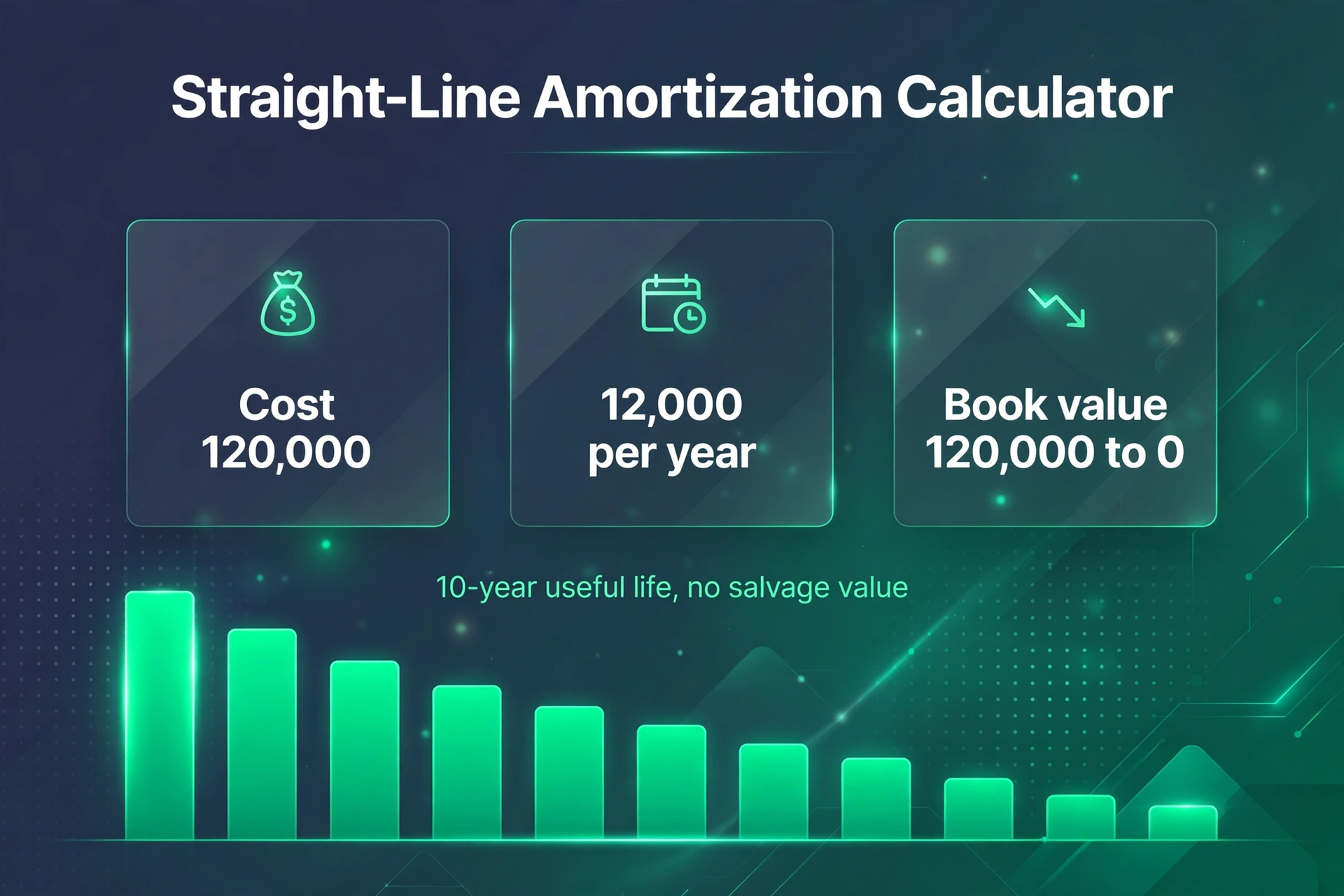
A worked example from the live tool
Take the first verified test. An asset costs $120,000, has a salvage value of $0, and a useful life of 10 years. The depreciable base is cost minus salvage value: $120,000 minus $0 gives $120,000. Divide that base by the useful life: $120,000 divided by 10 years gives an annual amortization expense of $12,000. The monthly figure is the annual expense divided by 12: $12,000 divided by 12 gives $1,000 per month. The total amortization over the whole life is the depreciable base itself, $120,000, because the full cost is spread across the ten years and nothing is left at the end.
The schedule makes the pattern visible. After year 1, accumulated amortization is $12,000 and the book value is $120,000 minus $12,000, which is $108,000. After year 2, accumulated amortization is $24,000 and the book value is $96,000. After year 3, accumulated amortization is $36,000 and the book value is $84,000. The fall is the same $12,000 every year, so the book value after any year can be found by multiplying $12,000 by the number of years and subtracting from $120,000. Halfway through, after year 5, accumulated amortization is $60,000 and the book value is $60,000. At the end of year 10, accumulated amortization is $120,000 and the book value is $0, which matches the salvage value entered.
A second test shows what changes when a salvage value is present. An asset costs $50,000, has a salvage value of $5,000, and a useful life of 5 years. The depreciable base is $50,000 minus $5,000, which is $45,000. Divide $45,000 by 5 years and the annual expense is $9,000. The monthly expense is $9,000 divided by 12, which is $750. After year 2, accumulated amortization is $18,000 and the book value is $50,000 minus $18,000, which is $32,000. At the end of year 5, accumulated amortization is $45,000 and the book value is $5,000, which is exactly the salvage value. The $5,000 is never amortized, because it is the value the asset is expected to keep.
A third test uses a longer life with a small salvage value. An asset costs $25,000, has a salvage value of $1,000, and a useful life of 8 years. The depreciable base is $25,000 minus $1,000, which is $24,000. Divide $24,000 by 8 years and the annual expense is $3,000. The monthly expense is $3,000 divided by 12, which is $250. After year 1, accumulated amortization is $3,000 and the book value is $25,000 minus $3,000, which is $22,000. At the end of year 8, accumulated amortization is $24,000 and the book value is $1,000.
What is amortization in accounting?
Amortization is the systematic spreading of a cost over the periods that benefit from it. When a business buys something that will be used for several years, the whole cost is not charged to the year of purchase. Instead, a share of the cost is charged in each year the asset is used. That share is the amortization expense for the year, and the running total of those shares is the accumulated amortization.
The word amortization is most often used for intangible assets, such as patents, copyrights, and software licences. The same arithmetic is used for tangible assets, where the word depreciation is more common, and the two terms overlap in everyday use. A machine, a vehicle, or office furniture is usually said to be depreciated, while a patent or a licence is usually said to be amortized. The straight-line method works the same way for both: the same amount each year, from cost down to salvage value.
Amortization is not a cash payment. The cash left the business when the asset was bought. The annual expense is an accounting allocation that matches the cost against the years of use. That is why the tool asks for cost, salvage value, and useful life, and not for an interest rate or a payment amount. There is no interest in this calculation, and no monthly bill. The monthly figure the tool shows is simply the annual expense divided by 12, for readers who plan by the month.
For the value of money over time, see the time value of money calculator.
How is straight-line amortization calculated?
The formula has three inputs and one division. First find the depreciable base by subtracting the salvage value from the cost. Then divide that base by the useful life in years. The result is the annual amortization expense. The monthly expense is the annual expense divided by 12. The total amortization over the asset’s life is the depreciable base, because the whole base is spread across the useful life and nothing more is charged after that.
Written out, the formula is: annual amortization expense = (cost − salvage value) ÷ useful life. The same formula can be expressed as a rate. The straight-line rate is 1 divided by the useful life, applied to the depreciable base. A 10-year life gives a rate of 10% of the base per year. A 5-year life gives a rate of 20% per year. An 8-year life gives a rate of 12.5% per year. The rate stays the same every year, which is what makes the method a straight line: the book value falls by the same amount in each year, so a chart of book value against time is a straight diagonal line from cost down to salvage value.
The formula is simple, but each input is an estimate that deserves care. Cost should include what was paid to acquire the asset and get it ready for use, not only the sticker price. Salvage value is a forecast of what the asset will be worth at the end, and it is often the hardest of the three inputs to pin down. Useful life is a judgement about how long the asset will serve, and it can change if the asset is used harder than expected or becomes outdated sooner. If any of the three estimates changes later, the annual expense is recalculated from the remaining book value over the remaining life. The tool itself only computes the arithmetic from the numbers entered; it does not judge whether those estimates are right for a particular asset.
What does the year-by-year schedule show?
The schedule turns a single annual figure into a year-by-year record. Each row has four numbers. The annual expense is the same in every row, because the straight-line method charges the same amount each year. The accumulated amortization is the running total of all annual expenses up to and including that year. The book value is the cost minus the accumulated amortization, and it is the value the asset still carries on the books at the end of that year.
The schedule answers questions that a single annual figure cannot. It shows the book value at any point in the asset’s life, which is the figure a reader needs when an asset is sold, written off, or checked against insurance. It shows when the book value crosses a particular level, such as the halfway point. And it shows that the book value never falls below the salvage value, because the last year’s expense brings it exactly to that value and the schedule stops there.
For the $120,000 asset over 10 years, the schedule reads $108,000 after year 1, $96,000 after year 2, $84,000 after year 3, $72,000 after year 4, $60,000 after year 5, $48,000 after year 6, $36,000 after year 7, $24,000 after year 8, $12,000 after year 9, and $0 after year 10. Each step down is $12,000. For the $50,000 asset with a $5,000 salvage value over 5 years, the schedule reads $41,000, $32,000, $23,000, $14,000, and $5,000, with each step down $9,000. Reading either schedule from top to bottom shows the same even fall, ending exactly at the salvage value.
What is salvage value and why does it matter?
Salvage value is the amount an asset is expected to be worth when its useful life ends. It may come from a resale price, a trade-in value, or scrap value. It is subtracted from the cost before anything is divided, so it directly lowers the amount that gets amortized. A higher salvage value means a smaller depreciable base and a smaller annual expense. A salvage value of zero means the whole cost is amortized.
The $50,000 asset in the worked example shows the effect clearly. With a salvage value of $5,000 and a 5-year life, the annual expense is $9,000. Without any salvage value, the same $50,000 over the same 5 years would give an annual expense of $10,000, because $50,000 divided by 5 is $10,000. The $5,000 of expected remaining value removes $1,000 a year from the expense. That is a real difference in the reported expense, so the salvage value should be an honest estimate, not a number chosen to make the expense look smaller.
Salvage value also sets the floor for the book value. No matter how the schedule is read, the book value never goes below the salvage value under this method. That floor is the reason the tool refuses a salvage value equal to or greater than the cost: if the asset is expected to be worth as much as it cost, there is no cost left to spread, and an amortization calculation has nothing to work with. A salvage value of zero is common for assets that are expected to be worthless at the end, such as a patent that expires or software that is replaced, and the tool accepts zero without complaint.
How does straight-line amortization differ from declining balance?
Straight-line amortization charges the same amount every year. Declining balance charges a larger amount in the early years and a smaller amount later, because each year’s expense is a fixed percentage of the book value at the start of that year, and the book value shrinks as the years pass. The two methods spread the same total cost, but they spread it on different timetables.
The contrast is sharpest in the first year. Under the double-declining balance method, the first-year expense is the book value multiplied by 2 divided by the useful life. For the $50,000 asset with a 5-year life, the double-declining first-year expense is $50,000 multiplied by 2 divided by 5, which is $20,000. The straight-line first-year expense for the same asset is $9,000. In year 2, the book value has fallen to $30,000 under double-declining, so the year 2 expense is $30,000 multiplied by 2 divided by 5, which is $12,000, while straight-line still charges $9,000. The declining method front-loads the expense and the straight-line method keeps it level.
There is also the sum-of-the-years-digits method, which is another accelerated method. For the same $50,000 asset with a $5,000 salvage value over 5 years, the sum of the years digits is 15, and the first-year expense is 5 fifteenths of the $45,000 base, which is $15,000. The final-year expense is 1 fifteenth of $45,000, which is $3,000. So the three methods give first-year expenses of $9,000, $15,000, and $20,000 for the same asset, and all three end at the same salvage value of $5,000. The choice between them is a matter of which pattern fits the asset’s use. Straight-line fits an asset that gives roughly the same benefit each year. An accelerated method fits an asset that gives more benefit early, or that loses value quickly after purchase.
Accounting standards such as US GAAP and IFRS generally require the method to reflect the pattern in which the asset’s future economic benefits are expected to be consumed. That is a judgement for the person preparing the accounts, not something this tool decides. The tool computes the straight-line arithmetic only, and it does not recommend one method over another.
What else is amortized with the straight-line method?
The same formula applies well beyond machinery and vehicles. Intangible assets are the classic case. A patent bought for $100,000 with no salvage value and a useful life of 10 years gives an annual amortization expense of $10,000, because $100,000 divided by 10 is $10,000. Copyrights, trademarks with a finite life, software licences, and franchise rights are treated the same way when they have a limited useful life and a known cost.
Bond premium and discount amortization is a second use. When a bond is issued for more than its face value, the premium is amortized over the bond’s term, and when it is issued for less, the discount is amortized the same way. Under the straight-line method, the premium or discount is spread evenly across the periods. A $10,000 premium spread over 10 years gives $1,000 a year. The effective interest method is the other common approach for bonds, and it gives a different yearly pattern, but the straight-line version follows the same even spread this tool computes.
Goodwill is handled differently. Under both US GAAP and IFRS, goodwill is not amortized. It is tested for impairment instead, which means its value is checked and written down only if it has fallen. A reader who enters a goodwill figure into this tool would get an arithmetic answer that does not match how goodwill is treated in accounts, so goodwill should not be run through a straight-line calculation.
For the effect of interest compounding over time, see the compound interest calculator.
For what a future sum is worth today, see the present value of money calculator.
What is the difference between amortization and depreciation?
In accounting, amortization usually refers to intangible assets and depreciation usually refers to tangible assets. A patent is amortized. A delivery truck is depreciated. The words describe the same idea, which is the systematic allocation of a cost over a useful life, and the straight-line formula is the same for both. In everyday use the two terms are often swapped, and many calculators and articles use them interchangeably, which is why the top search results for this keyword mix the two freely.
The distinction matters most when reading financial statements or tax rules, where the terms are used more precisely. It matters less for the arithmetic. Whether the asset is a patent or a machine, the calculation is cost minus salvage value, divided by useful life. This page uses the word amortization throughout because that is the keyword it answers, and it treats depreciation as the same method applied to tangible assets rather than as a different calculation.
Is this the same as a loan amortization schedule?
No. A loan amortization schedule shows how a loan is paid off: each payment is split between interest and principal, the interest falls as the balance falls, and the balance reaches zero at the end of the term. That schedule needs an interest rate, a loan amount, and a term, and it answers the question of what each payment is made of.
This tool answers a different question. It spreads an asset’s cost over its useful life, with no interest rate and no payments. The annual figure is an expense allocation, not a bill. The book value falls because cost is being allocated, not because a debt is being repaid. The two uses share the word amortization, which is why they are easy to confuse, and it is also why some top search results for this keyword describe loan repayment rather than asset cost spreading.
The site already has tools for the loan side. The loan calculator works out monthly payments, total interest, and total cost for a loan from an amount, a rate, and a term. The Loan Early Repayment Calculator works out what happens when a loan is paid off early. Use those tools for borrowing questions, and use this page for the accounting question of spreading an asset’s cost. The two are not interchangeable, and entering a loan amount into this tool will not give a loan payment.
What mistakes do people commonly make?
The first mistake is forgetting the salvage value. Dividing the full cost by the useful life, instead of cost minus salvage value, overstates the annual expense. For the $50,000 asset with a $5,000 salvage value, forgetting the salvage value gives $10,000 a year instead of $9,000. The error is small in any one year, but it adds up to $5,000 over the five years, and it leaves the book value at zero instead of $5,000 at the end.
The second mistake is mixing up useful life and physical life. An asset may keep working long after its useful life ends, or it may become useless before its physical life is over. The calculation uses useful life, which is the period the asset is expected to serve the business. Using a physical life of 20 years for a computer that will be replaced in 5 years would spread the cost far too thinly.
The third mistake is confusing amortization with loan repayment, as described above. Entering a loan amount and expecting a monthly payment is the most common version of this error, and it comes from the shared word. If the question involves an interest rate, it is a loan question, not an asset amortization question.
The fourth mistake is treating the monthly figure as a cash cost. The $1,000 a month for the $120,000 asset is an allocation of a cost already paid, not a monthly bill. Planning cash flow around it as if money were leaving the business each month would understate the cash actually available.
The fifth mistake is changing the useful life or salvage value without recalculating. If an asset is expected to last two years longer than first thought, the remaining book value should be spread over the remaining life from that point, not left on the old annual figure. The tool recomputes from whatever numbers are entered, so re-entering the updated estimates gives the corrected expense.
What are the limits of this calculator?
This calculator computes the straight-line arithmetic only. It does not give tax or accounting advice, and it does not claim that a qualified reviewer has checked the page. Tax treatment and accounting standards may differ from the straight-line result shown here, and the rules can differ by country and by asset type.
For tax purposes in the United States, most tangible property is depreciated under MACRS, the Modified Accelerated Cost Recovery System, rather than straight-line, and the recovery period is set by the asset’s class life in IRS Publication 946, How to Depreciate Property. MACRS also allows special rules such as the Section 179 deduction and bonus depreciation, which let some costs be recovered faster than any even spread. The straight-line figure from this tool is therefore not a tax deduction figure, and it should not be used as one without checking the rules that apply.
The tool also assumes a full first year. In practice, an asset bought partway through a year is often amortized for only part of that first year, under conventions such as the half-year convention. This tool does not apply any partial-year convention, so a first-year figure from real accounts may be smaller than the full annual expense shown here. The tool also assumes the estimates stay fixed. If the salvage value or useful life is revised, the expense must be recalculated from the remaining book value, as noted above.
Finally, the tool caps useful life at 50 years and requires whole years. Very long-lived assets, such as buildings, can have useful lives beyond 50 years, and those need a different treatment. The cap keeps the schedule readable, since a schedule with hundreds of rows would be hard to use on a page.
What information does this tool store?
This tool works from the numbers typed into it on the page. It does not ask for a name, an email address, or any account detail, and the article itself carries no personal information. A reader who wants to keep a result can note it down separately. The tool does not need any personal detail to produce an annual expense, a monthly figure, or a schedule. The results are shown on the page in the labelled boxes and the schedule table above, and the worked examples in this article use only the verified test figures listed at the end, so a reader can check the tool against a known answer before trusting it with a real asset.
For more tools in the same collection, browse the calculators category.
What does the quick-reference table show?
The table below is computed from the same formula the tool uses, so every row can be checked by hand. It shows five common cases, the depreciable base, the annual expense, and the monthly expense. It is a quick way to sense-check a result: if the tool gives an annual expense far from the row for similar inputs, one of the three inputs was probably entered wrongly.
| Asset cost | Salvage value | Useful life | Annual expense | Monthly expense |
| $100,000 | $10,000 | 10 years | $9,000.00 | $750.00 |
| $50,000 | $5,000 | 5 years | $9,000.00 | $750.00 |
| $25,000 | $0 | 5 years | $5,000.00 | $416.67 |
| $10,000 | $0 | 10 years | $1,000.00 | $83.33 |
| $60,000 | $10,000 | 4 years | $12,500.00 | $1,041.67 |
Each row follows the same arithmetic. For the first row, $100,000 minus $10,000 is $90,000, and $90,000 divided by 10 is $9,000 a year, which is $750 a month. For the third row, $25,000 minus $0 is $25,000, and $25,000 divided by 5 is $5,000 a year, which is $5,000 divided by 12, or $416.67 a month. The monthly figures in the last three rows are rounded to two decimal places, so multiplying a rounded monthly figure by 12 may differ from the annual expense by a few cents. The annual expense is the exact figure, and the monthly figure is that annual figure divided by 12.
Frequently asked questions
FAQ 1 — How do you calculate straight-line amortization?
Subtract the salvage value from the cost to get the depreciable base, then divide the base by the useful life in years. For a $120,000 asset with no salvage value over 10 years, the base is $120,000 and the annual expense is $120,000 divided by 10, which is $12,000.
FAQ 2 — What is the annual amortization expense for a $120,000 asset with no salvage value over 10 years?
The annual expense is $12,000, and the monthly expense is $1,000. Total amortization over the 10 years is $120,000, and the book value falls from $120,000 to $0, reaching $84,000 after year 3.
FAQ 3 — How does salvage value change the annual expense?
Salvage value is subtracted from the cost before dividing, so a higher salvage value lowers the expense. A $50,000 asset with a $5,000 salvage value over 5 years gives $9,000 a year, while the same asset with no salvage value would give $10,000 a year.
FAQ 4 — What is the book value of the asset after 3 years?
For the $120,000 asset over 10 years, the book value after year 3 is $84,000, because accumulated amortization after 3 years is $36,000 and $120,000 minus $36,000 is $84,000. The schedule on this page shows the book value for every year.
FAQ 5 — Is straight-line amortization the same as loan amortization?
No. This tool spreads an asset’s cost over its useful life with no interest rate and no payments. A loan amortization schedule splits loan payments between interest and principal. For loan payments, use the loan calculator instead.
FAQ 6 — Does this calculator give tax or accounting advice?
No. It computes the straight-line arithmetic only. Tax treatment and accounting standards, such as US GAAP and IFRS, may differ from the result shown, and tax depreciation in the United States generally follows MACRS under IRS Publication 946 rather than the straight-line method. Check the rules that apply to your situation.
How do you calculate straight-line amortization?
Subtract the salvage value from the cost to get the depreciable base, then divide the base by the useful life in years. For a $120,000 asset with no salvage value over 10 years, the base is $120,000 and the annual expense is $120,000 divided by 10, which is $12,000.
What is the annual amortization expense for a $120,000 asset with no salvage value over 10 years?
The annual expense is $12,000, and the monthly expense is $1,000. Total amortization over the 10 years is $120,000, and the book value falls from $120,000 to $0, reaching $84,000 after year 3.
How does salvage value change the annual expense?
Salvage value is subtracted from the cost before dividing, so a higher salvage value lowers the expense. A $50,000 asset with a $5,000 salvage value over 5 years gives $9,000 a year, while the same asset with no salvage value would give $10,000 a year.
What is the book value of the asset after 3 years?
For the $120,000 asset over 10 years, the book value after year 3 is $84,000, because accumulated amortization after 3 years is $36,000 and $120,000 minus $36,000 is $84,000. The schedule on this page shows the book value for every year.
Is straight-line amortization the same as loan amortization?
No. This tool spreads an asset’s cost over its useful life with no interest rate and no payments. A loan amortization schedule splits loan payments between interest and principal. For loan payments, use the loan calculator instead.
Does this calculator give tax or accounting advice?
No. It computes the straight-line arithmetic only. Tax treatment and accounting standards, such as US GAAP and IFRS, may differ from the result shown, and tax depreciation in the United States generally follows MACRS under IRS Publication 946 rather than the straight-line method. Check the rules that apply to your situation.