Pregnancy Weight Gain Calculator
Pregnancy Weight Gain Calculator
See how your gain so far compares with the IOM 2009 range for your pre-pregnancy BMI.
Gaining weight when pregnant is normal and needed: the extra weight supports the baby, the placenta, and the changes in your own body. How much weight is right depends mostly on your weight before pregnancy. The Institute of Medicine (IOM) 2009 ranges, endorsed by the American College of Obstetricians and Gynecologists (ACOG), give a total gain of 28–40 lb if you were underweight, 25–35 lb at a normal weight, 15–25 lb if overweight, and 11–20 lb if obese — and this calculator checks your gain so far against the range for your week.
How much weight should I gain during pregnancy?
The short answer is that it depends on your body mass index (BMI) before pregnancy. The IOM 2009 ranges for one baby are 28–40 lb for a pre-pregnancy BMI below 18.5, 25–35 lb for a BMI of 18.5–24.9, 15–25 lb for a BMI of 25.0–29.9, and 11–20 lb for a BMI of 30.0 and above. These are population ranges, not a personal target. Your clinician may set a different target for you, based on your health, your age, whether you are carrying twins, and how your pregnancy is going — and their target is the one to follow.
That is why the ranges are wide. A normal-weight range of 25–35 lb is a ten-pound span, and two people with the same starting BMI can both be doing well at opposite ends of it. The range exists because bodies differ: height, build, appetite, nausea, activity, and how much fluid the body holds all move the number. A range also stops a single weigh-in from feeling like a pass or fail. What matters is the pattern over weeks, read beside your clinician’s view of the whole pregnancy.
How does my weight before pregnancy change the range?
Your pre-pregnancy BMI sets the range, and the pattern is simple: the lower the starting BMI, the more gain the range allows; the higher the starting BMI, the less. Someone who was underweight before pregnancy is asked to gain the most, 28–40 lb, because the body needs extra reserves for the baby’s growth. Someone who was obese before pregnancy is asked to gain the least, 11–20 lb — but still to gain, not to lose, unless their clinician says otherwise.
The reason the starting point matters, rather than the weight at the first prenatal visit, is that weight in early pregnancy is already moving. Nausea can pull it down a little, and fluid can push it up. The pre-pregnancy weight is the clean baseline, so use the weight you were at before you became pregnant, even if that means estimating from a recent weigh-in. If you do not know it, use the earliest weight you have and tell your clinician that is what you used.
BMI itself is a simple ratio: weight divided by height squared. If you want to check the number first, the BMI Calculator works it out from your weight and height and shows which category it falls in. The categories the IOM uses are the standard World Health Organization cut-offs: below 18.5 is underweight, 18.5–24.9 is normal weight, 25.0–29.9 is overweight, and 30.0 and above is obese. The calculator on this page does the same maths from the weight and height you enter, so you do not need to work it out separately.
| Pre-pregnancy BMI | Category | Total gain, one baby | Weekly rate, 2nd and 3rd trimesters |
| Below 18.5 | Underweight | 28–40 lb (12.5–18 kg) | 1.0–1.3 lb per week |
| 18.5–24.9 | Normal weight | 25–35 lb (11.5–16 kg) | 0.8–1.0 lb per week |
| 25.0–29.9 | Overweight | 15–25 lb (7–11.5 kg) | 0.5–0.7 lb per week |
| 30.0 and above | Obese | 11–20 lb (5–9 kg) | 0.4–0.6 lb per week |
These are the IOM 2009 figures, as published in Weight Gain During Pregnancy: Reexamining the Guidelines and reproduced by the CDC and ACOG. The weekly rates apply from the second trimester onward, once the slow first trimester is over.
How much weight should I have gained by my current week?
A total range for the whole pregnancy does not say much at week 20, so this calculator works out an expected range for your week. The method is open and easy to check. In the first trimester, weeks 1–13, the expected gain runs in a straight line from nothing at conception to the IOM first-trimester allowance of 1.1–4.4 lb at week 13. After week 13, it runs in a straight line from that allowance to the total range at week 40. At week 40 the expected range lands exactly on the published total, which is how you can tell the method is consistent.
The table below gives the expected gain so far at four points in pregnancy, for each starting BMI category. It was computed with the same method the calculator uses, so the numbers match what the tool shows.
| Pre-pregnancy BMI category | Week 13 | Week 20 | Week 28 | Week 40 |
| Underweight (below 18.5) | 1.1–4.4 lb | 8.1–13.6 lb | 16.0–24.2 lb | 28–40 lb |
| Normal weight (18.5–24.9) | 1.1–4.4 lb | 7.3–12.3 lb | 14.4–21.4 lb | 25–35 lb |
| Overweight (25.0–29.9) | 1.1–4.4 lb | 4.7–9.7 lb | 8.8–15.8 lb | 15–25 lb |
| Obese (30.0 and above) | 1.1–4.4 lb | 3.7–8.4 lb | 6.6–13.1 lb | 11–20 lb |
Read the table across, not down. At week 20, a normal-weight starting BMI carries an expected gain of 7.3–12.3 lb, while an obese starting BMI carries only 3.7–8.4 lb. The same week means a different range for each category, which is why the starting BMI has to go in first. And read the table as a band, not a line: real weight gain jumps around from week to week, and landing inside the band is what counts, not hitting its middle.
One more thing the table shows: the first trimester is the same for everyone. Every category reads 1.1–4.4 lb at week 13, because the IOM assumes the same small first-trimester gain whatever the starting BMI. The categories only pull apart once the steady weekly rate takes over.
Why is weight gain slow in the first trimester?
In the first trimester the baby is still very small, so the body needs little extra. The IOM calculations assume a total gain of only 1.1–4.4 lb (0.5–2 kg) across the whole first 13 weeks, for every BMI category. Many people gain nothing at all in this stretch, and some lose a little, usually because nausea and food aversions cut appetite. That is common, and it is usually made up later once eating settles.
The tested figures on this page show how small the early numbers are. At week 10, with a normal starting BMI, the expected gain is only 0.8–3.4 lb — and a gain of 2.0 lb sits inside it. If your scale barely moved in the first three months, that is the guidance working as written, not a sign that something is wrong.
Gain picks up from about week 14. That is when the weekly rate for your category takes over: 1.0–1.3 lb a week if you were underweight, 0.8–1.0 lb a week at a normal weight, 0.5–0.7 lb a week if overweight, and 0.4–0.6 lb a week if obese. Most of the total gain arrives in the second and third trimesters, which is also what the NHS describes: most pregnant people gain between 10 kg and 12.5 kg (22 lb to 28 lb) in total, and put on most of it after week 20.
How many extra calories do I need when pregnant?
The idea of eating for two is a myth, and the real numbers are modest. For one baby and a healthy pre-pregnancy weight, the guidance is no extra calories in the first trimester, about 340 extra calories a day in the second trimester, and about 450 extra calories a day in the third trimester. Those figures come from ACOG patient guidance and the IOM Dietary Reference Intakes, and they sit on top of your normal daily calories — they are additions, not totals.
What 340 calories looks like in food is more useful than the number on its own. It is roughly a sandwich with a glass of milk, or a bowl of yoghurt with fruit and a handful of nuts — a snack, not a second dinner. The 450-calorie figure for the third trimester is a little more, but still far short of doubling what you eat. If you began pregnancy underweight you may need somewhat more than these figures, and if you began overweight or obese you may need somewhat fewer, and your clinician is the person to settle that.
To work out your own daily figure, start from your resting calorie burn and add the trimester amount. The Basal Metabolic Rate Calculator estimates your resting burn from your weight, height, age and sex, and the Caloric Expenditure Calculator adds your activity on top of that to give a daily total. Add 340 a day in the second trimester or 450 a day in the third to that total, and you have a planning figure to discuss with your clinician. What those calories are made of matters too, and the Macronutrient Calculator splits a daily calorie total into protein, carbohydrate and fat shares, which is a useful starting point for a conversation about food rather than a diet plan.
What is the weight I gain actually made of?
Not all of the gain is the baby, and knowing where it goes takes some of the mystery out of the number. The gain is spread across the baby, the placenta and the amniotic fluid around the baby, the uterus and breasts as they grow, the extra blood volume the body makes, the extra fluid the body holds, and the fat stores laid down for breastfeeding after the birth. That is why the scale moves even in weeks when the baby itself has grown only a little: your body is building the support system at the same time.
Fluid is the part that moves the scale most from day to day. Water, digestion, the clothes you are wearing and the time of day can shift a weigh-in by a pound or more, which is why one reading is never the full story. A reading taken after a salty meal or late in the day can sit a pound or two above a morning reading, with no change in the pregnancy behind it. The tracking section below is built around that fact.
Fat stores are the part people worry about most, and they are also the part with a job: they store energy for late pregnancy and for breastfeeding. The IOM ranges already allow for them. Gaining inside the range means those stores are building as the guidance expects, not that something has gone wrong.
What if I am gaining more than the range?
First, check the reading before worrying about it. Weigh again in the same conditions — same time of day, same scales, similar clothes — and see whether the high number holds. A single high weigh-in can reflect fluid, a heavy meal, or a different pair of scales, and the top-10 guides all make the same point: one reading is not a trend.
If the gain stays above the range over several weeks, tell your clinician. They can look at the whole picture — blood pressure, blood sugar, swelling, how the baby is growing — and decide whether anything needs to change. They may look at eating patterns, activity, or sleep, or they may simply keep watching. What they will not do is ask you to diet or lose weight during pregnancy: ACOG does not recommend intentional weight loss in pregnancy, and any change to how you eat should come from your clinician, not from a calculator result.
One case on this page shows what “above range” looks like in numbers. A pre-pregnancy BMI of 29.18 is overweight, so the total range is 15–25 lb and the expected gain at week 24 is 6.8–12.8 lb — but the gain in that case is 25.0 lb, already equal to the whole-pregnancy top end at week 24. That is the kind of gap worth raising at the next visit, calmly and with the figures in hand.
What if I am gaining less than the range?
The same rule applies in reverse: check the reading, then talk to your clinician. A slow start is common, above all in the first trimester, when nausea can hold weight flat or pull it down a little. The expected gain at week 10 for a normal starting BMI is only 0.8–3.4 lb, so there is very little room for a “low” reading to mean much that early. If the gain stays below the range into the second trimester, your clinician will want to know, because steady gain from the second trimester onward is part of how they judge that the pregnancy is progressing.
Do not try to catch up quickly on your own. Forcing extra food to chase a number can leave you uncomfortable and does not fix whatever is behind a slow gain. If your clinician thinks you need more, they will say so, and they will say how. If you were underweight before pregnancy, the range is wider for a reason — 28–40 lb — and your clinician may set the top end as your target rather than the middle.
Another case on this page is a useful warning about reading the week as well as the total. A pre-pregnancy BMI of 16.44 is underweight, with a total range of 28–40 lb, and the gain in that case is 15.0 lb — well inside the total range. But at week 20 the expected gain is only 8.1–13.6 lb, so 15.0 lb is above the range for that week. The total can look fine while the pace is fast, which is why the calculator checks the week, not just the total.
What about twins?
Twin pregnancies need more gain, and the IOM set separate provisional ranges for them: 37–54 lb for a normal pre-pregnancy BMI, 31–50 lb if overweight, and 25–42 lb if obese. No range was set for underweight twin pregnancies, because the evidence was insufficient — in that case the clinician sets the target from scratch. This calculator covers one baby only, so if you are carrying twins, use the twin ranges above as background and ask your clinician for your target. The extra-calorie figures are higher for twins too, at roughly 600 extra calories a day in the second and third trimesters, against 340 and 450 for one baby.
How do I track pregnancy weight gain?
Tracking works when the method stays the same. Weigh once a week, at the same time of day, on the same scales, in similar clothes, and write the number down with the week. Morning, after using the bathroom and before eating, is the most consistent time. Weighing every day adds noise without adding information: daily swings of a pound or two are fluid and digestion, not the pregnancy.
Keep the record simple — a week number beside a weight, on paper or in a notes app. The gain is the current weight minus the pre-pregnancy weight, which is the first number this calculator shows. Compare that gain with the expected range for the week, not with last week’s number on its own, and look at the direction over three or four weeks rather than the jump between two weigh-ins. Bring the record to your prenatal visits. It gives your clinician a cleaner picture than a single weigh-in in the clinic, and it gives you the figures to ask about if the pattern changes.
If you want a broader view of your weight over time, the Ideal Weight Calculator shows the healthy weight range for your height, which is a useful reference point for where you started — but it is a general-population range, not a pregnancy target, and it does not replace the IOM ranges on this page.
How do you use this pregnancy weight gain calculator?
Enter your weight before pregnancy in pounds, your height in feet and inches, your current week of pregnancy from 1 to 40, and your current weight in pounds. The calculator works out your pre-pregnancy BMI and its category, the gain so far, the expected gain range for your week, the total range for your category, and the weekly rate for the second and third trimesters. It then says whether your gain is on track, below range or above range, and explains the reading in plain words.
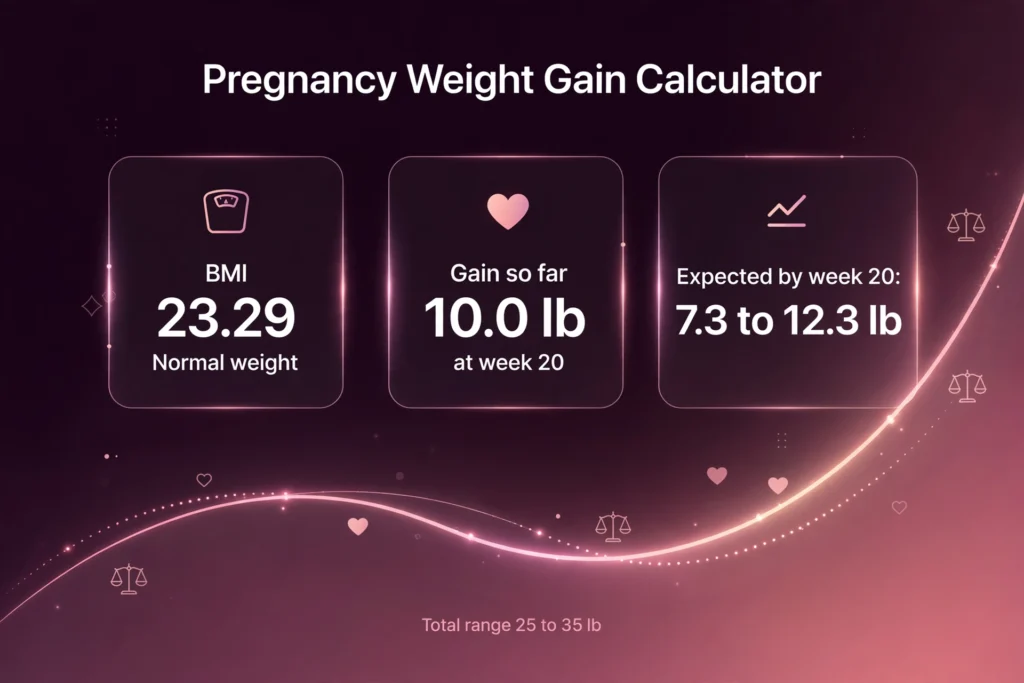
The defaults show a worked result before you type anything: a pre-pregnancy weight of 140 lb at 5 ft 5 in, at week 20 and 150 lb now, gives a BMI of 23.29 — normal weight — a gain of 10.0 lb against an expected 7.3–12.3 lb, and a total range of 25–35 lb. Change any number and the results update straight away. If you are looking for more tools in this style, the calculators hub lists the full set of calculators on this site.
Worked example
Take a person who weighed 140 lb before pregnancy, is 5 ft 5 in tall, is at week 20, and weighs 150 lb now. First the BMI: 703 × 140 ÷ 65² = 703 × 140 ÷ 4,225 = 23.29, which is normal weight, so the total range is 25–35 lb and the weekly rate is 0.8–1.0 lb a week. The gain so far is 150 − 140 = 10.0 lb. The expected gain at week 20 is 7.3–12.3 lb, worked out by the straight-line method from the 1.1–4.4 lb first-trimester allowance to the 25–35 lb total. A gain of 10.0 lb sits inside 7.3–12.3 lb, so the gain is on track.
Now the same starting point at week 10, weighing 142 lb. The gain is 2.0 lb and the expected range at week 10 is 0.8–3.4 lb — on track, and a good reminder of how little the first trimester is expected to add. And at week 40, weighing 170 lb, the gain is 30.0 lb against an expected 25.0–35.0 lb — on track again, because the method arrives at the published total at 40 weeks.
Two more cases show the other categories. A person who weighed 110 lb before pregnancy at 5 ft 6 in, at week 28 and 130 lb now, has a BMI of 17.75 — underweight — a total range of 28–40 lb, a gain of 20.0 lb against an expected 16.0–24.2 lb, and a verdict of on track. A person who weighed 210 lb before pregnancy at 5 ft 5 in, at week 32 and 222 lb now, has a BMI of 34.94 — obese — a total range of 11–20 lb, a gain of 12.0 lb against an expected 8.1–15.4 lb, and a verdict of on track. And the case to watch: a person who weighed 170 lb before pregnancy at 5 ft 4 in, at week 24 and 195 lb now, has a BMI of 29.18 — overweight — a total range of 15–25 lb, a gain of 25.0 lb against an expected 6.8–12.8 lb, and a verdict of above range. Same arithmetic, different stories — and in every case, the numbers are a starting point for a conversation with a clinician, not a verdict on their own.
This page gives general information about weight gain in pregnancy. It is not medical advice, it does not diagnose or treat anything, and it does not take your full situation into account. The ranges are population guidance from the Institute of Medicine (2009), endorsed by ACOG — your clinician sets your individual target, and their guidance comes first. If you are worried about your weight, your appetite, or how your pregnancy is progressing, contact your clinician or midwife.
How much weight should I gain when pregnant?
It depends on your BMI before pregnancy. The IOM 2009 ranges for one baby are 28–40 lb if you were underweight (BMI below 18.5), 25–35 lb at a normal weight (BMI 18.5–24.9), 15–25 lb if overweight (BMI 25.0–29.9), and 11–20 lb if obese (BMI 30.0 and above). These are population ranges, not a personal target — your clinician sets your individual target.
How much weight should I have gained by week 20?
It depends on your starting BMI category. At week 20 the expected gain is 8.1–13.6 lb if you were underweight, 7.3–12.3 lb at a normal weight, 4.7–9.7 lb if overweight, and 3.7–8.4 lb if obese. The calculator on this page works out the expected range for your exact week and category. For example, a gain of 10.0 lb at week 20 with a normal starting BMI sits inside the 7.3–12.3 lb range, so it is on track.
Is it normal to gain little weight in the first trimester?
Yes. The IOM calculations assume a total gain of only 1.1–4.4 lb across the whole first 13 weeks, for every BMI category. Many people gain nothing at all in this stretch, and some lose a little, usually because of nausea. At week 10 with a normal starting BMI, the expected gain is only 0.8–3.4 lb. Gain usually picks up from about week 14, at the weekly rate for your category.
What if I am gaining more weight than the range?
Check the reading first — weigh again in the same conditions, since fluid, food and the time of day can move the scale by a pound or more. If the gain stays above the range over several weeks, tell your clinician. They can look at the whole picture and decide whether anything needs to change. Do not diet or try to lose weight during pregnancy unless your clinician tells you to.
How many extra calories do I need when pregnant?
For one baby and a healthy pre-pregnancy weight, the guidance is no extra calories in the first trimester, about 340 extra calories a day in the second trimester, and about 450 extra calories a day in the third trimester. Those figures sit on top of your normal daily calories. If you began pregnancy underweight you may need somewhat more, and if you began overweight or obese you may need somewhat fewer — your clinician settles that.
Can I use this calculator for a twin pregnancy?
No — this calculator covers one baby only. The IOM provisional total ranges for twins are 37–54 lb for a normal pre-pregnancy BMI, 31–50 lb if overweight, and 25–42 lb if obese, and no range was set for underweight twin pregnancies because the evidence was insufficient. If you are carrying twins, ask your clinician for your target.