
Substitution Calculator
Substitution Calculator
Solve a pair of linear equations in two unknowns by the substitution method, with every step of the working shown — isolate one variable, substitute it into the other equation, solve, substitute back, and check. Free, in your browser, nothing uploaded. Scope, stated plainly: this tool handles two linear equations in x and y only — not quadratics, not three unknowns.
Equation 1: x + y =
Equation 2: x + y =
Try a1 = 1, b1 = 2, c1 = 10 and a2 = 3, b2 = -1, c2 = 5. Coefficients may be whole numbers, decimals, or fractions such as 1/2.
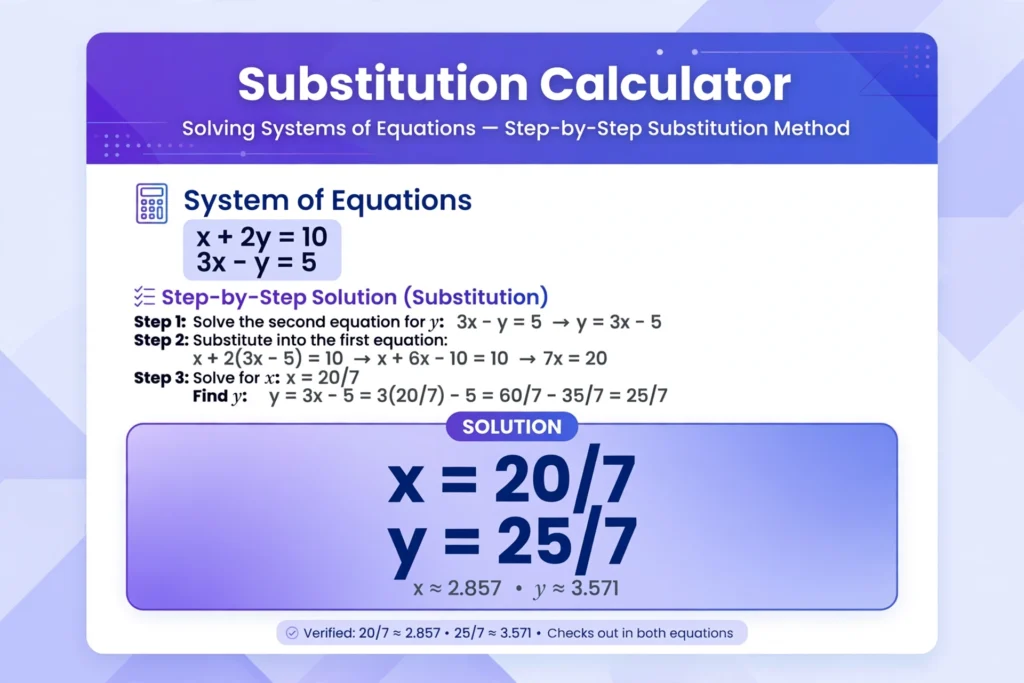
For x + 2y = 10 and 3x - y = 5, the solution is x = 20/7 (about 2.857143) and y = 25/7 (about 3.571429).
Two equations, two unknowns, and one reliable way through them: that is the promise of the substitution method, and it is the method this substitution calculator performs in front of you, step by step. Solving simultaneous equations comes up everywhere two conditions have to be true at once — two prices that must fit one budget, two moving objects that must be in the same place at the same time, two ingredients that must make a mixture of an exact strength. The substitution method handles all of these the same way: take one equation, rearrange it to say what one unknown equals, and substitute that expression into the other equation. What remains is a single equation in a single unknown, which ordinary algebra can finish. Then substitute back to find the other unknown, and check both answers in both original equations.
What makes this calculator worth using, rather than a tool that simply prints x and y, is that every one of those steps is shown with your numbers in it. The isolation step is shown. The substituted equation is shown before and after it is expanded. The division that produces the first unknown is shown. The back-substitution shows the actual product being subtracted, and the final check substitutes the answers into both original equations and shows the arithmetic landing exactly on the right-hand sides. Nothing is rounded along the way, because the working is done in exact fractions: an answer of 25/7 is shown as 25/7, with a decimal approximation beside it, not silently rounded to 3.57 before the next step uses it. If you are learning the substitution method, you can follow the working line by line. If you already know it, you can audit the working in seconds.
What It Is
A pair of linear equations in two unknowns, written in the standard form a1x + b1y = c1 and a2x + b2y = c2, describes two straight lines. A solution is a pair of values (x, y) that makes both equations true at once — geometrically, the point where the two lines cross. Most pairs of lines cross at exactly one point, and then the system has exactly one solution. Two special cases exist, and this calculator reports them honestly rather than forcing an answer: if the lines are parallel, substitution eventually produces a false statement such as 2 = 5, and the system has no solution; if the lines are the same line, substitution produces a true statement with the unknowns gone, and the system has infinitely many solutions.
The substitution method itself has four moves. First, isolate: rearrange one equation so one unknown stands alone, for example x = 10 − 2y. Second, substitute: everywhere the other equation mentions x, write the expression instead, so the second equation now contains y only. Third, solve: expand, collect terms, and divide to find y. Fourth, back-substitute and check: put the y value into the isolated expression to find x, then test the pair in both original equations. Students often ask why the check matters when the method was followed carefully; the honest answer is that expanding a substituted expression is the single most error-prone step in all of school algebra, and a ten-second check catches the sign slip that would otherwise cost the whole question. This calculator performs the check automatically and displays it, which is part of why its answers can be trusted.
Substitution is one of three standard methods for simultaneous linear equations, alongside elimination and graphing. Elimination is often faster when both equations are already in standard form with matching coefficients, and graphing is best when you want to see the situation. Substitution earns its place when one equation is already nearly solved for a variable, when a coefficient of 1 makes isolation painless, or when the problem arrives as two statements rather than two tidy equations — “the total is 10” and “three of the first less the second is 5”. It is also the method that generalises furthest: the same isolate-and-substitute idea solves systems with more unknowns and prepares the ground for substitution in calculus. A substitution calculator that shows its working is therefore useful twice over, once for the answer and once for the method.
How to Use the Calculator
Using the tool takes less than a minute. Follow these steps:
- Look at your first equation and identify the coefficient of x (a1), the coefficient of y (b1), and the right-hand side (c1). If a term is missing, its coefficient is 0. If a variable stands alone, its coefficient is 1. If a term is subtracted, its coefficient is negative.
- Enter a1, b1, and c1 in the first row. The live test uses 1, 2, and 10 for the equation x + 2y = 10.
- Do the same for the second equation in the second row. The live test uses 3, −1, and 5 for 3x − y = 5.
- Coefficients may be whole numbers, decimals such as 0.5, or fractions such as 1/2. All three are read exactly.
- Press “Solve by Substitution”. Read the final answer at the top, then the steps: the isolation, the substitution and expansion, the solve, the back-substitution, and the check in both equations.
One habit makes the tool much more useful: after it solves your system, change one coefficient slightly and solve again. Watching how the answer moves builds the intuition that a system is a balance — push one number and the crossing point of the two lines slides. Students who do this a few times stop seeing simultaneous equations as a ritual and start seeing them as two conditions negotiating with each other, which is what they are.
Worked Examples
Example 1: x + 2y = 10 and 3x − y = 5, the live test
This is the test used to check the tool, and it is worth following in full because the answers are fractions, which is exactly where hand working tends to wobble. Step 1, isolate x in the first equation: x = 10 − 2y. Step 2, substitute into the second equation: 3(10 − 2y) − y = 5. Expanding gives 30 − 6y − y = 5, which collects to 30 − 7y = 5. Step 3, solve: −7y = −25, so y = 25/7, about 3.571429. Step 4, back-substitute: x = 10 − 2 × (25/7) = 10 − 50/7 = 20/7, about 2.857143. The check in the first equation: 20/7 + 2 × (25/7) = 20/7 + 50/7 = 70/7 = 10, exactly the right-hand side. The check in the second: 3 × (20/7) − 25/7 = 60/7 − 25/7 = 35/7 = 5, again exact. Fractional answers are not a sign that something went wrong; they are the normal outcome whenever the lines cross between whole-number points, and exact fraction working is what keeps them clean.
Example 2: A whole-number system, two prices
A shop sells notebooks and pens. Three notebooks and two pens cost 27, and one notebook and one pen together cost 11. Let x be the price of a notebook and y the price of a pen: 3x + 2y = 27 and x + y = 11. Isolation is painless here because the second equation gives y = 11 − x directly. Substituting into the first: 3x + 2(11 − x) = 27, which expands to 3x + 22 − 2x = 27, so x = 5. Back-substituting, y = 11 − 5 = 6. A notebook costs 5 and a pen costs 6, and the check confirms it: 3 × 5 + 2 × 6 = 15 + 12 = 27, and 5 + 6 = 11. Notice how the problem arrived as sentences, not equations, and how substitution handled it without any special effort — this is the shape of most real simultaneous-equation problems.
Example 3: No solution, parallel lines
Consider x + y = 1 alongside 2x + 2y = 5. The second equation looks different but its left side is exactly twice the first equation's left side, while its right side is not twice 1. Isolating x from the first equation gives x = 1 − y; substituting into the second gives 2(1 − y) + 2y = 5, which simplifies to 2 = 5. That false statement is the algebra announcing that the lines are parallel: they run in the same direction and never meet, so no pair of values can satisfy both. The calculator reports this case plainly as “no solution” and shows the false statement it reached, rather than inventing numbers. Recognising this outcome matters because real problems sometimes contain contradictory conditions — a budget that cannot cover two fixed requirements, for instance — and the correct answer is to say so.
Example 4: Choosing which variable to isolate
In 2x + 3y = 12 and 4x − y = 6, isolating y from the second equation (y = 4x − 6) is cleaner than isolating x from the first (x = (12 − 3y)/2), because it avoids fractions until the end. Substituting: 2x + 3(4x − 6) = 12 gives 2x + 12x − 18 = 12, so 14x = 30 and x = 15/7, about 2.142857; then y = 4 × (15/7) − 6 = 60/7 − 42/7 = 18/7, about 2.571429. The lesson generalises: when solving simultaneous equations by substitution by hand, isolate the variable whose coefficient is 1 or −1 if there is one. The calculator isolates x from the first equation whenever it can and falls back gracefully when the first equation has no x term, but the answers are identical either way — the method is indifferent to the route, only the effort changes.
Substitution vs Elimination: Which Method When
Because both methods solve the same systems, students reasonably ask which one to reach for. Elimination shines when coefficients line up: if one equation has 2y and the other has −2y, adding the equations removes y in a single move, and no fractions appear until late. Substitution shines when a variable is already isolated or has a coefficient of 1, when one equation is given in the form y = something, or when the problem is stated in words and one condition naturally reads as a definition of one quantity in terms of another. Graphing, the third method, is the slowest for exact answers but the best for understanding: this calculator's no-solution and same-line outcomes are exactly the parallel and coincident cases a graph shows instantly. A practical rule used by many teachers is: substitute when isolation is cheap, eliminate when coefficients are symmetric, and always check by substitution into both originals. Whichever route you choose, the check at the end is not optional decoration; it is the step that converts a plausible answer into a verified one.
Common Mistakes
The first common mistake is substituting an expression into the same equation it came from, which produces a true but useless statement such as 10 = 10 and no progress. The expression must always go into the other equation. The second mistake is forgetting brackets: replacing x by 10 − 2y inside 3x means writing 3(10 − 2y), and students who write 30 − 2y have lost the distribution of the 3 over the second term. The third mistake is a sign slip when a subtracted term is substituted, especially when the isolated expression itself contains a minus sign; writing each step on its own line, as this calculator does, is the standard defence. The fourth mistake is stopping after finding one unknown — an answer that gives only y is half an answer, and the back-substitution and check are part of the solution, not extras. The fifth mistake is rounding mid-working: turning 25/7 into 3.57 and continuing introduces error that the final check then “fails” by a small amount, leaving the student unsure whether the method or the rounding was at fault. Exact fractions until the final line, which is how this tool works, remove that ambiguity entirely. The sixth mistake is misreading word problems: “three more than twice the second number” is x = 2y + 3, not x = 2(y + 3), and no calculator can rescue a wrong translation, so read each condition twice before entering coefficients.
Limits: What This Tool Does and Does Not Do
This tool solves systems of exactly two linear equations in exactly two unknowns, x and y, by the substitution method, showing the working. It does not solve quadratic or higher-degree systems, systems of three or more equations, or equations involving roots, powers of the unknowns, or trigonometric terms. Coefficients can be whole numbers, decimals, or simple fractions, and the arithmetic is exact, so there is no rounding error in the steps; extremely large coefficients are still handled exactly, though the fractions may become long. When the system has no solution or infinitely many solutions, the tool says which, and shows the statement that proves it, instead of returning a pair of numbers. If your problem has a variable already isolated, such as y = 2x + 1, rewrite the other condition in standard form and set the isolated equation's coefficients accordingly (for y = 2x + 1, that is −2x + y = 1). Within those limits, every step the tool displays is a real algebraic step performed on your numbers, and the final check in both equations is a genuine verification, not a decoration.
Privacy: Your Numbers Stay in Your Browser
Every number you enter into this substitution calculator stays in your browser. Nothing is uploaded to a server, nothing is stored, and there is no account to create. The calculation runs entirely on your own device. That matters for homework help and classroom use alike: the equations you are practising with are your business, and a tool that shows its working has no need to send them anywhere. Closing the page removes your inputs, and no one else sees them. This browser-only design is the same principle behind the other free tools on Your Smart Kit: a simple tool that does one job well, keeps your data private, and gives an answer you can check.
How does the determinant decide unique, no, or infinite solutions?
For a1x + b1y = c1 and a2x + b2y = c2, the determinant is D = a1xb2 - a2xb1. If D is not zero, the system has exactly one solution, and substitution will find it. If D is zero, check the constants: parallel lines give no solution, while the same line gives infinitely many solutions.
| Determinant D | What happens | Example |
| D is not zero | One unique solution | x + 2y = 10, 3x - y = 5 gives x = 20/7, y = 25/7 |
| D = 0, parallel lines | No solution | x + y = 1, 2x + 2y = 5 |
| D = 0, same line | Infinitely many solutions | One equation is a multiple of the other |
Frequently Asked Questions
What is the substitution method?
It is a method for solving simultaneous equations: rearrange one equation to isolate one unknown, substitute that expression into the other equation, solve the resulting single equation, then substitute back to find the remaining unknown and check the pair in both equations.
Why does this calculator show fractions instead of decimals?
Because the working is exact. Answers such as 20/7 and 25/7 are the true values; a decimal like 2.857143 is an approximation shown alongside for readability. Working in fractions means the final check lands exactly on the right-hand sides, with no rounding fog.
What does it mean when the calculator says no solution?
It means the two equations contradict each other: substitution produced a false statement such as 2 = 5. Geometrically the lines are parallel and never cross, so no values of x and y can satisfy both equations at once.
What does infinitely many solutions mean?
It means the two equations describe the same line — one is a multiple of the other — so every point on the line is a solution. Substitution produces a true statement with the unknowns cancelled out, and the calculator reports that instead of picking one arbitrary pair.
Should I use substitution or elimination?
Use substitution when one variable is easy to isolate, especially if a coefficient is 1 or −1, or when a condition is already stated as one quantity defined by another. Use elimination when coefficients of one variable are equal or opposite across the two equations. Both give the same answer on any system that has one.
Can this calculator solve three equations in three unknowns?
No. It is built for two linear equations in two unknowns, and it says so plainly. The substitution idea extends to larger systems, but this tool does not perform it.
Related Tools on Your Smart Kit
If you found the substitution calculator useful, you may also like the other free calculators on Your Smart Kit, including the rational calculator for exact fraction arithmetic, the greater than less than fractions calculator for comparing two fractions with the cross-multiplication shown, and the mixed fraction calculator for converting between improper fractions and mixed numbers. Each runs in your browser, free, with no sign-up, and each is built on the same principle: a simple tool that does one job well, keeps your data private, and gives an answer you can check. Try the substitution calculator at the top of this page with your own system of equations, and watch the method work line by line.