
Rational Calculator
Rational Calculator
Add, subtract, multiply, or divide two rational numbers (fractions), see the working step by step, and get the answer simplified to lowest terms — free, in your browser, nothing uploaded. Whole numbers are welcome too: just use 1 as the denominator.
First fraction: /
Second fraction: /
Try 7/12 + 5/18. Denominators must not be zero, and for division the second fraction must not be zero either.
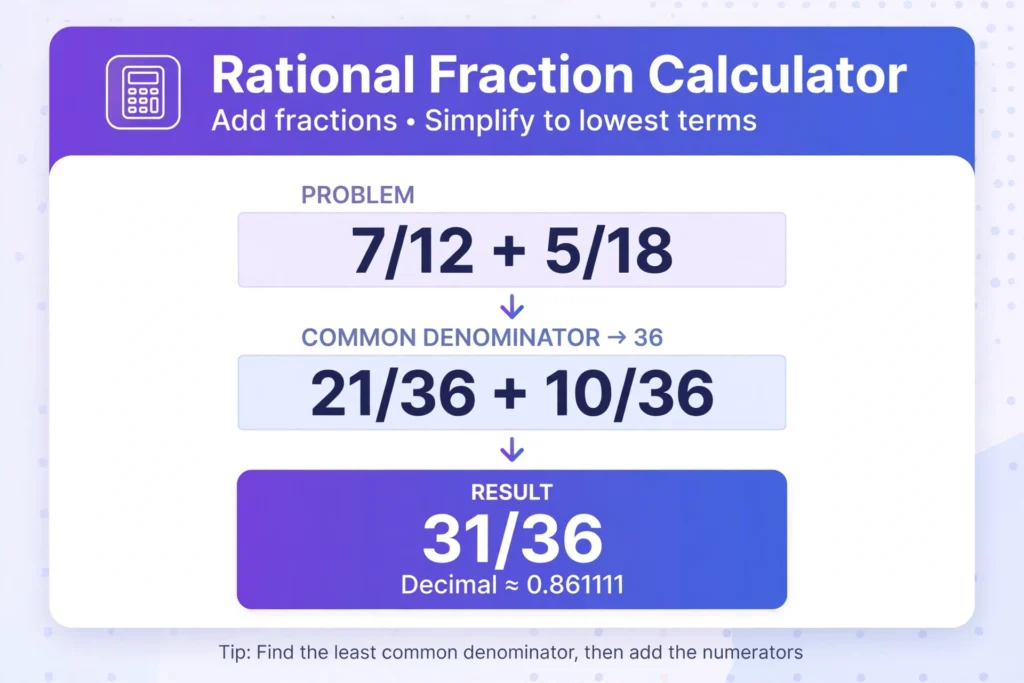
7/12 + 5/18 = 31/36, about 0.861111, with a least common denominator of 36.
A rational number is any number that can be written as one whole number divided by another — 3/4, −7/5, 12, and 0.625 are all rational — and rational arithmetic is the fraction arithmetic that school maths is built on. Adding fractions needs a common denominator. Multiplying them does not. Dividing means multiplying by a reciprocal, and every answer should finish in lowest terms. Those four rules are simple to state and surprisingly easy to fumble under time pressure, which is why a rational calculator that shows its working, rather than just its answer, is genuinely useful: this one rewrites your fractions over the least common denominator, adds or subtracts the numerators in front of you, multiplies numerators and denominators separately for products, flips the second fraction for division, and then simplifies by the greatest common factor, stating that factor.
The arithmetic here is exact. Nothing is converted to a decimal until the very end, and the decimal is offered only as a reading aid beside the true fractional answer. That matters more than it might seem: 1/3 is not 0.333, and a chain of fraction calculations done in rounded decimals drifts further from the truth at every step, while the same chain done in fractions is exact throughout. Whether you are checking homework, splitting a recipe, combining measurements in a workshop, or working through rational expressions on the way to algebra, the four operations behave identically, and this tool performs each one the way a careful teacher would write it on a board.
What It Is
Formally, a rational number is a number expressible as p/q where p and q are integers and q is not zero. The set includes every fraction, every whole number (as itself over 1), every terminating decimal, and every repeating decimal. Adding and subtracting rational numbers requires a shared denominator because a fraction is a count of equal-sized pieces: twelfths and eighteenths cannot be added as raw counts until both are expressed in the same piece size, which is why the calculator finds the least common multiple of the denominators — 36 for 12 and 18 — and rewrites both fractions over it. Multiplying needs no such preparation, because multiplying fractions multiplies the counts and the piece sizes independently. Dividing by a fraction is defined as multiplying by its reciprocal, the fraction turned upside down, because division asks “how many of these fit into that”, and the reciprocal converts that question into a multiplication.
Simplifying to lowest terms is the finishing step of every rational calculation: divide numerator and denominator by their greatest common divisor, the largest whole number that divides both. An answer of 126/60 and an answer of 21/10 are the same number, but only the second is in lowest terms, and only the second is accepted as a final answer in a classroom. This calculator performs the simplification openly, naming the common factor it divided by — or stating plainly when the result is already in lowest terms, as with 31/36, whose numerator and denominator share no factor above 1. When the answer is an improper fraction, larger on top than on the bottom, the tool also offers the mixed number form, so 21/10 can be read as 2 1/10.
Rational numbers sit between the whole numbers and the full number line: integers are rational, rationals are dense (between any two there is another), yet they do not fill the line — square roots and pi live in the gaps. For everyday calculation, though, fractions are the native language of proportions: scale drawings, gear ratios, probabilities stated as odds, map scales, and recipes are all rational arithmetic in costume. A rational number calculator that adds, subtracts, multiplies, and divides with visible steps covers all of those uses, because each is one of the four operations applied carefully.
How to Use the Calculator
Using the tool takes less than a minute. Follow these steps:
- Enter the numerator and denominator of the first fraction. The live test uses 7 over 12. For a whole number, enter the number as the numerator and 1 as the denominator. For a negative fraction, put the minus sign on the numerator.
- Choose the operation: add, subtract, multiply, or divide.
- Enter the numerator and denominator of the second fraction. The live test uses 5 over 18.
- Press “Calculate”. Read the answer in lowest terms at the top, with its decimal approximation.
- Read the steps below the answer: the common denominator and the rewritten fractions for addition and subtraction, the separate numerator and denominator products for multiplication, the reciprocal for division, and the simplification with the common factor named.
If your expression has three fractions, work through it two at a time, following the usual order of operations: multiplications and divisions before additions and subtractions, and brackets first. Enter the first pair, note the exact fractional result, and use it as the first fraction of the next calculation. Because every intermediate result is an exact fraction, a chain built this way loses nothing to rounding.
Worked Examples
Example 1: 7/12 + 5/18, the live test
This is the test used to check the tool. The denominators 12 and 18 share factors, so the least common denominator is 36, not 216 — using the least one keeps the numbers small. Step 1: lcm(12, 18) = 36. Step 2: rewrite each fraction over 36: 7/12 = 21/36 (multiply top and bottom by 3) and 5/18 = 10/36 (multiply top and bottom by 2). Step 3: add the numerators and keep the denominator: 21 + 10 = 31, giving 31/36. Final step: 31 is prime and does not divide 36, so the greatest common divisor of 31 and 36 is 1 and 31/36 is already in lowest terms. As a decimal it is about 0.861111. Notice what the common denominator bought us: the addition itself became a whole-number addition, 21 + 10, because the pieces were made the same size first. Every fraction addition works exactly this way.
Example 2: Subtraction, 7/12 − 5/18
Change only the operation and the same preparation applies: over the common denominator 36, the subtraction is 21/36 − 10/36 = 11/36, about 0.305556, and 11/36 is already in lowest terms. Subtraction is where sign errors breed in hand working — the classic slip is subtracting the denominators as well as the numerators, which would give the nonsense answer 2/−6 here. The denominator names the size of the pieces; you are counting how many more thirty-sixths one quantity has than the other, and the count is 11, over the same 36. The calculator's step display, which rewrites both fractions before touching the numerators, makes the correct structure visible.
Example 3: Multiplication and division, the pair
Multiply the same two fractions and no common denominator is needed: 7/12 × 5/18 multiplies numerators (7 × 5 = 35) and denominators (12 × 18 = 216) to give 35/216, already in lowest terms, about 0.162037. Now divide them: 7/12 ÷ 5/18 means 7/12 × 18/5 by the reciprocal rule, which is 126/60 before simplifying, and dividing top and bottom by their greatest common divisor, 6, gives 21/10, or 2 1/10 as a mixed number, exactly 2.1. Division answers the question “how many 5/18 are there in 7/12”, and since 7/12 is the larger quantity, an answer above 2 is plausible — a useful sanity check, because dividing fractions by multiplying straight across without flipping is the most common of all fraction errors, and it produces a suspiciously small answer here (35/216 again), which the plausibility check would catch.
Example 4: A recipe scaled by fractions
A recipe for four people uses 3/4 of a cup of flour. Cooking for six means scaling by 6/4, which is 3/2: the flour becomes 3/4 × 3/2 = 9/8, which is 1 1/8 cups. If instead you are halving the recipe, the scale factor is 1/2 and the flour is 3/4 × 1/2 = 3/8 of a cup. And if the bag holds 5/2 cups and each batch needs 3/4 of a cup, the number of batches is a division, 5/2 ÷ 3/4 = 5/2 × 4/3 = 20/6 = 10/3, so three full batches with flour to spare. Recipes are rational arithmetic with flour on your hands, and every one of these is a single use of this calculator: multiplication for scaling, division for counting portions, with the mixed-number reading doing the practical work of matching the answer to measuring cups.
Why Exact Fractions Beat Decimals for This Work
It is tempting to convert everything to decimals at the start and let a normal calculator handle it, but for fraction work that habit quietly taxes every answer. One third becomes 0.333, and three of them sum to 0.999 instead of 1. Two thirds of three quarters, done exactly, is 1/2; done in three-place decimals it is 0.667 × 0.75 = 0.50025, close but wrong, and the error compounds in longer chains. Decimals also hide structure: 0.142857 looks arbitrary, while 1/7 announces exactly what it is, and 31/36 shows at a glance that it cannot simplify, whereas 0.861111 shows nothing of the kind. The professional habit, and the one this tool follows, is fractions all the way through the working and a decimal only as a final translation for readers who think in decimals. That is also why the steps are displayed: a student who sees 21/36 + 10/36 = 31/36 learns the method, while a student handed 0.861111 learns nothing except dependence on the machine.
Common Mistakes
The first common mistake is adding denominators: 7/12 + 5/18 is not 12/30, because the denominator is the size of the pieces, not another count to be added. The second is reaching for the product of the denominators when a smaller common denominator exists — 216 works for twelfths and eighteenths, but 36 works better, and smaller numbers mean smaller errors. The third is dividing without flipping: division by a fraction is multiplication by its reciprocal, full stop, and the calculator's first division step exists to make that flip explicit. The fourth is simplifying only once when a fraction needs it twice: 126/60 divided by 2 gives 63/30, which still shares a factor of 3, so the full greatest common divisor — 6 here — must be found, as the tool does, rather than peeling off small factors and stopping early. The fifth is cancelling across addition: in (21 + 10)/36 nothing may be cancelled between the 21 and the 36 before the addition happens, because cancellation is a property of multiplication only. The sixth is sign placement: a negative denominator is legal input here but is normalised by moving the sign to the numerator, and in hand working the safest habit is the same — one minus sign, kept with the numerator, never one on each. Each of these mistakes has the same cure, which is writing the steps out, exactly as this calculator displays them.
Limits: What This Tool Does and Does Not Do
This tool performs one operation — addition, subtraction, multiplication, or division — on two rational numbers entered as numerator over denominator, and shows the working and the simplified result. Inputs must be whole numbers; decimals and mixed numbers should be converted to fractions first (0.75 is 75/100, which the tool will happily simplify to 3/4 if entered as a fraction; a mixed number like 2 1/10 should be entered as 21/10). Denominators of zero are rejected, because division by zero is undefined, and division by a fraction equal to zero is rejected for the same reason. The tool does not parse typed expressions such as “7/12 + 5/18” in a single box, does not handle more than two fractions at once, and does not work with algebraic fractions containing letters. Its arithmetic is exact for inputs of any practical size, since the working is done in whole numbers throughout. Within those limits, every displayed step is the real arithmetic on your fractions — the actual common denominator, the actual products, the actual greatest common divisor — not an illustration.
Privacy: Your Numbers Stay in Your Browser
Every number you enter into this rational calculator stays in your browser. Nothing is uploaded to a server, nothing is stored, and there is no account to create. The calculation runs entirely on your own device, so the homework problem, the recipe, or the workshop measurement you are working on remains yours alone. Closing the page removes your inputs, and no one else sees them. This browser-only design is the same principle behind the other free tools on Your Smart Kit: a simple tool that does one job well, keeps your data private, and gives an answer you can check.
How are rational numbers different from rational expressions?
A rational number uses whole numbers only, such as 7/12. A rational expression uses polynomials, such as (x+1)/(x-2), and is not handled by this tool.
| Topic | Rule | Example |
| Mixed number | Whole part plus proper fraction | 21/10 = 2 1/10 |
| GCD | Divide by GCD | 12/18 = 2/3 |
| LCD | Use least common denominator | 7/12 + 5/18, LCD 36 |
Frequently Asked Questions
What is a rational number?
A rational number is any number that can be written as one integer divided by another, with the denominator not zero. All fractions, all whole numbers, all terminating decimals, and all repeating decimals are rational.
Why do fractions need a common denominator to add but not to multiply?
Addition counts pieces, and pieces can only be counted together when they are the same size, so the denominators must first be made equal. Multiplication combines the counts and the piece sizes independently, so no common denominator is needed.
How does the calculator simplify fractions?
It finds the greatest common divisor of the numerator and denominator — the largest whole number dividing both — and divides both by it. If that divisor is 1, the fraction is already in lowest terms and the tool says so.
Why is dividing by a fraction the same as multiplying by its reciprocal?
Because division asks how many of the divisor fit into the dividend. Turning the divisor upside down converts that question into a multiplication with the same answer: 7/12 ÷ 5/18 = 7/12 × 18/5 = 21/10.
Can I enter whole numbers and negative fractions?
Yes. Enter a whole number as itself over 1, and a negative fraction by putting the minus sign on the numerator. A minus sign on the denominator is also accepted and is moved to the numerator automatically.
What is a mixed number?
A mixed number writes an improper fraction as a whole part plus a proper fraction: 21/10 is 2 1/10. The calculator shows the mixed number form alongside the improper fraction whenever the answer is larger than 1 in magnitude.
Related Tools on Your Smart Kit
If you found the rational calculator useful, you may also like the other free calculators on Your Smart Kit, including the greater than less than fractions calculator for comparing two fractions with cross-multiplication, the mixed fraction calculator for improper fractions and mixed numbers, and the substitution calculator for solving two equations with every algebraic step shown. Each runs in your browser, free, with no sign-up, and each is built on the same principle: a simple tool that does one job well, keeps your data private, and gives an answer you can check. Try the rational calculator at the top of this page with your own pair of fractions, and watch the common denominator do its quiet work.