
Polynomial Root Calculator
Polynomial Root Calculator
Find the roots (zeros) of a polynomial up to degree 4 — free, in your browser, nothing uploaded. Degrees 1 and 2 are solved exactly with the linear and quadratic formulas. Degrees 3 and 4 are solved numerically by scanning for sign changes and refining each one by bisection, and they are labelled numeric.
Enter 2 to 5 coefficients for a degree 1 to 4 polynomial. The first coefficient must not be zero.
A root of a polynomial is a value of x that makes the polynomial equal zero — the place where its graph crosses or touches the horizontal axis, and, in applied problems, often the answer itself: the break-even quantity, the time when a height reaches zero, the rate that makes a present value come out even. Finding roots by hand is pleasant for quadratics, where the quadratic formula settles everything, and genuinely laborious for cubics and quartics, whose exact formulas are so unwieldy that professionals almost always switch to numeric methods. A polynomial root calculator mirrors that division of labour honestly. Enter the coefficients of a polynomial up to degree 4, and the calculator at the top of this page solves degrees 1 and 2 exactly with formulas, solves degrees 3 and 4 numerically by scanning for sign changes and refining with bisection, and labels which kind of answer you are looking at, with the steps and a substitution check for every root it reports.
That labelling is not fine print; it is the heart of using root-finding tools well. An exact root from the quadratic formula is the true value in closed form. A numeric root from bisection is an approximation, typically accurate to many decimal places after enough refinements, but obtained by narrowing an interval rather than by formula, and a scanning method can in principle miss certain roots — ones where the graph touches the axis without crossing, or that lie outside the scanned range. This tool states its scan range, its step, and its method in the answer area, and adds a caution exactly when the root count suggests something may be hidden. You get speed without the illusion that every method sees everything.
What It Is
A polynomial in x is a sum of terms a·x^k with whole-number powers. Its degree is its highest power. A root, also called a zero of the polynomial, is any number — real or complex — that makes the value zero. The fundamental theorem of algebra guarantees that a polynomial of degree n has exactly n roots when complex roots and repeated roots are counted properly, which gives you a budget to check against: a quadratic has two roots in that accounting, a cubic three, a quartic four. Real roots are the ones visible as axis crossings or touches on a graph; complex roots come in conjugate pairs for polynomials with real coefficients, like 2 + 3i and 2 − 3i.
For degree 1, the root of ax + b is x = −b/a. For degree 2, the quadratic formula x = (−b ± √(b² − 4ac)) / (2a) gives both roots, and the discriminant D = b² − 4ac sorts the cases before you compute: positive D means two distinct real roots, zero D means one repeated real root, negative D means a complex conjugate pair with no real roots at all. The tool prints the discriminant and its value for every quadratic, because reading D first is the habit that prevents nonsense answers. For degrees 3 and 4, this tool evaluates the polynomial across the range −100 to 100 in steps of 0.005, watches for sign changes — a continuous polynomial that is negative at one point and positive at the next must pass through zero between them — and then applies bisection: halving the bracket about sixty times, keeping the half that still contains the sign change, until the root is pinned to far more precision than the four decimals displayed. Every reported real root is then checked by substitution, and the tool prints the value of the polynomial at each root so you can see it is zero up to rounding.
How to Use the Calculator
Using the tool takes less than a minute. Follow these steps:
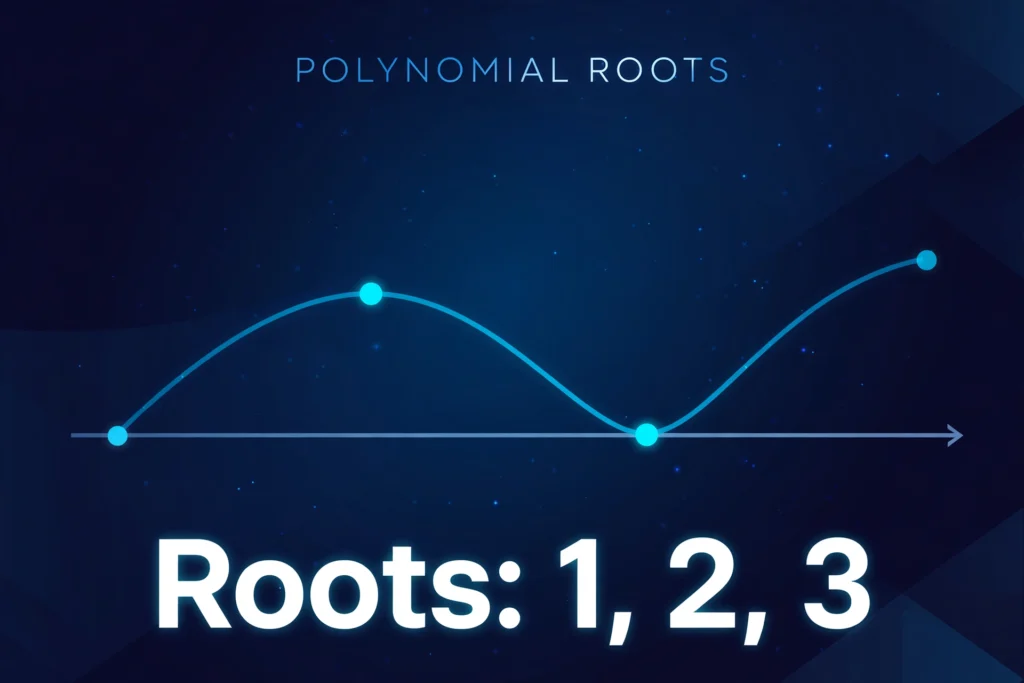
- Enter the coefficients, highest power of x first, separated by commas. For x³ − 6x² + 11x − 6, enter 1, -6, 11, -6 — that is the live test, whose roots are 1, 2, and 3. For a quadratic like x² − 5x + 6, enter 1, -5, 6.
- Enter every coefficient, including zeros. The polynomial x³ + 1 is entered as 1, 0, 0, 1; leaving out the zeros would change the degree and the polynomial.
- Use two to five coefficients (degree 1 to 4). The first coefficient must not be zero — if it is, remove it, because the true degree is lower.
- Press "Find Roots" and read the result. For degree 2, read the discriminant line first: it tells you whether to expect two real roots, one repeated root, or a complex pair. For degrees 3 and 4, read the numeric-method note and any caution about roots that touch rather than cross.
- Use the printed substitution checks to confirm each root: the polynomial's value at a true root is zero, up to the rounding shown.
If your polynomial has degree 5 or more, this tool will not accept it — and no general formula exists for degree 5 and above anyway, a famous result in algebra; numeric software with wider machinery is the right tool there.
How does the rational root theorem narrow the search?
For a polynomial with integer coefficients, any rational root in lowest terms p/q must have p dividing the constant term and q dividing the leading coefficient. Worked on the live test x^3 - 6x^2 + 11x - 6: possible rational roots are ±1, ±2, ±3, ±6 (factors of 6 over factors of 1). Testing them: P(1)=0, P(2)=0, P(3)=0, while P(-1)=-24, P(6)=60, P(-2)=-60, P(-3)=-120, so the roots that pass are 1, 2, and 3 — the same roots the tool reports. The theorem lists candidates; it does not prove a candidate is a root until substitution gives zero, and it says nothing about irrational or complex roots.
| Degree | Name | Method in this tool | Exact or numeric |
| 1 | linear | x = -b/a | exact |
| 2 | quadratic | quadratic formula, discriminant first | exact, including complex pairs |
| 3 | cubic | scan for sign changes, then bisection | numeric, rational candidates narrow the search by hand |
| 4 | quartic | scan, then bisection | numeric |
| 5 or higher | quintic and above | not accepted by this tool | no general formula exists — numeric software is the right tool |
Worked Examples
Example 1: The cubic x³ − 6x² + 11x − 6, the live test
Coefficients 1, -6, 11, -6. The tool scans and finds sign changes that refine, by bisection, to x = 1, x = 2, and x = 3. Substitution confirms each: at 1, 1 − 6 + 11 − 6 = 0; at 2, 8 − 24 + 22 − 6 = 0; at 3, 27 − 54 + 33 − 6 = 0. Three real roots for a cubic is the maximum distinct count, so the budget from the fundamental theorem is fully accounted for, and the factorisation is (x − 1)(x − 2)(x − 3). This cubic is the classic teaching example precisely because its roots are whole numbers hiding inside untidy-looking coefficients — the −6 and 11 give no hint until the work is done.
Example 2: The quadratic x² − 5x + 6, exact
Coefficients 1, -5, 6. Discriminant D = (−5)² − 4(1)(6) = 25 − 24 = 1, positive, so two distinct real roots. The formula gives x = (5 + 1) / 2 = 3 and x = (5 − 1) / 2 = 2. Substitution: 4 − 10 + 6 = 0 and 9 − 15 + 6 = 0. Done exactly, no approximation anywhere. Notice the tool reports the larger root first, as the + branch of the formula produces it; order carries no meaning.
Example 3: No real roots — x² + 1
Coefficients 1, 0, 1. Discriminant D = 0 − 4 = −4, negative. There are no real roots: x² + 1 is always at least 1, so its parabola never reaches the axis. The quadratic formula still yields the complex pair: x = 0 + 1i and x = 0 − 1i, since √(−4) = 2i and (0 ± 2i) / 2 = ±i. The tool reports exactly this, stating plainly that there are no real roots rather than failing silently or inventing a decimal. When a modelling problem produces a negative discriminant, that is real information: the event you are solving for does not happen — the projectile does not reach that height, the break-even point does not exist at those prices.
Example 4: A quartic found numerically — x⁴ − 5x² + 4
Coefficients 1, 0, -5, 0, 4 (note the zeros for the missing x³ and x terms). This quartic factorises as (x² − 1)(x² − 4), so its roots are −2, −1, 1, and 2 — all crossings, so the scan finds all four and bisection refines each to the whole number. Substitution at 2: 16 − 20 + 4 = 0. Contrast this with x⁴ − 2x² + 1, which is (x² − 1)² with roots −1 and 1 that touch the axis without crossing; a sign-change scan can walk straight over a touching root, because the polynomial is positive on both sides. The tool's quartic note warns about exactly this case. Knowing your method's blind spot is part of knowing the answer's worth.
A useful cross-check when roots come back whole or simple is Vieta's formulas, which tie the roots to the coefficients without any solving. For a cubic x³ + px² + qx + r, the three roots add to −p, their pairwise products add to q, and their product is −r. The live test's roots 1, 2, 3 give sum 6 = −(−6) ✓, pairwise sum 1·2 + 1·3 + 2·3 = 11 ✓, and product 6 = −(−6) ✓, matching the coefficients 1, −6, 11, −6 on all three counts. For a quadratic, the roots add to −b/a and multiply to c/a. Running Vieta's check takes seconds and catches swapped coefficients, dropped signs, and roots that belong to a different polynomial than the one you meant to enter.
Exact Versus Numeric: Reading Your Answer
It is worth internalising the trade the tool makes. Exact formulas exist for degrees up to 4 — the cubic and quartic formulas fill pages and are numerically treacherous, which is why working mathematicians use them rarely. Numeric root-finding trades the closed form for reliability: bisection is slow but cannot be fooled about a crossing it has bracketed, because the intermediate value theorem guarantees a root inside any sign-changing bracket of a polynomial. The guarantees run in one direction only. A reported numeric root, refined and substitution-checked, is solid. A claim that no other roots exist is weaker: it rests on the scan's step (0.005 here) and range (−100 to 100 here), and on crossings rather than touches. That is why the tool phrases its cubic and quartic output as the roots it found, notes the total root budget, and flags the specific situations — an even-multiplicity touch, an out-of-range root, two roots closer together than the scan step — where a root could hide. A closer pair of roots than 0.005 apart is rare in practice, but rare is not impossible, and the honest statement costs one sentence.
Common Mistakes
The first common mistake is omitting zero coefficients, which silently changes the polynomial: 1, 0, 0, 1 is x³ + 1, but 1, 1 is the line x + 1. The second mistake is entering coefficients in ascending order; this tool expects highest power first, like most conventions, and says so on the page. The third mistake is reading a negative discriminant as an error rather than an answer — it means no real roots, full stop. The fourth mistake is expecting four distinct roots from every quartic or three from every cubic; roots can repeat, and complex roots take up part of the budget without appearing on the real line. The fifth mistake is assuming a numeric scan proves completeness; as Example 4 showed, touching roots can evade any sign-change method. If a root count comes back lower than the shape of your problem suggests, graph the polynomial or try a tool that also hunts with derivatives before concluding the missing roots are complex.
Limits: What This Tool Does and Does Not Do
This tool finds roots of real-coefficient polynomials of degree 1 to 4. Degrees 1 and 2 are exact: the linear formula and the quadratic formula, with complex roots reported for degree 2 when the discriminant is negative. Degrees 3 and 4 are numeric: a sign-change scan from −100 to 100 in steps of 0.005, refined by about sixty bisection halvings, reported to four decimal places with substitution checks. The scan can miss roots that touch without crossing, roots outside the range, and pairs of roots closer together than the scan step; complex roots are not reported for degrees 3 and 4. It does not factor polynomials symbolically, does not handle degree 5 or higher, and does not accept non-numeric or fractional-expression coefficients — enter decimals instead of fractions if needed (0.5 rather than 1/2). Within those limits, every step it prints is the computation it actually performed.
Privacy: Your Numbers Stay in Your Browser
Every coefficient you enter into this polynomial root calculator stays in your browser. Nothing is uploaded to a server, nothing is stored, and there is no account to create. The calculation runs entirely on your own device, and closing the page removes your inputs. This browser-only design is the same principle behind the other free tools on Your Smart Kit: a simple tool that does one job well, keeps your data private, and gives an answer you can check.
Frequently Asked Questions
What is a root of a polynomial?
A value of x that makes the polynomial equal zero — also called a zero of the polynomial. Graphically, real roots are where the curve crosses or touches the x-axis. The cubic x³ − 6x² + 11x − 6 has roots 1, 2, and 3.
How does the numeric method work for cubics and quartics?
The tool evaluates the polynomial across a range in small steps and looks for sign changes. A sign change brackets a root, by the intermediate value theorem, and bisection then halves the bracket repeatedly, keeping the half that still changes sign, until the root is located precisely. Reported roots are checked by substitution.
What does the discriminant tell me?
For a quadratic, D = b² − 4ac. Positive: two distinct real roots. Zero: one repeated real root. Negative: no real roots, and a complex conjugate pair instead. The tool prints D and its value for every quadratic so you can see which case you are in before the roots.
Can this calculator miss a root?
For degrees 1 and 2, no — the formulas are complete. For degrees 3 and 4, the scan finds crossing roots inside −100 to 100; a root that only touches the axis (even multiplicity), lies outside the range, or sits within 0.005 of another root could be missed, and the tool says so in its notes when the count leaves room for doubt.
Why are complex roots only shown for quadratics?
Because the quadratic formula produces them directly and exactly. For cubics and quartics, this tool's job is locating real roots numerically; it states when a cubic's remaining roots must be a complex pair (when only one real root is found) but does not compute complex values for degrees 3 and 4.
What should I enter for a polynomial with missing terms?
Zero coefficients for the missing powers. x⁴ − 5x² + 4 is entered as 1, 0, -5, 0, 4. Skipping the zeros would describe a different, lower-degree polynomial and produce unrelated roots.
Related Tools on Your Smart Kit
If you found the polynomial root calculator useful, you may also like the other free calculators on Your Smart Kit, including the partial fraction calculator with steps for splitting rational functions into simple parts, the linear equations in two variables calculator for solving equation pairs with determinants, and the exponent calculator for powers and roots of single numbers. Each runs in your browser, free, with no sign-up, and each is built on the same principle: a simple tool that does one job well, keeps your data private, and gives an answer you can check. Try the polynomial root calculator at the top of this page with your own coefficients, and read the discriminant or the scan notes before you read the roots.