
Linear Equations in Two Variables Calculator
Linear Equations in Two Variables Calculator
Solve a pair of linear equations in x and y — free, in your browser, nothing uploaded. Enter each equation as a x + b y = c. The tool uses determinants (Cramer’s rule, which is elimination in compact form), shows every determinant with its numbers, and states honestly when a pair has no solution or infinitely many solutions instead of inventing an answer.
Equation 1: a1 x + b1 y = c1
Equation 2: a2 x + b2 y = c2
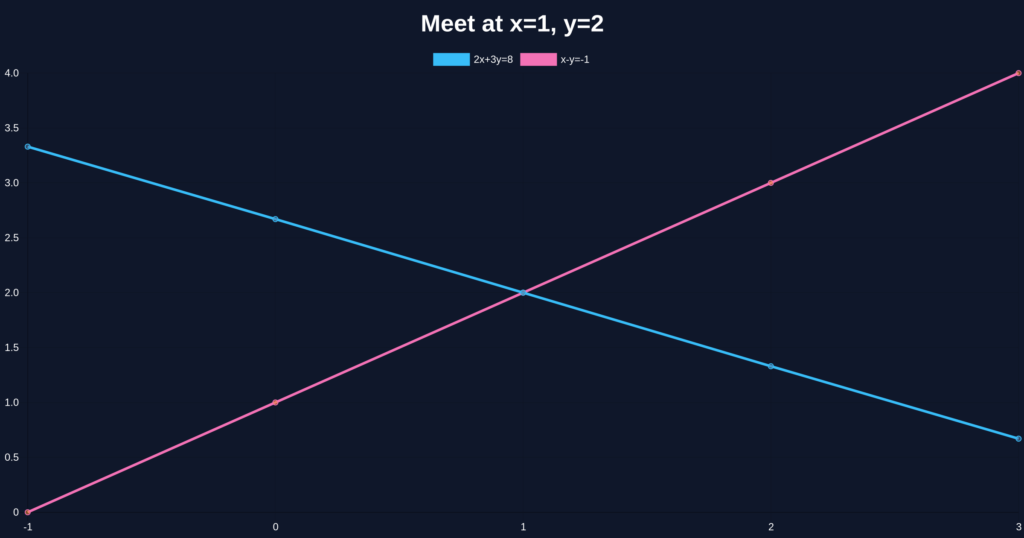
One linear equation in two variables, like 2x + 3y = 8, has infinitely many solutions — a whole line of them. Add a second equation, like x − y = −1, and the picture changes: two lines usually cross at exactly one point, and that point, x = 1, y = 2 here, solves both equations at once. Solving pairs like this is one of the most-used skills in school algebra and in everyday modelling, because any problem with two unknowns and two independent conditions — two products and two totals, two speeds and two journey facts, two ingredients and two nutrient targets — lands in exactly this shape. A linear equations in two variables calculator does the solving cleanly: enter the six coefficients, and the calculator at the top of this page applies the determinant method (Cramer’s rule), shows every determinant with its numbers substituted, checks the solution in both original equations, and — just as important — tells you honestly when your pair has no solution or infinitely many, instead of forcing out a pair of numbers that do not work.
Direct answer: For 2x + 3y = 8 and x – y = -1, the tool gives x = 1 and y = 2, with D = -5.
That honesty matters because the three cases look identical from the input side. The coefficients of a unique-solution pair, a no-solution pair of parallel lines, and an infinitely-many-solutions pair of identical lines all just sit there as six numbers; only the arithmetic reveals which world you are in. The determinant D is the detector: nonzero means one crossing point, zero means the lines are parallel or the same, and cross-checks on the constants then separate those two. The tool walks exactly that path in its steps, so you can learn to read a pair of simultaneous equations the way a mathematician does — case first, computation second.
What It Is
A linear equation in two variables has the form ax + by = c, where a, b, and c are known numbers and at least one of a, b is nonzero. Its solutions graph as a straight line. A pair of such equations — a system of two simultaneous equations — asks for the points on both lines at once. Geometrically there are three possibilities. The lines cross once: a unique solution. The lines are parallel and distinct: no solution, and the system is called inconsistent. The lines coincide, because one equation is a multiple of the other: infinitely many solutions, and the system is called dependent. Algebraically, the determinant D = a1·b2 − b1·a2 measures the crossing: it is zero exactly when the coefficient rows are proportional, which is exactly the parallel-or-same situation.
Cramer’s rule turns the unique case into three determinant computations. With D as above, form Dx by replacing the x-coefficients with the constants: Dx = c1·b2 − b1·c2. Form Dy by replacing the y-coefficients: Dy = a1·c2 − c1·a2. Then x = Dx / D and y = Dy / D. This is not a different method from the elimination you may have learned — it is elimination, pre-packaged: if you eliminate y by multiplying the equations by b2 and b1 and subtracting, the coefficient of x that falls out is precisely D, and the right-hand side is precisely Dx. The calculator shows the determinants with your numbers in place, then the divisions, then a substitution check in both equations. When D is zero, it shows the cross-multiplication comparisons a1·c2 versus a2·c1 and b1·c2 versus b2·c1 that decide between “same line” and “parallel lines”, so the no-solution and infinite-solutions verdicts come with their evidence too.
How to Use the Calculator
Using the tool takes less than a minute. Follow these steps:
- Rearrange each of your equations into the form a x + b y = c: x and y terms on the left, the constant on the right. For example, y = x − 1 becomes x − y = −1, so a = 1, b = −1, c = −1.
- Enter the first equation’s a1, b1, c1. The live test uses 2, 3, 8 for 2x + 3y = 8.
- Enter the second equation’s a2, b2, c2. The live test uses 1, -1, -1 for x − y = −1.
- If a term is missing, enter 0 for its coefficient — an equation like 3x = 6 has b = 0. Every box needs a number.
- Press “Solve the Pair of Equations”. Read the determinant steps, the solution, and the checks. If the tool reports no solution or infinitely many solutions, read the cross-product evidence in the steps to see why.
If one of your “equations” has no x or y at all, the tool handles it explicitly: 0 = 5 makes the whole pair impossible, and 0 = 0 restricts nothing, leaving the other equation’s line as the solution set.
Both are reported in words, not silently absorbed.
Worked Examples
Example 1: 2x + 3y = 8 and x − y = −1, the live test
Coefficients: a1 = 2, b1 = 3, c1 = 8; a2 = 1, b2 = −1, c2 = −1. Step 1: D = a1·b2 − b1·a2 = 2 × (−1) − 3 × 1 = −2 − 3 = −5. Not zero, so a unique solution exists. Step 2: Dx = c1·b2 − b1·c2 = 8 × (−1) − 3 × (−1) = −8 + 3 = −5. Step 3: Dy = a1·c2 − c1·a2 = 2 × (−1) − 8 × 1 = −2 − 8 = −10. Step 4: x = Dx / D = −5 / −5 = 1; y = Dy / D = −10 / −5 = 2. Check in equation 1: 2(1) + 3(2) = 8 ✓. Check in equation 2: 1 − 2 = −1 ✓. Solution: x = 1, y = 2 — the point (1, 2), where the two lines cross.
Example 2: A word problem shape — prices
A shop sells notebooks and pens. Two notebooks and one pen cost 7; one notebook and two pens cost 8 (in any currency). Let x be a notebook’s price and y a pen’s: 2x + y = 7 and x + 2y = 8. Determinants: D = 2×2 − 1×1 = 3. Dx = 7×2 − 1×8 = 6, so x = 6/3 = 2. Dy = 2×8 − 7×1 = 9, so y = 9/3 = 3. Notebook 2, pen 3. Check: 2(2) + 3 = 7 ✓; 2 + 2(3) = 8 ✓. Nearly every two-unknown word problem — ages, mixtures, speeds with and against a current — reduces to this same coefficient entry once the unknowns are named. The modelling is the thinking; the determinants are arithmetic.
Example 3: No solution — parallel lines
Equations x + y = 3 and 2x + 2y = 8. Here D = 1×2 − 1×2 = 0, so there is no crossing. Which zero-case is it? Cross-multiply the constants: a1·c2 = 1 × 8 = 8 against a2·c1 = 2 × 3 = 6 — they differ, so the equations are not multiples of each other. The second equation simplifies to x + y = 4, a line parallel to x + y = 3 and distinct from it. No point can make x + y equal both 3 and 4, so the pair has no solution. In a word problem, this verdict is information, not failure: it says your two conditions contradict each other, and one of the given numbers must be wrong.
Example 4: Infinitely many solutions — the same line twice
Equations x + y = 3 and 2x + 2y = 6. Again D = 0. But now a1·c2 = 6 equals a2·c1 = 6, and b1·c2 = 6 equals b2·c1 = 6: both cross-products match, because the second equation is exactly twice the first. The two “lines” are one line; every point on x + y = 3 — (0, 3), (1, 2), (3, 0), infinitely many more — solves the pair. The tool reports this as infinitely many solutions and names the line, rather than picking one point and pretending it is the answer. In modelling terms, your two conditions turned out to be the same condition said twice, and you need one more independent fact to pin down a single point.
Before computing anything, a ten-second estimation habit will protect you from most blunders. Sketch the two lines roughly from their equations: where does each cross the axes, and which way does each slope? The crossing of your sketch gives a rough prediction of the solution, and if the calculated answer lands nowhere near it, a coefficient was probably copied wrong. In the live test, 2x + 3y = 8 crosses the axes at (4, 0) and (0, 2.67), while x − y = −1 crosses at (−1, 0) and (0, 1); two lines through those points must cross somewhere near (1, 2) — exactly where the determinants put it. The estimate cannot replace the computation, but it audits it, and audits are what make answers trustworthy rather than merely produced.
Determinants, Elimination, and Substitution: Same Answer, Different Roads
Students meet three methods for these systems, and it is worth knowing they are one idea in three outfits. Substitution solves one equation for one variable and plugs it into the other — fine for small numbers, messy with fractions. Elimination adds multiples of the equations to cancel a variable — systematic, and what most people use by hand. Cramer’s rule, used here, is elimination with the bookkeeping done once and for all: the determinant D is the coefficient that elimination produces, and Dx, Dy are its matching right-hand sides. For a calculator, determinants win on transparency: three small computations, each displayed, with no choices about which equation to multiply by what. For three equations in three variables there is a determinant method too, but the patterns grow quickly, and this tool deliberately stops at two variables — stated plainly in its notes — where the steps stay short enough to read at a glance.
Common Mistakes
The first common mistake is entering equations that have not been rearranged: if y is still on the right or a constant sits on the left, the coefficients you type describe a different system. Move everything into a x + b y = c form first, watching the signs flip as terms cross the equals sign — Example 1’s x − y = −1 began life as y = x − 1, and both its b and its c are negative for that reason. The second mistake is sign errors in the determinants, especially with negative coefficients: D for the live test is 2 × (−1) − 3 × 1, and dropping either negative turns −5 into a wrong value and the whole solution after it. The third mistake is assuming every pair has a unique solution and forcing one: when D = 0 there is no pair (x, y) to find, or there are infinitely many, and reporting x = something anyway is simply wrong. The fourth mistake is skipping the substitution check; it takes seconds, uses the original equations, and catches nearly every arithmetic slip. The fifth mistake is rounding mid-solution in hand work — keep fractions until the final division, as the determinant method naturally does.
Limits: What This Tool Does and Does Not Do
This tool solves exactly two linear equations in exactly two unknowns, entered in the standard form a x + b y = c, by Cramer’s rule, and reports the unique solution, no solution, or infinitely many solutions with the deciding arithmetic shown. It does not handle three or more variables, systems with quadratic or higher terms, inequalities, or equations that still need rearranging — rearrange them yourself first, as the how-to section describes. Degenerate inputs are handled honestly: an equation with no x or y term is reported as impossible (if it claims 0 equals a nonzero number) or as no restriction (if it claims 0 = 0). Arithmetic is exact on the numbers entered, with results displayed to four decimal places. Within those limits, every determinant in the steps is computed from your coefficients in front of you, and the final check substitutes the answer back into both of your equations.
Privacy: Your Numbers Stay in Your Browser
Every coefficient you enter into this linear equations in two variables calculator stays in your browser. Nothing is uploaded to a server, nothing is stored, and there is no account to create. The calculation runs entirely on your own device, and closing the page removes your inputs. This browser-only design is the same principle behind the other free tools on Your Smart Kit: a simple tool that does one job well, keeps your data private, and gives an answer you can check.
Frequently Asked Questions
What is Cramer’s rule?
A formula for solving a system of linear equations with determinants. For a pair in two variables, D = a1b2 − b1a2, Dx = c1b2 − b1c2, Dy = a1c2 − c1a2, and when D is not zero the solution is x = Dx/D, y = Dy/D. It is elimination expressed as three short computations.
How do I know if a pair has no solution or infinitely many?
Compute D. If D is zero, the lines are parallel or identical. Then compare cross-products: if a1c2 equals a2c1 and b1c2 equals b2c1, the equations are multiples — the same line, infinitely many solutions. Otherwise the lines are parallel and distinct — no solution. The calculator shows these comparisons in its steps.
What form must my equations be in?
Standard form: a x + b y = c, variables on the left, constant on the right. Rearrange first if needed, and enter 0 for any missing term’s coefficient. The calculator reads the six coefficients a1, b1, c1, a2, b2, c2 directly.
Can this calculator solve three equations in three variables?
No — it is built and stated for two equations in two unknowns. Three-variable systems need larger determinants and more bookkeeping, and this tool will not accept the extra coefficients rather than solving a cut-down version of your problem without telling you.
Why does the answer show four decimal places?
Determinant divisions can produce non-whole values, like x = 7/3. The tool displays results rounded to four decimal places, while the substitution check in the steps uses the unrounded values, so a correct answer checks out cleanly against your original equations.
What if one of my equations has only one variable?
Enter 0 for the other variable’s coefficient. For example, 3x = 6 with x + y = 5 is entered as a1 = 3, b1 = 0, c1 = 6 and a2 = 1, b2 = 1, c2 = 5, giving D = 3, x = 2, and then y = 3. The determinant method handles zero coefficients without any special case.
Related Tools on Your Smart Kit
If you found the linear equations in two variables calculator useful, you may also like the other free calculators on Your Smart Kit, including the polynomial root calculator for finding where a single polynomial equals zero, the partial fraction calculator with steps for splitting rational functions apart, and the mean median mode calculator for summarising lists of numbers. Each runs in your browser, free, with no sign-up, and each is built on the same principle: a simple tool that does one job well, keeps your data private, and gives an answer you can check. Try the linear equations in two variables calculator at the top of this page with your own pair, and watch the determinant tell you which of the three worlds your system lives in before any solving begins.
How do I read the determinant result at a glance?
Read D first, then Dx and Dy. In the live test, D = -5, Dx = -5 and Dy = -10, so x = Dx / D = 1 and y = Dy / D = 2. A non-zero D means one crossing point; the sign of D alone does not change the answer, it only comes from the order in which the two equations were entered.
What does a zero determinant mean in a classroom check?
A zero D means the lines do not cross at a single point. The second live test, 1, 1, 2 and 1, 1, 3, returned no solution, because the lines are parallel and distinct. If the second equation is an exact multiple of the first, the same D = 0 instead gives infinitely many solutions, one for every point on that shared line. Do not divide by D in either zero case.
How do I set up a word problem before entering numbers?
Name the two unknowns first, then turn each sentence into one equation and rearrange it to a x + b y = c before typing anything. After the tool answers, substitute the pair back into both original sentences: for the live test, 2 times 1 plus 3 times 2 equals 8, and 1 minus 2 equals -1, so the pair passes both checks. A pair that passes only one equation is not a solution to the system.
Quick-reference table for the live tests
| Case | Coefficients entered | Main determinant D | Tool result |
|---|---|---|---|
| Unique solution | 2, 3, 8 and 1, -1, -1 | -5 | x = 1, y = 2 |
| Parallel lines | 1, 1, 2 and 1, 1, 3 | 0 | No solution |
Worked example with the live test figures
Solve 2x + 3y = 8 and x – y = -1. Step 1: D = 2 times (-1) minus 3 times 1 = -5. Step 2: Dx = 8 times (-1) minus 3 times (-1) = -5. Step 3: Dy = 2 times (-1) minus 8 times 1 = -10. Step 4: x = -5 / -5 = 1 and y = -10 / -5 = 2. Check: 2 times 1 plus 3 times 2 equals 8, and 1 minus 2 equals -1. For a different kind of single-input calculation, see the Cosh Calculator and the Angle of Complex Number Calculator.