
Loan Early Repayment Calculator
Loan Early Repayment Calculator
See what paying a loan off early actually saves — free, in your browser, nothing uploaded. Enter the loan as it stands, then add an extra monthly payment, a one-off lump sum, or both. The tool runs the real month-by-month amortisation both ways and compares payoff time and total interest, with no fees or penalties assumed.
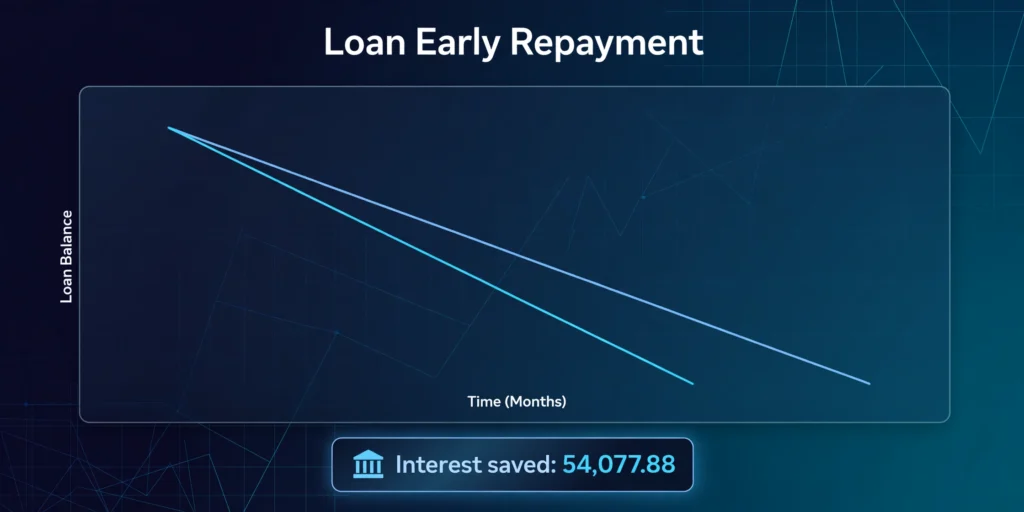
A loan is a machine that converts a lump sum today into a long stream of payments, and interest is the price of running it. The longer the machine runs, the more it costs — which is why paying a loan off early saves money out of all proportion to the extra amounts paid. A loan early repayment calculator runs the real month-by-month amortisation twice — once on the standard schedule, once with your extra payments — and reports the difference: how much sooner you are debt-free, and how much interest you never pay. The calculator at the top of this page does exactly that, for an extra monthly payment, a one-off lump sum, or both together. On the worked example used to test it, an extra 200 a month on a 200,000 loan at 6 percent over 25 years clears the debt 76 months early and saves 54,077.88 of interest — more than a quarter of the original loan, saved by an extra payment of about a sixth of the normal one.
Those proportions surprise most people the first time, and the surprise is the point of the tool. Interest is charged on the outstanding balance, so every early payment does double duty: it removes some balance immediately, and it removes all the future interest that balance would have generated for every remaining month of the term. Early in a loan, when the balance is large and the remaining term long, that second effect is powerful. Late in a loan, with little time left, the same extra payment saves much less. A calculator that runs the genuine schedule, month by month, captures all of this honestly, which a rule of thumb cannot.
How Early Repayment Saves Money: The Amortisation Mechanics
A standard amortising loan charges the same payment every month, but the payment’s composition changes constantly. Each month, interest is charged on the current balance at the monthly rate — the annual rate divided by twelve — and whatever is left of the payment reduces the balance. At the start of a 200,000 loan at 6 percent, the monthly rate is 0.5 percent, so the first month’s interest is 1,000.00, and of the 1,288.60 payment only 288.60 touches the balance. Years later, with the balance down to 100,000, the month’s interest is 500.00 and about 788.60 of the same payment reduces the balance. This is why early payments feel unrewarding on a statement — most of the payment is interest — and why they are actually so effective: the balance is at its largest, and interest is being charged on the largest possible base.
Now add 200 to every payment. The interest charge each month is unchanged at first — it depends only on the balance — so the entire extra 200 comes off the balance, every month, on top of the scheduled reduction. Next month the balance is 200 lower than it would have been, so the interest is 1.00 less, and that saved 1.00 also comes off the balance, and so on, compounding quietly. Over 224 months instead of 300, the accumulation of those small monthly edges is the 54,077.88 saving: the loan spent 76 fewer months with a balance to charge interest on, and its balance was lower in every month it did run. A lump sum works the same way, compressed: 10,000 paid at the start of the same loan removes 10,000 of balance immediately and saves 31,280.41 of interest — more than triple the amount paid, because that 10,000 would have been charged 0.5 percent a month, month after month, for most of 25 years.
The payment formula itself deserves one line, because the calculator shows it in its working. The standard monthly payment for a loan of P at monthly rate r over n months is P × r / (1 − (1 + r)^−n). For 200,000 at 0.5 percent monthly over 300 months, that gives 1,288.60. The formula is just the level payment whose interest-and-principal stream exactly retires the balance at month n — change any of P, r, or n and the payment moves, which the base loan calculator on this site explores on its own. This early repayment tool takes that payment as the fixed spine of both schedules and varies only what you add to it.
How to Use the Calculator
Using the tool takes less than a minute. Follow these steps:
- Enter the loan amount (the principal, or the current outstanding balance if the loan is already running — see the note below). The live test uses 200,000.
- Enter the annual interest rate as a percentage, for example 6 for 6 percent per year.
- Enter the term in years, for example 25. For a loan already running, enter the years remaining, not the original term.
- Enter an extra monthly payment, or 0 for none. The live test uses 200.
- Enter a one-off lump sum paid at the start, or 0 for none.
- Press “Calculate Early Repayment Savings” and read the new payoff time, the interest saved, and the full comparison of both schedules.
A note for loans already in progress: enter the balance still owed today, the years still remaining, and treat today as the start. A lump sum then means a lump sum paid now, and the extra monthly payment means from now on. The arithmetic is identical; only the starting point moves. And if you enter no extra payment and no lump sum, the two schedules come out identical and the saving is zero — a useful sanity check that the comparison machinery is honest.
Worked Examples
Example 1: Extra 200 a month, the live test
Loan 200,000, rate 6 percent, term 25 years (300 monthly payments of 1,288.60), extra 200 a month, no lump sum. Original schedule: 300 months, total interest 186,580.84 — note that the borrower repays 386,580.84 in all, nearly double the amount borrowed, which is the true long-run price of a 25-year loan at 6 percent. With the extra payment: the loan clears in 224 months, total interest 132,502.97. Interest saved: 186,580.84 − 132,502.97 = 54,077.88. Time saved: 76 months, which is 6 years and 4 months of payments that never happen. In exchange, the borrower paid up to 200 extra in each of those 224 months (the final month, as always, is only the small balance remaining), to avoid 54,077.88 of interest and finish more than six years early. That exchange rate, better than a pound back for every pound added plus the freedom of an early finish, is typical for overpayments made from the start of a long loan.
Example 2: A 10,000 lump sum instead
Same loan, no extra monthly payment, lump sum 10,000 at the start. The balance drops to 190,000 immediately, and the loan clears in 268 months with total interest 155,300.43 — saving 31,280.41 and 32 months. Compare the two examples directly: the lump sum cost 10,000 once, the extra payments cost 44,800 spread over years, and the savings per amount paid are strikingly different — the lump sum returns over three times its size in saved interest, because every unit of it works for the whole remaining term. Timing is the multiplier: money off the balance early is worth far more than the same money paid late, which is why a windfall applied to a loan in its first years outperforms the same windfall saved up and applied in the last years.
Example 3: A shorter loan
Loan 50,000, rate 5 percent, term 10 years: payment 530.33, original interest 13,639.31 over 120 months. Add 100 a month: the loan clears in 97 months, interest 10,826.94, saving 2,812.37 and 23 months. The saving is real but far smaller than Example 1’s, for two structural reasons the calculator makes visible: the term is shorter, so there are fewer months of interest to avoid, and the rate is lower, so each month avoided costs less. Early repayment is most powerful on long, high-rate loans — which is also where the temptation to leave the schedule alone is strongest, because the monthly payment already feels large.
Example 4: Zero rate and zero extras — the honesty checks
Enter a rate of 0 with any amount and term: interest is 0.00 on both schedules, payoff takes exactly the term, and extra payments shorten the schedule with an interest saving of exactly 0.00 — arithmetically right, because a zero-rate loan charges nothing to avoid, and early repayment of it is a convenience, not a saving. Enter real extras as 0 and the plans match to the cent. A calculator that cannot reproduce these boring cases exactly should not be trusted on the interesting ones; this one is built to run both schedules by the same month-by-month engine, so the boring cases fall out automatically.
Comparing Strategies: Extra Monthly, Lump Sum, or Both
The three strategies differ mainly in timing and commitment. Extra monthly payments are a habit: modest, adjustable, and spread across the term; their power builds as the balance stays permanently below schedule. A lump sum is an event: it applies a windfall — a bonus, an inheritance, the proceeds of a sale — where it earns a guaranteed return equal to the loan’s interest rate, which no savings account matches after tax for most borrowers. Both together are the fastest route and the one this calculator models directly. What the calculator deliberately does not decide is whether early repayment is the best use of the money at all: that depends on early-repayment charges in your loan terms, on whether you hold more expensive debt elsewhere (clear that first — 20 percent card interest beats 6 percent loan interest for your extra money every time), on your emergency savings, and on any investment or pension alternative with employer contributions or tax relief. The tool prices the loan strategy precisely so the comparison with those alternatives can be made with real numbers.
Common Mistakes
The first common mistake is comparing only the payments: “200 extra costs me 200” — it costs 200 of cash flow but buys back more than 200 of total repayment, as Example 1 shows. Judge early repayment on total interest and payoff date, not on the monthly figure alone. The second mistake is ignoring early-repayment charges: many fixed-rate loans cap penalty-free overpayments (a common pattern is 10 percent of the balance per year) and charge beyond it, which can erase the saving; this calculator assumes no charges and says so — read your terms before acting. The third is entering the original loan amount and term for a loan that is years old, which overstates both the interest and the potential saving; enter today’s balance and remaining term. The fourth is forgetting more expensive debts: overpaying a cheap loan while carrying card balances is arithmetically backwards. The fifth is assuming the saving is a return you keep regardless: it is realised only if the loan actually runs to the earlier payoff — selling up, refinancing, or defaulting changes the picture, and the saved interest is avoided cost, not cash in hand.
Limits: What This Tool Does and Does Not Do
This tool models a fixed-rate, level-payment amortising loan with monthly payments, an optional extra monthly payment, and an optional lump sum applied at the start, and it compares total interest and payoff time between the standard schedule and the accelerated one, computing both month by month. It assumes no early-repayment charges, no fees, no rate changes, and no missed payments, and it states that assumption in its output. It does not model variable-rate loans, interest-only periods, payment holidays, graduated payments, or loans with more complex rules such as daily interest or Rule-of-78s schedules, and a lump sum paid mid-loan rather than at the start will save somewhat less than the figure shown, because the balance it removes has already accrued some interest. Terms are capped at 50 years and the schedule run at 1,200 monthly steps, which covers any realistic loan. Within those limits, every figure is computed from the schedule itself — the interest total is the sum of the interest actually charged month by month in the simulation, not a formula shortcut — and the worked examples above are reproduced by the tool exactly.
Privacy: Your Numbers Stay in Your Browser
Every number you enter into this loan early repayment calculator stays in your browser. Nothing is uploaded to a server, nothing is stored, and there is no account to create. The calculation runs entirely on your own device. That matters for a finance tool, because the amounts people enter reveal their debts and their plans, and that information deserves to stay private. Closing the page removes your inputs, and no one else sees them. This browser-only design is the same principle behind the other free tools on Your Smart Kit: a simple tool that does one job well, keeps your data private, and gives an answer you can check.
Frequently Asked Questions
How much interest can I save by repaying a loan early?
It depends on the balance, the rate, the remaining term, and how early the extra money lands. On this page’s live test — 200,000 at 6 percent over 25 years — an extra 200 a month saves 54,077.88 and clears the loan 76 months early. Long terms and high rates produce the largest savings; enter your own figures to get your number.
Is a lump sum or extra monthly payments better?
Per unit paid, a lump sum at the start usually saves more, because the whole amount stops accruing interest for the entire remaining term. In the examples above, 10,000 as a lump sum saves 31,280.41, while the monthly route involves paying more in total. Doing both saves the most. But a lump sum paid late in the term saves far less — timing dominates.
Does this calculator include early-repayment penalties?
No. It assumes none, and says so in its output. Many lenders charge for overpaying beyond an allowance, especially during a fixed-rate period. Subtract any charge your lender would apply from the interest saved to get your true saving.
Can I use it for a mortgage?
Yes — a mortgage is an amortising loan, and the same mechanics apply: enter the outstanding balance, the rate, and the years remaining. Just check your mortgage’s overpayment allowance and charges first, since those are common in mortgage terms.
Why does the saving exceed the extra money I pay in?
Because the extra payments are not the saving — the avoided interest is. Each extra unit removes balance for every remaining month, so it avoids interest many times over. The extra payments themselves also come back to you in the sense that the loan ends sooner; you stop making the standard payments months or years earlier.
My rate is variable. Can I still use it?
You can, as an illustration at today’s rate, but the real outcome will differ when the rate changes. Treat the result as the saving if the current rate held for the whole term, which no variable-rate loan guarantees.
Related Tools on Your Smart Kit
If you found the loan early repayment calculator useful, you may also like the other free calculators on Your Smart Kit, including the loan calculator for the standard payment and amortisation of a loan as taken out, the compound interest calculator for seeing the same compounding work in your favour as savings, and the time value of money calculator for comparing amounts at different points in time. Each runs in your browser, free, with no sign-up, and each is built on the same principle: a simple tool that does one job well, keeps your data private, and gives an answer you can check. Try the loan early repayment calculator at the top of this page with your own balance and one realistic extra payment — the size of the saving, on a real schedule, is usually the moment the idea stops being abstract.
How much extra is enough? Every strategy on the same loan
The same loan runs through every row below: 200,000 at 6% over 25 years. The standard payment is 1,288.60 a month, 300 months, and the total interest on the standard plan is 186,580.84. Each row is a live test on this page.
| Strategy | Months to clear | Interest saved | Months saved |
|---|---|---|---|
| No extra payments | 300 | 0.00 | 0 |
| Extra 100 a month | 256 | 32,020.70 | 44 |
| Extra 200 a month | 224 | 54,077.88 | 76 |
| Extra 300 a month | 200 | 70,341.04 | 100 |
| Lump sum 10,000 at the start | 268 | 31,280.41 | 32 |
| Extra 200 a month + lump sum 10,000 | 204 | 73,157.14 | 96 |
The returns shrink as the extra grows. The first 100 a month saves 32,020.70; the second 100 adds 22,057.18; the third adds 16,263.16. A lump sum alone saves 31,280.41, just short of the 32,020.70 an extra 100 a month saves. Both together is the fastest route, but it beats extra 300 alone by only 2,816.10 of interest (73,157.14 against 70,341.04) — the lump sum’s edge shrinks once the monthly extra is already large.
This calculator is for general information only. It shows what extra payments would do to a fixed-rate loan on the figures you enter; it is not financial advice, and it does not account for early-repayment charges, rate changes, or your other debts. Check your loan terms before overpaying.