
Basal Metabolic Rate Calculator
Basal Metabolic Rate Calculator
What is basal metabolic rate?
Basal metabolic rate, or BMR, is the number of calories your body uses in a day at complete rest, in a neutral environment, simply to stay alive. That covers breathing, circulation, body temperature, brain activity and cell repair, before you walk a single step, lift anything, or digest a meal. For most adults, BMR accounts for roughly 60 to 70 percent of all calories used in a day, which is why it is the starting point for almost every calorie estimate that follows.
How to use this basal metabolic rate calculator
Choose Male or Female, enter your age in years, your weight in kilograms and your height in centimetres, then pick the activity level that best matches a normal week. Press Calculate BMR. The tool gives your BMR in calories per day, your burn per hour at rest, and your total daily energy expenditure (TDEE) for the activity level you chose. If you work in pounds and inches, convert first: divide pounds by 2.20462 to get kilograms, and multiply inches by 2.54 to get centimetres. A 180-pound person weighs 81.65 kg, and a person 5 feet 10 inches tall is 177.8 cm tall, since 70 inches times 2.54 equals 177.8.
A worked example from the live tool
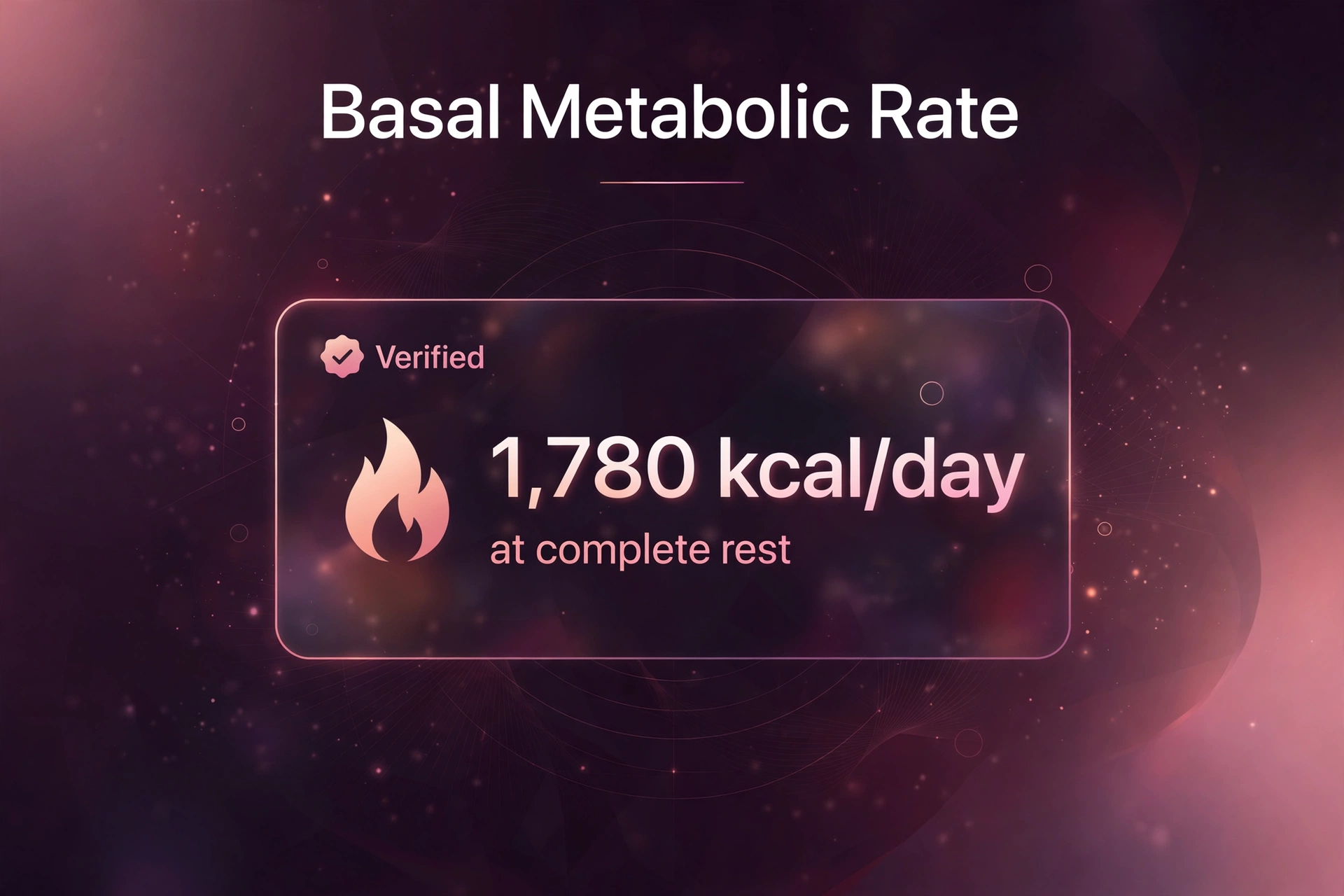
A 30-year-old man weighing 80 kg at 180 cm tall has a BMR of 1780 kcal per day on the live tool. The arithmetic is: 10 times 80 gives 800; 6.25 times 180 gives 1125; 5 times 30 gives 150; then 800 + 1125 - 150 + 5 = 1780. His burn per hour at rest is 1780 divided by 24, which is 74.17 kcal per hour. At a moderately active level, his daily needs are 1780 times 1.55, which is 2759 kcal per day. A 30-year-old woman weighing 60 kg at 165 cm tall has a BMR of 1320 kcal per day on the same tool: 600 + 1031.25 - 150 - 161 = 1320.25, shown rounded to 1320. Her burn per hour is 55.01 kcal per hour, and at a sedentary level her daily needs are 1584 kcal per day. Both examples are live tool results, and both can be checked by hand from the formula below.
How the maths works: the Mifflin-St Jeor equation
This tool uses the Mifflin-St Jeor equation, published in 1990 by Mifflin, St Jeor and colleagues, based on measurements from 498 healthy adults. It is the equation most current calculators use as their default, because later comparisons have generally found it among the most accurate standard predictions for healthy adults. The two versions differ only in the final constant:
| Group | Mifflin-St Jeor equation |
|---|---|
| Men | BMR = 10 x weight in kg + 6.25 x height in cm - 5 x age + 5 |
| Women | BMR = 10 x weight in kg + 6.25 x height in cm - 5 x age - 161 |
Weight adds calories, height adds calories, and age subtracts them: the equation lowers BMR by 5 kcal per day for each year of age, at fixed weight and height. The 166 kcal gap between the two constants reflects average differences in body composition between men and women at the same weight, height and age, not a judgement about any individual.
What is the difference between BMR, RMR and TDEE?
BMR is measured under strict laboratory conditions: fully rested, fasted, lying still, in a thermally neutral room, shortly after waking. Resting metabolic rate (RMR) is the looser, everyday version of the same idea, measured under less strict conditions, and it usually comes out slightly higher than BMR. In practice, most online calculators labelled BMR actually estimate something closer to RMR, because the Mifflin-St Jeor equation was built from resting measurements. The distinction matters less than the next one. TDEE, total daily energy expenditure, is BMR plus everything else: daily movement, exercise, the energy cost of digesting food, and shivering or sweating to hold body temperature. BMR alone never describes a full day, which is why this tool also gives a TDEE figure for your activity level.
Daily needs by activity level, computed from the worked example
Activity multipliers turn a BMR into a daily figure. Applied to the worked example of 1780 kcal per day, the levels give:
| Activity level | Multiplier | Daily needs from a BMR of 1780 |
|---|---|---|
| Sedentary (desk job, little exercise) | 1.2 | 2136 kcal per day |
| Lightly active (light exercise 1 to 3 days a week) | 1.375 | 2448 kcal per day |
| Moderately active (moderate exercise 3 to 5 days a week) | 1.55 | 2759 kcal per day |
| Very active (hard exercise 6 to 7 days a week) | 1.725 | 3071 kcal per day |
| Extra active (very hard exercise or a physical job) | 1.9 | 3382 kcal per day |
These multipliers are standard estimates, not measurements of your week. If you pick a level above your real activity, the daily figure will be too high, and the reverse is true if you pick too low. When in doubt, pick the lower of two candidate levels, then watch what actually happens over two to three weeks before adjusting.
How does BMR compare with the older Harris-Benedict equation?
The Harris-Benedict equation dates from 1919 and was revised by Roza and Shizgal in 1984. Its revised forms are: men, BMR = 88.362 + 13.397 x weight in kg + 4.799 x height in cm - 5.677 x age; women, BMR = 447.593 + 9.247 x weight in kg + 3.098 x height in cm - 4.330 x age. On the worked example man (30 years, 80 kg, 180 cm), the revised Harris-Benedict equation gives 88.362 + 1071.76 + 863.82 - 170.31 = 1853.63, shown as 1854 kcal per day, against 1780 from Mifflin-St Jeor: a gap of about 74 kcal per day. On the worked example woman (30 years, 60 kg, 165 cm), it gives 447.593 + 554.82 + 511.17 - 129.90 = 1383.68, shown as 1384, against 1320 from Mifflin-St Jeor: a gap of about 64 kcal per day. The older equation tends to run higher, which is one reason current tools prefer Mifflin-St Jeor. Either way, a gap of this size is a reminder that every equation estimates: laboratory measurement by indirect calorimetry remains the only true test, and published comparisons put standard equations within about 10 percent for most people, not exact.
What moves your BMR up or down?
Weight is the largest lever in the formula: each extra kilogram adds 10 kcal per day, at fixed height and age. Height adds 6.25 kcal per day per centimetre. Age subtracts 5 kcal per day per year, which is why two people of the same size can have different BMRs a decade apart. Beyond the formula, muscle tissue uses more energy at rest than fat tissue, so two people at the same weight can have different true resting burns if their body composition differs; the equation cannot see that difference, because it only receives weight, height, age and sex. Illness, fever, pregnancy, some medications and thyroid conditions also move real resting expenditure, and none of those are in the equation. That is why the result is an estimate for planning, not a medical measurement.
Common mistakes
The most common mistake is treating BMR as daily needs and eating to the BMR figure alone, which understates a full day by the whole activity share. The second is entering pounds as kilograms or inches as centimetres, which inflates or shrinks the result badly: always convert first, using the factors in the how-to-use section. The third is picking an activity level from aspiration rather than a normal week, which inflates TDEE. The fourth is comparing BMR figures from two calculators that use different equations and concluding that one of them is wrong; the Harris-Benedict comparison above shows a 60 to 75 kcal gap on identical inputs, from the equation choice alone. The fifth is expecting precision the method cannot give: a result quoted to the single calorie is still an estimate with a margin around it.
Limits you should know
This tool estimates resting energy expenditure for adults from the Mifflin-St Jeor equation. It does not measure your metabolism, it does not account for body composition, pregnancy, illness, medication or thyroid conditions, and it does not give advice about eating, weight loss, weight gain or training. If a health decision depends on the number, check it with a qualified clinician. The activity multipliers are population estimates, and your own daily needs will differ with your actual movement, job and training. Results are estimates, not medical advice.
Privacy note
The calculation runs in your browser. The age, weight and height you type are not uploaded or stored by this tool. If a result looks wrong, use the Contact page and include the figures you entered, so the error can be repeated.
Related tools
Try the BMI calculator for weight relative to height, the age calculator for an exact age from a birth date, the percentage calculator for shares and changes, and the calculators hub for the full set.
How do I calculate my basal metabolic rate?
Use the Mifflin-St Jeor equation: for men, 10 x weight in kg + 6.25 x height in cm - 5 x age + 5; for women, the same terms with - 161 instead of + 5. The result is calories per day at complete rest.
What is the BMR of a 30-year-old man weighing 80 kg at 180 cm?
1780 kcal per day. The steps are 800 + 1125 - 150 + 5 = 1780, giving 74.17 kcal per hour at rest and 2759 kcal per day at a moderately active level.
What is the difference between BMR and TDEE?
BMR is calories used at complete rest. TDEE is BMR multiplied by an activity factor, from 1.2 for a sedentary day to 1.9 for a very active one, giving total daily needs including movement and exercise.
Is BMR the same as resting metabolic rate?
Closely related, but not identical. BMR is measured under strict laboratory conditions, while resting metabolic rate is measured under looser conditions and usually comes out slightly higher. Most online BMR calculators estimate something closer to resting metabolic rate.
Why do two BMR calculators give different answers?
They often use different equations. On identical inputs, the revised Harris-Benedict equation gives about 60 to 75 kcal per day more than Mifflin-St Jeor in the worked examples on this page, so the equation choice alone explains a gap of that size.
Is a BMR result exact?
No. It is an estimate from a population equation, generally within about 10 percent for most healthy adults. Laboratory measurement by indirect calorimetry is the only exact test, and body composition, illness and medication all move the true figure.