
Time Distance Speed Calculator
Time Distance Speed Calculator
Section A – Find speed
Section B – Find distance
Section C – Find time
What is a time distance speed calculator?
A time distance speed calculator finds the missing one of three linked values: speed, distance and time. Given any two, the third follows, because the three are tied by a single relationship: distance equals speed multiplied by time. A driver planning a trip, a runner checking a pace, a student checking homework, and a cyclist comparing routes all use the same triangle, just solving for a different corner. This tool solves for all three corners, so you never need to rearrange the formula yourself.
How to use this time distance speed calculator
Use Section A when you know how far you went and how long it took: enter the distance and the time, and press Find Speed. Use Section B when you know your speed and your time: enter both, and press Find Distance. Use Section C when you know the distance and the speed: enter both, and press Find Time. Enter time as hours plus minutes, so a 1 hour 30 minute journey is 1 hour and 30 minutes, not 1.30 hours: 1.30 as a decimal means 1 hour 18 minutes, which is a different journey. Every speed result also shows miles per hour, and every distance result also shows miles, so the tool works in both unit systems at once.
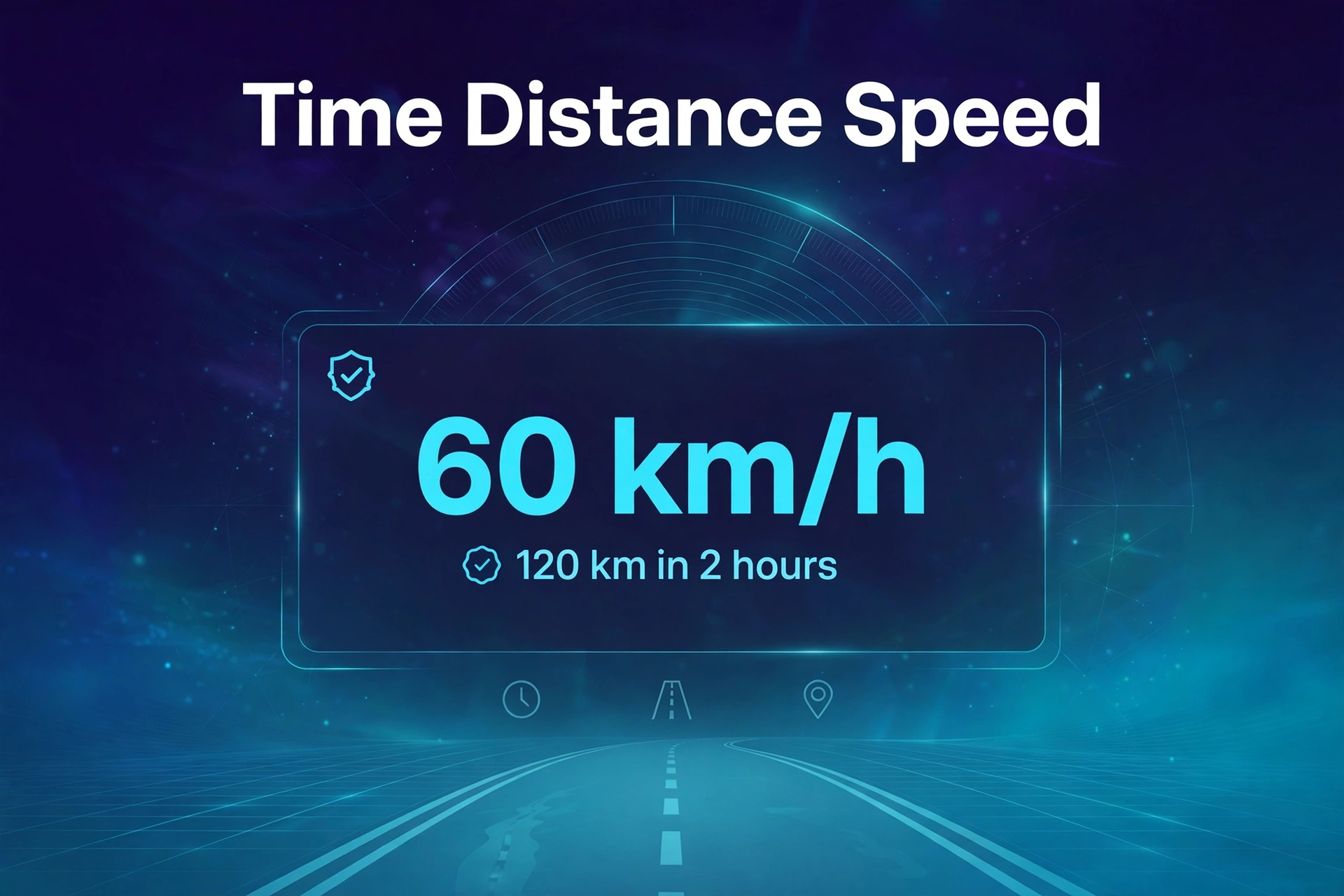
A worked example from the live tool
Travelling 120 km in 2 hours gives an average speed of 60.00 km per hour, which is 37.28 miles per hour, on the live tool. The steps are: speed = distance divided by time, so 120 divided by 2 is 60 km per hour; miles per hour is 60 divided by 1.60934, which is 37.28. Travelling at 60 km per hour for 1 hour 30 minutes covers 90.00 km, which is 55.92 miles: distance = speed times time, so 60 times 1.5 is 90, and 90 divided by 1.60934 is 55.92. Covering 90 km at 45 km per hour takes 2 hours 0 minutes: time = distance divided by speed, so 90 divided by 45 is 2.00 hours, which is 120 minutes. All three examples are live tool results, and all three can be checked by hand from the formulas below.
How the maths works: one triangle, three formulas
The whole tool rests on distance = speed x time. Cover one corner of that triangle and the other two give the formula you need:
| Wanted | Formula |
|---|---|
| Speed | Speed = distance divided by time |
| Distance | Distance = speed times time |
| Time | Time = distance divided by speed |
Units must match before you divide or multiply: kilometres with hours give kilometres per hour, and miles with hours give miles per hour. Mixing them is the classic error: 120 km in 2 hours is 60 km per hour, not 60 miles per hour, and 60 miles per hour for 2 hours is 120 miles, which is 193.12 km, not 120 km. The conversion factors are: 1 mile = 1.60934 km, so miles per hour = kilometres per hour divided by 1.60934, and kilometres per hour = miles per hour times 1.60934. A speed of 100 km per hour is 62.14 miles per hour, and a speed of 60 miles per hour is 96.56 km per hour. Time needs the same care: always convert hours and minutes to a single unit first. A time of 1 hour 30 minutes is 1.5 hours or 90 minutes, never 1.30 hours.
Speed, pace and average speed: three different readings
Speed answers "how far per hour", while pace answers "how long per unit of distance", and runners, walkers and swimmers usually think in pace. Pace is time divided by distance: a 5 km run in 25 minutes is 25 divided by 5, which is 5 minutes per kilometre, and the same run at speed is 5 divided by (25 divided by 60), which is 12 km per hour. The two readings describe the same run, and either can be converted to the other by dividing 60 by the figure: 60 divided by a pace of 5 minutes per km gives 12 km per hour, and 60 divided by 12 km per hour gives a pace of 5 minutes per km. Average speed is a third idea again: it is total distance divided by total time, including slow stretches, stops and fast stretches together. A journey of 60 km at 120 km per hour followed by 60 km at 40 km per hour has an average speed of 60 km per hour, not 80, because the slow half takes 1.5 hours while the fast half takes 0.5 hours, so total time is 2 hours for 120 km. Averaging the two speeds directly gives the wrong answer whenever the two halves take different times, which is the trap to watch for.
Quick-reference table: speeds, paces and journey times
The table below is computed from the formulas above, so every entry can be checked by hand:
| Speed | Pace (minutes per km) | Time for 10 km | Time for 100 km |
|---|---|---|---|
| 6 km per hour (walking) | 10.00 | 1 hour 40 minutes | 16 hours 40 minutes |
| 12 km per hour (running) | 5.00 | 50 minutes | 8 hours 20 minutes |
| 30 km per hour (city cycling) | 2.00 | 20 minutes | 3 hours 20 minutes |
| 60 km per hour | 1.00 | 10 minutes | 1 hour 40 minutes |
| 90 km per hour | 0.67 | 6 minutes 40 seconds | 1 hour 6 minutes 40 seconds |
| 120 km per hour | 0.50 | 5 minutes | 50 minutes |
Read the walking row with care: 10 km at 6 km per hour takes 10 divided by 6, which is 1.6667 hours, which is 1 hour 40 minutes, not 1 hour 67 minutes. The same decimal trap appears in every row, and it is why this tool reports hours and minutes separately rather than as a bare decimal.
Everyday uses: trips, training and homework
For a road trip, Section C is the planning tool: 100 km at 80 km per hour takes 1 hour 15 minutes, and adding stops, fuel and traffic on top of that figure gives a realistic arrival estimate, because the tool's steady-speed figure is a floor, not a promise. For training, Section A turns a timed run into a speed and, by dividing 60 by that speed, into a pace, so a week's runs can be compared on one scale. For homework, the triangle gives every textbook variant: a car travelling 90 km in 1.5 hours is travelling at 60 km per hour; a train at 75 km per hour for 2.4 hours covers 180 km; a cyclist covering 45 km at 15 km per hour takes 3 hours. In each case, the method is the same: write down the two known values, pick the formula for the missing one, convert time to a single unit first, and check the units of the answer.
Common mistakes
The most common mistake is entering 1 hour 30 minutes as 1.30 hours, which understates the time by 12 minutes and inflates the speed. The second is mixing kilometres and miles, so a speed in one unit is read as if it were the other. The third is averaging speeds directly across unequal times, as in the 120 km per hour and 40 km per hour example above, instead of dividing total distance by total time. The fourth is forgetting that average speed includes stops: a journey with a 30 minute stop has a lower average speed than the driving speed, because the stop adds time without adding distance. The fifth is quoting a decimal hour as hours and minutes: 1.67 hours is 1 hour 40 minutes, not 1 hour 67 minutes.
Limits you should know
This tool computes steady average speed, distance and time from the values you enter. It does not model acceleration, braking, stops, traffic, gradients, wind, or speed changes during the journey, so a real trip will usually take longer than the steady-speed figure. It works in kilometres and miles only, with time to the minute in the first two sections, and it does not handle dates or time zones. For a planned arrival time, add stops and a margin for traffic on top of the tool's figure.
Privacy note
The calculation runs in your browser. The distances, speeds and times you type are not uploaded or stored by this tool. If a result looks wrong, use the Contact page and include the distances, speeds and times you entered, so the error can be repeated.
Related tools
Try the unit converter for other unit conversions, the date calculator for days between dates, the minutes calculator for converting and adding durations, and the calculators hub for the full set.
How do I calculate speed from distance and time?
Divide distance by time, in matching units. 120 km in 2 hours is 120 divided by 2, which is 60 km per hour, or 37.28 miles per hour.
How long does 100 km take at 80 km per hour?
1 hour 15 minutes. Time is distance divided by speed, so 100 divided by 80 is 1.25 hours, which is 1 hour 15 minutes and 75 total minutes.
How do I convert km per hour to miles per hour?
Divide by 1.60934. 60 km per hour divided by 1.60934 is 37.28 miles per hour, and 100 km per hour is 62.14 miles per hour.
What is the difference between speed and pace?
Speed is distance per hour, while pace is time per unit of distance. A 5 km run in 25 minutes is 12 km per hour at speed, and 5 minutes per kilometre at pace. Divide 60 by either figure to get the other.
Why is my average speed not the average of my two speeds?
Because average speed is total distance divided by total time, not the average of the speeds. 60 km at 120 km per hour plus 60 km at 40 km per hour takes 2 hours for 120 km, so the average is 60 km per hour, not 80.
How do I enter 1 hour 30 minutes?
As 1 hour and 30 minutes in the tool's two fields, which is 1.5 hours. Do not enter 1.30 hours, because 0.30 of an hour is 18 minutes, not 30 minutes.