
Car Payment Interest Calculator
Car Payment Interest Calculator
Car Payment Interest Calculator
A car payment interest calculator works out the monthly payment, total interest, and total cost of a car loan from the amount financed, the interest rate, and the term in months. It starts from the vehicle price, subtracts what you already put toward the car, adds tax and fees you choose to finance, and then applies fixed-rate loan maths to that financed amount.
How do I use the car payment interest calculator?
Enter the vehicle price first, because every other figure is measured against it. Then enter the down payment and the trade-in value, if you have either. Enter the sales tax percentage only if that tax will be added to the loan, and enter 0 if you will pay tax separately. Enter any other fees you plan to finance, again as 0 if there are none. Enter the annual interest rate as a percentage and the term in months, then select Calculate Car Payment.
The result boxes show five figures, and they are best read in order. Amount financed is the loan principal, after down payment, trade-in, tax, and fees. Monthly payment is the fixed payment for each month of the term. Total interest is the cost of borrowing over the full term. Total payment is loan payments only, meaning monthly payment multiplied by term. Total cost of the car adds the down payment and trade-in value to that total payment. If the amount financed looks wrong, check down payment, trade-in, tax, and fees before questioning the payment itself, because most surprises come from the financed amount rather than the interest formula.
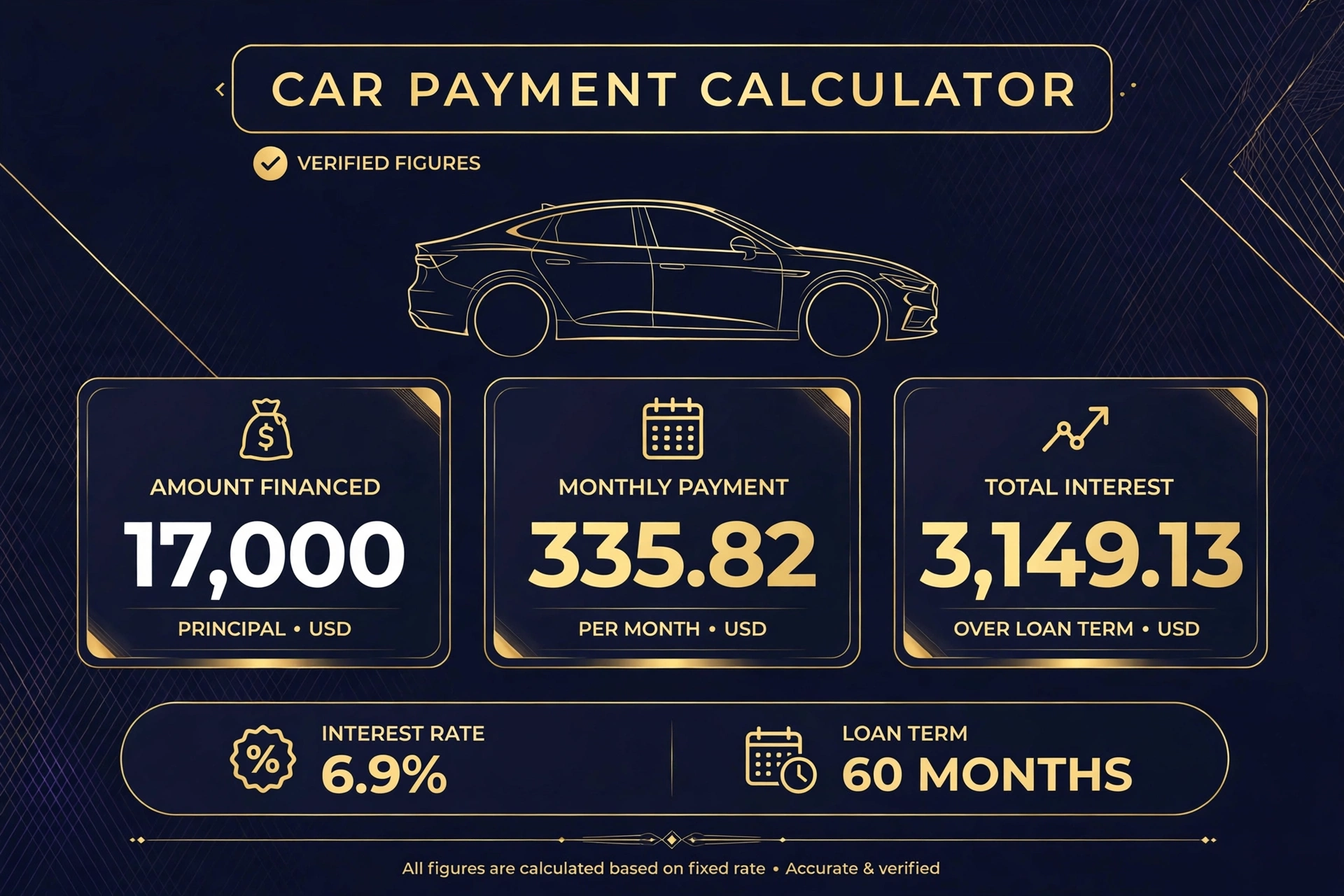
A worked example from the live tool: what do the numbers show?
The first live test used a vehicle price of 25000, a down payment of 5000, a trade-in value of 3000, sales tax of 0 percent, other fees of 0, an annual interest rate of 6.9 percent, and a term of 60 months. The amount financed was 17000.00, the monthly payment was 335.82, total interest was 3149.13, total payment was 20149.13, and total cost of the car was 28149.13. The steps are simple: 25000 minus 5000 minus 3000 leaves 17000 to finance, and at 6.9 percent over 60 months that 17000 produces the payment and interest above.
A second live test shows what happens when tax and fees join the loan. It used a vehicle price of 32000, a down payment of 5000, a trade-in value of 4000, sales tax of 6 percent, other fees of 350, an annual interest rate of 6.9 percent, and a term of 60 months. The taxable amount was 28000, which is 32000 minus 4000, and tax at 6 percent was 1680. The amount financed was 25030.00, from 32000 minus 5000 minus 4000 plus 1680 plus 350. The monthly payment was 494.44, total interest was 4636.64, total payment was 29666.64, and total cost of the car was 38666.64. The second car costs 7000 more than the first, yet the amount financed is 8030 more, because tax and fees were also financed. That gap is why two similar prices can still give quite different payments.
How does the maths behind a car payment work?
A car loan in this calculator is a fixed-rate amortising loan. The rate stays the same for the whole term, the monthly payment stays the same, and each payment covers part interest and part principal. Early payments cover more interest, because the balance is still high, and later payments cover more principal, because the balance has fallen. By the final payment, the balance reaches zero.
The formula is M = P x r(1+r)^n / ((1+r)^n - 1), where M is the monthly payment, P is the amount financed, r is the monthly interest rate, and n is the number of monthly payments. The monthly rate r is the annual rate divided by 100 and then divided by 12, so for 6.9 percent it is 0.00575 per month. If the rate is 0 percent, the monthly payment is simply the amount financed divided by the term. The third live test confirms this: 20000 financed at 0 percent over 48 months, with no down payment, trade-in, tax, or fees, gave a monthly payment of 416.67, total interest of 0.00, total payment of 20000.00, and total cost of 20000.00.
One rounding point matters for anyone checking by hand. Totals are computed from the unrounded monthly payment, not from the rounded figure shown on screen. For the first test, 335.82 multiplied by 60 is 20149.20, while the tool shows total payment of 20149.13, because the unrounded monthly payment is slightly below 335.82. The tool keeps full precision through the calculation and rounds only for display.
How is the amount financed built up?
The amount financed is built in a fixed order that can be checked step by step. Start with the vehicle price, subtract the down payment, subtract the trade-in value, add sales tax on the taxable amount, and add other fees you choose to finance. The result is the amount financed. The taxable amount is the vehicle price minus the trade-in value, floored at zero, so it never goes below zero, and sales tax is that amount multiplied by the tax percentage and divided by 100.
Three figures must not be confused. The price is what the car is sold for. The amount financed is what is borrowed. The total cost adds the cash and trade-in value back to the loan payments. A low monthly payment can still sit on top of a high total cost if the term is long, and a high price does not always mean a high loan if a large down payment or trade-in sits behind it.
How do down payment and trade-in change the loan?
A down payment is cash paid toward the car at purchase, and it reduces the amount financed dollar for dollar in this tool. A trade-in value works the same way in the arithmetic: it is value from an old vehicle put toward the new car, and it also reduces the amount financed. In the first test, 5000 down and 3000 trade-in together removed 8000 from a price of 25000, leaving 17000 to finance before tax and fees. Both lower the loan, both lower the monthly payment, and both lower total interest, because interest is charged on a smaller amount.
Negative equity needs care. Negative equity means you still owe more on the old vehicle than its trade-in value. If that applies, enter only net equity in this tool, which is the trade-in value minus what is still owed, and only if that net figure is positive. If what is still owed is larger than the trade-in value, the net figure is not positive, so do not enter the full trade-in value as if it were equity. Settle the old loan separately, outside this calculation, and enter the figures for the new car on their own. This tool does not add an old loan balance to a new loan, and it does not model rolling an old balance into a new loan.
How do sales tax and fees affect the amount financed?
Sales tax and fees affect the payment only when they are financed. If you pay them in cash at purchase, they do not enter the loan, and you should enter 0 for both. If they are added to the loan, they raise the amount financed, and interest is then charged on them as well as on the car itself. That is why the second test, with 1680 of tax and 350 of fees financed, has a higher payment than price alone would suggest.
Tax treatment varies by place. This tool applies tax to the price minus the trade-in value, but some places tax the full price, and some places treat trade-in differently. If your place taxes the full price, enter 0 for tax in this tool and add the tax separately, because the tool's tax base would not match your case. Fees work in a similar way: registration, documentation, and dealer fees vary, and only the fees you choose to finance belong in the fees input. Fees paid in cash should not be entered here, even though they are part of what you pay overall.
How does the term change the monthly payment and total interest?
A shorter term means a higher monthly payment and lower total interest, while a longer term means a lower monthly payment and higher total interest. The table below holds the financed amount and rate fixed, so only the term changes. All figures are for 17000 financed at 6.9 percent.
| Term (months) | Monthly payment ($) | Total interest ($) |
|---|---|---|
| 36 | 524.13 | 1868.81 |
| 48 | 406.30 | 2502.30 |
| 60 | 335.82 | 3149.13 |
| 72 | 289.02 | 3809.26 |
Moving from 36 months to 72 months cuts the monthly payment from 524.13 to 289.02, a drop of 235.11 per month, but raises total interest from 1868.81 to 3809.26, an increase of 1940.45. That is the trade-off in plain numbers. A reader comparing offers should compare term, rate, and amount financed together, because a monthly payment on its own hides how much interest sits behind it. Longer terms also mean owing money for longer, while this calculator does not model depreciation or resale value; it models the loan only.
For a related way to look at loan costs, see the Loan Calculator and the Loan Early Repayment Calculator. For working out percentages in a deal, such as a tax rate or a discount, the Percentage Calculator is useful. More tools of this kind are listed in the Calculators hub.
What are common mistakes when estimating a car payment?
The first common mistake is entering the vehicle price as the amount financed and forgetting the down payment, trade-in, tax, and fees, which overstates the loan when a down payment or trade-in exists and understates it when tax and fees are financed. The reverse mistake is entering tax or fees paid in cash as if they were financed. A third mistake is comparing monthly payments from loans with different terms or financed amounts as if they were the same deal: 289.02 over 72 months and 524.13 over 36 months are different terms on the same 17000 at 6.9 percent, with total interest of 3809.26 and 1868.81 respectively, so total interest and total payment should be compared alongside the monthly figure.
A fourth mistake is treating a gross trade-in value as equity when an old loan is still outstanding; only net equity belongs in the input, as explained above. A fifth mistake is rounding too early when checking by hand, since multiplying the rounded monthly payment by the term can differ by a few cents from the tool's total, which uses the unrounded payment. A sixth mistake is assuming the payment includes insurance, maintenance, or fuel. It does not: it covers the loan only, and running costs should be budgeted separately.
What are the limits of this calculator?
This calculator models a fixed-rate loan with equal monthly payments, no extra payments, no missed payments, no fees charged during the loan, and no change in the rate. Real loans can differ: some have variable rates, some allow extra payments, some carry charges for late payment, and some include products added to the loan that are not in the inputs here. If any of those apply, the figures here are an estimate of the basic loan, not a full picture of that specific agreement. The calculator also does not check whether a loan will be offered, what rate a lender will quote, or whether the inputs match a dealer's paperwork. Rates, tax rules, and fees vary by place and by lender, and the final figures on a loan agreement are the ones that govern. Use this tool to compare options on the same inputs and to spot when a quoted payment does not match the financed amount, rate, and term you expected.
Frequently asked questions
How is a car payment interest calculator different from a general loan calculator?
A car payment interest calculator starts from a vehicle price and builds the amount financed from down payment, trade-in, tax, and fees, while a general loan calculator usually starts from a loan amount already given. For the first test here, the price of 25000 became an amount financed of 17000.00 after a down payment of 5000 and a trade-in of 3000, with a monthly payment of 335.82 and total interest of 3149.13 over 60 months at 6.9 percent. For a general loan, see the Loan Calculator.
What monthly payment does 17000 financed at 6.9 percent over 60 months give?
It gives a monthly payment of 335.82, with total interest of 3149.13 and total payment of 20149.13. Total cost of the car in that test was 28149.13, from a price of 25000, a down payment of 5000, and a trade-in value of 3000, with no tax or fees financed.
How does sales tax change the amount financed in this tool?
Sales tax is applied to the price minus the trade-in value, floored at zero. In the second test, a price of 32000 minus a trade-in value of 4000 gave a taxable amount of 28000, tax at 6 percent was 1680, and the amount financed was 25030.00 after a down payment of 5000, the trade-in of 4000, tax of 1680, and fees of 350. The monthly payment was 494.44 and total interest was 4636.64 over 60 months at 6.9 percent.
What happens if the rate is 0 percent?
The monthly payment is the amount financed divided by the term. In the third test, 20000.00 financed at 0 percent over 48 months gave a monthly payment of 416.67, total interest of 0.00, total payment of 20000.00, and total cost of 20000.00, with no down payment, trade-in, tax, or fees.
Does a longer term always lower the monthly payment?
Yes, in this tool a longer term lowers the monthly payment but raises total interest, when the financed amount and rate stay the same. For 17000 at 6.9 percent, 36 months gives 524.13 per month with interest of 1868.81, 48 months gives 406.30 with interest of 2502.30, 60 months gives 335.82 with interest of 3149.13, and 72 months gives 289.02 with interest of 3809.26.
What if my down payment and trade-in already cover the car?
The tool shows: Your down payment and trade-in already cover the price plus tax and fees, so no loan is needed. That happens when the amount financed is zero or less, for example if the down payment and trade-in together are at least as large as the price plus any tax and fees entered.