
Fuel Cost Travel Calculator
Enter the trip distance, your car’s fuel efficiency, and the fuel price where you plan to fill up. Tick the round-trip box if you are driving back by the same route.
If you pick MPG, enter the price per gallon. If you pick L/100km, enter the price per litre.
A fuel cost travel calculator works out how much fuel a trip will use and what that fuel will cost, from three numbers: the trip distance, the car's fuel efficiency, and the fuel price. A 300-mile trip in a car that does 30 mpg, with fuel at $3.50 a gallon, needs 10 gallons and costs $35.00.
How do I use the Fuel Cost Travel Calculator?
Enter the one-way trip distance and pick miles or kilometres, then enter the fuel efficiency and pick MPG or L/100km, then enter the fuel price per gallon or per litre and pick the currency. Press Calculate fuel cost and the tool shows the fuel needed for one way, the total fuel cost for one way, and the cost per mile or per kilometre. Tick the round-trip box if driving back by the same route: the tool then doubles the one-way fuel and cost and shows the round-trip cost in its own box.
The tool converts the distance to match the efficiency unit you picked, so the two need not be in the same system: a trip of 500 km with an efficiency of 7 L/100km works directly, and a trip of 300 miles at 30 mpg works directly, but a trip of 500 km at 30 mpg also works, because the tool converts 500 km to miles before dividing by the mpg figure. The currency selector changes only the symbol shown, not the numbers: $3.50, €1.70, and £1.50 are entered as they are, and the tool shows the symbol picked. The results are shown to two decimal places, which is the precision of the fuel price and of the pump.
To work out how long a trip takes at a given speed before costing its fuel, see the time distance speed calculator.
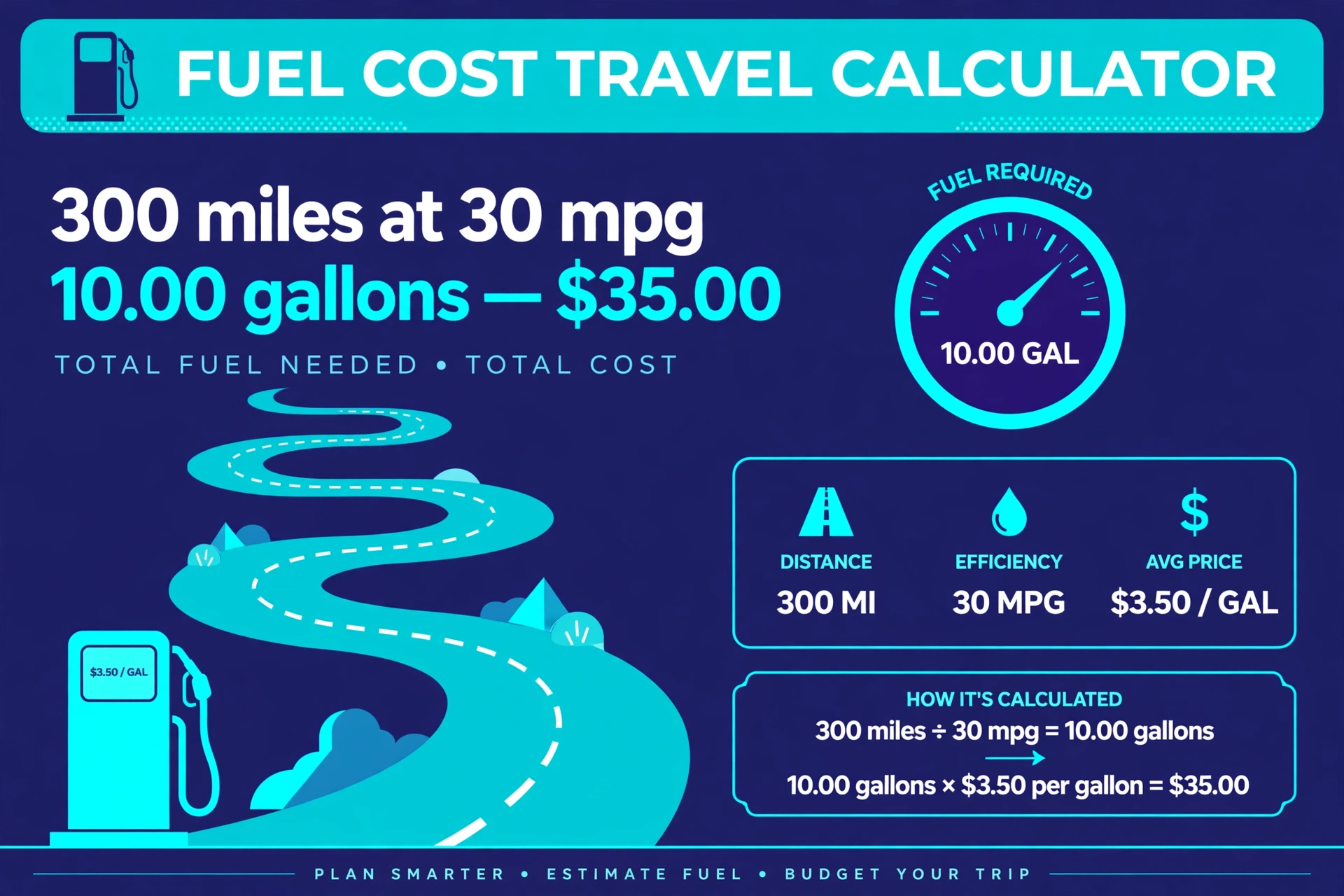
A worked example from the live tool
Test 1 uses 300 miles, 30 mpg, and $3.50 a gallon, the figures in the illustration above. The tool gives 10.00 gallons needed, a total cost of $35.00, and a cost per mile of $0.12. The steps are: 300 ÷ 30 is 10 gallons, 10 × 3.50 is $35.00, and 35.00 ÷ 300 is $0.12 a mile. This is the simplest case: the distance is in miles, the efficiency is in mpg, and the price is per gallon, so no conversion is needed.
Test 2 uses 500 km, 7 L/100km, and €1.70 a litre, to show the metric path. The tool gives 35.00 litres needed, a total cost of €59.50, and a cost per km of €0.12. The steps are: 500 × 7 ÷ 100 is 35 litres, 35 × 1.70 is €59.50, and 59.50 ÷ 500 is €0.12 a kilometre. The metric formula is fuel = distance in km × L/100km ÷ 100, which is the direct formula, with no conversion through mpg and no constant. The tool's metric path uses this formula, and the article's formula section below explains it.
Test 3 uses 200 miles, 25 mpg, and $4.00 a gallon, with the round-trip box ticked. The tool gives 8.00 gallons and $32.00 one way, a cost per mile of $0.16, and a round-trip cost of $64.00. The steps are: 200 ÷ 25 is 8 gallons, 8 × 4.00 is $32.00, 32.00 ÷ 200 is $0.16 a mile, and the round trip doubles the one-way cost to $64.00 and the fuel to 16 gallons. The error cases are plain-language messages with the results hidden until the inputs are valid: a missing distance gives 'Please enter a trip distance.', a missing efficiency gives 'Please enter a fuel efficiency figure.', a missing price gives 'Please enter a fuel price.', and a zero or negative figure gives a message that names the field, such as 'Trip distance must be greater than 0.'
What is the fuel cost formula for a trip?
In miles and gallons, the formula has two steps. First, fuel needed = distance ÷ mpg, in gallons. Then, total cost = fuel needed × price per gallon. A 300-mile trip at 30 mpg needs 300 ÷ 30, which is 10 gallons, and at $3.50 a gallon that costs 10 × 3.50, which is $35.00. The cost per mile is the total cost ÷ the distance, which is 35.00 ÷ 300, or $0.12 a mile. The cost per mile is the most useful of the three figures for comparing cars, because it does not depend on the trip length: a car that costs $0.12 a mile costs $12.00 for 100 miles and $120.00 for 1,000 miles.
In kilometres and litres, the formula is fuel = distance in km × L/100km ÷ 100, in litres, then total cost = fuel × price per litre. A 500 km trip at 7 L/100km needs 500 × 7 ÷ 100, which is 35 litres, and at €1.70 a litre that costs 35 × 1.70, which is €59.50. The cost per km is 59.50 ÷ 500, or €0.12 a kilometre. This is the direct formula, with no conversion through mpg and no constant: the L/100km figure already says how many litres the car uses per 100 km, so multiplying by the distance in km and dividing by 100 gives the litres directly. The tool's metric path uses this formula, and the worked example above shows it.
The two formulas are the same calculation in different units, and they give the same answer when the units are converted correctly. A car that does 30 mpg uses 7.84 L/100km, and a 300-mile trip is 482.8 km: 482.8 × 7.84 ÷ 100 is 37.85 litres, which is 10 gallons, because 1 gallon is 3.78541 litres. The tool converts the distance to match the efficiency unit, so a mixed entry, such as 500 km at 30 mpg, is handled by converting 500 km to 310.69 miles first, then dividing by 30 to get 10.36 gallons. The conversion section below gives the mpg to L/100km figures for the common efficiencies.
How do I find my car's real MPG or L/100km?
Use the fill-up method, which is the most accurate figure a driver can get without a meter. Fill the tank until the pump clicks off, reset the trip meter to zero, drive normally until the tank is low, then fill up again until the pump clicks off and note the gallons it took and the miles on the trip meter. Divide the miles by the gallons to get the real mpg. A driver who covers 300 miles and then puts in 10 gallons has a real figure of 30 mpg. In metric units, divide the litres put in by the kilometres driven and multiply by 100: 35 litres for 500 km is 35 ÷ 500 × 100, which is 7 L/100km.
Repeat over two or three fill-ups and average the results, because one tank can be misleading. A tank that includes a long motorway run gives a higher mpg than a tank of short urban trips, and a tank filled on a slope or to a different level gives a different figure. The average over three tanks, with normal driving, is the figure to enter in the tool. A car's own trip computer gives a similar figure, but it is usually 2% to 5% optimistic, so the fill-up method is the better check.
The manufacturer's combined figure is a starting point, not a real figure. It is measured on a standard test cycle, which is mostly steady-speed driving, and a real driver's mpg is usually 10% to 20% lower, because real driving includes cold starts, short trips, traffic, and hills. A car rated at 35 mpg combined may give 30 mpg in real use, and that 5 mpg difference changes a 300-mile trip from 8.57 gallons to 10 gallons, or $30.00 to $35.00 at $3.50 a gallon. Enter the real figure, not the brochure figure, and the tool's answer will be closer to the pump.
How do I convert MPG to L/100km?
MPG and L/100km measure the same thing in opposite directions: mpg is miles per gallon, so a higher number is better, and L/100km is litres per 100 km, so a lower number is better. A car that does 30 mpg uses 7.84 L/100km, and a car that uses 5 L/100km does 47.04 mpg. The two are reciprocals, scaled by the gallon and the kilometre, which is why the conversion uses division rather than multiplication.
For US gallons, the formula is L/100km = 235.215 ÷ mpg. A car that does 30 mpg uses 235.215 ÷ 30, which is 7.84 L/100km. A car that does 25 mpg uses 235.215 ÷ 25, which is 9.41 L/100km. The reverse formula is mpg = 235.215 ÷ L/100km: a car that uses 7 L/100km does 235.215 ÷ 7, which is 33.60 mpg. The constant 235.215 comes from the US gallon, which holds 3.78541 litres, and the mile, which is 1.60934 km: 100 ÷ 3.78541 × 1.60934 is 235.215, to three decimal places.
| MPG (US) | L/100km | Cost per mile at $3.50/gal |
|---|---|---|
| 20 mpg | 11.76 L/100km | $0.17 |
| 25 mpg | 9.41 L/100km | $0.14 |
| 30 mpg | 7.84 L/100km | $0.12 |
| 35 mpg | 6.72 L/100km | $0.10 |
| 40 mpg | 5.88 L/100km | $0.09 |
| 50 mpg | 4.70 L/100km | $0.07 |
Each L/100km value is 235.215 divided by the mpg figure, and each cost per mile is $3.50 divided by the mpg figure. The cost per mile falls as the mpg rises, but not in proportion: going from 20 to 25 mpg saves $0.03 a mile, while going from 40 to 50 mpg saves only $0.02 a mile, because the cost per mile is the price divided by the mpg, and the saving shrinks as the mpg grows. The tool does the conversion when the efficiency unit is changed, so a figure entered in one unit can be read in the other by switching the selector.
One trap catches many travellers: a UK gallon is not a US gallon. A UK gallon holds 4.54609 litres, while a US gallon holds 3.78541 litres, so a UK mpg figure is about 20% higher than the same car's US mpg figure. A car that does 36 mpg in the UK does 30 mpg in the US. The conversion constant for UK gallons is 282.481, not 235.215, so 36 UK mpg is 282.481 ÷ 36, which is 7.84 L/100km, the same as 30 US mpg. Enter the figure that matches the gallon the tool's price is in: if the price is per US gallon, enter US mpg, and if the price is per UK gallon, enter UK mpg. Mixing the two gives a fuel figure that is 20% out.
To convert between miles and kilometres, or gallons and litres, before entering figures, see the unit converter.
Why do fuel prices vary, and how do I budget for them?
Fuel prices vary by place, by time, and by grade, and the variation is large enough to matter. The same litre can cost 20% more at a motorway service station than at a supermarket forecourt a few miles away, and the price in one region can be 10% higher than in another. Prices also move with the oil price, the exchange rate, and the season: summer driving demand pushes prices up, and a refinery outage or a tax change can move them by several pence a litre in a week. A trip costed at today's price may cost more next month, and a trip costed at a supermarket price may cost more at a motorway pump.
Budget with the highest price expected along the route, not the lowest. If the price at home is €1.60 a litre and the price at the destination is €1.80, enter €1.80, because the tank will need filling at the higher price at some point. If the route passes through a country or a region with higher prices, use that figure. A trip of 500 km at 7 L/100km needs 35 litres, and the difference between €1.60 and €1.80 is €7.00, which is the difference between a budget that holds and one that does not. The tool does not track prices, so the price entered is the reader's own estimate, and it should be a cautious one.
Add a margin for the distance as well as for the price. A route planner's distance is the shortest route, not the route actually driven: detours, roadworks, and a wrong turn add miles, and a 500 km plan can easily become 550 km. Add about 10% to the planned distance before entering it, or enter the distance with the margin built in, and the tool's answer will cover the detours. A 10% margin on a €59.50 trip is €5.95, which is a small price for a budget that does not run out. The mistakes section below lists the other figures that are usually understated.
To work out fuel cost as a share of a trip budget, see the percentage calculator.
What does the quick-reference table show?
The table below is computed from the same formulas the tool uses, at 30 mpg and $3.50 a gallon, for one-way trips from 100 to 1,000 miles. It can be used to read off the fuel and the cost for a trip without opening the tool. The cost per mile is $0.12 in every row, because the cost per mile depends only on the mpg and the price, not on the distance: $3.50 ÷ 30 is $0.12 a mile, whatever the trip length. The fuel and the total cost grow in proportion to the distance, so a 1,000-mile trip needs ten times the fuel of a 100-mile trip and costs ten times as much.
| Trip distance | Fuel needed | Total fuel cost | Cost per mile |
|---|---|---|---|
| 100 miles | 3.33 gallons | $11.67 | $0.12 |
| 200 miles | 6.67 gallons | $23.33 | $0.12 |
| 300 miles | 10.00 gallons | $35.00 | $0.12 |
| 500 miles | 16.67 gallons | $58.33 | $0.12 |
| 1,000 miles | 33.33 gallons | $116.67 | $0.12 |
Each row follows the same two steps: fuel is the distance ÷ 30, and cost is the fuel × $3.50. A 500-mile trip needs 500 ÷ 30, which is 16.67 gallons, and costs 16.67 × 3.50, which is $58.33. For a different mpg or price, scale the fuel by 30 ÷ the new mpg, and the cost by the new price ÷ 3.50: at 25 mpg, a 300-mile trip needs 10.00 × 30 ÷ 25, which is 12.00 gallons, and at $4.00 a gallon it costs 12.00 × 4.00, which is $48.00. The tool does these steps exactly, and the worked example above shows a 25 mpg case.
What mistakes do people commonly make when estimating trip fuel cost?
The first mistake is using the manufacturer's combined mpg instead of the real mpg. A car rated at 35 mpg combined may give 30 mpg in real use, and that 5 mpg difference changes a 300-mile trip from 8.57 gallons to 10 gallons, or $30.00 to $35.00 at $3.50 a gallon. The fill-up method in the section above gives the real figure, and it is the figure to enter. A trip costed on the brochure figure is costed on a figure the car does not achieve.
The second mistake is forgetting the return leg. A 200-mile trip at 25 mpg and $4.00 a gallon costs $32.00 one way and $64.00 round trip, and a driver who budgets $32.00 for the whole journey is short by half. Tick the round-trip box when driving back by the same route, and the tool doubles the one-way fuel and cost. If the return follows a different route, enter each leg separately and add the two costs, because the distances and the prices may differ.
The third mistake is using the wrong gallon. A UK gallon holds 4.54609 litres, while a US gallon holds 3.78541 litres, so a UK mpg figure is about 20% higher than the same car's US mpg figure. Entering 36 UK mpg as if it were 36 US mpg understates the fuel needed by 20%: a 300-mile trip at 36 US mpg needs 8.33 gallons, but at 36 UK mpg, which is 30 US mpg, it needs 10 gallons. The conversion section above explains the two constants, 235.215 for US gallons and 282.481 for UK gallons, and the price must match the gallon entered.
The fourth mistake is using the lowest price seen, rather than the price that will actually be paid. A trip costed at a supermarket price of $3.20 a gallon will cost more if the tank is filled at a motorway price of $3.80, and the difference on a 10-gallon fill is $6.00. Use the highest price expected along the route, add about 10% to the planned distance for detours, and the budget will hold. The section on fuel prices above explains both margins.
What are the limits of a fuel cost estimate?
This calculator works from the three numbers entered and nothing else. It takes the distance, the efficiency, and the price, and returns the fuel, the cost, and the cost per mile or per kilometre. It does not know whether the efficiency is the real figure or the brochure figure, whether the price is the highest along the route or the lowest, or whether the distance includes detours. A result computed from the wrong inputs is a wrong result, and the tool has no way to spot it.
The calculator assumes the efficiency stays the same for the whole trip. It does not account for the difference between motorway driving and urban driving, for a loaded car or a roof box, for air conditioning, or for a headwind, and each of those changes the real mpg. A car that does 30 mpg on a motorway may do 22 mpg in town, and a trip that mixes the two will use more fuel than the tool's single figure suggests. The tool also assumes the price stays the same, which is not true if the route crosses a border or a region with different prices.
The calculator gives the fuel cost only. It does not include tolls, parking, food, wear on the car, or the value of the driver's time, and the cost per mile it gives is the fuel cost per mile only, not the total cost per mile. A trip's full cost is the fuel plus those extras, and the tool's figure is the fuel part. The results are shown to two decimal places, which is the precision of the fuel price and of the pump, and the calculation keeps full precision inside, so multiplying a rounded figure back out can differ by a cent from the tool's own figure, which is normal rounding, not an error.
What about diesel, premium fuel, and other fuel types?
The tool works for any fuel, as long as the efficiency and the price are for the same fuel. A diesel car that does 40 mpg on diesel at $4.00 a gallon costs $0.10 a mile, and a petrol car that does 30 mpg on petrol at $3.50 a gallon costs $0.12 a mile, and the tool gives both from the same three inputs. The fuel type does not change the formula: fuel is distance ÷ efficiency, and cost is fuel × price, whatever the fuel is. What changes is the efficiency and the price, and those are the reader's inputs.
Premium fuel is usually dearer than regular, and it is worth entering the premium price if that is what the car takes. A car that needs premium at $4.00 a gallon costs more per mile than the same car on regular at $3.50, even at the same mpg, and the difference is the price difference divided by the mpg. Electric cars are a different case: they use kWh, not gallons or litres, and this tool does not calculate their cost. A driver of an electric car should use an electricity cost calculator instead, with the car's kWh per 100 km and the price per kWh.
Frequently asked questions
FAQ 1 — How do I calculate the fuel cost for a trip?
Divide the trip distance by your car's fuel efficiency to get the fuel needed, then multiply by the fuel price. For 300 miles at 30 mpg and $3.50 a gallon, 300 divided by 30 is 10 gallons, and 10 multiplied by 3.50 is $35.00. In metric units, multiply the kilometres by L/100km and divide by 100 to get litres, then multiply by the price per litre.
FAQ 2 — How much fuel will a 300-mile trip use at 30 mpg?
It will use 10.00 gallons, because 300 divided by 30 is 10. At $3.50 a gallon that costs $35.00, and the cost per mile is $0.12. This is the first verified test in this article, and the tool gives the same figures.
FAQ 3 — How do I find my car's real mpg?
Use the fill-up method: fill the tank, reset the trip meter, drive normally, then fill up again and divide the miles on the trip meter by the gallons it took to refill. A driver who covers 300 miles and then puts in 10 gallons has a real figure of 30 mpg. Repeat over two or three fill-ups and average the results, because one tank can be misleading.
FAQ 4 — How do I convert mpg to L/100km?
For US gallons, divide 235.215 by the mpg figure: 30 mpg is 235.215 divided by 30, which is 7.84 L/100km. For UK gallons, divide 282.481 by the mpg figure instead, because a UK gallon holds 4.54609 litres while a US gallon holds 3.785411784 litres. The reverse formula is mpg = 235.215 divided by L/100km for US gallons.
FAQ 5 — Does the calculator include the return journey?
Yes, when the round-trip box is ticked. The tool doubles the one-way fuel and cost. A 200-mile trip at 25 mpg and $4.00 a gallon costs $32.00 one way and $64.00 round trip, using 8 gallons one way and 16 gallons for the return. If the return follows a different route, enter each leg separately instead.
FAQ 6 — Why is my trip costing more than the calculator says?
The usual causes are a real mpg lower than the figure entered, a fuel price higher than the one entered, a longer route than the planner showed, or a return leg left out. Check the efficiency with the fill-up method, use the highest price expected along the route, add about 10% to the planned distance for detours, and tick the round-trip box when driving back by the same route.
How do I calculate the fuel cost for a trip?
Divide the trip distance by your car's fuel efficiency to get the fuel needed, then multiply by the fuel price. For 300 miles at 30 mpg and $3.50 a gallon, 300 divided by 30 is 10 gallons, and 10 multiplied by 3.50 is $35.00. In metric units, multiply the kilometres by L/100km and divide by 100 to get litres, then multiply by the price per litre.
How much fuel will a 300-mile trip use at 30 mpg?
It will use 10.00 gallons, because 300 divided by 30 is 10. At $3.50 a gallon that costs $35.00, and the cost per mile is $0.12. This is the first verified test in this article, and the tool gives the same figures.
How do I find my car's real mpg?
Use the fill-up method: fill the tank, reset the trip meter, drive normally, then fill up again and divide the miles on the trip meter by the gallons it took to refill. A driver who covers 300 miles and then puts in 10 gallons has a real figure of 30 mpg. Repeat over two or three fill-ups and average the results, because one tank can be misleading.
How do I convert mpg to L/100km?
For US gallons, divide 235.215 by the mpg figure: 30 mpg is 235.215 divided by 30, which is 7.84 L/100km. For UK gallons, divide 282.481 by the mpg figure instead, because a UK gallon holds 4.54609 litres while a US gallon holds 3.785411784 litres. The reverse formula is mpg = 235.215 divided by L/100km for US gallons.
Does the calculator include the return journey?
Yes, when the round-trip box is ticked. The tool doubles the one-way fuel and cost. A 200-mile trip at 25 mpg and $4.00 a gallon costs $32.00 one way and $64.00 round trip, using 8 gallons one way and 16 gallons for the return. If the return follows a different route, enter each leg separately instead.
Why is my trip costing more than the calculator says?
The usual causes are a real mpg lower than the figure entered, a fuel price higher than the one entered, a longer route than the planner showed, or a return leg left out. Check the efficiency with the fill-up method, use the highest price expected along the route, add about 10% to the planned distance for detours, and tick the round-trip box when driving back by the same route.
For more tools in the same collection, browse the calculators category.