
Electricity Cost Calculator
Electricity Cost Calculator
Work out the running cost of any appliance from its watts, hours and your price per kWh.
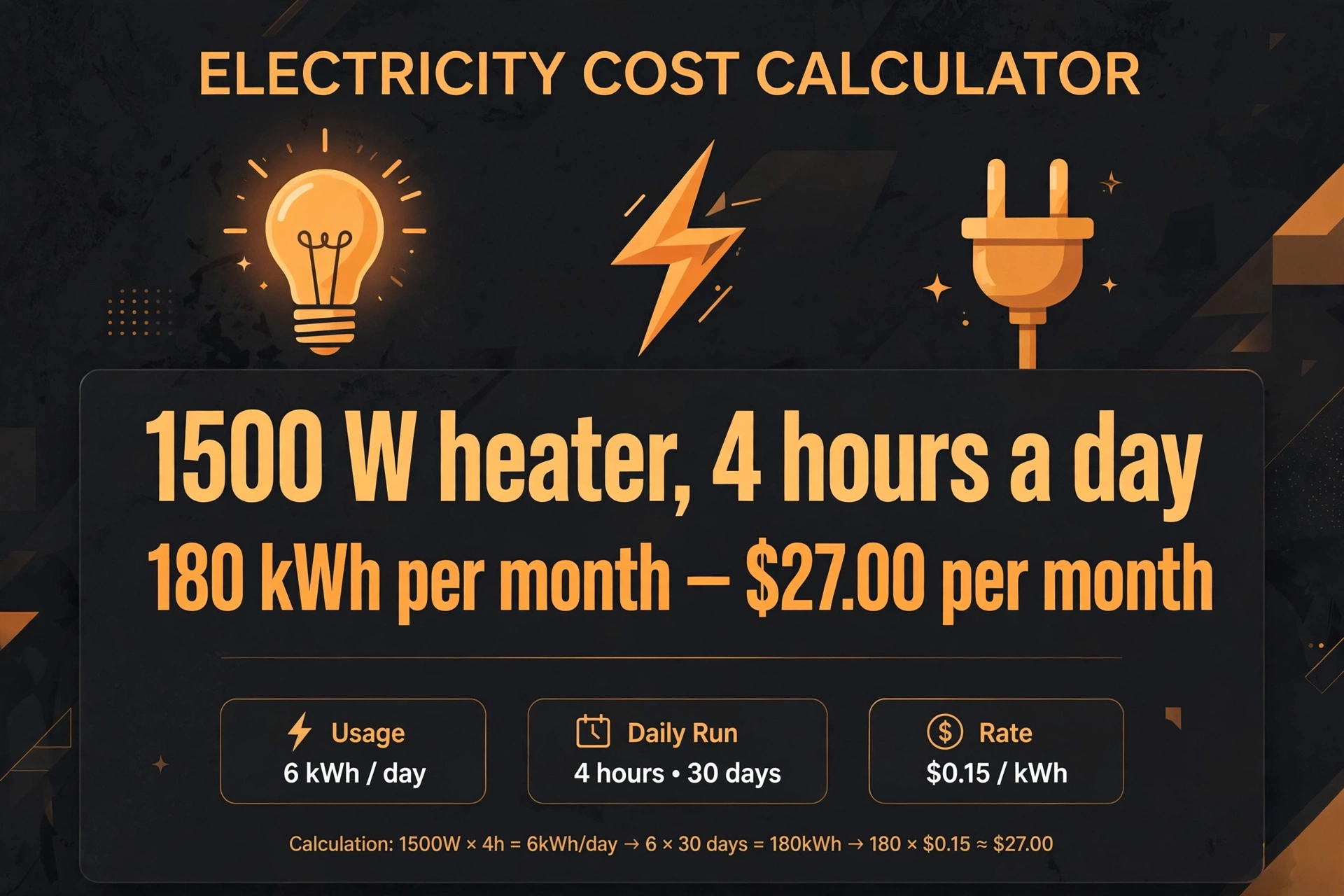
An electricity cost calculator works out what an appliance costs to run from three numbers: its power in watts, how many hours a day it runs, and the price of one kilowatt-hour (kWh) on your tariff. A 1,500 W heater running 4 hours a day at $0.15 per kWh uses 180 kWh a month and costs $27.00 a month.
How do I use the Electricity Cost Calculator?
Enter the appliance’s power in watts first. That figure is usually on a label on the appliance itself, or in its manual, or on the manufacturer’s website. If only kilowatts are given, multiply by 1,000 to get watts: 1.5 kW is 1,500 W. If the label gives a range, such as 1,200 to 1,500 W, use the figure that matches how you actually use the appliance, or the higher one for a cautious estimate.
Then enter the hours the appliance runs each day. For an appliance that runs in bursts, such as a kettle or a washing machine, estimate the total running time in hours, not the time it is switched on. A kettle that boils for three minutes ten times a day runs for 30 minutes, which is 0.5 hours. A washing machine that runs a one-hour cycle three times a week runs for about 0.43 hours a day, because 3 hours a week divided by 7 days is 0.43.
Then enter your price per kWh, which is the energy charge on your tariff. If it is shown in cents per kWh, divide by 100 to enter it in dollars: 15 cents per kWh is $0.15 per kWh. The days per month field starts at 30, which is the average month, and the calculator multiplies by 12 to get the yearly figure, so the year is 360 days rather than 365.
A worked example from the live tool
Start with the first verified test. Enter a power of 100 W, 10 hours a day, 30 days a month, and a price of $0.15 per kWh. The tool first works out the kWh per day: 100 multiplied by 10 is 1,000, and divided by 1,000 it is 1.00 kWh a day. Multiply by 30 days and the kWh per month is 30.00. The cost per day is 1.00 kWh multiplied by $0.15, which is $0.15. The cost per month is 30.00 kWh multiplied by $0.15, which is $4.50. The cost per year is $4.50 multiplied by 12, which is $54.00. The cost per hour is 100 divided by 1,000, which is 0.1 kW, multiplied by $0.15, which is $0.015 an hour.
A second test changes the power and the hours. Enter 1,500 W, 4 hours a day, 30 days a month, and $0.15 per kWh. The kWh per day is 1,500 multiplied by 4, divided by 1,000, which is 6.00. The kWh per month is 6.00 multiplied by 30, which is 180.00. The cost per day is 6.00 multiplied by $0.15, which is $0.90. The cost per month is 180.00 multiplied by $0.15, which is $27.00. The cost per year is $27.00 multiplied by 12, which is $324.00. The cost per hour is 1.5 kW multiplied by $0.15, which is $0.225 an hour.
A third test uses a small appliance at a higher rate. Enter 60 W, 8 hours a day, 30 days a month, and $0.25 per kWh. The kWh per day is 60 multiplied by 8, divided by 1,000, which is 0.48. The kWh per month is 0.48 multiplied by 30, which is 14.40. The cost per day is 0.48 multiplied by $0.25, which is $0.12. The cost per month is 14.40 multiplied by $0.25, which is $3.60. The cost per year is $3.60 multiplied by 12, which is $43.20. The cost per hour is 0.06 kW multiplied by $0.25, which is $0.015 an hour. Notice that the hourly cost matches the first test, $0.015, even though the watts and the rate differ, because 0.06 kW at $0.25 is the same as 0.1 kW at $0.15.
Section B works the other way round, from a bill rather than from an appliance. Enter a total bill of $120 and a total usage of 800 kWh. The tool divides $120 by 800 and gives an average price of $0.15 per kWh. Enter a second bill: $95 for 600 kWh. The tool divides $95 by 600 and gives $0.16 per kWh, to two decimal places. These averages include everything on the bill, so they are higher than the energy rate alone, which is why the article warns against using them as the rate in Section A.
The tool also handles missing or out-of-range figures. If any field in Section A is left blank, it shows “Enter watts, hours per day, days per month and price per kWh to see the cost.” and no results. A negative figure shows “Values cannot be negative.” Hours above 24 show “Hours per day cannot be more than 24.” Days above 31 show “Days per month cannot be more than 31.” In Section B, a blank field shows “Enter your total bill and total kWh to see the average price.”, a zero or negative kWh figure shows “kWh must be greater than zero.”, and a zero or negative bill shows “Bill amount must be greater than zero.”
What is a kilowatt-hour (kWh)?
A kilowatt-hour is the amount of energy used by a 1,000-watt appliance running for one hour. It is the unit electricity is billed in almost everywhere, and it is the unit every tariff quotes its price in. The “kilo” means 1,000, so one kWh is 1,000 watt-hours. A 100 W bulb running for 10 hours uses the same 1 kWh as a 1,000 W heater running for one hour, because 100 multiplied by 10 is 1,000 watt-hours in both cases.
The kWh is an amount of energy, not a rate. Power, measured in watts, is the rate at which energy is used at a given moment. Energy, measured in kWh, is power multiplied by time. A kettle rated at 2,000 W draws energy at that rate while it is on, and if it runs for 15 minutes it uses 2,000 multiplied by 0.25, divided by 1,000, which is 0.5 kWh. The same kettle running for an hour would use 2 kWh. The rating tells you the rate; the time tells you the amount.
Your bill shows kWh for the same reason. The meter does not measure the highest power you drew. It measures the total energy you used over the billing period, which is what the supplier charges for. A household that uses 300 kWh in a month has used 300 units of energy, whatever mix of appliances produced them. At $0.15 per kWh, the energy charge for that month is $45.00.
How is electricity cost calculated?
The calculation has three steps. First, work out the energy used in a day: multiply the watts by the hours used per day and divide by 1,000. That gives kWh per day. Second, multiply by the days in the month to get kWh per month. Third, multiply the kWh by the price per kWh to get the cost. The cost per hour is the same formula with one hour: watts divided by 1,000, multiplied by the price per kWh. The cost per year is the monthly cost multiplied by 12.
Take the second verified test as the worked calculation. The appliance is 1,500 W and it runs 4 hours a day. Multiply 1,500 by 4 and the result is 6,000. Divide by 1,000 and the result is 6.00 kWh a day. Multiply by 30 days and the result is 180.00 kWh a month. Multiply by $0.15 and the result is $27.00 a month. Multiply by 12 and the result is $324.00 a year. Every step is one multiplication or division, and the tool shows each intermediate figure so the arithmetic can be checked.
The same steps work for any appliance and any rate. A 2,000 W kettle used for 15 minutes a day at $0.15 per kWh uses 2,000 multiplied by 0.25, divided by 1,000, which is 0.5 kWh a day, 15 kWh a month, and $2.25 a month. A 10 W LED bulb used for 5 hours a day at $0.25 per kWh uses 10 multiplied by 5, divided by 1,000, which is 0.05 kWh a day, 1.50 kWh a month, and $0.38 a month, to two decimal places. The formula does not change. Only the numbers do.
What is the difference between watts and kWh?
Watts measure power, which is the rate of energy use at a moment. Kilowatt-hours measure energy, which is power used over time. The two are related by time: energy in kWh equals power in kW multiplied by hours. A 1,500 W heater is a 1.5 kW appliance. Run it for one hour and it uses 1.5 kWh. Run it for four hours and it uses 6 kWh. The wattage never changes while it runs. The kWh grows with every hour.
Confusing the two is the most common error in electricity cost. A 1,500 W heater does not cost 1,500 multiplied by the price per kWh. It costs 1.5 kW multiplied by the hours multiplied by the price per kWh. At $0.15 per kWh, one hour costs $0.225, four hours cost $0.90, and a month of four hours a day costs $27.00. For the electrical side of these units, including converting between watts, kilowatts, volts, and amps, see the electrical unit converter.
The same distinction explains why two appliances with the same wattage can cost very different amounts. A 1,500 W heater running 4 hours a day costs $27.00 a month at $0.15 per kWh. A 1,500 W air conditioner running 6 hours a day costs $40.50 a month at the same rate, because it runs for longer. The wattage is the same. The hours are not, and the hours are what the kWh counts.
Where do I find my electricity rate?
Your rate is on your bill or your tariff, listed as the energy charge, usage charge, or unit rate, quoted per kWh. It is the figure to enter in the tool. If the bill shows it in cents, divide by 100: 15 cents per kWh is $0.15 per kWh, and 25 cents per kWh is $0.25 per kWh. If the bill shows a daily or monthly fixed charge, that is a separate line. Do not add it to the rate, because the tool works out the energy cost only.
Do not use the total bill divided by the total kWh as the rate. That average includes the fixed charge, taxes, and any surcharges, so it is higher than the energy rate. A bill of $120 for 800 kWh gives an average of $0.15 per kWh, but if $20 of that bill is a fixed charge and tax, the energy rate is $100 divided by 800, which is $0.125 per kWh. Using $0.15 instead of $0.125 would overstate the cost of every appliance by 20%. Section B of the tool gives the bill average for reference, and the article warns against using it as the rate for exactly this reason.
Some tariffs charge different rates at different times of day, called time-of-use or peak and off-peak rates. This tool takes one rate. If your tariff has two rates, work out the cost for each part separately and add them together, or enter the weighted average rate if you know the split. A tariff with a peak rate of $0.25 and an off-peak rate of $0.10, used equally, averages $0.175 per kWh. The tool does not split the day, and a single-rate estimate on a time-of-use tariff is approximate.
What does it cost to run common appliances?
The table below uses the same formula the tool uses, so every cell can be checked by hand: watts multiplied by hours per day, divided by 1,000, gives kWh per day, and multiplied by 30 days and $0.15 per kWh gives the monthly cost. The watts are typical figures, not exact ratings, and the hours are typical daily use. Read across a row to see what one appliance costs. Read down the cost column to see which appliances dominate a bill.
| Appliance | Typical watts | Hours a day | kWh a day | kWh a month | Cost a month at $0.15/kWh |
|---|---|---|---|---|---|
| LED bulb | 10 | 5 | 0.05 | 1.50 | $0.22 |
| Ceiling fan | 75 | 8 | 0.60 | 18.00 | $2.70 |
| Laptop | 65 | 6 | 0.39 | 11.70 | $1.76 |
| LED TV (55 in) | 100 | 4 | 0.40 | 12.00 | $1.80 |
| Refrigerator | 150 | 8 | 1.20 | 36.00 | $5.40 |
| Washing machine | 500 | 1 | 0.50 | 15.00 | $2.25 |
| Microwave | 1,200 | 0.5 | 0.60 | 18.00 | $2.70 |
| Air conditioner | 1,500 | 6 | 9.00 | 270.00 | $40.50 |
| Electric kettle | 2,000 | 0.25 | 0.50 | 15.00 | $2.25 |
| Electric water heater | 3,000 | 2 | 6.00 | 180.00 | $27.00 |
Two patterns stand out. First, the cost follows the product of watts and hours, not the watts alone. A 2,000 W kettle used for 15 minutes a day costs $2.25 a month, while a 100 W TV used for 4 hours a day costs $1.80 a month, and a 10 W bulb used for 5 hours a day costs $0.22 a month. Second, heating and cooling dominate. An air conditioner at 1,500 W for 6 hours a day costs $40.50 a month, more than the other nine appliances in the table combined, which total $27.18. A water heater at 3,000 W for 2 hours a day costs $27.00 a month, the same as the 1,500 W heater in the worked example, because 3,000 multiplied by 2 is the same as 1,500 multiplied by 4.
Check one row by hand. Take the refrigerator: 150 W for 8 hours a day. Multiply 150 by 8 and the result is 1,200. Divide by 1,000 and the result is 1.20 kWh a day. Multiply by 30 and the result is 36.00 kWh a month. Multiply by $0.15 and the result is $5.40 a month, which matches the table. Take the washing machine: 500 W for 1 hour a day. Multiply 500 by 1 and divide by 1,000, which is 0.50 kWh a day, 15.00 kWh a month, and $2.25 a month, which matches the table.
What is standby power, and how much does it cost?
Standby power, also called vampire power or phantom load, is the small amount of electricity a device draws when it is switched off but still plugged in. Televisions, set-top boxes, game consoles, chargers, and printers all draw standby power, usually between 0.5 and 10 watts each. The amount is small for one device, but it runs 24 hours a day, every day, which is 720 hours a month. A device drawing 5 watts in standby uses 5 multiplied by 24, divided by 1,000, which is 0.12 kWh a day, and 3.60 kWh a month.
At $0.15 per kWh, that 5-watt standby load costs $0.54 a month, or $6.48 a year. A device drawing 10 watts costs $1.08 a month, or $12.96 a year. A household with ten devices averaging 5 watts each in standby spends $5.40 a month, or $64.80 a year, on electricity that does nothing. The figures are small per device, which is why standby power is easy to ignore, and they add up across a household, which is why it is worth counting.
The tool can estimate standby cost directly. Enter the standby watts, 24 hours a day, 30 days a month, and your rate. A 5 W device gives 0.12 kWh a day, 3.60 kWh a month, and $0.54 a month at $0.15 per kWh. A 10 W device gives 0.24 kWh a day, 7.20 kWh a month, and $1.08 a month. A switched-off power strip, a smart plug, or simply unplugging a device stops the draw entirely, and the saving is the figure the tool gives.
Why do fridges and air conditioners cost more than their wattage suggests?
A fridge rated at 150 W does not draw 150 W all the time. Its compressor cycles on and off as the thermostat calls for cooling, so the average draw over a day is lower than the rating, often around a third of it. The table above uses 8 hours a day for a fridge, which is a rough average of the compressor running time, not the 24 hours the fridge is plugged in. A fridge that ran its compressor for 24 hours a day would use 3.60 kWh a day and cost $16.20 a month at $0.15 per kWh, which is three times the table figure. The table figure is the realistic one, and the difference is the duty cycle.
An air conditioner has the same behaviour in the other direction. Its rating is the draw while the compressor runs, and on a hot day the compressor runs most of the time, so the average is close to the rating. The table uses 6 hours a day for an air conditioner, which is a moderate summer day. On a very hot day it may run 12 hours, which doubles the cost to $81.00 a month at $0.15 per kWh. On a mild day it may run 2 hours, which cuts the cost to $13.50 a month. The hours, not the rating, are what move the cost.
The lesson is to enter the hours the appliance actually runs, not the hours it is switched on. A fridge is switched on for 24 hours but runs for about 8. A television is switched on for 4 hours and runs for 4, because it has no duty cycle. A washing machine is switched on for the length of its cycle and runs for that long. The tool multiplies the watts by the hours you enter, so the hours are the number that carries the duty cycle.
What mistakes do people commonly make with electricity cost?
The first mistake is using the wrong rate. The rate to enter is the energy charge per kWh from the tariff, not the bill total divided by the kWh, and not a national average. A national average of $0.16 per kWh is useless if your tariff charges $0.10 or $0.25. The bill total divided by the kWh includes the fixed charge and tax, so it overstates the energy rate. Use the energy charge line from your own bill.
The second mistake is entering the rated watts for an appliance that cycles. A fridge rated at 150 W does not use 150 W for 24 hours. Enter the hours the compressor actually runs, which is about 8 hours a day for a typical fridge, not 24. Entering 24 hours would triple the estimate. The same applies to air conditioners, freezers, and any appliance with a thermostat.
The third mistake is entering the time an appliance is switched on instead of the time it runs. A kettle is switched on for the time it takes to boil, not for the hour it sits on the counter. A washing machine runs for its cycle, not for the day it is loaded. A television runs for the hours it is watched. The tool needs running hours, and switched-on hours overstate the cost.
The fourth mistake is forgetting the days per month. The tool starts at 30 days, which is the average month, but a bill covers the days in that month, which may be 28, 30, or 31. A 31-day month costs about 3% more than a 30-day month for the same daily use. The yearly figure multiplies the monthly cost by 12, which is 360 days, not 365, so it understates a full year by about 1.4%. Those are small differences, but they are the reason the tool’s yearly figure and a year’s bills do not match exactly.
The fifth mistake is comparing the tool’s figure with the bill total and concluding the tool is wrong. The tool estimates the energy charge only. A bill adds a fixed charge, taxes, and surcharges, and it may use time-of-use or tiered rates. The energy charge line on the bill is the figure to compare with the tool, not the total at the bottom. The article’s section on checking the tool against a bill explains the comparison step by step.
What are the limits of this calculator?
This calculator works from the three numbers entered and nothing else. It takes the watts, the hours per day, the days per month, and the price per kWh, and returns the kWh and the cost. It does not know whether the watts are the rated figure or the average draw, whether the hours are running hours or switched-on hours, or whether the rate is the energy charge or the bill average. A result computed from the wrong inputs is a wrong result, and the tool has no way to spot it.
The calculator assumes the rate stays the same for the whole period. It does not handle time-of-use tariffs, tiered rates, or rates that change during the month. It also assumes the appliance runs the same hours every day, which is not true for appliances used more at weekends or in one season. A heater used only in winter costs nothing in summer, but the tool’s monthly figure assumes it runs every day of every month. The yearly figure is the monthly figure multiplied by 12, which is 360 days, not 365, so it understates a full year by about 1.4%.
The calculator does not include the fixed charge, taxes, or surcharges on a bill. It estimates the energy charge only. A household that wants the full bill should add the fixed monthly charge and the tax to the tool’s figure. The tool also does not account for the duty cycle of a fridge or an air conditioner. It multiplies the watts by the hours entered, so the hours must already reflect the duty cycle, or the result will be wrong.
Finally, the watts entered are only as good as the label or the manual. A label gives the maximum draw, not the average, and an old appliance may draw more than its label says. A plug-in energy monitor, which measures the actual kWh over a week, gives a better figure than a label, and the tool’s result can be checked against it. The tool is an estimator, not a meter, and it should be used as one.
How can I check the tool against my own bill?
Take the energy charge line from your bill, not the total. Divide it by the kWh on the bill to get your energy rate per kWh, and enter that rate in the tool. Then enter the watts and hours for your largest appliances and add up their monthly costs. The total should be close to the energy charge on the bill, within the accuracy of your watt and hour estimates. If it is far off, one of the inputs is wrong: the rate, the watts, or the hours.
Check the biggest appliances first, because they dominate the total. An air conditioner, a water heater, a fridge, and a washing machine usually account for most of a household’s energy. A 10 W bulb, even left on all day, costs $1.08 a month at $0.15 per kWh, which is too small to explain a large gap. If the tool’s total is much lower than the bill’s energy charge, look for an appliance you forgot, or hours you underestimated, or a rate that is higher than the one you entered.
To turn the annual net pay figure into a monthly one, use the take home pay calculator for the gross-to-net calculation and the unit converter for any unit changes. To turn the energy figure into money, enter the kWh figure in the tool above and use the time distance speed calculator only if you also need the distance covered. For more tools in the same collection, browse the calculators category.
What information does this tool store?
This tool works from the numbers typed into it on the page. It does not ask for a name, an email address, or any account detail, and it does not send the figures anywhere. The figures stay in the browser and are never stored or shared. A reader who wants to keep a result can note it down separately. Closing the page clears the inputs.
Frequently asked questions
FAQ 1 — How do I calculate the electricity cost of an appliance?
Multiply the watts by the hours used per day and divide by 1,000 to get kWh per day, multiply by the days in the month to get kWh per month, then multiply by your rate per kWh. A 1,500 W heater running 4 hours a day for 30 days uses 180 kWh a month, which costs $27.00 a month at $0.15 per kWh.
FAQ 2 — What is a kWh?
A kilowatt-hour is the energy used by a 1,000-watt appliance running for one hour. It is the unit electricity is billed in almost everywhere. A 100 W bulb running for 10 hours also uses 1 kWh, because watts × hours ÷ 1,000 is the same in both cases.
FAQ 3 — Where do I find my electricity rate per kWh?
On your bill or tariff, listed as the energy charge or usage charge per kWh. If it is shown in cents per kWh, divide by 100 to enter it in dollars: 15 cents per kWh is $0.15 per kWh. Do not use the total bill divided by the total kWh, because that includes fixed charges and taxes.
FAQ 4 — How much does a 1,500 W heater cost to run per hour?
A 1,500 W heater is 1.5 kW, so at $0.15 per kWh it costs $0.225 an hour. Four hours a day costs $0.90 a day, and 30 days costs $27.00 a month. At a different rate, multiply 1.5 kW by that rate to get the hourly cost.
FAQ 5 — Why does my bill not match the calculator?
The calculator estimates the energy charge only. A real bill adds a fixed monthly charge, taxes, and sometimes surcharges, and it may use time-of-use or tiered rates that change the price per kWh. Check the energy charge line on the bill against the tool, not the bill total, and enter the energy rate from the bill rather than a national average.
FAQ 6 — How much does standby power cost?
A device drawing 5 watts in standby uses 0.12 kWh a day and 3.60 kWh a month, which costs $0.54 a month at $0.15 per kWh, or $6.48 a year. A device drawing 10 watts costs $1.08 a month, or $12.96 a year. The cost is small for one device but adds up across many devices left plugged in.
How do I calculate the electricity cost of an appliance?
Multiply the watts by the hours used per day and divide by 1,000 to get kWh per day, multiply by the days in the month to get kWh per month, then multiply by your rate per kWh. A 1,500 W heater running 4 hours a day for 30 days uses 180 kWh a month, which costs $27.00 a month at $0.15 per kWh.
What is a kWh?
A kilowatt-hour is the energy used by a 1,000-watt appliance running for one hour. It is the unit electricity is billed in almost everywhere. A 100 W bulb running for 10 hours also uses 1 kWh, because watts × hours ÷ 1,000 is the same in both cases.
Where do I find my electricity rate per kWh?
On your bill or tariff, listed as the energy charge or usage charge per kWh. If it is shown in cents per kWh, divide by 100 to enter it in dollars: 15 cents per kWh is $0.15 per kWh. Do not use the total bill divided by the total kWh, because that includes fixed charges and taxes.
How much does a 1,500 W heater cost to run per hour?
A 1,500 W heater is 1.5 kW, so at $0.15 per kWh it costs $0.225 an hour. Four hours a day costs $0.90 a day, and 30 days costs $27.00 a month. At a different rate, multiply 1.5 kW by that rate to get the hourly cost.
Why does my bill not match the calculator?
The calculator estimates the energy charge only. A real bill adds a fixed monthly charge, taxes, and sometimes surcharges, and it may use time-of-use or tiered rates that change the price per kWh. Check the energy charge line on the bill against the tool, not the bill total, and enter the energy rate from the bill rather than a national average.
How much does standby power cost?
A device drawing 5 watts in standby uses 0.12 kWh a day and 3.60 kWh a month, which costs $0.54 a month at $0.15 per kWh, or $6.48 a year. A device drawing 10 watts costs $1.08 a month, or $12.96 a year. The cost is small for one device but adds up across many devices left plugged in.