Roman Numeral Copy Paste
Convert a number to Roman numerals, or Roman numerals back to a number, then copy the result with one click. The tool works with whole numbers from 1 to 3999, and it only accepts Roman numerals written in standard form.
Number to Roman numeral
Roman numeral to number
Copy and paste chart: Roman numerals 1 to 20
Tap any button to copy that Roman numeral. The chart is built by the converter, so every entry is a verified conversion.
Roman numerals use seven letters: I is 1, V is 5, X is 10, L is 50, C is 100, D is 500 and M is 1000. A smaller letter before a larger one is subtracted, so IV is 4 and XC is 90. The largest standard Roman numeral is 3999, written MMMCMXCIX. There is no Roman numeral for zero.
Roman numerals are written with seven letters — I, V, X, L, C, D and M — and this tool converts any whole number from 1 to 3999 into Roman numerals, or any Roman numeral back into a number, with a copy button on every result.
How do I use the Roman Numeral Copy Paste tool?
The tool has two directions, and each one has its own box at the top of the page. To turn a number into Roman numerals, type a whole number from 1 to 3999 in the first box and press “Convert to Roman numeral”. Two labelled boxes appear: the Roman numeral itself, and a breakdown that shows how it was built from its parts. Press “Copy Roman numeral” to put the result on your clipboard, and the tool confirms what it copied.
To turn Roman numerals back into a number, type the letters in the second box and press “Convert to number”. The tool accepts lower case as well as capitals, and it ignores spaces, so “xcvii” and “XCVII” both give 97. Press “Copy number” to copy the result.
Below the two converters sits a chart of the Roman numerals from 1 to 20. Tap any button on the chart to copy that numeral. The chart is built by the converter itself, so every button on it shows a conversion the tool has already verified, and the same figures appear in the quick-reference table at the end of this article.
If an input is wrong, the tool shows a plain-language error and no result. A blank number box, a decimal such as 12.5, a zero, a negative number, or a number above 3999 are all rejected with an explanation of what is wrong. A Roman numeral that is not written in standard form — IIII, VV, IC, or a string with letters that are not Roman numerals, such as HELLO — is rejected with the rules it broke. The edge cases are listed with their exact messages in the 'How can I check the tool against a known number?' section below.
What does a worked example look like?
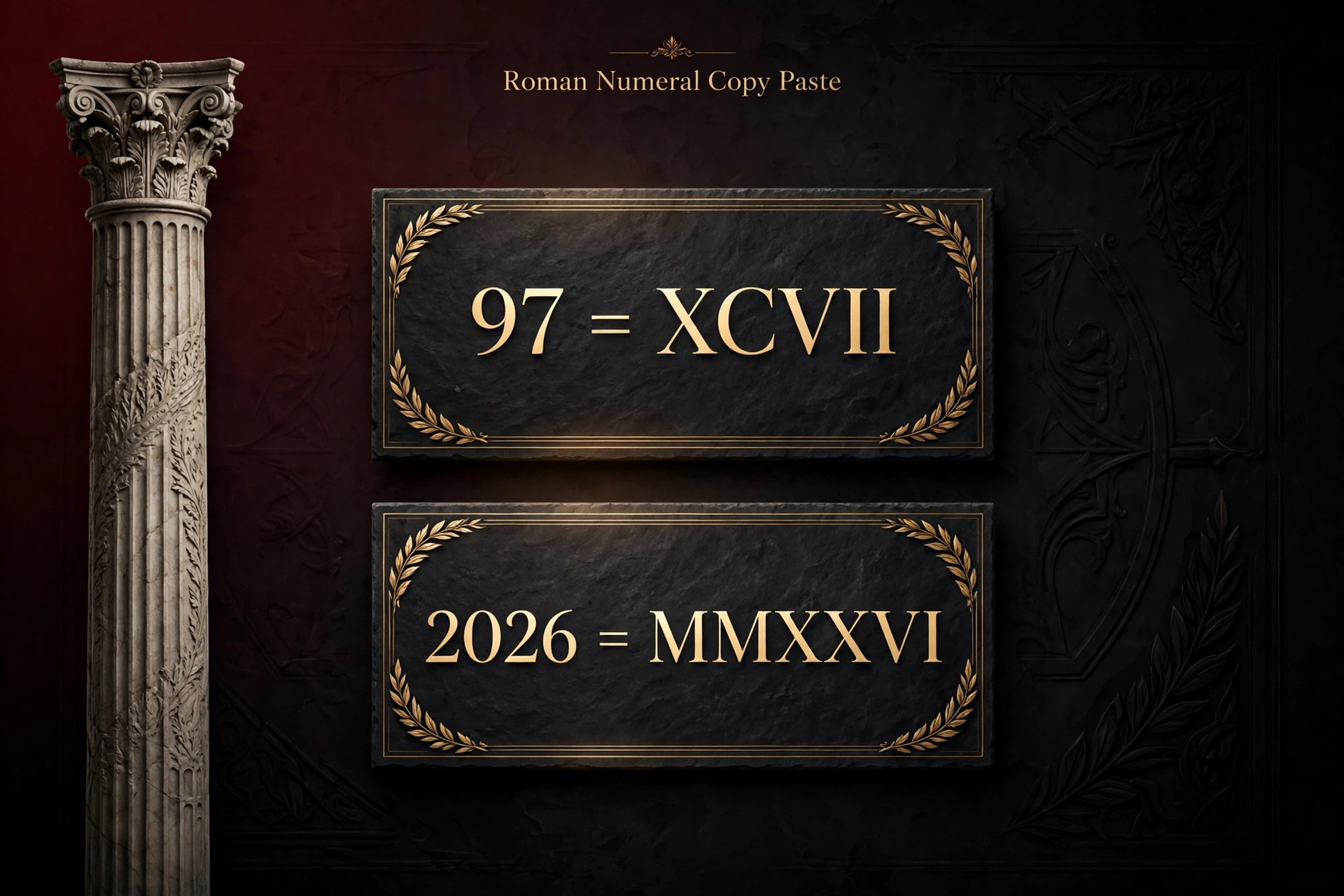
Start with the number most people search for. 97 in Roman numerals is XCVII. The breakdown the tool shows is 97 = 90 = XC + 7 = VII = XCVII. The 90 becomes XC, because 90 is 100 minus 10, and the 7 becomes VII, because 7 is 5 plus 1 plus 1. Put the two parts together and you get XCVII, which reads as 100 − 10 + 5 + 1 + 1 = 97.
A second test uses the current year. 2026 in Roman numerals is MMXXVI. The breakdown is 2026 = 2000 = MM + 20 = XX + 6 = VI = MMXXVI. The 2000 becomes MM, the 20 becomes XX, and the 6 becomes VI. Each part is translated on its own, then the parts are joined from largest to smallest.
A third test runs the other way. XCVII back into a number is 97. Read the letters left to right: X is 10 and the next letter is C, which is 100, so the X is subtracted, giving −10; C is 100 and the next letter is V, which is 5, so the C is added, giving 90; V is 5 and the next letter is I, which is 1, so the V is added, giving 95; then I is 1 and I is 1, giving 97. The tool does that reading for you, and it refuses the input if the letters do not form a numeral in standard form.
A fourth test uses the largest number the tool accepts. 3999 in Roman numerals is MMMCMXCIX. The breakdown is 3999 = 3000 = MMM + 900 = CM + 90 = XC + 9 = IX = MMMCMXCIX. Every part of it uses subtractive notation except the 3000, which is three Ms in a row — the most Ms that standard form allows.
A fifth test uses a year from history. 1776 in Roman numerals is MDCCLXXVI. The breakdown is 1776 = 1000 = M + 700 = DCC + 70 = LXX + 6 = VI = MDCCLXXVI. The 700 is DCC, which is 500 plus 100 plus 100, and the 70 is LXX, which is 50 plus 10 plus 10. This is the year written on the tablet in the Statue of Liberty's arm, and it is a good check of the tool because it uses five of the seven symbols.
What are the seven Roman numeral symbols?
The whole system is built from seven letters, each with a fixed value. I is 1, V is 5, X is 10, L is 50, C is 100, D is 500 and M is 1000. The letters were chosen from the Latin alphabet, and their values follow a simple pattern: every other symbol is five times the one before it, and the symbols in between are ten times the one two places before. I is 1, V is 5, X is 10, L is 50, C is 100, D is 500 and M is 1000.
Three of the letters are worth a note of their own. V, L and D are the “five” symbols — 5, 50 and 500 — and they are never repeated. Two Vs would make an X, two Ls would make a C, and two Ds would make an M, so the system never writes VV, LL or DD. The other four letters — I, X, C and M — may repeat, but never more than three times in a row. Three Is make 3, but 4 is not IIII. Three Xs make 30, but 40 is not XXXX. Three Cs make 300, but 400 is not CCCC. Three Ms make 3000, and that is the most Ms the system allows, which is part of why the largest standard number is 3999.
The values are also the reason the system has no place value. In the numbers we use every day, a 2 means two hundred in 200 and two in 2, because its position decides its value. In Roman numerals, a letter always means the same amount wherever it stands: X is always 10, C is always 100, and M is always 1000. The number is built by adding the letters up, with subtraction in six special cases, and the next section sets out the rules that decide when to add and when to subtract.
How do Roman numerals work?
The rules fit in three short statements. First, add the letters when they run from largest to smallest. VI is 5 + 1 = 6. XXI is 10 + 10 + 1 = 21. MDC is 1000 + 500 + 100 = 1600. Most numerals are written this way, with the biggest letter first and each later letter the same size or smaller.
Second, subtract when a smaller letter comes directly before a larger one. IV is 5 − 1 = 4. IX is 10 − 1 = 9. XL is 50 − 10 = 40. XC is 100 − 10 = 90. CD is 500 − 100 = 400. CM is 1000 − 100 = 900. Only these six pairs are allowed. That restriction is the heart of the system: 99 is XCIX, not IC, and 49 is XLIX, not IL. The smaller letter in a subtractive pair is always the one just below the larger letter in the sequence of powers of ten — I before V and X, X before L and C, C before D and M — and it is always subtracted once, never twice. That is why 8 is VIII, not IIX, and why 800 is DCCC, not CCM.
Third, repeat I, X, C and M at most three times in a row, and never repeat V, L or D. This rule and the subtraction rule work together: 4 is IV rather than IIII because four Is in a row are not allowed, and 9 is IX rather than VIIII for the same reason. The two rules together give every number from 1 to 3999 exactly one correct spelling, which is what makes a converter possible at all — and what lets this tool reject a misspelling instead of guessing at it.
One habit survives outside the rules. Clock faces often show IIII for 4 instead of IV, and that is a deliberate choice by clock makers, not a mistake and not a second spelling. The usual explanation is that IIII balances the VIII on the other side of the dial and keeps the face symmetrical, and the habit is centuries old. It is the one place where IIII is correct, and it is the only exception this article covers. Everywhere else, 4 is IV, and this tool rejects IIII.
How do I convert a number to Roman numerals by hand?
Split the number into thousands, hundreds, tens and ones, translate each part on its own, and join the parts from largest to smallest. That is the method the tool uses, and it is the method the breakdown box shows.
Take 2026. Split it into 2000, 20 and 6. The thousands part is 2000, which is MM. The tens part is 20, which is XX. The ones part is 6, which is VI. There is no hundreds part. Join them in order: MM + XX + VI = MMXXVI.
Take 97. Split it into 90 and 7. The tens part is 90, which is XC, because 90 is 100 minus 10. The ones part is 7, which is VII, because 7 is 5 plus 1 plus 1. Join them: XC + VII = XCVII.
Take 1999, a year that uses subtraction three times over. Split it into 1000, 900, 90 and 9. The thousands part is 1000, which is M. The hundreds part is 900, which is CM, because 900 is 1000 minus 100. The tens part is 90, which is XC. The ones part is 9, which is IX. Join them: M + CM + XC + IX = MCMXCIX.
Take 44, which trips people up because both of its parts use subtraction. Split it into 40 and 4. The tens part is 40, which is XL, because 40 is 50 minus 10. The ones part is 4, which is IV, because 4 is 5 minus 1. Join them: XL + IV = XLIV. The wrong answer, IL, is not a subtractive pair, and the tool rejects it.
A useful check while you work: count the letters. A correct numeral from 1 to 3999 is never longer than 15 letters, and the longest ones are 3888, written MMMDCCCLXXXVIII, which is 15 letters. If your answer runs much longer than that, you have probably written a number by adding ones instead of using subtraction.
How do I convert Roman numerals back to numbers?
Read the letters from left to right. Add a letter to the total when the letter after it is the same size or smaller, and subtract it when the letter after it is larger. The last letter is always added, because there is nothing after it.
Take MCMXCIV, which is 1994. M is 1000 and the next letter is C, which is 100, so add the M: 1000. C is 100 and the next letter is M, which is 1000, so subtract the C: 900. M is 1000 and the next letter is X, which is 10, so add the M: 1900. X is 10 and the next letter is C, which is 100, so subtract the X: 1890. C is 100 and the next letter is I, which is 1, so add the C: 1990. I is 1 and the next letter is V, which is 5, so subtract the I: 1989. V is 5 and there is nothing after it, so add the V: 1994.
Take XLIV, which is 44. X is 10 and the next letter is L, which is 50, so subtract the X: −10. L is 50 and the next letter is I, which is 1, so add the L: 40. I is 1 and the next letter is V, which is 5, so subtract the I: 39. V is 5 and there is nothing after it, so add the V: 44.
The same reading is how the tool checks your input. Before it adds anything up, it tests the whole string against the pattern of standard form: at most three Ms, then one hundreds part, one tens part and one ones part, each written with the allowed letters. A string that does not fit that pattern is rejected, and the error names the rules it broke. That is why IIII, VV, IC, IL, VX and MMMM are all refused, and why a string with letters outside the seven symbols, such as HELLO, is refused too. The tool would rather say no than hand back a number for a numeral that is not written correctly.
Why is there no zero in Roman numerals?
The Romans had no symbol for zero, and no need for one. Their system was built for counting and recording amounts, not for written arithmetic, and a system that adds letters together has no place where a zero belongs. A Roman merchant counting goods would simply write nothing where we would write 0, and a Roman scribe recording a year would never need to write a year zero, because the Roman calendar counted years from the founding of Rome and never passed through zero.
The absence of zero is also why there are no negative numbers and no fractions in the system. The smallest Roman numeral is I, which is 1, and the tool refuses 0 and every negative number for exactly that reason. The error it shows says so in plain words: Roman numerals start at 1, and there is no Roman numeral for 0 or for negative numbers.
Zero arrived in Europe centuries later, with the Hindu-Arabic digits we use today, and it changed arithmetic because it made place value possible. A 0 in 101 holds the tens place empty, and without it the 1s on either side would run together. Roman numerals never needed that trick, because each letter carries its own value and its position only decides whether it is added or subtracted. The trade-off is that Roman numerals are poor for arithmetic: adding MMXXVI and XCVII on paper means regrouping letters by hand, while adding 2026 and 97 takes a moment. That is why the system survives as labels and dates rather than as a way of working sums out.
What is the largest Roman numeral I can write?
The largest number in standard Roman numerals is 3999, written MMMCMXCIX. The limit comes from two rules working together. M is the largest symbol, at 1000, and it may repeat at most three times, so the thousands part stops at 3000. The hundreds part stops at 900, written CM, the tens part stops at 90, written XC, and the ones part stops at 9, written IX. Add them together — 3000 + 900 + 90 + 9 — and you get 3999, written MMMCMXCIX.
For numbers above 3999, the Romans used a bar drawn over a letter, called a vinculum, which multiplied the letter by 1000. A V with a bar over it meant 5000, and an X with a bar over it meant 10000. This tool does not use that notation, and it refuses any number above 3999 with an explanation. The reasons are practical: almost no font renders the overline, almost no keyboard can type it, and a pasted result with a combining overline often breaks when it is copied into another app. A converter that produced it would hand back text most people could not use, so the tool stops at the largest number the plain letters can write.
The same limit applies to the year. There is no standard Roman numeral for the year 4000, and dates after 3999 are written in Arabic numbers even in the most formal settings. The year 2026 sits comfortably inside the range, and so does every year anyone is likely to want for a birthday, a wedding date, an anniversary, or a tattoo: 1994 is MCMXCIV, 2000 is MM, and 1776 is MDCCLXXVI.
What is the difference between Roman numerals and Greek numerals?
Greek numerals are a different system that solves the same problem in a different way. The classical Greek system, called the Milesian system, gave a value to each letter of the Greek alphabet: alpha is 1 through theta is 9, iota is 10 through pi is 80, and rho is 100 through omega is 800, with three archaic letters kept to fill the gaps — stigma is 6, koppa is 90 and sampi is 900. A Greek number is a short string of letters added together, with no subtraction and no repetition rule.
The same number looks very different in the two systems. 97 in Roman numerals is XCVII, built from 90 and 7 with a subtraction inside the 90. 97 in Greek numerals is Ϟζʹ, built from koppa for 90 and zeta for 7, added together with no subtraction at all. The small mark after the zeta is the Greek numeral sign, which marks the letters as a number rather than a word.
The two systems also differ in range. Greek numerals cover 1 to 999 with single letters, and thousands are marked by a stroke before the letter, so the system reaches further than the Roman 3999 without needing an overline. But the Greek system needs 27 symbols against the Roman seven, and three of them — stigma, koppa and sampi — fell out of the alphabet and survive only as numbers. This tool converts Roman numerals only. If you need a Greek numeral, the Milesian values above are the ones to use, and a Greek numeral converter is a different tool from this one.
Where are Roman numerals used today?
Roman numerals survive where a label needs to look formal, traditional or timeless, and they show up in more places than most people notice. Clock faces use them, often with IIII for 4. Book chapters and preface pages use them: front matter is numbered in lower case — i, ii, iii, iv — and chapters in capitals. Monarchs and popes carry them as part of their names: Elizabeth II, Henry VIII, Pope John Paul II. The Super Bowl is numbered with them, which is why the 2026 game is Super Bowl LX. Films once put the copyright year in Roman numerals at the end of the credits, and some still do. Outlines use them for the top level, with capital letters and Arabic numbers for the levels below. Legal documents number clauses with them, and the Olympic Games were numbered with them until recently.
Dates are the most personal use. A birthday, a wedding date or an anniversary written in Roman numerals turns an ordinary date into something made to last, and that is where most copy-and-paste searches come from. A birth date of 25 December 2024 becomes XII·XXV·MMXXIV, with each part converted on its own and joined with a dot, a slash or a space. To work out the date itself, including the weekday it fell on, the date calculator counts days between dates and finds weekdays, and to work out an exact age in years, months and days, the age calculator takes a date of birth and gives the age as of any date. The Roman numeral tool then turns the year, the month and the day into the letters for the engraving, the invitation or the tattoo stencil.
One caution belongs with dates and tattoos. A Roman numeral is permanent once it is inked or carved, and a wrong letter is a wrong year. Check the conversion with the tool, then read the result back the other way: paste the Roman numeral into the second box and confirm it gives back the number you started with. The same check catches a mistyped letter in a chapter heading, an outline or a document before anyone else sees it.
How do I copy and paste Roman numerals on any device?
The simplest way is the tool on this page. Convert the number, press the copy button, and paste with Ctrl+V on Windows or Cmd+V on a Mac, or with a long press and Paste on a phone. The chart of 1 to 20 works the same way: tap a button and the numeral is on your clipboard.
There is a second way, and it matters because the two ways produce different characters. The tool writes Roman numerals with ordinary capital letters — I, V, X, L, C, D and M — which every keyboard, font and search box handles. Unicode also has dedicated single-character Roman numerals in the Number Forms block: Ⅰ is U+2160, Ⅱ is U+2161, Ⅲ is U+2162, Ⅳ is U+2163, Ⅴ is U+2164, Ⅵ is U+2165, Ⅶ is U+2166, Ⅷ is U+2167, Ⅸ is U+2168, Ⅹ is U+2169, Ⅺ is U+216A and Ⅻ is U+216B, with Ⅼ, Ⅽ, Ⅾ and Ⅿ for 50, 100, 500 and 1000, and a matching lower-case set from ⅰ (U+2170) to ⅿ (U+217F). On Windows, hold Alt and type the code on the number pad: Alt + 8544 gives Ⅰ, Alt + 8545 gives Ⅱ, and the codes run up to Alt + 8559 for Ⅿ.
For ordinary writing, plain letters are the better choice. A numeral written as XCVII can be searched, read aloud by a screen reader, and copied into any app without a second thought, while a single-character Ⅻ can fail in an old font, a search box or a form that does not expect it. Use the Unicode characters only when you need one number to stay together as a single glyph, for example on a clock face, in a username, or in a heading where the shape matters. The copy-paste pages at the top of the search results offer those characters, and the table in the next section of this article lists them alongside the plain-letter forms so you can see both.
What mistakes do people commonly make with Roman numerals?
The first mistake is writing IIII for 4. Four Is in a row break the repetition rule, and 4 is IV. The same mistake appears at 9, written VIIII instead of IX, at 40, written XXXX instead of XL, and at 900, written DCCCC instead of CM. The fix is always the same: when a symbol would repeat a fourth time, use the subtractive pair instead.
The second mistake is inventing a subtractive pair that does not exist. IC for 99 and IL for 49 look tidy, and they are both wrong: the only allowed pairs are IV, IX, XL, XC, CD and CM. 99 is XCIX, which is 90 plus 9, and 49 is XLIX, which is 40 plus 9. The tool rejects IC and IL outright, and the error names the six pairs that are allowed.
The third mistake is repeating V, L or D. VV is not 10, LL is not 100, and DD is not 1000. Two of a “five” symbol make the next symbol up, so VV is X, LL is C and DD is M, and the numeral is written with that symbol instead. The tool rejects VV, LL and DD for the same reason it rejects IIII.
The fourth mistake is reading a numeral backwards. XC is 90, not 110, because the X comes before the C and is subtracted. CX is 110, because the C comes first and is added. The order of the letters is the whole meaning: the same two letters give a different number depending on which one comes first, and reading left to right with the subtraction rule is the only way to get it right.
The fifth mistake is assuming there is a zero, or a numeral for a year like 0 or 4000. There is no zero, and the system stops at 3999. A date that needs a zero, or a number above 3999, has to be written in Arabic numbers, and this tool says so rather than inventing a spelling.
The sixth mistake is copying a Unicode single-character numeral where plain letters belong. A Ⅻ pasted into a search box, a spreadsheet or a form may not match a search for XII, and a screen reader may read it as an unfamiliar symbol instead of the number twelve. Plain letters are the safe default, and the Unicode characters are for display only.
What are the limits of this tool?
This tool covers whole numbers from 1 to 3999 and Roman numerals written in standard form, and nothing outside that range. It does not use the vinculum, the overline notation for numbers above 3999, so it refuses any number above 3999 and any numeral that needs it. It does not convert dates: a date such as 25 December 2024 has to be split into its day, month and year first, and each part converted on its own. It does not convert Greek numerals, which use a different set of letters and values, and it does not turn words into numerals letter by letter — a name has no numeric value in this system, and letters such as J, K, G, R or Z are not Roman numerals.
It only accepts standard form. A numeral written the way a clock face writes 4 — IIII — is rejected, because IIII is not standard form outside a clock dial. A numeral written with lower-case letters is accepted, because lower case means the same as capitals, and spaces inside a numeral are ignored, so “XCVII” and “xcvii” both give 97. The tool runs entirely in your browser: nothing you type is uploaded, stored or shared, and closing the page removes it.
The copy button needs clipboard access, which browsers allow on secure pages and when the page is interacted with. If clipboard access is unavailable, the tool says so in plain words and tells you to select the result and press Ctrl+C, or Cmd+C on a Mac. The result itself stays on the page either way, so nothing is lost.
How can I check the tool against a known number?
The simplest check uses the first verified test. Enter 97 in the first box and press “Convert to Roman numeral”. The tool should show the Roman numeral XCVII and the breakdown “97 = 90 = XC + 7 = VII = XCVII”. Press “Copy Roman numeral” and the message should read “Copied: XCVII”.
A second check uses the current year. Enter 2026 and the tool should show MMXXVI with the breakdown “2026 = 2000 = MM + 20 = XX + 6 = VI = MMXXVI”. A third check runs the other way: enter XCVII in the second box and the tool should show 97. A fourth check uses the limit: enter 3999 and the tool should show MMMCMXCIX with the breakdown “3999 = 3000 = MMM + 900 = CM + 90 = XC + 9 = IX = MMMCMXCIX”.
A fifth check tests the errors. Enter 0 and the tool should show the error “Roman numerals start at 1. There is no Roman numeral for 0 or for negative numbers.” with no result. Enter 4000 and the tool should show the error “The largest standard Roman numeral is 3999 (MMMCMXCIX). This tool does not use the overline notation for larger numbers.” with no result. Leave the number box blank and the tool should show the error “Please enter a whole number from 1 to 3999.” with no result. Enter IIII in the second box and the tool should show an error saying it is not a valid Roman numeral in standard form, with no result, and VV should give the same error. Every one of these figures and messages was checked against the tool before this page was written.
The rules in this article follow the standard account of the system given by the converter guides this article draws on, including calculatodo’s Roman numeral converter guide, which gives the thirteen-value table, the 2026 breakdown and the Excel ROMAN and ARABIC functions, and codingmarble’s Roman numerals converter guide, which sets out the five rules of standard form and the date and tattoo uses. The Greek numeral values follow the Milesian system as set out in the Greek isopsephy letter-values chart, which lists koppa at 90 and zeta at 7. More tools in the same collection are in the converters category. To see what share of a number a part represents, see the percentage calculator.
How many Roman numerals are there from 1 to 100?
Every figure in this table was computed with the same conversion the tool uses, and every cell was recomputed with Node. The first table gives 1 to 20, matching the copy-and-paste chart on the tool. The second gives the tens from 10 to 100 and the hundreds from 100 to 1000. The third gives the years people look up most often.
| Number | Roman numeral | Number | Roman numeral |
|---|---|---|---|
| 1 | I | 11 | XI |
| 2 | II | 12 | XII |
| 3 | III | 13 | XIII |
| 4 | IV | 14 | XIV |
| 5 | V | 15 | XV |
| 6 | VI | 16 | XVI |
| 7 | VII | 17 | XVII |
| 8 | VIII | 18 | XVIII |
| 9 | IX | 19 | XIX |
| 10 | X | 20 | XX |
| Number | Roman numeral | Number | Roman numeral |
|---|---|---|---|
| 10 | X | 100 | C |
| 20 | XX | 200 | CC |
| 30 | XXX | 300 | CCC |
| 40 | XL | 400 | CD |
| 50 | L | 500 | D |
| 60 | LX | 600 | DC |
| 70 | LXX | 700 | DCC |
| 80 | LXXX | 800 | DCCC |
| 90 | XC | 900 | CM |
| 100 | C | 1000 | M |
| Year | Roman numeral |
|---|---|
| 1776 | MDCCLXXVI |
| 1900 | MCM |
| 1994 | MCMXCIV |
| 1999 | MCMXCIX |
| 2024 | MMXXIV |
| 2025 | MMXXV |
| 2026 | MMXXVI |
Two patterns in the tables are worth reading. First, the numbers that use subtraction — 4, 9, 40, 90, 400 and 900 — are the ones that break the adding-up pattern, and each of them is one less than a round number: IV is one less than V, IX is one less than X, XL is ten less than L, XC is ten less than C, CD is a hundred less than D, and CM is a hundred less than M. Second, the hundreds table repeats the tens table exactly, with C, D and M standing where X, L and C stood: 40 is XL and 400 is CD, 90 is XC and 900 is CM, 70 is LXX and 700 is DCC. Once you can write the tens, you can write the hundreds by moving one place up the ladder of symbols. For a number that is not in the tables, the tool at the top of the page gives the answer and its breakdown, and the method in the “How do I convert a number to Roman numerals by hand?” section shows how to work it out without the tool.
Frequently asked questions
How do I copy and paste Roman numerals?
Convert the number with the tool on this page, press the copy button, and paste with Ctrl+V on Windows or Cmd+V on a Mac, or with a long press and Paste on a phone. The chart of 1 to 20 works the same way: tap any button to copy that numeral. The tool writes Roman numerals with ordinary capital letters, which work in every app, font and search box.
What is 97 in Roman numerals?
97 in Roman numerals is XCVII. The breakdown is 97 = 90 = XC + 7 = VII = XCVII: the 90 is XC, because 90 is 100 minus 10, and the 7 is VII, because 7 is 5 plus 1 plus 1. Enter 97 in the tool to see the same breakdown, or enter XCVII in the second box to check it back to 97.
How do I convert Roman numerals to numbers?
Read the letters left to right. Add a letter when the letter after it is the same size or smaller, and subtract it when the letter after it is larger. XCVII reads as −10 + 100 + 5 + 1 + 1 = 97, and MCMXCIV reads as 1000 − 100 + 1000 − 10 + 100 − 1 + 5 = 1994. The second box on this tool does the reading for you and refuses numerals that are not in standard form.
Why is there no zero in Roman numerals?
The Romans had no symbol for zero, and their system had no place for one. It was built for counting and recording amounts by adding letters together, not for written arithmetic, and a system that adds letters has no place where a zero belongs. Zero arrived in Europe centuries later with the Hindu-Arabic digits, and it made place value possible. The smallest Roman numeral is I, which is 1, and this tool refuses 0 and negative numbers.
What is the largest number in Roman numerals?
The largest number in standard Roman numerals is 3999, written MMMCMXCIX. The limit comes from the rules: M is the largest symbol and it may repeat at most three times, so the thousands part stops at 3000, and the hundreds, tens and ones parts stop at 900 (CM), 90 (XC) and 9 (IX). Larger numbers need a bar over a letter, called a vinculum, which this tool does not use.
Can I type Roman numerals with my normal keyboard?
Yes. Roman numerals are ordinary capital letters — I, V, X, L, C, D and M — so any keyboard can type them. Unicode also has dedicated single-character numerals, such as Ⅰ (U+2160, Alt + 8544) through Ⅻ (U+216B), but plain letters are the better choice for ordinary writing, because they can be searched and read aloud, and they work in every app. Use the Unicode characters only when you need one number to stay together as a single glyph, for example on a clock face or in a username.