CD Interest Calculator
Work out the interest on a certificate of deposit (CD) in seconds. Enter your deposit, rate, term and compounding to see the maturity value, the APY, the early-withdrawal penalty and what you would get if you withdrew early.
Interest is worked out with compound interest, and the APY counts compounding. The penalty is simple interest: the deposit times the annual rate times the penalty months divided by 12.
A certificate of deposit (CD) is a bank deposit that pays a fixed rate of interest for a fixed term, and the interest it earns depends on the deposit, the rate, the term, and how often interest compounds. This calculator works out the maturity value, the total interest, the APY, and the cost of cashing in early from those five inputs.
How do I use the CD Interest Calculator?
Enter your deposit amount in the first box. That is the lump sum you put into the CD when you open it, such as $10,000. A CD takes a single deposit, so there is no box for monthly additions: if you plan to save a little each month, a savings account fits that pattern better, and a CD fits money you can leave alone for the whole term.
Enter the annual interest rate in the second box. Enter the nominal rate from your CD terms, not the APY. The nominal rate is the rate the bank uses to work out each interest payment, and the tool turns it into an APY for you. If your bank quotes only an APY, enter that figure as the rate and choose “Annually” for compounding: with annual compounding the APY equals the rate, so the result is exact, and compounding an APY a second time would overstate the return.
Enter the term in months in the third box. CDs are sold by the month — 3, 6, 9, 12, 18 or 24 months are the terms most often offered — so the tool takes months rather than years. A 9-month CD is entered as 9, and a 2-year CD is entered as 24.
Choose the compounding frequency in the fourth box. Monthly is the most common choice for CDs, and it is already selected. Quarterly and annually are the other frequencies banks commonly use. “At maturity” is for CDs that pay interest only once, when the term ends, with no compounding along the way.
Enter the early-withdrawal penalty in the fifth box, in months of interest. It is already filled in as 3, which is the most common penalty for a CD of a year or less. If your CD has no penalty, enter 0. Your CD terms state the penalty, usually as a number of days or months of interest, and the penalty section below explains the usual ranges.
Press the calculate button and five labelled boxes appear. The first box is the maturity value: your deposit plus all the interest earned by the end of the term. The second box is the total interest earned, which is the maturity value minus the deposit. The third box is the APY, the effective annual return once compounding is counted, and it assumes the interest stays in the CD for the full term. The fourth box is the early-withdrawal penalty in dollars. The fifth box is the value if withdrawn early, which is the maturity value minus the penalty. Under the boxes, a note repeats the compounding frequency and the APY assumption, and a warning appears when the penalty is larger than the interest earned.
If an input is wrong, the tool shows a plain-language error and no results. A deposit of 0 is rejected because a CD needs money in it. A rate below 0 is rejected because a rate cannot be negative, while a rate of 0 is allowed and gives a maturity value equal to the deposit. A term of 0 months is rejected because the term must be at least 1 month, and a term above 120 months is rejected because the tool covers terms up to 10 years. A penalty below 0 is rejected, and a penalty above 24 months of interest is rejected as outside the range banks use.
What does a worked example look like?
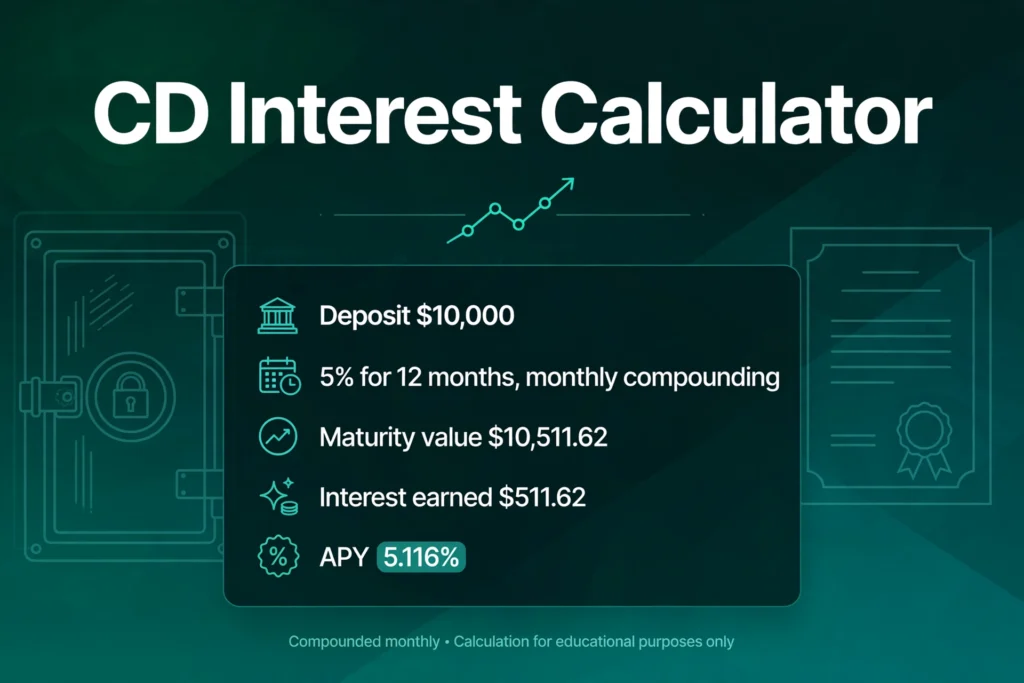
Start with the first verified test. A deposit of $10,000 at 5% for 12 months, compounded monthly, with a 3-month penalty. The compound interest formula is A = P(1 + r/n)^(nt), where P is $10,000, r is 0.05, n is 12 and t is 1 year. Work out the factor first: 1 + 0.05 ÷ 12 = 1.0041667, and 1.0041667 raised to the 12th power is 1.0511619. Multiply by the deposit: $10,000 × 1.0511619 = $10,511.62 at maturity. The interest earned is $10,511.62 − $10,000 = $511.62. The APY is (1 + 0.05 ÷ 12)^12 − 1 = 5.116%. The penalty is 3 months of simple interest on the deposit: $10,000 × 0.05 ÷ 12 × 3 = $125.00. The value if withdrawn early is $10,511.62 − $125.00 = $10,386.62.
A second test uses the 9-month CD that many savers ask about. A deposit of $5,000 at 4.50% for 9 months, compounded monthly, with a 3-month penalty. The factor is 1 + 0.045 ÷ 12 = 1.00375, raised to the 9th power (12 × 0.75 years) is 1.0342607. Multiply by the deposit: $5,000 × 1.0342607 = $5,171.30 at maturity. The interest earned is $5,171.30 − $5,000 = $171.30. The APY is (1 + 0.045 ÷ 12)^12 − 1 = 4.594%. The penalty is $5,000 × 0.045 ÷ 12 × 3 = $56.25. The value if withdrawn early is $5,171.30 − $56.25 = $5,115.05. The same 9-month CD compounded quarterly instead of monthly would reach $5,170.66, earning $170.66 — $0.64 less — which shows how small the frequency effect is over a short term.
A third test uses a larger deposit and a longer term. A deposit of $25,000 at 5.25% for 24 months, compounded quarterly, with a 3-month penalty. The factor is 1 + 0.0525 ÷ 4 = 1.013125, raised to the 8th power (4 × 2 years) is 1.1099522. Multiply by the deposit: $25,000 × 1.1099522 = $27,748.80 at maturity. The interest earned is $27,748.80 − $25,000 = $2,748.80. The APY is (1 + 0.0525 ÷ 4)^4 − 1 = 5.354%. The penalty is $25,000 × 0.0525 ÷ 12 × 3 = $328.125, shown as $328.12 after rounding to cents. The value if withdrawn early is $27,748.80 − $328.12 = $27,420.68.
A fourth test shows the at-maturity choice. A deposit of $10,000 at 4% for 6 months, with interest paid only at maturity and a 3-month penalty. There is no compounding, so the simple interest formula applies: $10,000 × (1 + 0.04 × 0.5) = $10,200.00 at maturity. The interest earned is $200.00. The APY equals the nominal rate, 4.000%, because no interest-on-interest lifts it. The penalty is $10,000 × 0.04 ÷ 12 × 3 = $100.00, and the value if withdrawn early is $10,200.00 − $100.00 = $10,100.00.
A fifth test shows what happens when the penalty is larger than the interest earned. A deposit of $10,000 at 5% for 3 months, compounded monthly, with a 6-month penalty. The factor is 1.0041667 raised to the 3rd power, which is 1.012552, so the maturity value is $10,125.52 and the interest earned is $125.52. The penalty is $10,000 × 0.05 ÷ 12 × 6 = $250.00, which is nearly double the interest. The value if withdrawn early is $10,125.52 − $250.00 = $9,875.52, which is $124.48 below the $10,000 deposit. The tool shows a warning in this case, because the penalty has eaten into the deposit itself. That is the real cost of breaking a short CD early, and it is why the penalty box matters as much as the maturity value.
What is a certificate of deposit?
A certificate of deposit is a deposit account where you give a bank your money for a fixed term, and the bank pays you a fixed rate of interest in return. The term is agreed when you open the account — 3 months, 6 months, 9 months, 1 year, 2 years or 5 years are the terms most often offered — and the rate is locked for that whole term. When the term ends, the CD matures, and you get your deposit back plus the interest it earned. You can then take the money, or roll it into a new CD.
The fixed rate is the point of the product. A savings account rate can move up or down while your money sits in it, but a CD rate does not move once the account is open. If rates fall after you open a 2-year CD at 5%, you keep earning 5% for the full two years. If rates rise instead, you keep earning 5% while new CDs pay more, which is the trade-off you accept when you lock the money away.
The other side of that trade is access. Money in a CD is not meant to be touched before maturity. You can usually take it out early, but the bank charges an early-withdrawal penalty, which is a number of months or days of interest taken from what you receive. That penalty is why a CD fits money you will not need before the term ends — a house deposit you plan to use in a year, or savings you want to keep out of easy reach — and why money you might need next month belongs in a savings account instead.
A CD is a single-deposit product. You put the money in once, when you open it, and you cannot add more later. If you save a little each month, that habit belongs in a savings account, and when the balance is large enough you can move a lump sum into a CD. The compound interest calculator models the same growth for a lump sum over years, while this tool is built around the way CDs are actually sold: a term in months, a choice of compounding frequency, and a penalty for cashing in early.
How is CD interest calculated?
Most CDs compound interest, which means the interest earned in one period is added to the balance, and the next period’s interest is worked out on that larger balance. The formula is A = P(1 + r/n)^(nt). A is the maturity value, P is the deposit, r is the annual rate as a decimal, n is the number of compounding periods per year, and t is the term in years. Once you have A, subtract P to get the interest earned. That is the formula the tool uses whenever you choose monthly, quarterly or annual compounding.
Simple interest is the other way a CD can pay. With simple interest, the interest is worked out only on the original deposit, never on interest already earned. The formula is Interest = Principal × Rate × Time. A $10,000 deposit at 5% for 12 months earns $10,000 × 0.05 × 1 = $500.00 of simple interest. The same deposit compounded monthly earns $511.62, which is $11.62 more, because each month’s interest starts earning interest of its own. Some short-term CDs pay simple interest, and CDs that pay interest only at maturity are simple-interest CDs: the interest is worked out once, at the end, on the deposit alone.
The rate you enter matters more than the formula. The tool takes the nominal annual rate, which is the rate the bank uses to work out each interest payment. A bank may also quote an APY, which is the effective annual return once compounding is counted, and the two are different numbers for the same CD. A 5% nominal rate compounded monthly is a 5.116% APY. Entering 5.116% as the rate and then compounding it monthly would count the compounding twice and overstate the return, so enter the nominal rate and let the tool work out the APY. If your bank quotes only an APY, enter it as the rate and choose annual compounding, where the APY and the rate are the same number.
Time is measured in years inside the formula, even though CDs are sold in months. A 9-month term is 0.75 years, a 6-month term is 0.5 years, and an 18-month term is 1.5 years. The tool does that conversion for you: enter the term in months, and the exponent becomes the compounding periods per year multiplied by the months divided by 12. A 9-month CD compounded monthly has 9 compounding periods, and the same CD compounded quarterly has 3.
What is APY, and how is it different from the interest rate?
APY stands for annual percentage yield. It is the effective annual return on a deposit once compounding is counted, and it is the number that lets you compare two CDs with different compounding frequencies on equal terms. The interest rate, also called the nominal rate, is the rate the bank uses to work out each interest payment, and it does not count compounding. Federal rules require banks to disclose the APY and to use that term when advertising a rate of return, so the APY is the figure you will see in most CD advertisements.
The formula is APY = (1 + r/n)^n − 1, where r is the nominal annual rate as a decimal and n is the number of compounding periods per year. Take a 5% nominal rate. Compounded annually, n is 1, so the APY is (1 + 0.05)^1 − 1 = 5.000%. Compounded quarterly, n is 4, so the APY is (1 + 0.05 ÷ 4)^4 − 1 = 5.095%. Compounded monthly, n is 12, so the APY is (1 + 0.05 ÷ 12)^12 − 1 = 5.116%. The same 5% rate gives three different APYs, and the APY rises as compounding gets more frequent, because interest starts earning interest sooner.
APR is a different figure again, and it causes confusion because the two look alike. APR stands for annual percentage rate, and it is the simple annualised rate without compounding. On a deposit account the APY is the figure that describes what you actually earn, while APR is the figure more often used for borrowing, where it describes what you pay. When you compare two CDs, compare their APYs, not their nominal rates: a CD quoted at 5% compounded monthly (5.116% APY) earns more than a CD quoted at 5% compounded annually (5.000% APY), even though the quoted rate is the same.
The APY this tool shows comes with one plain assumption: the interest stays in the CD for the full term. If your CD pays interest out to a separate account each month instead of adding it to the balance, the interest does not compound, and the return is the nominal rate rather than the APY. Check your CD terms for whether interest is added to the balance or paid out, and read the APY on that basis.
How does compounding frequency change what I earn?
More frequent compounding earns more, but the difference is modest over the terms CDs usually carry. Take a $10,000 deposit at 5% for 12 months. Compounded monthly, it reaches $10,511.62. Compounded quarterly, it reaches $10,509.45. Compounded annually, or paid only at maturity, it reaches $10,500.00. The gap between monthly and annual compounding is $11.62 on $10,000 over a full year — real money, but far smaller than the gap a higher rate or a longer term would make.
The effect grows with the rate and the term. At a higher rate the interest payments are larger, so there is more interest to earn interest on. Over a longer term there are more periods for the compounding to build on itself. Over 24 months at 5% monthly, $10,000 earns $1,049.41, while the same deposit at 5% simple interest would earn $1,000.00 over the same two years — a gap of $49.41. Over 6 months the gap is smaller: $252.62 compounded monthly against $250.00 simple interest, a difference of $2.62.
The frequency also matters less than most people expect when the term is short. The 9-month example above shows it: $5,000 at 4.50% earns $171.30 compounded monthly and $170.66 compounded quarterly, a difference of $0.64. If two CDs offer the same rate and the same term but different compounding frequencies, take the more frequent one, but do not pay a lower rate for it: a CD at 4.75% compounded annually beats a CD at 4.50% compounded monthly, because the rate gap is worth far more than the frequency gap.
One choice deserves a note of its own. “At maturity” means the bank pays all the interest once, when the term ends, and nothing compounds along the way. Some short-term CDs and some brokered CDs work this way. The tool treats at-maturity CDs as simple interest, which is the correct treatment, and the APY it shows for them equals the nominal rate. A brokered CD bought through a brokerage firm is a different product from a bank CD in other ways too — it often cannot be cashed in early at the bank at all — so this tool models a standard bank CD, not a brokered one.
How does the term in months change the result?
The term is the single biggest lever on the interest a CD earns, after the rate itself. A longer term gives the deposit more time to grow, and it gives compounding more periods to build on the interest already earned. On $10,000 at 5% compounded monthly, a 6-month term earns $252.62, a 12-month term earns $511.62, and a 24-month term earns $1,049.41. Doubling the term from 12 to 24 months more than doubles the interest, because the second year’s interest is worked out on a balance that already includes the first year’s interest.
Short terms have their own logic. A 3-month CD at 5% earns $125.52 on $10,000 compounded monthly, which is a small return for locking the money away at all — and, as the fifth worked example shows, a 6-month penalty on that CD would cost $250.00, more than the interest earned. Short CDs make sense when you know you will need the money soon and want a slightly better return than a savings account for a few months, not when you want the money to grow.
Longer terms usually pay higher rates, which is the second reason they earn more. A bank can afford to pay more for money it can count on keeping for five years than for money it must return in three months. That is the whole idea behind laddering, covered below: longer terms pay more, but they lock the money away longer, so a ladder spreads the money across terms instead of putting it all in one place.
The term also sets the penalty. Banks scale the penalty to the term: a short CD carries a short penalty and a long CD carries a long one. A 3-month penalty is common on a CD of a year or less, a 6-month penalty is common on a 2-year CD, and a penalty of a full year of interest is common on a 5-year CD. That is why the tool asks for the penalty in months of interest rather than in dollars: the penalty belongs to the term, and the tool turns it into dollars from the deposit and the rate.
What happens if I withdraw a CD early?
Taking money out of a CD before it matures costs a penalty, and the penalty is almost always a number of months or days of interest. The bank takes that interest from what it pays you, and if the penalty is larger than the interest you have earned so far, the rest comes out of your deposit. Federal rules set only a floor: if you withdraw within the first six days after opening a CD, the bank must charge at least seven days of simple interest on the amount withdrawn. Beyond that floor, each bank sets its own schedule, and your CD terms state the figure that applies to your account.
The usual pattern is easy to remember. For CDs of 12 months or less, the penalty is commonly 90 days of interest, which is about 3 months. For CDs longer than 12 months and shorter than 4 years, it is commonly 180 days, which is about 6 months. For CDs of 4 years or more, it is commonly a full year of interest. NerdWallet’s published list of bank penalties shows the same pattern with real names attached: Chase charges 90 days of interest for 1–5 month CDs, 180 days for 6–23 months, and 1 year for 2–10 years; Ally Bank charges 60 days; Capital One charges 3 months; American Express charges 270 days. Your own bank’s schedule may differ, so check the terms rather than relying on the pattern.
The tool works the penalty out as simple interest on the deposit: deposit × rate ÷ 12 × penalty months. That matches the way most banks describe their penalty, and it matches the assumption NerdWallet’s own penalty calculator uses. A 3-month penalty on a $10,000 CD at 5% is $10,000 × 0.05 ÷ 12 × 3 = $125.00. A 6-month penalty on a $25,000 CD at 5.25% is $25,000 × 0.0525 ÷ 12 × 6 = $656.25. Some banks work the penalty out in days rather than months, and a day-count figure can differ slightly from a month-count figure: at 4% on $10,000, six months of interest is $200.00 while 180 days of interest is $197.26, because six calendar months are not exactly 180 days. The difference is small, and the tool states its method so you can compare it with your terms.
The penalty can exceed the interest earned, and that is the case to watch for. It happens on short CDs with long penalties, and it happens whenever you withdraw very early, before much interest has built up. The fifth worked example shows it plainly: $125.52 of interest against a $250.00 penalty, leaving $9,875.52 from a $10,000 deposit. If you think you might need the money, a no-penalty CD — offered by some banks, usually at a slightly lower rate — removes this risk entirely, and it is worth comparing against the penalty figure this tool shows.
What is a CD ladder, and how do I build one?
A CD ladder splits your savings across several CDs with staggered maturity dates, so that a portion of your money comes due regularly while the rest keeps earning the higher rates that longer terms pay. The classic design uses five rungs: split the money into five equal pieces and open CDs with terms of 1, 2, 3, 4 and 5 years. Each year the shortest CD matures, and you roll that money into a new 5-year CD. After the first four years of setup, every CD in the ladder is a 5-year CD, and one matures every year.
Take $10,000 split into five $2,000 CDs, all at 4% compounded monthly. The 12-month rung reaches $2,081.48, earning $81.48. The 24-month rung reaches $2,166.29, earning $166.29. The 36-month rung reaches $2,254.54, earning $254.54. The 48-month rung reaches $2,346.40, earning $346.40. The 60-month rung reaches $2,441.99, earning $441.99. Held to their own maturities, the five rungs together earn $1,290.70 and return $11,290.70. Those figures assume the same 4% rate on every rung, which is a simplification: in practice each rung’s rate is set when it is opened, and rates move between openings.
The ladder helps in both directions. If rates rise, each maturing rung can be reinvested at the new, higher rate, so you are never locked into yesterday’s rate on all your money. If rates fall, the longer rungs you already hold keep paying their older, higher rates. And if you need cash, you only need to wait for the next rung to mature instead of breaking a CD and paying a penalty. That regular access is the reason ladders exist: a single 5-year CD pays the best rate but gives you no access for five years, while a ladder gives you access every year without giving up the 5-year rate on most of the money.
Building one is straightforward. Decide the total amount and the number of rungs — five rungs over five years is the classic design, but three rungs over three years works the same way on a smaller scale. Open the CDs on the same day, one for each term. When the shortest rung matures, decide whether to spend the money or roll it into a new CD at the longest term. Repeat each year. Use this calculator on each rung separately to see what it will be worth at maturity, and use the penalty box to see what breaking a rung early would cost before you do it.
How is CD interest taxed?
CD interest is taxed as ordinary income in the year it is credited to your account, even if you do not withdraw it and it stays inside the CD. There is no special rate for it, and it is not treated as a capital gain. Your bank reports the interest on Form 1099-INT when it is $10 or more in a year, and you owe the tax whether or not you receive the form. A CD earning 4% on $10,000 produces about $400 of taxable interest in a year, and at a 22% marginal rate that is about $88 of tax — which is why the after-tax return on a CD is lower than the APY suggests.
The timing rule has one wrinkle worth knowing. For CDs that credit interest monthly, quarterly or annually, the interest counts as income in the year it is credited, because you could have withdrawn it. For a multi-year CD that locks the interest away until maturity and genuinely prevents you from withdrawing it before then, the tax rules treat the accruing interest differently, and the IRS publication on investment income (Publication 550) covers that case. Most bank CDs credit interest regularly, so most CD holders owe tax on the interest each year rather than only at maturity.
Holding a CD inside a retirement account changes the timing. In a traditional IRA the tax is deferred until withdrawal, and in a Roth IRA qualified withdrawals are tax-free. The bank’s early-withdrawal penalty still applies inside an IRA, and taking money from an IRA CD before age 59½ can also bring a separate tax penalty on top of the bank’s penalty. This page gives general information about how CD interest is taxed, not tax advice: tax rules depend on your situation and change over time, so check the current IRS guidance or ask a tax professional about your own case.
Is my money safe in a CD?
A CD at a bank is covered by deposit insurance from the Federal Deposit Insurance Corporation (FDIC), up to $250,000 per depositor, per insured bank, for each ownership category. That limit covers the deposit plus any interest that has accrued, so a balance that grows past $250,000 with interest is partly uninsured. The coverage is automatic: you do not buy a policy or fill in a form, and it applies from the day you open the account. CDs at credit unions carry the same $250,000 coverage through the National Credit Union Administration (NCUA).
The limit applies per bank, not per account. If you hold a checking account and a CD at the same bank under your own name alone, the two balances are added together and insured up to $250,000 in total. If you hold $250,000 at one bank and $250,000 at a different bank, both amounts are fully insured, because each bank carries its own limit. Joint accounts fall into a separate ownership category with their own limit. Before opening a large CD, check that your bank is FDIC-insured — the FDIC’s BankFind tool lets you search by bank name — and add up everything you hold at that bank under the same ownership category.
Insurance covers the bank failing, not the rate changing. A CD rate is fixed, so a fall in rates after you open the account costs you nothing, and a rise in rates costs you only the opportunity to earn more elsewhere. Inflation is the other risk the insurance does not cover: if prices rise faster than your CD’s APY, the money buys less when the term ends than it did when you opened the account. A CD protects the amount, not what the amount will buy, and that distinction matters when you compare a CD with other places to keep savings.
What mistakes do people commonly make with CD interest?
The first mistake is entering the APY as the rate and then letting the tool compound it again. The APY already includes compounding, so feeding it into the compound formula counts the compounding twice and overstates the return. Enter the nominal rate from your CD terms, and let the tool work out the APY. If your bank quotes only an APY, enter it as the rate and choose annual compounding, where the two figures are the same.
The second mistake is comparing rates instead of APYs. Two CDs quoted at the same nominal rate can earn different amounts if one compounds monthly and the other compounds annually. Compare the APY boxes, not the quoted rates, and compare CDs with the same term: a 5-year CD’s rate means little next to a 3-month CD’s rate without the term attached.
The third mistake is forgetting the penalty when choosing a term. A 5-year CD at a higher rate looks better than a 1-year CD until you need the money in year two and pay a full year of interest to get it out. Work out the penalty figure before you commit, and ask whether a shorter term or a no-penalty CD fits your plans better. The penalty box exists for exactly this comparison.
The fourth mistake is entering the term in years when the tool asks for months. A 2-year CD is 24 months, not 2, and entering 2 gives the interest on a 2-month CD instead. Check the term box before pressing calculate, and check it again when the maturity value looks far too small.
The fifth mistake is assuming the interest is tax-free or taxed only at maturity. It is taxed as ordinary income in the year it is credited, and the bank reports it on Form 1099-INT. A CD that earns $511.62 in a year adds $511.62 to taxable income for that year, even if the money stays in the CD.
The sixth mistake is expecting to add money to a CD later. A CD takes one deposit when it opens, and you cannot top it up. If you are saving monthly, keep the money in a savings account and move a lump sum into a CD when the balance is large enough. To see what share of your deposit the interest represents, the percentage calculator gives the figure: $511.62 of interest on a $10,000 deposit is 5.116% of the deposit, which is the APY itself.
The seventh mistake is assuming the penalty can never exceed the interest earned. It can, and it does on short CDs with long penalties, as the fifth worked example shows. A penalty that takes $250.00 from $125.52 of interest leaves you with less than you deposited, and that is a result worth seeing before you open the account rather than after you break it.
What are the limits of this calculator?
This calculator models a standard bank CD with a fixed rate, a single deposit, and a penalty charged as simple interest on the deposit. It assumes the rate stays fixed for the whole term, which is true of a standard CD but not of a variable-rate CD. It assumes no money is added after opening, because a standard CD does not accept additions. It shows the result before tax, so the after-tax return is lower by whatever tax applies to the interest in your situation.
It does not adjust for inflation, so the maturity value is a nominal figure: $10,511.62 in a year’s time will not buy what $10,511.62 buys today if prices rise. It does not model brokered CDs, which often do not compound and cannot always be cashed in early at the bank. It does not model no-penalty CDs as a separate product, though entering a penalty of 0 gives the no-penalty result. It does not model CD terms that pay interest out to a separate account: if your interest is paid out rather than added to the balance, the return is the nominal rate, not the APY the tool shows.
The penalty figure is an estimate based on months of simple interest on the deposit. Your bank may work the penalty out in days rather than months, may base it on the balance at the time of withdrawal rather than the original deposit, and may cap it at the interest earned. A day-count penalty can differ slightly from a month-count penalty, as the penalty section shows, so treat the tool’s penalty as a planning figure and read the exact rule in your CD terms before you act on it. The loan calculator works the other side of the same arithmetic — what borrowing costs — if you want to compare the return on a CD with the cost of a loan over the same term.
How can I check the tool against a known CD?
The simplest check uses the first verified test. Enter a deposit of $10,000, a rate of 5%, a term of 12 months, monthly compounding, and a penalty of 3 months. The tool should show a maturity value of $10,511.62, total interest of $511.62, an APY of 5.116%, a penalty of $125.00, and a value if withdrawn early of $10,386.62. Every box should match. If any box differs, an entered value differs from the test, and the error is in the input rather than in the tool.
A second check uses the at-maturity choice. Enter a deposit of $10,000, a rate of 4%, a term of 6 months, at-maturity compounding, and a penalty of 3 months. The tool should show a maturity value of $10,200.00, interest of $200.00, an APY of 4.000%, a penalty of $100.00, and a value if withdrawn early of $10,100.00. A third check uses the penalty warning: enter a deposit of $10,000, a rate of 5%, a term of 3 months, monthly compounding, and a penalty of 6 months. The tool should show a maturity value of $10,125.52, interest of $125.52, a penalty of $250.00, a value if withdrawn early of $9,875.52, and a warning that the penalty is larger than the interest earned.
A fourth check uses the quick-reference table below. Pick a rate and a term from the table, enter them with a $10,000 deposit and monthly compounding, and check the total-interest box against the table row. A rate of 4% for 24 months should give $831.43 of interest, and a rate of 6% for 6 months should give $303.78. A fifth check tests the zero rate: enter a rate of 0 with any term, and the tool should show a maturity value equal to the deposit, interest of $0.00, and an APY of 0.000%.
The formula behind the tool is the standard compound interest formula, as set out in Chase’s guide to how CD interest is calculated, which gives both the simple and compound formulas and explains how compounding frequency changes the result. The APY formula follows the definition in the Consumer Financial Protection Bureau’s Regulation DD, which requires banks to disclose the APY and to work it out from the rate and the compounding frequency. The penalty conventions in this article follow NerdWallet’s CD early withdrawal penalty calculator and bank penalty list, which states the penalty as months or days of simple interest and lists the schedules banks actually use. The FDIC insurance limit of $250,000 per depositor, per insured bank, per ownership category is the FDIC’s own published standard. More tools in the same collection are in the calculators category.
How much interest does $10,000 earn at common rates?
Every figure in this table was computed from the same formula the tool uses: A = P(1 + r/n)^(nt), with monthly compounding and a deposit of $10,000. The interest shown is the maturity value minus the deposit. Rates are shown at 3%, 4%, 5% and 6%; terms are shown at 6, 12 and 24 months. For a different deposit, scale the figures: the interest on $5,000 is half the table figure, and the interest on $20,000 is double it, because the formula multiplies the deposit by the same factor.
| Rate | 6 months | 12 months | 24 months |
|---|---|---|---|
| 3% | $150.94 | $304.16 | $617.57 |
| 4% | $201.67 | $407.42 | $831.43 |
| 5% | $252.62 | $511.62 | $1,049.41 |
| 6% | $303.78 | $616.78 | $1,271.60 |
Two patterns in the table are worth reading. First, each extra percentage point of rate adds roughly $50 of interest over 6 months, roughly $100 over 12 months, and roughly $210 over 24 months on a $10,000 deposit — the reward for a higher rate grows with the term. Second, doubling the term from 12 to 24 months more than doubles the interest at every rate: at 5%, 12 months earns $511.62 and 24 months earns $1,049.41, which is $26.17 more than twice the 12-month figure, because the second year’s interest is worked out on a balance that already includes the first year’s interest. That extra $26.17 is compounding doing its work.
Frequently asked questions
How do I calculate interest on a CD?
Use the compound interest formula A = P(1 + r/n)^(nt), where P is the deposit, r is the annual rate as a decimal, n is the number of compounding periods per year, and t is the term in years, then subtract the deposit from A to get the interest. A $10,000 deposit at 5% for 12 months compounded monthly gives $10,000 × (1 + 0.05 ÷ 12)^12 = $10,511.62, so the interest is $511.62. This calculator does that arithmetic for you, including the APY and any early-withdrawal penalty.
What is the difference between APY and interest rate on a CD?
The interest rate, or nominal rate, is the rate the bank uses to work out each interest payment and does not count compounding. The APY, or annual percentage yield, is the effective annual return once compounding is counted. A 5% nominal rate compounded monthly is a 5.116% APY, while the same rate compounded annually is a 5.000% APY. Compare CDs by their APY, not by their quoted rate.
How much interest does $10,000 earn in a 12-month CD at 5%?
It earns $511.62 with monthly compounding, giving a maturity value of $10,511.62 and an APY of 5.116%. With annual compounding, or with interest paid only at maturity, it earns $500.00, giving a maturity value of $10,500.00 and an APY of 5.000%. The $11.62 difference is the interest earned on the interest over the year.
What is the penalty for withdrawing a CD early?
It is usually a number of months or days of simple interest, set by your bank and stated in your CD terms. A common pattern is 90 days of interest for CDs of 12 months or less, 180 days for longer terms, and up to a full year of interest for multi-year CDs. A 3-month penalty on a $10,000 CD at 5% is $125.00. Federal rules set only a floor: at least seven days of simple interest for money taken out in the first six days.
Can an early withdrawal penalty be more than the interest I earned?
Yes. It happens on short CDs with long penalties, or when you withdraw very early before much interest has built up. A $10,000 CD at 5% for 3 months earns $125.52 of interest, but a 6-month penalty on it is $250.00, so cashing in early leaves $9,875.52 — $124.48 less than the deposit. This tool warns you when the penalty is larger than the interest earned.
Is CD interest taxed?
Yes, in general terms. CD interest is taxed as ordinary income in the year it is credited to your account, even if you do not withdraw it and it stays inside the CD. Your bank reports it on Form 1099-INT when it is $10 or more in a year. CDs held inside a retirement account follow IRA tax rules instead. This is general information, not tax advice.