Credit Cards Calculator
Enter your card balance, APR and how you plan to pay, and the tool works out how long the balance takes to clear, how much interest you pay, and the date you are debt-free.
Interest is worked out monthly at APR divided by 12, with no new purchases, no fees and a fixed APR. Your entries stay in your browser.
A credit cards calculator works out how long it takes to pay off a credit card balance and how much interest that costs. Enter the balance, the APR and how you plan to pay, and it shows the months to pay off, the total interest, the total paid, the payoff date, and a monthly breakdown of interest and principal.
How do I use the Credit Cards Calculator?
Enter the card balance in dollars — the amount you owe right now, from your latest statement. Enter the APR, the annual percentage rate on purchases, also from your statement. Then choose how you want to pay.
There are three payment modes. "Pay a fixed amount each month" takes the monthly payment you can afford and works out how many months the balance lasts and what it costs in all. "Pay only the minimum each month" uses the common minimum rule of 2% of the balance or $25, whichever is higher, and shows what that slow route costs — your card's own rule may differ, so check your statement. "Pay it off in a set number of months" takes the number of months you want and works out the fixed payment that clears the balance in that time.
Press Calculate to see six results. Months to pay off is the count of monthly payments until the balance reaches zero. Total interest is all the interest charged across those months. Total paid is the balance plus the total interest. Payoff date is the month and year of the last payment, counted forward from today. Monthly payment is the fixed amount you entered, or the required amount in pay-in-N-months mode, or the first month's minimum in minimum mode. First month's interest is the interest charged in month one, which is also the smallest payment that makes any progress at all.
Below the results, the first 12 months table shows each month's payment split into interest and principal, with the balance left after that payment. The yearly totals table shows the interest and the amount paid in each year, with the balance at each year end. For a payoff that runs longer than 11 years, the yearly table shows the first 10 years and the final year, and says so.
If an input is wrong, the tool shows a plain-language error and no results. A blank balance is rejected with "Enter your card balance." A balance of $0 or below is rejected, because there is nothing to pay off. A balance above $1,000,000 is rejected. A blank APR is rejected with "Enter the APR." An APR below 0% is rejected, and an APR above 100% is rejected. In fixed-payment mode a blank payment is rejected with "Enter your monthly payment.", and a payment of $0 or below is rejected. In pay-in-N-months mode a blank target is rejected with "Enter the number of months.", a target below 1 is rejected, a target above 600 is rejected, and a target that is not a whole number is rejected with "Enter a whole number of months."
What does a worked example look like?
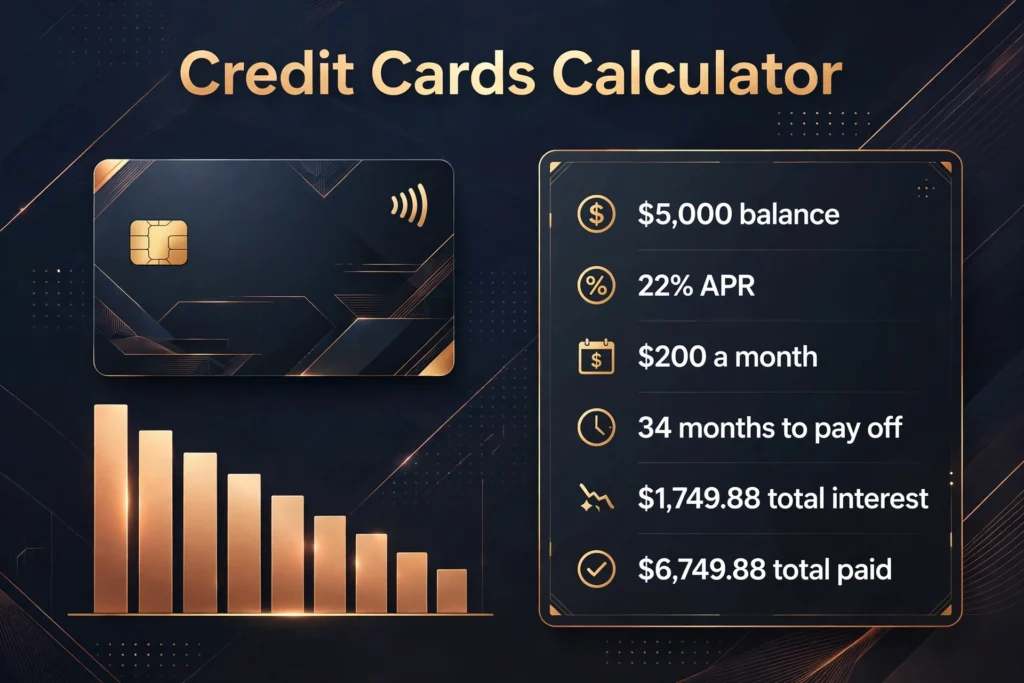
Take a $5,000 balance at 22% APR, paid at a fixed $200 a month. The monthly rate is 22% divided by 12, which is 1.8333% a month. In month one, the interest is $5,000 × 0.22 / 12 = $91.67. The $200 payment covers that interest and leaves $108.33 of principal, so the balance falls to $4,891.67. In month two, the interest is $4,891.67 × 0.22 / 12 = $89.68, the principal part rises to $110.32, and the balance falls to $4,781.35. The interest shrinks a little every month because it is always charged on a smaller balance, and the principal part grows by the same amount.
The balance keeps falling month by month. After 12 months the balance is $3,560.57. The first year costs $960.57 in interest and $2,400.00 in payments. After 24 months the balance is $1,770.49, with the second year costing $609.92 in interest. In month 34, the last month, only $149.88 is due: $2.70 of interest and $147.18 of principal, and the balance reaches $0.00. In all, the card takes 34 months — 2 years 10 months — to clear, with $1,749.88 of total interest and $6,749.88 paid in total. Counted from November 2026, the last payment falls in September 2029. The same case can be checked with the payoff formula: n = −log(1 − rB/P) / log(1 + r), where r is 0.22/12, B is $5,000 and P is $200, which gives 33.75 months — and since a part month still needs a payment, that rounds up to 34.
A second example changes the payment. The same $5,000 balance at 22% APR, paid at $250 a month instead of $200, takes 26 months and costs $1,285.72 in interest, for $6,285.72 paid in total. That extra $50 a month saves $464.16 in interest and clears the card 8 months sooner, with the last payment falling in January 2029 when counted from November 2026. In month one the interest is still $91.67, but the principal part is $158.33 instead of $108.33, so the balance falls to $4,841.67. In month 12 the interest is $56.64 and the balance is $2,896.21. The final month, month 26, needs only $35.72: $0.64 of interest and $35.08 of principal.
A third example lowers the payment. The same $5,000 at 22% APR, paid at $150 a month, takes 52 months and costs $2,798.05 in interest, for $7,798.05 paid in total, with the last payment in March 2031 when counted from November 2026. In month one only $58.33 goes to principal, because $91.67 of the $150 is interest. After 12 months the balance is still $4,224.92, and the first year costs $1,024.92 in interest — more than the first year of the $200 plan, even though less was paid. The smaller the payment, the larger the share of it that goes to interest, and the longer the balance lasts.
A fourth example uses the pay-in-N-months mode. A $6,000 balance at 22.9% APR, to be cleared in 36 months, needs a fixed payment of $231.95 a month. The formula is P = rB / (1 − (1 + r)^−n), where r is 0.229/12, B is $6,000 and n is 36, which gives $231.95. In month one the interest is $114.50 and the principal is $117.45, leaving $5,882.55. After 12 months the balance is $4,432.90, and the first year costs $1,216.25 in interest. After 24 months the balance is $2,466.77. In month 36 the last payment of $231.95 clears the balance: $4.34 of interest and $227.60 of principal. The total interest is $2,350.05 and the total paid is $8,350.05, with the last payment in November 2029 when counted from November 2026.
A fifth example has no interest at all. A $1,200 balance at 0% APR, paid at $100 a month, takes 12 months and costs $0.00 in interest, for $1,200.00 paid in total, with the last payment in November 2027 when counted from November 2026. Every dollar of every payment goes to principal, so the balance falls by exactly $100 a month. A 0% rate usually comes from a promotional period, and the rate after the promotion ends is the one that decides what happens to any balance left over.
How is credit card interest calculated?
Card interest is charged on the balance you carry, at the APR divided by the number of periods in a year. Most issuers work it out daily: the APR divided by 365, applied to the average daily balance, added up over the billing cycle. The Consumer Financial Protection Bureau (CFPB) describes it in those terms: many card companies calculate the interest you owe daily, based on your average daily balance, and the interest is added to your balance, so it compounds. This tool uses the simpler monthly form, balance × APR / 12, which gives a figure very close to the daily method for a balance that does not change during the month. For the headline example the monthly figure is $91.67 in month one; the daily method on the same balance gives a figure within a few cents of that, because 22% / 365 × 30 days is 1.808% against the monthly 1.833%.
The average daily balance is the balance on each day of the cycle added together and divided by the number of days. New purchases during the cycle raise it, payments lower it, and the timing of each matters: a payment made early in the cycle cuts the average more than the same payment made on the last day. That is why two people with the same starting balance and the same APR can be charged different interest in the same month — one paid early, the other paid late.
The grace period is the exception to all of this. If you pay the full statement balance by the due date, most cards charge no interest on purchases at all. The CFPB notes that issuers must get your bill to you at least 21 days before the payment is due, and that due date is at least 21 days after the close of the billing period. The grace period applies to purchases only. It does not apply to cash advances, and it does not apply once a balance is carried: after a month in which the full balance was not paid, new purchases start gathering interest from the day they are made.
The APR itself is the yearly rate, and it is not one number on every card. A card can carry one APR for purchases, a higher APR for cash advances, and a different rate again for balance transfers, with a promotional rate that ends on a set date. This tool takes one APR for the whole payoff, so enter the purchase APR from your statement, and treat the result as an estimate for a balance that stays on that one rate. The Federal Reserve's G.19 release put the average rate on accounts assessed interest at 21.19% in August 2026, which is close to the 22% used in the examples on this page.
How much interest do I pay on my credit card in one month?
Multiply the balance by the APR and divide by 12. That is the interest for one month at the start of the payoff, before any payment comes off. A $5,000 balance at 22% APR costs $91.67 in one month. A $3,000 balance at 20% APR costs $50.00 in one month. A $10,000 balance at 24.99% APR costs $208.25 in one month. A $1,000 balance at 18% APR costs $15.00 in one month.
That one-month figure is also the line that decides whether a payment makes progress. Any monthly payment above it cuts the balance; any payment at or below it does not. A $200 payment on the $5,000 balance at 22% clears the $91.67 of interest and puts $108.33 against the balance. A $90 payment on the same balance does not even cover the $91.67, so the balance grows by $1.67 that month despite the payment. The tool's "First month's interest" box shows this figure for your own numbers, so you can see at a glance what your payment has to beat.
The one-month figure falls as the balance falls. On the $5,000 at 22% plan, the interest is $91.67 in month one, $67.70 in month 12, and $2.70 in the final month. That is the whole mechanism of a payoff: each payment cuts the balance, the smaller balance gathers less interest, and more of the next payment goes to principal. It is also why the first months feel slow — in month one, nearly half of a $200 payment is interest — and why the last months move fast.
What is the minimum payment, and why does it take so long?
The minimum payment is the smallest amount you must pay each billing cycle to keep the account in good standing — typically a percentage of the balance or a flat dollar floor, whichever is higher. Issuers use different formulas: some charge a flat percentage of the balance, commonly 1% to 3%; some charge 1% of the balance plus that month's interest; and every issuer sets a floor, commonly $25 to $35, that applies when the percentage works out lower. The CFPB requires issuers to disclose how they calculate the minimum in the cardholder agreement, and the Credit CARD Act of 2009 requires the statement itself to carry a minimum-payment warning showing how long paying only the minimum would take and what it would cost in all.
This tool's minimum mode uses the common rule of 2% of the balance or $25, whichever is higher. The reason it takes so long is that the minimum shrinks as the balance shrinks. On a $3,000 balance at 20% APR, the first minimum payment is $60.00: $50.00 of interest and only $10.00 of principal, leaving $2,990.00. By month 12 the payment has fallen to $57.84, with $48.20 of interest and $9.64 of principal, and the balance is still $2,882.18. After a full year of payments totalling $706.95, the balance has fallen by only $117.82, and $589.12 of what was paid was interest. The balance keeps falling by smaller and smaller amounts each month, because each payment is smaller than the last. It takes 371 months — 30 years 11 months — to clear, with $10,209.99 of total interest and $13,209.99 paid in all, and the last payment falls in October 2057 when counted from November 2026. The final month's payment is only $15.05, because it is capped at what is left: $0.25 of interest and $14.80 of principal.
A larger balance makes the trap deeper. On a $5,000 balance at 22% APR, paying only the minimum takes 968 months — 80 years 8 months — and costs $43,419.49 in interest, for $48,419.49 paid in all. The first minimum payment is $100.00. Against that, the same balance at a fixed $200 a month takes 34 months and costs $1,749.88 in interest. The fixed plan saves 934 months and $41,669.61 in interest. The CFPB's 2025 Consumer Credit Card Market Report found that US consumers were assessed $160 billion in interest charges in 2024, up from $105 billion in 2022, and much of that interest is driven by minimum-payment behaviour.
There is one case where the minimum never works at all. On a $10,000 balance at 24.99% APR, the first month's interest is $208.25, but the first minimum payment is only $200.00 — 2% of $10,000. The payment does not cover the interest, so the balance grows every month no matter how faithfully the minimum is paid. The tool says so plainly instead of showing a payoff date. The same rule applies to any payment: if it does not beat the month's interest, the balance never falls.
How much do I need to pay to be debt-free in a set time?
Choose "Pay it off in a set number of months", enter the balance, the APR and the number of months, and the tool works out the fixed payment that clears the balance in that time. The formula is the standard amortising formula: payment = rB / (1 − (1 + r)^−n), where r is the monthly rate (APR / 12 / 100), B is the balance and n is the number of months.
For a $5,000 balance at 22% APR, the payments are $467.97 a month to clear it in 12 months, $259.39 a month for 24 months, and $190.95 a month for 36 months. The 12-month plan costs the least interest but asks the most each month; the 36-month plan asks the least each month but costs more interest over the longer run. The $6,000 at 22.9% example in the worked-example section needs $231.95 a month for 36 months, with $2,350.05 of total interest. Shortening the target is the most direct way to cut the interest: every month cut from the plan removes a month of interest on the whole remaining balance.
A target date works the same way. Count the months from now to the date you want, enter that count, and the tool gives the payment. If the payment it gives is more than you can afford, lengthen the target by a few months and look again — the tool makes that trade-off visible in seconds, and the yearly totals table shows how much of each year goes to interest at the longer target.
What happens if my payment does not cover the interest?
The balance grows. Interest is added first and the payment comes off second, so if the payment is smaller than the interest, the balance after the payment is higher than it was before. A $90 payment on a $5,000 balance at 22% APR faces $91.67 of interest in the first month, so the balance rises by $1.67 to $5,001.67 — and next month's interest is charged on that larger balance. The card is never paid off, however long the payments continue. The tool shows a plain message for this case: the payment, the month's interest, and the amount the payment must beat.
A payment only just above the interest is barely better. A payment of $91.67 a month on that same $5,000 balance at 22% APR — one cent above the first month's interest of $91.67 — takes 563 months and costs $46,579.04 in interest, for $51,579.04 paid in all. A payment of $92 a month takes 310 months and costs $23,462.14 in interest. The first few dollars above the interest line buy almost nothing, because nearly all of each payment is still interest and the balance falls by cents. The payoff only starts moving at a reasonable pace when the payment is well above the monthly interest — on this balance, $150 a month clears it in 52 months, and $200 a month clears it in 34.
This is the number to check before choosing a payment: the first month's interest, which the tool shows in its own box. Any plan that pays less than that figure is not a payoff plan at all, and any plan that pays only a little more is a very slow one.
What is a cash advance, and why does it cost more?
A cash advance is cash taken from a credit card — from an ATM or a bank counter — instead of a purchase. It costs more than a purchase in three ways, and this tool does not calculate it: the figures on this page are for purchase balances only.
First, a cash advance usually carries a higher APR than purchases on the same card, often in the high twenties or higher. Second, there is no grace period: interest starts on the transaction date, not after the statement, so even a cardholder who pays every purchase balance in full still pays interest on a cash advance from day one. Third, there is a fee on top, commonly 3% to 5% of the amount taken, with a minimum fee per advance. A $500 cash advance at a 3% fee costs $15 before any interest is charged, and the interest then runs daily from the day the cash is taken. Some cardholder agreements also apply payments to the lowest-rate balance first, so a cash advance balance can sit gathering interest while payments go against cheaper balances. Check the cardholder agreement for the exact order. If cash is needed, the purchase APR and the cash-advance APR on the same statement are the two numbers to compare first.
How does a balance transfer compare?
A balance transfer moves a balance from one card to another, usually to a card offering a low or 0% promotional rate for a set period. During the promotion, the interest that would have been charged at the old APR is not charged, so the whole payment goes to principal — the same effect as the 0% example in the worked-example section, where a $1,200 balance at $100 a month cleared in 12 months with no interest at all. The saving depends on the transfer fee, commonly 3% to 5% of the amount moved, and on clearing the balance before the promotion ends. A $5,000 balance moved with a 3% fee costs $150 in fees; at 22% APR the same balance costs $91.67 of interest in the first month alone, so the fee is recovered in under two months if the payments stay the same. If the balance is still there when the promotion ends, the remaining balance is charged at the new card's standard rate, which can be as high as the old one. A transfer also does not change the amount owed — it changes the rate and the clock. The tool on this page can be used to compare the two cases: run the balance at the old APR with your payment, then run it at 0% for the length of the promotion, and the difference in total interest is the most the transfer can save before fees.
How is this different from a loan calculator?
A loan has a fixed term and a fixed payment set at the start: borrow $5,000 for 36 months at a set rate and the payment is the same every month until the last one. A card balance has no term. The balance falls only as fast as the payments allow, the payment can change every month, new purchases can be added, and the rate can change. That is why the same balance can take 34 months at $200 a month, 52 months at $150 a month, or 968 months on minimum payments alone — the term is whatever the payment makes it.
The maths underneath is the same amortising maths, and the loan calculator on this site uses it for a fixed loan: enter the amount, the rate and the term, and it gives the monthly payment. The EMI calculator does the same for an equated monthly instalment. Use those when the debt has a fixed term and a fixed payment. Use this tool when the debt is a card balance with no term, a minimum payment that shrinks, or a target payoff date you want to work back from. The debt to income calculator is the matching tool for the wider picture: it takes all monthly debt payments against monthly income and gives the ratio lenders look at. The get out of debt calculator is the matching tool for several debts at once, where the order of payoff matters.
What are the limits of this calculator?
The tool assumes the APR stays fixed for the whole payoff, the interest is charged monthly at APR divided by 12, no new purchases are added, no fees are charged, and every payment is made on time and in full each month. Real cards differ in each of these: issuers usually charge interest daily on the average daily balance, the APR can change, a late payment can add a fee and a penalty rate, and new purchases add to the balance. Any of those makes the real payoff longer and the real interest higher than the figure here. The tool is an estimate for planning, not a statement figure — the statement is the final word on what is owed.
The tool also rounds every money figure to the nearest cent for display. The final month's payment is capped at what is actually left, so it is usually smaller than the fixed payment: $149.88 on the $5,000 at 22% plan, $35.72 on the $250 plan, and $15.05 in the final month of the minimum-only plan. Because each figure is rounded on its own, the parts of the final month can differ from the payment by a cent. The payoff date counts forward from the month the tool is run, assuming the first payment is made next month.
The figures on this page are general information about how card interest works. They are not financial advice, and they do not recommend any card, payment or course of action. Card terms differ between issuers and between cards from the same issuer, so the cardholder agreement and the statement are the sources for the APR, the minimum-payment formula and the fees on any one card. The Consumer Financial Protection Bureau's pages on credit card interest and on grace periods, and the Federal Reserve's G.19 consumer credit release, are the authoritative sources for the rules and rates quoted in this article.
How long does it take to pay off common balances at $200 a month?
Every figure in this table was computed with the same formula the tool uses, for a fixed payment of $200 a month. A dash means the payment does not cover the first month's interest, so the balance never falls.
| Balance | 18% APR | 22% APR | 24.99% APR |
|---|---|---|---|
| $1,000 | 6 months, $47.53 interest | 6 months, $58.80 interest | 6 months, $67.40 interest |
| $3,000 | 18 months, $424.15 interest | 18 months, $540.63 interest | 19 months, $634.37 interest |
| $5,000 | 32 months, $1,313.96 interest | 34 months, $1,749.88 interest | 36 months, $2,135.16 interest |
| $10,000 | 94 months, $8,622.36 interest | 137 months, $17,356.12 interest | never — first month's interest is $208.25 |
Three patterns in the table are worth reading. First, the APR matters more as the balance grows: on $1,000 the gap between 18% and 24.99% is $19.87 of interest, while on $5,000 it is $821.20. Second, the payoff time grows faster than the balance: doubling the balance from $5,000 to $10,000 at 22% more than quadruples the time, from 34 months to 137 months, because the same $200 payment is spread over a much larger balance and the interest eats more of it. Third, the $10,000 row at 24.99% shows the hard edge: at $200 a month the payment is $8.25 short of the first month's interest, so the balance never falls at all, and the payment has to rise above $208.25 before any payoff begins.
Frequently asked questions
What is a credit cards calculator?
A credit cards calculator works out how long it takes to pay off a credit card balance and how much interest that costs. Enter the balance, the APR and how you plan to pay — a fixed amount, the minimum only, or a target number of months — and it shows the months to pay off, the total interest, the total paid, the payoff date and a monthly breakdown of interest and principal.
How much interest do I pay on my credit card in one month?
Multiply the balance by the APR and divide by 12. A $5,000 balance at 22% APR costs $91.67 in one month. A $3,000 balance at 20% APR costs $50.00. A $10,000 balance at 24.99% APR costs $208.25. That figure is also the smallest payment that makes any progress: a payment below it leaves the balance higher than before.
How long does it take to pay off $5,000 on a credit card?
It depends on the payment. At 22% APR, a fixed $200 a month clears $5,000 in 34 months with $1,749.88 of interest. At $250 a month it takes 26 months with $1,285.72 of interest. At $150 a month it takes 52 months with $2,798.05 of interest. Paying only the minimum takes 968 months with $43,419.49 of interest. All four figures come from the same balance and the same APR — only the payment changes.
What is the minimum payment on a credit card?
The minimum payment is the smallest amount you must pay each billing cycle, usually a percentage of the balance or a flat dollar floor, whichever is higher. This tool uses the common rule of 2% of the balance or $25. Because the minimum shrinks as the balance shrinks, paying only the minimum takes far longer than a fixed payment: a $3,000 balance at 20% APR takes 371 months on minimum payments alone, with $10,209.99 of interest. Your card's own formula is in the cardholder agreement.
How do I calculate credit card interest per month?
Multiply the balance by the APR and divide by 12. That is the monthly form of the charge. Issuers usually work it out daily instead — the APR divided by 365, applied to the average daily balance — which gives a figure very close to the monthly form. Interest is added to the balance before the payment comes off, so next month's interest is charged on the smaller balance.
Why does my credit card balance never go down?
Because the payment does not cover the monthly interest. On a $10,000 balance at 24.99% APR, the first month's interest is $208.25, so a $200 payment leaves the balance higher than before. On a $5,000 balance at 22% APR, a $90 payment faces $91.67 of interest and the balance grows by $1.67 that month. A payment has to be above the month's interest before the balance starts falling, and the further above it the payment sits, the faster the balance falls.