IRA Calculator
IRA Calculator
Project your IRA balance at retirement and compare Traditional vs Roth after tax.
An IRA calculator shows what your retirement savings could grow to and what you keep after tax. Enter your current balance, yearly contribution, years until retirement, and expected return, and it projects your balance — then compares a Traditional IRA with a Roth IRA side by side, so you can see which one leaves you with more.
What is an IRA?
An IRA, or individual retirement account, is a personal savings account built for retirement. You open one yourself through a bank, brokerage, or other financial institution — it is not tied to an employer the way a 401(k) is. You put money in, choose how to invest it, and the account grows over time through your contributions and investment earnings. To compare your IRA with a workplace 401(k), use the Matching 401K Calculator.
The reason IRAs matter is the tax treatment. Depending on the type you choose, you get a tax benefit either when you put money in or when you take it out. That single difference shapes everything else about the account: how much you can contribute, when you pay tax, and when you must start withdrawing.
An IRA is a container, not an investment by itself. Inside it you can hold cash, stocks, bonds, mutual funds, or exchange-traded funds. The account sets the tax rules; your investment choices decide the return. Both parts matter, and this calculator deals with the first part — the growth of the balance — while the article explains the rules around it.
How does an IRA calculator work?
An IRA calculator takes a few numbers and projects them forward with compound growth. It starts with your current balance and grows it at your expected return for the number of years you enter. Then it adds each yearly contribution and grows those too, year by year, so money contributed early has longer to compound than money contributed late.
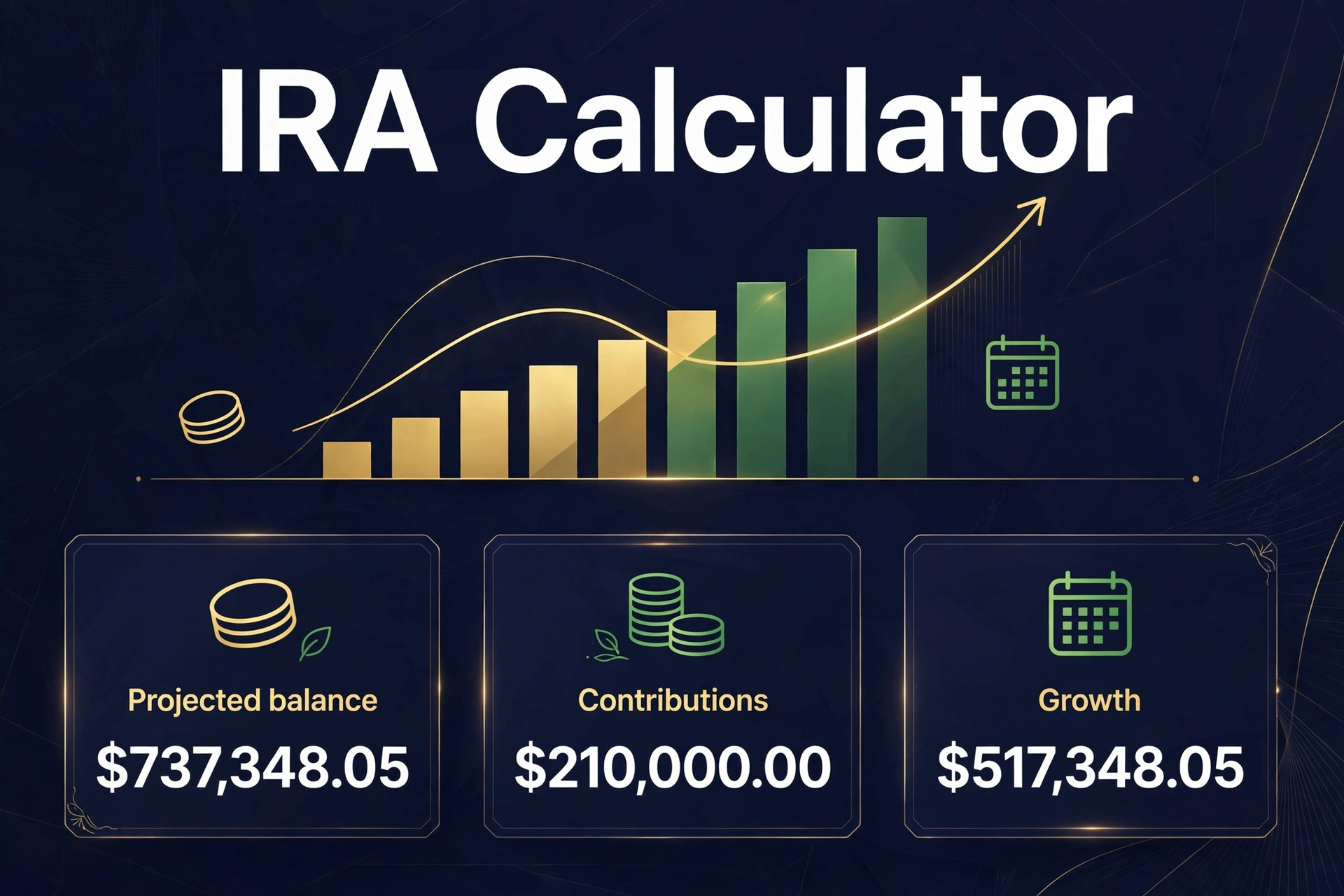
The maths is the same formula used for any growing savings pot. Each year, the balance is multiplied by one plus the return, and the annual contribution is added. Over 30 years at 7%, a $10,000 starting balance grows to about $76,123 on its own, and $7,000 a year grows to about $661,226 — together, $737,348. The formula is simple, but the result surprises most people because the growth overtakes the contributions: in that example, $517,348 of the final balance is growth, against $210,000 of contributions.
This calculator adds one step that a plain growth calculator does not: tax. It works out what you keep after tax in a Traditional IRA and in a Roth IRA, using the tax rate you enter for today and the rate you expect in retirement. Both accounts reach the same gross balance. The difference is when the tax is paid, and that timing decides which one leaves you with more.
Every projection on this page assumes a steady return, the same contribution each year, and no fees or withdrawals before retirement. Real returns vary from year to year, and a bad year early on changes the outcome more than a bad year late. Treat the result as a planning guide, not a promise.
What is the difference between a Traditional IRA and a Roth IRA?
The difference between a Traditional IRA and a Roth IRA is when you pay tax. A Traditional IRA is funded with pre-tax money: contributions may be tax-deductible, the money grows tax-deferred, and you pay ordinary income tax on every dollar you withdraw in retirement. A Roth IRA is funded with after-tax money: you get no deduction now, the money grows tax-free, and qualified withdrawals in retirement are completely tax-free, including all the growth.
Think of it as paying tax on the seed or on the harvest. With a Traditional IRA, you skip the tax on the seed and pay it on the whole harvest later. With a Roth IRA, you pay tax on the seed and keep the whole harvest. If your tax rate is lower in retirement than it is today, the Traditional IRA usually wins. If your rate is higher in retirement, the Roth usually wins. If the rates are equal, the two come out even — the maths cancels out, and the choice turns on other features.
The two accounts also differ on withdrawals during your working years. Roth IRA contributions — the money you put in, not the growth — can generally be withdrawn at any time without tax or penalty. Traditional IRA withdrawals before age 59½ usually face income tax plus a 10% additional tax, unless an exception applies. That flexibility is one reason younger savers often favour the Roth, even before the tax maths.
How much can you contribute to an IRA in 2026?
For 2026, the total you can contribute to all of your traditional and Roth IRAs combined is $7,500, or $8,600 if you are age 50 or older, thanks to a $1,100 catch-up contribution. If your taxable compensation for the year is less than that, your limit is your compensation. These figures come from the IRS and are adjusted for cost of living each year, so they change over time — always check the current year's figure on irs.gov before planning around it.
The limit applies across both account types together, not per account. If you put $4,000 into a Traditional IRA, you can put at most $3,500 into a Roth IRA in the same year. Rollover contributions from another retirement account do not count against the limit.
Two more conditions apply. First, you need earned income to contribute — wages, salary, or self-employment income. Investment income, Social Security, and pension payments do not count. Second, Roth contributions have income limits: for 2026, single filers must earn less than $168,000 and joint filers less than $252,000 to contribute the full amount, with a phase-out above lower thresholds. Traditional IRA contributions have no income limit, but the tax deduction phases out if you or your spouse are covered by a workplace retirement plan — for 2026, from $81,000 to $91,000 of modified adjusted gross income for single filers and $129,000 to $149,000 for married couples filing jointly.
How does an IRA grow over time?
An IRA grows from two sources: the money you put in and the return on that money. Early on, contributions do most of the work. Later, growth takes over, because each year's return applies to a larger balance. That crossover is the whole case for starting early — time in the account matters more than the size of any single contribution.
The table below shows what $7,000 a year grows to at a steady 7% return, starting from nothing. The figures come from the same formula this calculator uses.
| Years saving | You contribute | Balance | Growth |
|---|---|---|---|
| 10 | $70,000 | $96,715 | $26,715 |
| 20 | $140,000 | $286,968 | $146,968 |
| 30 | $210,000 | $661,226 | $451,226 |
| 40 | $280,000 | $1,397,446 | $1,117,446 |
After 10 years, growth is about a quarter of the balance. After 40 years, growth is four times the contributions. The last ten years add more than the first thirty combined. That is why a missed decade is expensive: the money you do not contribute at 25 is not just $7,000 — it is the decades of growth that $7,000 would have earned.
The return you assume changes the outcome sharply. At 5% instead of 7%, $7,000 a year for 30 years reaches about $465,000 rather than $661,226. At 9%, it reaches about $954,000. Small differences in return compound into large differences over a working lifetime, which is why fees and investment choices deserve as much attention as the contribution amount. The 7% figure used in the examples is a planning assumption, not a forecast of any particular investment. You can check the future value of yearly contributions over your chosen term. It also helps to see how compound growth builds your balance.
What taxes will you pay when you withdraw from an IRA?
With a Traditional IRA, every dollar you withdraw in retirement is taxed as ordinary income — both the contributions and the growth. If your balance is $737,348 and your retirement tax rate is 15%, the tax bill is $110,602 and you keep $626,746. The balance the calculator shows is the gross figure, not the spendable figure, and that distinction matters: a million-dollar Traditional IRA at a 22% rate is $780,000 of spendable money.
With a Roth IRA, qualified withdrawals are tax-free. You already paid tax on the contributions, so the balance at retirement is yours in full. In the same example, the Roth keeps $575,131 after accounting for the tax paid on contributions at 22% — less than the Traditional's $626,746, because the retirement rate is lower than today's rate. Reverse the rates, and the answer flips: at 12% today and 22% in retirement, the Roth keeps $648,866 and the Traditional keeps $575,131.
Taxes also apply to early withdrawals. Taking money from a Traditional IRA before age 59½ generally means income tax plus a 10% additional tax, unless an exception applies — for example, certain medical expenses, higher-education costs, or a first home purchase. Roth earnings withdrawn early face the same treatment, though your original contributions can come out tax- and penalty-free. The rules have exceptions, and the IRS Publication 590-B sets them out in full.
State taxes add another layer. Some states tax IRA withdrawals and some do not, and moving to a different state in retirement can change the bill. This calculator uses the single federal-style rate you enter, so treat its after-tax figures as a guide and check your own state's rules separately. You can work out how much you can withdraw each year in retirement with the 4 Percent Rule Calculator.
What are required minimum distributions (RMDs)?
A required minimum distribution is the amount the IRS makes you withdraw each year from a Traditional IRA once you reach a set age. The money has never been taxed, and the RMD is the mechanism that makes sure it eventually is. You divide the prior December 31 balance by a life-expectancy factor from the IRS Uniform Lifetime Table — at 73, the factor is 26.5, so a $500,000 balance means a withdrawal of about $18,868 for the year.
RMDs start at age 73 if you were born between 1951 and 1959, and at age 75 if you were born in 1960 or later. Your first RMD is due by April 1 of the year after you reach that age; every later one is due by December 31. Missing an RMD can mean an excise tax of 25% of the amount not withdrawn, reduced to 10% if corrected promptly.
Roth IRAs have no required minimum distributions for the original owner during their lifetime. That is a real planning advantage: a Roth balance can keep growing untouched for as long as you live, and it passes to heirs under different rules. If you want to see the yearly amount for your own balance, the Estimate RMD Calculator works it out from the IRS table.
When should you choose a Roth IRA over a Traditional IRA?
The tax-rate rule is the starting point: choose the Roth when you expect your retirement tax rate to be higher than your rate today, and the Traditional when you expect it to be lower. Early in a career, when income — and the tax rate that goes with it — is low, the Roth is usually the better buy. Near the peak of your earnings, when your rate is at its highest, the Traditional deduction is worth more.
But the rate is not the only factor. A Roth makes sense when you want flexibility: contributions can be withdrawn without penalty, there are no RMDs, and tax-free withdrawals in retirement will not push you into a higher bracket or raise the tax on your Social Security benefits. A Traditional makes sense when you need the deduction now — for example, to bring your income under a threshold — or when you are confident your income will drop sharply in retirement.
Many people split the difference and hold both types. The $7,500 annual limit applies across both accounts combined, so you can divide it however you like. Holding both also hedges against the one thing nobody can predict: future tax law. Rates, brackets, and rules change, and a mix of pre-tax and after-tax savings means you are not betting everything on one outcome.
One common misunderstanding is worth clearing up: a Roth IRA is not automatically better because the withdrawals are tax-free. The tax was paid — it was paid on the way in, on the contributions. If your rate is the same at both ends, the two accounts give you exactly the same spendable money. The Roth wins only when your future rate is higher than today's.
What mistakes do people make with IRAs?
The most expensive mistake is waiting. Every year without contributions is a year of compounding lost, and the table above shows how much the later years are worth. Starting with a small amount beats waiting for a large one, because the habit and the time matter more than the opening balance.
The second mistake is contributing too much — or rather, contributing over the limit. The IRS limit covers all your IRAs together, and going over it can mean a 6% excise tax on the excess each year until it is fixed. If you hold accounts at more than one provider, the providers do not check each other. Add up your contributions across every account before the year ends.
The third mistake is forgetting the RMD. Traditional IRA owners who reach 73 must withdraw every year, and the penalty for missing one is steep. Set a reminder, or arrange automatic withdrawals with your provider. Roth owners do not face this, which is one more reason to know which type you hold.
The fourth mistake is treating the gross balance as spendable money. A Traditional IRA balance is pre-tax, and the tax bill arrives with the withdrawals. Plan your retirement income on the after-tax figure — the one this calculator shows in the comparison table — not the headline balance.
The fifth mistake is withdrawing early without checking the cost. A withdrawal before 59½ from a Traditional IRA can lose 10% to the additional tax on top of income tax, and the money stops compounding. An emergency fund outside the IRA is what keeps a short-term problem from becoming a retirement problem.
How do you use this IRA calculator?
Enter your current IRA balance, or zero if you are starting from scratch. Enter the amount you expect to contribute each year — remember the 2026 limit is $7,500 across all IRAs, or $8,600 if you are 50 or older. Enter the years until you plan to retire and the annual return you expect. A 7% return is a common planning assumption for a diversified stock portfolio, but use a lower figure if your investments are conservative.
Then enter your tax rate now and the rate you expect in retirement. Your current rate is your marginal rate — the rate on your next dollar of income, not your average rate. Your retirement rate is a guess, and it is the most uncertain input on the page. If you are unsure, try a few values and watch the comparison change: the verdict flips the moment the retirement rate passes your current rate.
Choose Traditional, Roth, or Compare both. The comparison shows the same balance in both columns, the tax paid now, the tax due at withdrawal, and the after-tax value each type leaves you with. The verdict line states which one keeps more under the rates you entered and why.
Worked example
Take a saver with $10,000 already in an IRA who contributes $7,000 a year for 30 years at a 7% return. The calculator projects a balance of $737,348.05 at retirement, built from $210,000.00 of contributions and $517,348.05 of growth. The growth is more than double the contributions — the account earns more than the saver puts in.
Now the tax comparison. At a 22% rate today and a 15% rate in retirement, the Traditional IRA owes $110,602.21 in tax at withdrawal and keeps $626,745.85. The Roth IRA, with the tax already paid on contributions, keeps $575,131.48. The Traditional IRA comes out $51,614.36 ahead, and the $7,000 yearly contribution also saves $1,540.00 in tax each year along the way.
Change only the tax rates — 12% today, 22% in retirement — and the result reverses. The Traditional IRA now keeps $575,131.48 after paying $162,216.57 in tax, while the Roth keeps $648,866.29. The Roth wins by $73,734.81. Same saver, same contributions, same return, same balance — the only thing that changed is when the tax is paid.
A third case shows what happens when nothing is added. A $50,000 balance left alone for 20 years at 6% grows to $160,356.77, with $110,356.77 of that being growth. At equal tax rates of 22% now and in retirement, both account types keep exactly $125,078.28 — the tie that confirms the rule.
This page gives general information about IRAs and how the numbers work. It is not tax advice or financial advice, and it does not take your full situation into account. Tax law, limits, and your personal circumstances change, so check the current figures on irs.gov or speak to a qualified tax professional before making a decision. You can also browse more calculators.
How much will my IRA be worth at retirement?
It depends on your starting balance, yearly contributions, return, and time. As an example, $10,000 plus $7,000 a year for 30 years at 7% grows to $737,348.05. Enter your own numbers in the calculator above for a projection based on your situation.
Is a Roth IRA better than a Traditional IRA?
It depends on your tax rates. A Roth IRA usually wins when your retirement tax rate is higher than your rate today, because you pay the tax now at the lower rate. A Traditional IRA usually wins when your retirement rate is lower. When the rates are equal, the two come out even after tax.
How much can I contribute to an IRA in 2026?
For 2026, you can contribute $7,500 in total across all your traditional and Roth IRAs, or $8,600 if you are age 50 or older. If your taxable compensation is lower, your limit is your compensation. Check the current figures on irs.gov, as limits change each year.
Do I pay tax on IRA withdrawals?
Traditional IRA withdrawals are taxed as ordinary income in the year you take them. Qualified Roth IRA withdrawals are tax-free. Withdrawals before age 59½ may also face a 10% additional tax unless an exception applies.
What happens if I withdraw from my IRA before age 59½?
A withdrawal from a Traditional IRA before 59½ is usually taxed as income plus a 10% additional tax, unless an exception applies. Roth IRA contributions can generally be withdrawn tax- and penalty-free at any time, but the earnings are subject to tax and the 10% additional tax if withdrawn early without an exception.
Do Roth IRAs have required minimum distributions?
No. Roth IRAs have no required minimum distributions for the original owner during their lifetime. Traditional IRAs require withdrawals starting at age 73 (for people born 1951–1959) or age 75 (for people born 1960 or later).