
1/4 Mile Calculator
Section A — ET and trap speed from weight and horsepower
Enter your car’s race weight and its crank horsepower to estimate the quarter-mile elapsed time (ET) and trap speed.
Use crank horsepower (at the engine), not wheel horsepower. Race weight means the car with the driver, fuel, and everything aboard. If you enter the weight in kg, the tool converts it to lb first (1 kg = 2.20462 lb).
Section B — Horsepower needed for a target ET
Enter the quarter-mile time you want to run and your car’s race weight to estimate the crank horsepower needed to reach it.
The formula is the ET formula turned around: HP = weight ÷ (ET ÷ 6.269)³. The answer is crank horsepower at the same weight.
To calculate a 1/4 mile time, enter your car's race weight and crank horsepower: the estimated ET is 6.269 × (weight ÷ HP)^(1/3) seconds, and the estimated trap speed is 234 × (HP ÷ weight)^(1/3) mph. A 3,500 lb car with 400 HP, for example, is estimated at 12.92 seconds with a trap speed of 113.56 mph.
How do I use the 1/4 Mile Calculator?
Section A of the tool estimates the quarter-mile time and the trap speed from the car's weight and horsepower. Enter the race weight and the crank horsepower, then press Calculate ET and trap speed. The tool shows the estimated ET in seconds, the estimated trap speed in mph and in km/h, and the power-to-weight ratio in HP per 1,000 lb. Race weight means the car with the driver, fuel, and everything aboard. A car that weighs 3,000 lb empty is about 3,200 lb at the strip with a driver and a full tank, and that difference changes the ET by about 0.14 seconds, so enter the race weight, not the kerb weight.
Use crank horsepower (HP), not wheel horsepower. If the only figure available is a wheel horsepower figure from a dyno, convert it with the WHP to HP conversion tool first; the link to the WHP conversion page is in the links at the end of this article. The tool has a weight-unit selector, so the weight can be entered in pounds or in kilograms. If it is entered in kilograms, the tool converts it to pounds at 1 kg = 2.20462 lb before applying the formulas. There is no separate input for altitude, temperature, or traction: the formulas use weight and power only, and the article explains below why a real time can differ.
Section B works in the other direction. It takes the target ET and the weight and returns the crank horsepower needed to reach that time, plus the pounds per horsepower that target implies. It is the section to use when the question is what power is needed, rather than what time a given power gives. The worked example below shows both sections with the verified test figures, so each answer can be checked against the tool.
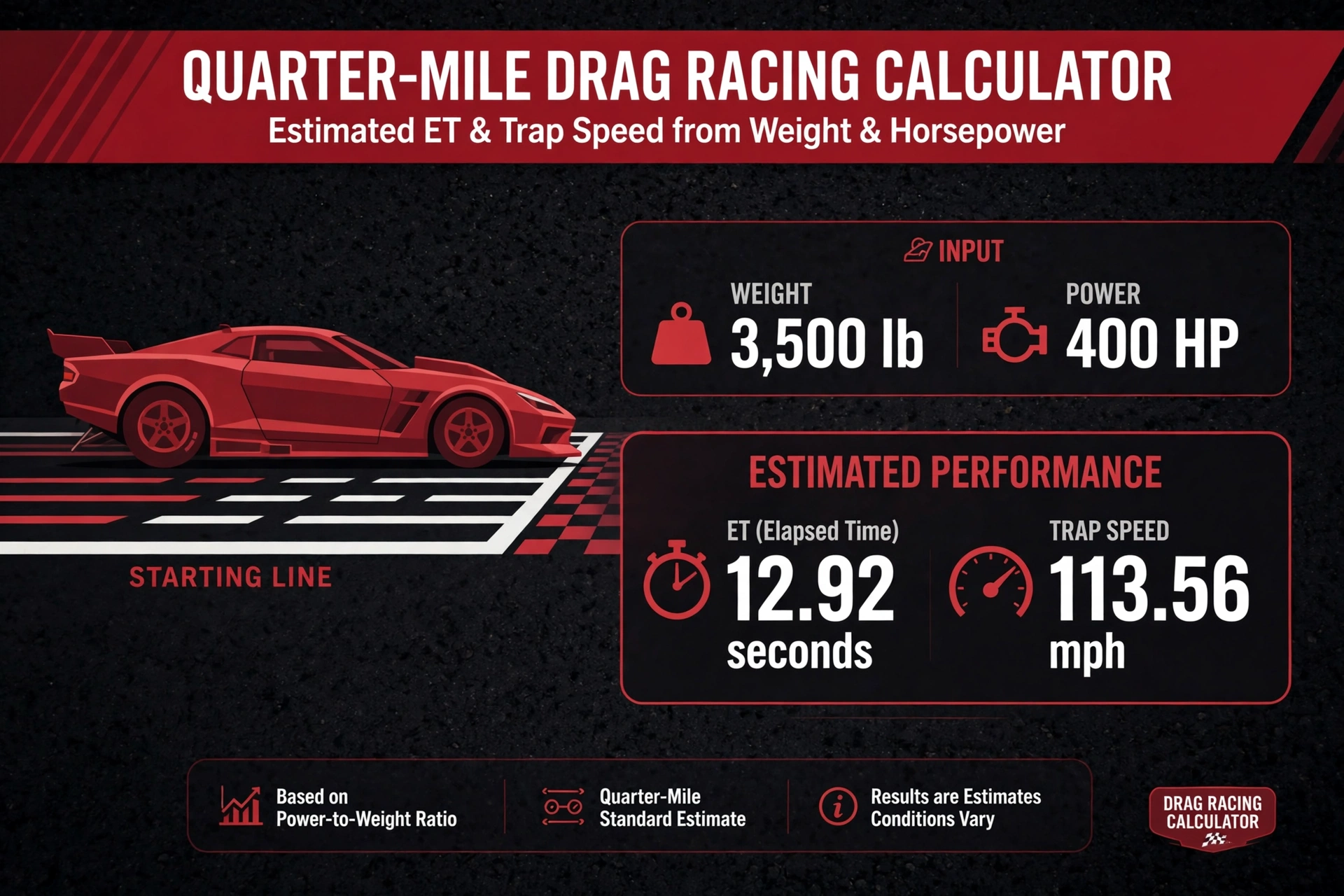
A worked example from the live tool
Test 1 uses a 3,500 lb car with 400 HP, the figures on the worked example and in the illustration above. In Section A, the tool gives an estimated ET of 12.92 seconds, a trap speed of 113.56 mph, which is 182.8 km/h, and a power-to-weight ratio of 114.29 HP per 1,000 lb. The ET comes from 6.269 × (3,500 ÷ 400)^(1/3): 3,500 ÷ 400 is 8.75, its cube root is 2.0606, and 6.269 × 2.0606 is 12.92. The trap speed comes from 234 × (400 ÷ 3,500)^(1/3): 400 ÷ 3,500 is 0.11429, its cube root is 0.48529, and 234 × 0.48529 is 113.56 mph, and 113.56 × 1.60934 is 182.8 km/h.
Test 2 uses a 3,000 lb car with 250 HP. Section A gives an estimated ET of 14.35 seconds, a trap speed of 102.21 mph, which is 164.5 km/h, and a power-to-weight ratio of 83.33 HP per 1,000 lb. The steps are the same: 3,000 ÷ 250 is 12, its cube root is 2.2894, and 6.269 × 2.2894 is 14.35 seconds, while 250 ÷ 3,000 is 0.08333, its cube root is 0.43679, and 234 × 0.43679 is 102.21 mph.
Test 3 uses 1,587 kg and 300 HP, to show the kilogram input. The tool converts 1,587 kg to 3,499.73 lb (1 kg = 2.20462 lb), then gives an estimated ET of 14.22 seconds, a trap speed of 103.18 mph, which is 166.0 km/h, and a power-to-weight ratio of 85.71 HP per 1,000 lb. The kg figure was chosen to be close to 3,500 lb, so the ET is close to the 14.22-second figure in the quick-reference table for 300 HP at 3,500 lb; the small difference comes from the 0.27 lb rounding in the conversion, not from a different formula.
Test 4 uses Section B: a target ET of 12.0 seconds at 3,500 lb. The tool gives 499.02 crank HP needed and 7.01 lb per HP. The steps are: 12.0 ÷ 6.269 is 1.9142, cubed that is 7.0129, and 3,500 ÷ 7.0129 is 499.02 HP, and 3,500 ÷ 499.02 is 7.01 lb per HP. A second Section B check, a target ET of 11.0 seconds at 3,000 lb, gives 555.32 HP and 5.40 lb per HP, which matches the quick-reference table in the section on horsepower for a target ET.
The pattern across the tests is the same as in the formula section below: ET falls as power rises, but slowly, because the cube root compresses the change. Doubling the power from 200 to 400 HP at 3,500 lb cuts the ET from 16.28 to 12.92 seconds, a saving of 3.36 seconds, while doubling it again from 400 to 800 HP would save only about 2.7 seconds more. The tool's error cases are plain-language messages with no results shown: a weight of zero, a negative weight, a horsepower of zero or less, or a target ET of zero or less all give a message that names the problem, such as 'Vehicle weight must be greater than 0.', and the result boxes stay hidden.
What is ET in drag racing?
ET, or elapsed time, is the time the car takes to cover the quarter mile from a standing start to the finish line. It is measured in seconds to two decimal places on a time slip, and it is the number most people mean when they say their car 'runs a 12.9'. The clock starts when the car leaves the start line, not when the light turns green: the reaction time, which is how long the driver takes to move after the green, is shown separately on a time slip and is not part of the ET. A driver can have a slow reaction time and a quick ET, or a quick reaction and a slow ET, and the two are separate numbers.
ET is mostly set by the launch and the early part of the run. A car that spins its tyres off the line loses time it can never recover, because the first 60 feet set the pace for the whole run. The 60-foot time, which is the time to cover the first 60 feet, is the best single predictor of ET: a 60-foot time of 1.6 seconds usually gives an ET in the low 11s, while a 60-foot time of 2.2 seconds usually gives an ET in the mid 14s. The formulas on this page do not use the 60-foot time, which is why they are estimates: they assume a good launch.
ET is also the number that decides a drag race. The car with the lower ET wins, unless it breaks out in a bracket race, where running quicker than the dial-in time loses. Trap speed does not decide the race, and a car can win with a lower trap speed if it gets off the line better. ET is the result that matters at the strip, and it is the result this tool estimates.
What is trap speed?
Trap speed is the speed the car is travelling as it crosses the finish line, measured over the last 66 feet of the quarter mile. It is shown in mph on a time slip, and this tool also shows it in km/h. Trap speed is mostly set by power: a car with more power traps higher, even if its ET is slow because of a bad launch. A car that spins its tyres at the start can still trap well, because the launch hurts the ET far more than it hurts the speed at the end of the run. That is why ET and trap speed should be read together: a slow ET with a high trap speed points to a traction problem, while a slow ET with a low trap speed points to a power problem.
Trap speed is also the number that best shows what a car can do on the road, because it is a measure of power rather than of launch skill. A car that traps at 113.56 mph has the power to run a 12.92-second quarter mile with a good launch, even if its actual time slip says 13.5 because it spun off the line. The trap speed is the honest number, and the ET is the number that depends on the driver and the tyres.
What are the formulas behind the estimates?
The tool uses two formulas, both cube-root formulas that come from a regression on real quarter-mile runs. The ET formula is ET = 6.269 × (weight ÷ HP)^(1/3), with weight in pounds and HP as crank horsepower. The trap-speed formula is Trap speed = 234 × (HP ÷ weight)^(1/3) mph, with the same inputs. The trap speed in km/h is the mph figure × 1.60934. The power-to-weight ratio is HP ÷ weight × 1,000, in HP per 1,000 lb. These are the same formulas used in the worked example above, and the same formulas used to build the tables below.
The cube root is the key to both formulas. It means that doubling the power does not halve the ET: it cuts it by about 21%, because 2^(1/3) is 1.2599, and 1 ÷ 1.2599 is 0.7937. Doubling the weight does not double the ET either: it raises it by about 26%, because 2^(1/3) is 1.2599. The cube root compresses large changes in power or weight into small changes in ET, which is why a car needs a large power increase to shave a second off its time. It also means that the ET is not very sensitive to small errors in the inputs: a 10% error in the horsepower changes the ET by only about 3%.
Several published formulas give similar answers, and the differences between them are small. The table below compares three published models with this tool, all at the same 3,500 lb and 400 HP. Huntington's model, with an ET constant of 6.290 and a trap-speed constant of 224, gives 12.96 seconds and 108.70 mph. Fox's model, with 6.269 and 230, gives 12.92 seconds and 111.62 mph. Hale's model, with 5.825 and 234, gives 12.00 seconds and 113.56 mph. This tool uses 6.269 and 234, which gives 12.92 seconds and 113.56 mph, the same ET as Fox's model and the same trap speed as Hale's. The spread across the models is under a second for ET and under 5 mph for trap speed, which is smaller than the effect of traction or weather on a real run.
| Model | ET constant | Trap speed constant | ET at 3,500 lb / 400 HP | Trap speed at 3,500 lb / 400 HP |
|---|---|---|---|---|
| Huntington | 6.290 | 224 | 12.96 seconds | 108.70 mph |
| Fox | 6.269 | 230 | 12.92 seconds | 111.62 mph |
| Hale | 5.825 | 234 | 12.00 seconds | 113.56 mph |
| This tool | 6.269 | 234 | 12.92 seconds | 113.56 mph |
The inverse formula, used in Section B, is HP = weight ÷ (ET ÷ 6.269)³, which is the ET formula turned around. It takes the target ET and the weight and returns the crank horsepower needed to reach that time. The worked example above shows it for 12.0 seconds at 3,500 lb, giving 499.02 HP, and the section on horsepower for a target ET has a table of the same figures for 11 to 14 seconds.
What is a good 1/4 mile time?
What counts as good depends on the car, so the table below gives the ET ranges most commonly published in quarter-mile guides for stock or lightly modified road cars. These are typical ranges, not guarantees for any specific car, and a car at the quick end of its range is usually lighter, better tyred, or better driven than one at the slow end. Trap speeds are left out of this table because they vary with the launch: two cars with the same ET can trap several mph apart, and the trap speed for a given ET depends on which of the three formula pairs is used.
| Vehicle type | Typical quarter-mile ET |
|---|---|
| Economy commuter | 17–19 seconds |
| Family sedan | 15–17 seconds |
| Hot hatch / sport sedan | 14–15 seconds |
| Muscle car / sports car | 12–14 seconds |
| Modern supercar | 10–11 seconds |
| Modified drag car | Under 10 seconds |
For a stock road car, under 14 seconds is good, under 12 is quick, and under 11 is very quick. A family sedan at 16 seconds is ordinary, a hot hatch at 14.5 is respectable, and a sports car at 12.5 is quick. The tool's quick-reference table in the section below shows what power is needed to reach each of these times at 3,500 lb, so a target ET can be turned into a power target.
A time that looks slow for one car can be quick for another. A 3,500 lb car that runs 12.92 seconds is quick; a 2,500 lb car that runs the same time is ordinary, because it needs far less power to get there. The ET alone does not say how powerful a car is. The power-to-weight ratio, which the tool shows in HP per 1,000 lb, is the better comparison between cars of different weights, and the formula section above shows how it works.
What affects your real 1/4 mile time?
Traction is the biggest factor. The formulas assume the car hooks up cleanly off the line, with no wheelspin. On street tyres on an unprepared surface, a powerful car can lose a second or more to wheelspin in the first 60 feet, and no amount of power fixes that: more power only spins the tyres harder. Drag radials, a prepared strip, and a careful launch are what turn the estimate into a real time. A car that traps at 113.56 mph but runs 13.5 seconds has a traction problem, not a power problem, and the fix is tyres and launch technique, not more horsepower.
Weight is the second factor, and it is the one most often understated. Race weight is the car with the driver, fuel, and everything aboard, and it is usually 200 to 300 lb more than the kerb weight in the brochure. A car that weighs 3,000 lb empty is about 3,200 lb at the strip, and that 200 lb costs about 0.14 seconds. Removing weight is the cheapest way to go quicker: taking 100 lb out of a 3,500 lb car saves about 0.12 seconds, which is the same as adding about 12 HP. The tool's weight input is where this is handled, so enter the race weight, not the brochure weight.
Weather and altitude are the third factor. Hot air is less dense, so the engine makes less power, and high altitude has the same effect: at 5,000 feet, a naturally aspirated engine loses about 15% of its power, which costs about 0.6 seconds on a 12.92-second car. Turbocharged and supercharged cars lose less, because the forced induction partly compensates. The standard correction for altitude and temperature is the density altitude, and a run at a high density altitude will always be slower than the same car at sea level in cool air. The formulas assume standard air, so a run in hot weather or at altitude will be slower than the estimate.
Gearing and shift points are the fourth factor. A car whose gearing is too tall for the strip will still be in third gear at the finish, and a car whose gearing is too short will hit the rev limiter before the line. Both cost time. The formulas assume the gearing suits the strip, which is true for most stock cars, but a modified car with a different final drive or different tyre size can be quicker or slower than the estimate. The driver is the fifth factor: a missed shift, a slow reaction, or a bad launch all cost time, and the formulas assume a clean run.
Finally, the power figure itself is often wrong. Crank horsepower is the figure the manufacturer quotes, and it is the figure the formulas need, but a car that has lost power with age, or a figure taken from a dyno in wheel horsepower, will give a wrong estimate. Wheel horsepower is typically 12% to 15% lower than crank horsepower for a rear-wheel-drive car, and 15% to 20% lower for an all-wheel-drive car. Entering 400 WHP as if it were 400 crank HP understates the power by about 60 HP and makes the ET estimate about 0.6 seconds too slow. Convert WHP to crank HP first, using the link at the end of this article.
How much horsepower do I need for a target ET?
Section B of the tool answers this directly, and the table below gives the figures for a 3,500 lb car. The formula is HP = weight ÷ (ET ÷ 6.269)³, which is the ET formula turned around. A 3,500 lb car needs 314.25 HP for a 14.0-second ET, 392.49 HP for 13.0 seconds, 499.02 HP for 12.0 seconds, and 647.87 HP for 11.0 seconds. Each second saved costs more power than the last: going from 14 to 13 seconds needs 78 HP, going from 13 to 12 needs 107 HP, and going from 12 to 11 needs 149 HP. That is the cube root working in reverse: the ET falls slowly as power rises, so each second is harder to buy than the one before.
| Target ET | Crank HP needed at 3,500 lb | Pounds per HP |
|---|---|---|
| 14.0 seconds | 314.25 HP | 11.14 lb per HP |
| 13.0 seconds | 392.49 HP | 8.92 lb per HP |
| 12.0 seconds | 499.02 HP | 7.01 lb per HP |
| 11.0 seconds | 647.87 HP | 5.40 lb per HP |
The pounds-per-HP column is the more useful number for comparing cars of different weights. A car at 11.14 lb per HP runs about 14 seconds, whatever it weighs, and a car at 7.01 lb per HP runs about 12 seconds, whatever it weighs. That is because the formulas depend on the weight-to-power ratio, not on the absolute weight or power. A 2,000 lb car with 285 HP has the same 7.01 lb per HP as a 3,500 lb car with 499 HP, and both are estimated at 12.0 seconds.
For a different weight, use Section B of the tool rather than scaling the table by hand. The power needed scales in direct proportion to the weight: a 3,000 lb car needs 3,000 ÷ 3,500, or 85.7%, of the power a 3,500 lb car needs for the same ET, so a 12.0-second target at 3,000 lb needs 499.02 × 0.857, which is about 427.73 HP. The tool does this exactly, and the worked example above shows a Section B check at 3,000 lb for 11.0 seconds, giving 555.32 HP.
What does the quick-reference table show?
The table below gives the estimated ET and trap speed for a 3,500 lb car at crank horsepower from 200 to 600 HP, in steps of 50 HP. It is the same calculation as Section A, run for each power figure, and it can be used to read off the ET for a power figure without opening the tool. The trap speed is shown in mph and in km/h. The ET falls from 16.28 seconds at 200 HP to 11.29 seconds at 600 HP, a saving of just under 5 seconds for a tripling of the power, which shows how slowly the ET responds to power.
| Crank HP at 3,500 lb | ET | Trap speed (mph) | Trap speed (km/h) |
|---|---|---|---|
| 200 HP | 16.28 seconds | 90.13 mph | 145.1 km/h |
| 250 HP | 15.11 seconds | 97.09 mph | 156.3 km/h |
| 300 HP | 14.22 seconds | 103.17 mph | 166.0 km/h |
| 350 HP | 13.51 seconds | 108.61 mph | 174.8 km/h |
| 400 HP | 12.92 seconds | 113.56 mph | 182.8 km/h |
| 450 HP | 12.42 seconds | 118.10 mph | 190.1 km/h |
| 500 HP | 11.99 seconds | 122.33 mph | 196.9 km/h |
| 600 HP | 11.29 seconds | 129.99 mph | 209.2 km/h |
For a different weight, the ET can be adjusted by the cube root of the weight ratio. A 3,000 lb car at 400 HP runs about 12.31 seconds, because the weight ratio is 3,000 ÷ 3,500, or 0.857, and its cube root is 0.9498, and 12.92 × 0.9498 is 12.27 seconds, which is close to the tool's exact figure of 12.31 seconds for 3,000 lb at 400 HP. The small difference is rounding in the cube root. For an exact figure at another weight, use Section A of the tool.
What mistakes do people commonly make with quarter-mile estimates?
The first mistake is entering wheel horsepower as crank horsepower. A dyno measures wheel horsepower, which is 12% to 20% lower than crank horsepower, depending on the drivetrain. Entering 400 WHP as 400 crank HP understates the power and makes the ET estimate too slow by about 0.6 seconds. Convert WHP to crank HP first, using the link at the end of this article, or use the manufacturer's crank figure.
The second mistake is entering the kerb weight instead of the race weight. Kerb weight is the car empty, with no driver and no fuel. Race weight adds the driver, a full tank, and anything else aboard, which is usually 200 to 300 lb. Entering the kerb weight makes the ET estimate too quick by about 0.14 seconds for a 200 lb difference. Weigh the car at the strip, or add 250 lb to the kerb weight as a rough figure.
The third mistake is treating the estimate as a promise. The formulas assume a good launch, good traction, standard air, and suitable gearing. A real run on street tyres in hot weather at altitude will be slower, sometimes by a second or more. The estimate is a target to aim for, not a time slip. Use it to compare cars and to set a power target, and treat the real time as the test of the car, the tyres, and the driver.
The fourth mistake is comparing ETs from different strips without correcting for altitude and weather. A 12.92-second run at sea level in cool air is not the same as a 12.92-second run at 5,000 feet in the heat: the second car is making less power and would run quicker at sea level. The standard correction is the density altitude, and time slips from different days should be compared on that basis, not on the raw ET.
The fifth mistake is forgetting that the ET constant matters. Different published formulas use different ET constants, from 5.825 to 6.290, and they give different ETs for the same car: at 3,500 lb and 400 HP, Hale's 5.825 gives 12.00 seconds, while this tool's 6.269 gives 12.92 seconds. The difference is almost a second, which is larger than the effect of 100 lb of weight. The model table in the formula section above shows the four constants side by side, so the choice of constant is visible rather than hidden. This tool uses 6.269, and the article and the tool use the same figure throughout.
What are the limits of a 1/4 mile estimate?
The estimate uses weight and power only. It does not account for traction, gearing, aerodynamics, altitude, weather, or the driver, and each of those can move a real time by half a second or more. A car with a good launch and good tyres will beat the estimate, and a car with wheelspin or a bad shift will be slower than it. The estimate is a regression on real cars, and it is usually within half a second of the real ET for a car with good traction, but it is not a prediction of a time slip.
The formulas are also fitted to road cars, not to purpose-built drag cars. A drag car with a transbrake, a two-step, and slicks launches far harder than the regression assumes, and it will run quicker than the estimate. A car with a very high power-to-weight ratio, above about 200 HP per 1,000 lb, is also outside the range the formulas were fitted to, and the estimate becomes less reliable. For those cars, the trap speed is the more reliable number, because it depends on power rather than on the launch.
Finally, the formulas assume the power figure is crank horsepower at the engine, and the weight is the race weight. If either input is wrong, the estimate is wrong, and the tool has no way to check. The worked example and the tables in this article give figures that can be checked against the tool, so an error in the inputs can be spotted by comparing the tool's answer with the table for the same weight and power.
Can I use this for an 1/8 mile or a 0–60 time?
Not directly. The formulas on this page are fitted to the quarter mile, and they do not give an eighth-mile time or a 0–60 time. A rough rule for the eighth mile is that the eighth-mile ET is about 64% of the quarter-mile ET, so a car that runs 12.92 seconds in the quarter runs about 8.27 seconds in the eighth, but that is a rule of thumb, not a calculation, and it is less accurate than the quarter-mile estimate. The eighth-mile trap speed is about 80% of the quarter-mile trap speed, so 113.56 mph in the quarter is about 90.8 mph in the eighth. These are approximations, and the tool does not calculate them.
A 0–60 time is a different measurement again, and it depends even more on the launch and the gearing than the quarter mile does. A car that runs a 12.92-second quarter mile usually does 0–60 in about 4.5 to 5.0 seconds, but the range is wide: a car with good traction and short gearing can do it in 4.0, and a car with wheelspin can take 5.5. There is no reliable formula that turns a quarter-mile ET into a 0–60 time, so this tool does not try. Use a dedicated 0–60 calculator for that figure, and use this tool for the quarter mile.
What information does this tool store?
This tool works from the numbers typed into it on the page. It does not ask for a name, an email address, or any account detail, and the article itself carries no personal information. A reader who wants to keep a result can note it down separately; the tool does not need any personal detail to produce an ET or a trap speed. The results are shown on the page in the labelled boxes above, and the worked examples in this article use only the verified test figures listed at the end, so a reader can check the tool against a known answer before trusting it with a real car.
Frequently asked questions
FAQ 1 — How do I calculate a 1/4 mile time?
Enter your car's race weight and crank horsepower. The estimated ET is 6.269 × (weight ÷ HP)^(1/3) seconds. For a 3,500 lb car with 400 HP, the weight per HP is 8.75, its cube root is 2.0606, and 6.269 × 2.0606 is 12.92 seconds. Section A of the tool does this calculation, and also shows the trap speed of 113.56 mph and 182.8 km/h.
FAQ 2 — How do I calculate trap speed?
Trap speed is 234 × (HP ÷ weight)^(1/3) mph. For a 3,500 lb car with 400 HP, HP ÷ weight is 0.11429, its cube root is 0.48529, and 234 × 0.48529 is 113.56 mph. Section A of the tool shows this figure in mph and in km/h, and the worked example in the article shows each step.
FAQ 3 — How much horsepower do I need for a 12-second quarter mile?
It depends on the weight. At 3,500 lb, a 12.0-second ET needs about 499.02 crank HP, from HP = weight ÷ (ET ÷ 6.269)³. At 3,000 lb the same 12.0-second target needs about 427.73 HP. Section B of the tool calculates this for any weight and target ET.
FAQ 4 — What is a good 1/4 mile time?
For a stock road car, under 14 seconds is good, under 12 is quick, and under 11 is very quick. Typical ranges are 17–19 seconds for an economy car, 15–17 for a family sedan, 14–15 for a hot hatch or sport sedan, 12–14 for a muscle car or sports car, and 10–11 for a modern supercar. These are typical ranges for stock cars, not guarantees for any specific car.
FAQ 5 — Is ET the same as trap speed?
No. ET is the time the car takes to cover the quarter mile from a standing start, and trap speed is the speed it is travelling as it crosses the finish line. ET is mostly set by the launch and the early part of the run, while trap speed is mostly set by power. A car can have a slow ET and a high trap speed if it spins its tyres at the start, so the two numbers should be read together.
FAQ 6 — Why is my real quarter-mile time slower than the estimate?
The estimate assumes a well-set-up car on a prepared strip in standard air. The usual reasons for a slower real time are poor traction at the launch, a heavier race weight than the figure entered, hot weather or high altitude reducing power, gearing or shift points that do not suit the strip, and wheel horsepower entered instead of crank horsepower. Check the weight and the power unit first, then the launch and the conditions.
How do I calculate a 1/4 mile time?
Enter your car's race weight and crank horsepower. The estimated ET is 6.269 × (weight ÷ HP)^(1/3) seconds. For a 3,500 lb car with 400 HP, the weight per HP is 8.75, its cube root is 2.0606, and 6.269 × 2.0606 is 12.92 seconds. Section A of the tool does this calculation, and also shows the trap speed of 113.56 mph and 182.8 km/h.
How do I calculate trap speed?
Trap speed is 234 × (HP ÷ weight)^(1/3) mph. For a 3,500 lb car with 400 HP, HP ÷ weight is 0.11429, its cube root is 0.48529, and 234 × 0.48529 is 113.56 mph. Section A of the tool shows this figure in mph and in km/h, and the worked example in the article shows each step.
How much horsepower do I need for a 12-second quarter mile?
It depends on the weight. At 3,500 lb, a 12.0-second ET needs about 499.02 crank HP, from HP = weight ÷ (ET ÷ 6.269)³. At 3,000 lb the same 12.0-second target needs about 427.73 HP. Section B of the tool calculates this for any weight and target ET.
What is a good 1/4 mile time?
For a stock road car, under 14 seconds is good, under 12 is quick, and under 11 is very quick. Typical ranges are 17–19 seconds for an economy car, 15–17 for a family sedan, 14–15 for a hot hatch or sport sedan, 12–14 for a muscle car or sports car, and 10–11 for a modern supercar. These are typical ranges for stock cars, not guarantees for any specific car.
Is ET the same as trap speed?
No. ET is the time the car takes to cover the quarter mile from a standing start, and trap speed is the speed it is travelling as it crosses the finish line. ET is mostly set by the launch and the early part of the run, while trap speed is mostly set by power. A car can have a slow ET and a high trap speed if it spins its tyres at the start, so the two numbers should be read together.
Why is my real quarter-mile time slower than the estimate?
The estimate assumes a well-set-up car on a prepared strip in standard air. The usual reasons for a slower real time are poor traction at the launch, a heavier race weight than the figure entered, hot weather or high altitude reducing power, gearing or shift points that do not suit the strip, and wheel horsepower entered instead of crank horsepower. Check the weight and the power unit first, then the launch and the conditions.
If you only have a wheel horsepower figure from a dyno, convert it first with the WHP to HP conversion tool, which turns a dyno WHP figure and a drivetrain loss percentage into crank horsepower.
If you need the distance covered at a speed over a time, use the time distance speed calculator, which works out distance, time, and speed from the other two.
If you need to change a speed, a distance, or a weight into another unit, use the unit converter, which converts between the common imperial and metric units.
For more tools in the same collection, browse the tools category.