
Dirt Calculator
Calculation runs in the browser; nothing is uploaded or stored.
How to use this dirt calculator
Enter the length and width of the area in feet and the depth in inches. Choose the material, set the waste or settling allowance, and choose a bag size if you plan to buy bags. The default waste is 10 percent. Press Calculate dirt. The tool gives you the area, the exact volume, the order volume after waste, an estimated weight in tons, and a bag count. Read the order volume when you buy bulk material, and read the bag count when you buy bags: both already include the waste allowance, so do not add it a second time. If a supplier sells by the ton, use the estimated weight as a starting figure and confirm the supplier’s own tons-per-yard figure, because moisture and compaction move the real weight.
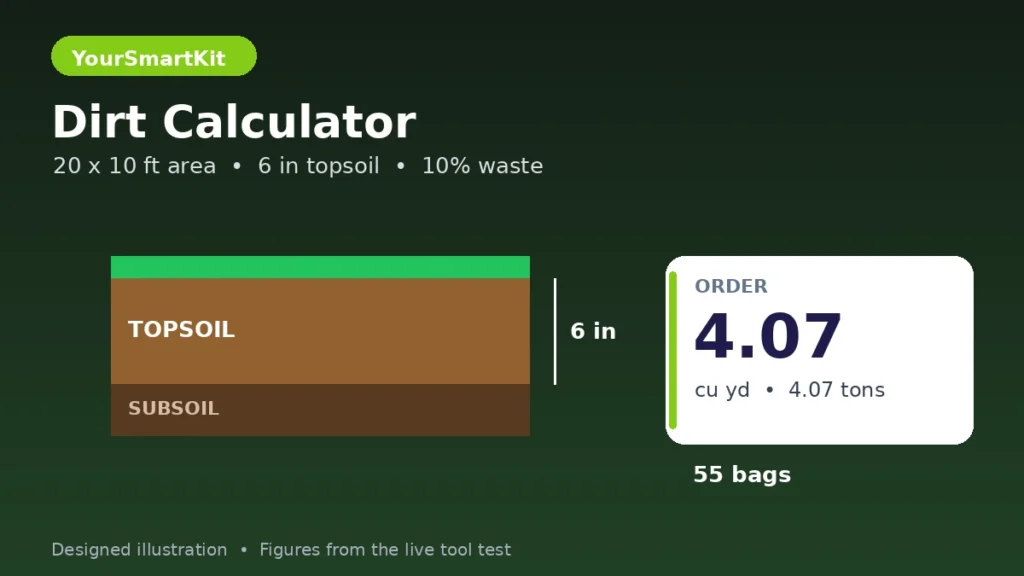
A worked example from the live tool
A 20 ft by 10 ft bed at 6 inches deep, filled with topsoil and a 10 percent settling allowance, gave an area of 200 square feet, a volume of 100.00 cubic feet, 3.70 cubic yards before waste, an order volume of 4.07 cubic yards, an estimated weight of 4.07 tons, and 55 bags of 2 cubic feet. A gravel example shows how the material changes the weight but not the volume: a 10 ft by 10 ft area at 4 inches deep, with 10 percent waste, gave 33.33 cubic feet, 1.23 cubic yards before waste, 1.36 cubic yards to order, 1.90 tons of gravel, and 19 bags. The volume is the same kind of arithmetic in both cases; only the tons-per-yard factor changes, which is why a volume tool that ignores material gives an incomplete answer for a ton-priced order.
How the maths works
Volume in cubic feet is length in feet multiplied by width in feet multiplied by depth in feet. Depth is entered in inches, so the tool divides it by 12 first. For the worked example: 20 x 10 x (6 / 12) = 100 cubic feet. Cubic yards are cubic feet divided by 27, because one cubic yard is 27 cubic feet. The order volume multiplies the exact volume by 1 plus the waste percentage divided by 100. Tons are order cubic yards multiplied by the material factor in tons per cubic yard. Bags divide the order volume in cubic feet by the bag size and round up, because part of a bag cannot be bought. A useful check: one cubic yard at 3 inches deep covers 108 square feet, at 4 inches it covers 81 square feet, and at 6 inches it covers 54 square feet. If your result is far from that check, the depth is the first input to re-check, since inches and feet are easily mixed up.
How much dirt do different projects need
Depth is chosen by the job, not by this tool. The table below gives typical depths seen across the top results, as a planning guide only. Topdressing an existing lawn is usually a quarter to half an inch. A lawn refresh or overseeding layer is often around 2 inches. A new lawn from seed commonly needs 4 to 6 inches of topsoil. Sod is often laid on at least 4 inches of prepared topsoil. Vegetable beds in the ground are commonly built at 8 to 12 inches. Raised beds vary with the bed height, and the depth you enter should be the depth of material inside the bed, not the height of the boards above the ground. Levelling and grading work is often 2 to 4 inches, but low spots need measuring at their deepest point, not their average, or the fill will run short in the hollow. For any planting job, the quality of the soil matters as much as the quantity: screened topsoil, fill dirt and compost are different materials, and the cheapest fill is a poor substitute for topsoil where plants must grow.
Coverage table: cubic yards before waste
| Area | 2 in deep | 4 in deep | 6 in deep |
|---|---|---|---|
| 100 sq ft | 0.62 | 1.23 | 1.85 |
| 500 sq ft | 3.09 | 6.17 | 9.26 |
| 1,000 sq ft | 6.17 | 12.35 | 18.52 |
Add the settling allowance to these figures before ordering. A 1,000 square foot lawn at 4 inches needs 12.35 cubic yards before waste, and about 13.58 cubic yards with 10 percent added. That gap is the difference between a finished lawn and a lawn that is thin in patches after the first watering, because loose material settles.
Material weights: why tons differ for the same volume
A cubic yard measures space, and a ton measures weight, so the same volume weighs a different amount for each material. The planning factors used by this tool are: topsoil 1.0 ton per cubic yard, fill dirt 1.2, gravel 1.4, compost 0.6, and mulch 0.3. Those figures sit inside the ranges reported by material-weight references: gravel is commonly reported around 1.2 to 1.5 tons per yard loose, dry soil around 1.0 to 1.3, compost much lighter, and mulch lighter still. Moisture is the main reason a real load differs from the estimate: wet soil can weigh 20 to 30 percent more than dry soil from the same pile, and wet gravel weighs noticeably more than dry gravel. Compaction also adds weight per yard, because pressed material holds less air. For that reason, treat the tons figure as a planning estimate. If you are charged by the ton, ask the supplier for their tons-per-yard figure for the exact product, and use the scale ticket as the final word.
Bags or bulk: how to choose
Bags suit small beds and topdressing. A 2 cubic foot bag is a convenient unit, and the tool counts bags from the order volume, so the count already includes the settling allowance. Bulk delivery suits larger areas: a standard dump truck commonly carries around 10 to 14 cubic yards, though the exact load depends on the truck and the material, so confirm with the supplier. The crossover depends on local bag prices, delivery fees and minimum loads. Small bulk loads can carry a minimum-load fee that makes bags cheaper, while a large bed bought in bags becomes expensive and slow to move. As a rule of thumb, once the order passes a few cubic yards, price a bulk quote before buying bags. When you buy bags, check the bag size on the label: a 1 cubic foot bag needs twice as many bags as a 2 cubic foot bag for the same volume, and the tool lets you change that input rather than assuming one size.
Settling, compaction and uneven ground
Loose material settles after delivery, watering and foot traffic. Topsoil commonly settles by around 10 percent, which is why the default allowance is 10 percent. For a new lawn or a raised bed that must finish at a stated depth, ordering the exact volume without an allowance leaves the finished layer thinner than planned. On uneven ground, measure the depth at the deepest point and at several other points, and use the depth that reflects the area as measured: an average depth across a hollow and a hump under-orders for the hollow and over-orders for the hump only if the two balance, which they rarely do. For a slope, split the area into sections, work out each section at its own depth, and add the results. For a round bed, work out the area as pi multiplied by the radius squared, then use that area with the depth in the same formula; this tool handles rectangles only, so a round bed needs that one extra step by hand.
Common mistakes
The most common mistake is entering depth in feet instead of inches, which makes the answer twelve times too small when the depth is typed as a small decimal, or twelve times too large in the other direction. The second is ordering the exact volume with no settling allowance. The third is using the area of the whole garden when only part of it needs material. The fourth is comparing a tons figure from one supplier with a yards figure from another without converting: one ton of gravel is only about 0.71 cubic yards, while one ton of compost is far more volume, so the two materials cannot be compared by weight alone. The fifth is forgetting that bag size changes the count: the same volume needs 27 bags of 1 cubic foot, but only about 14 bags of 2 cubic feet per cubic yard before waste, so always state the bag size alongside the count.
Limits you should know
This tool estimates volume, weight and bag count for a rectangular area at one depth. It does not test soil quality, drainage, contamination or suitability for planting. It does not price the order, because prices vary by place, product and week. It does not account for access: a truck that cannot reach the area means barrowing, which changes the practical order size. It does not handle trenches, slopes or irregular shapes in a single run. Confirm the final quantity with your supplier, and give them the dimensions and the material, not only the yard figure, so a unit error can be spotted before delivery.
Privacy note
The calculation runs in your browser. The numbers you type are not uploaded or stored by this tool. If a result looks wrong, use the Contact page and include the length, width, depth, material and waste percentage you entered, so the error can be repeated.
Related tools
Try the unit converter for feet, inches and yards, the geometry calculator for round and other area shapes, the mass converter for pounds and tons, and the calculators hub for the full set.
Frequently asked questions
How many cubic yards of dirt do I need for a 10×10 area 6 inches deep?
1.85 cubic yards before waste, or about 2.04 cubic yards with 10 percent added. The formula is 10 x 10 x (6 / 12) = 50 cubic feet, divided by 27.
How many bags of topsoil equal a cubic yard?
It depends on the bag size. At 2 cubic feet per bag, about 14 bags make a cubic yard before waste. At 1 cubic foot per bag, 27 bags make a yard. This tool counts bags from the order volume, after waste, so its count is slightly higher than a no-waste count.
How much does a cubic yard of topsoil weigh?
About 1 ton as a planning figure, though the real weight varies with moisture and composition, from roughly 1,000 to 3,000 pounds in published ranges for topsoil. Wet soil weighs more than dry soil, so confirm with the supplier for a ton-priced order.
How much does a cubic yard of gravel weigh?
About 1.4 tons as a planning figure, inside the commonly reported loose range of about 1.2 to 1.5 tons per yard. One ton of gravel is therefore about 0.71 cubic yards.
How deep should topsoil be for a new lawn?
A new lawn from seed commonly needs 4 to 6 inches of topsoil, and sod is often laid on at least 4 inches. A lawn refresh needs far less, often around 2 inches or less for topdressing.
Should I add extra for settling?
Yes, in most cases. Loose material settles after watering and traffic, and 10 percent is the usual planning allowance used by this tool. Add it before ordering, not after the material arrives thin.