
Figure Concrete for Slab Calculator
Calculation runs in the browser; nothing is uploaded or stored.
How to use this concrete slab tool
Enter the length and width of the slab in feet, the thickness in inches, and a waste percentage. The default waste is 10 percent. Press Calculate concrete. Read the order volume, not only the exact volume: the exact volume is the space inside the forms, and the order volume adds the waste allowance for spillage, uneven ground and forms that are not perfectly level. If your supplier sells ready-mix in whole or half yards, round the order volume up to the next increment they offer. Do not round it down. A short load can stop a pour halfway, and a second load rarely matches the first pour exactly in colour and finish.
A worked example from the live tool
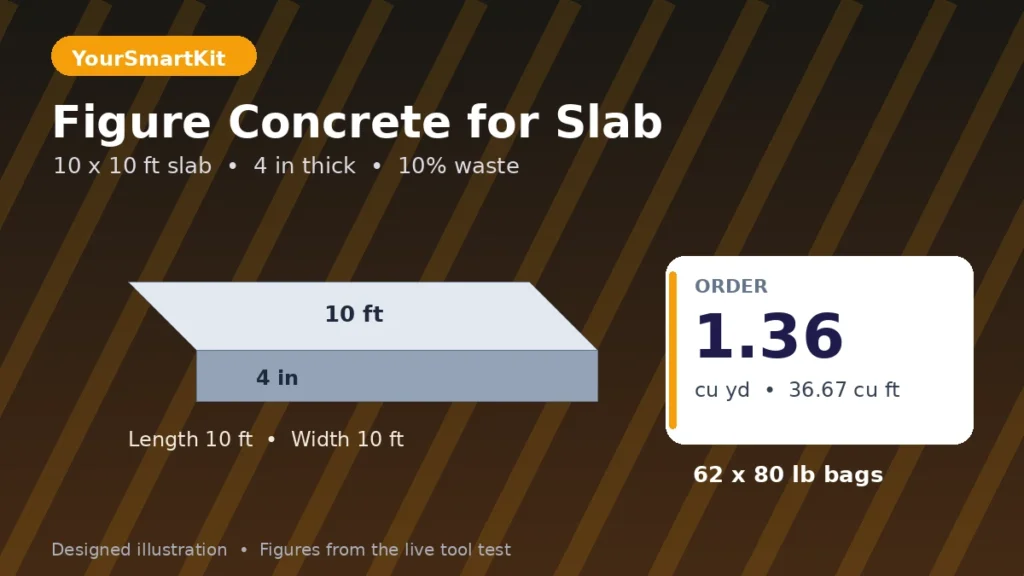
A 10 ft by 10 ft patio at 4 inches thick, with 10 percent waste, gave 33.33 cubic feet before waste and 36.67 cubic feet after waste, which is 1.36 cubic yards. That order volume needs 62 bags of 80 lb mix, 82 bags of 60 lb mix, or 123 bags of 40 lb mix. A larger example, 12 ft by 16 ft at 6 inches thick with 10 percent waste, gave 96.00 cubic feet before waste, 105.60 cubic feet after waste, 3.91 cubic yards, and 176 bags of 80 lb mix. The second example shows why thickness matters as much as area: doubling the thickness from 3 inches to 6 inches doubles the concrete, even though the patio footprint does not change at all.
How the maths works
Volume in cubic feet is length in feet multiplied by width in feet multiplied by thickness in feet. Thickness is entered in inches, so the tool divides it by 12 first. For the 10 ft by 10 ft slab at 4 inches: 10 x 10 x (4 / 12) = 33.33 cubic feet. One cubic yard holds 27 cubic feet, so cubic yards are cubic feet divided by 27. Waste is applied before any bag count: order volume is exact volume multiplied by 1 plus the waste percentage divided by 100. Bag counts divide the order volume by the yield of one bag and always round up, because a bag cannot be bought in part. The yields used here are 0.60 cubic feet for an 80 lb bag, 0.45 cubic feet for a 60 lb bag, and 0.30 cubic feet for a 40 lb bag. Those yields are the standard published yields for bagged concrete mix; check the bag you actually buy, because a different product can yield a different volume, and the bag label wins over any calculator.
Common slab sizes at 4 inches, before waste
The table below is computed from the same formula, with no waste added, so add your own allowance before ordering. Bag counts are 80 lb bags, rounded up.
| Slab | Area | Cubic yards | 80 lb bags |
|---|---|---|---|
| 8 x 8 ft | 64 sq ft | 0.79 | 36 |
| 10 x 10 ft | 100 sq ft | 1.23 | 56 |
| 10 x 12 ft | 120 sq ft | 1.48 | 67 |
| 12 x 12 ft | 144 sq ft | 1.78 | 80 |
| 20 x 20 ft | 400 sq ft | 4.94 | 223 |
At 6 inches, a 10 ft by 10 ft slab needs 1.85 cubic yards and 84 bags of 80 lb mix before waste, and a 12 ft by 12 ft slab needs 2.67 cubic yards and 120 bags before waste. A quick check that catches many errors: one cubic yard covers 324 divided by the thickness in inches, in square feet. At 4 inches, one yard covers 81 square feet. At 6 inches, one yard covers 54 square feet. If your answer is far from that check, re-measure the thickness first, because thickness is the input most often entered in the wrong unit.
How thick should a slab be
Thickness is a design decision, not a number this tool can choose for you. As a planning guide only, light foot traffic, patios, walkways and shed floors are commonly built at 4 inches, while driveways and garage floors that carry vehicles are commonly built at 5 to 6 inches. Those are typical ranges seen across the top results, not a rule for your site, and local building rules, soil, drainage and the loads the slab must carry can change the right thickness. If the slab will carry a vehicle, a heavy shed, a hot tub or a wall, get the thickness and reinforcement specified by a qualified person before ordering. This page estimates volume only. It does not check whether a slab of that thickness is strong enough for its use, and it does not replace a structural check.
Bags or ready-mix: how to choose
Bagged mix suits small jobs. Below about one cubic yard, bags are usually the practical choice: no truck booking, no minimum-load fee, and you can buy a few extra bags as insurance. Above about one cubic yard, ready-mix delivery is usually cheaper per yard and far faster to place, because mixing hundreds of bags by hand is slow and the first batches can start to set before the last ones are mixed. The break-even point is not a fixed number. It depends on bag prices near you, delivery and short-load fees, how far the concrete must be moved on site, and whether you have help. Use the tool twice when you are near the boundary: once for the bag count, once for the order volume in yards, then price both options with real local quotes. Do not order bags for a 4-yard slab on price alone without counting the labour and the setting time.
Measuring tips that change the answer
Measure inside the forms, not outside the boards, because the boards themselves add inches that are not concrete. Measure length and width at more than one place when the site is not square: use the largest dimensions for ordering, or split an L-shaped area into two rectangles and add the two volumes together, since this tool handles one rectangle at a time. Check the depth at several points with a tape or a straight edge, because a base that dips by half an inch across a patio adds real volume. Keep the waste percentage at 10 percent unless your forms are dead level, tight and on a firm, even base; on rough or sloping ground, a higher allowance is safer than a short pour. Record the measurements on the day of the pour, not a week earlier, because formwork moves when it is staked, braced and walked on.
Common mistakes
The most common mistake is entering thickness in feet instead of inches, which makes the answer twelve times too large. The second is measuring the outside of the forms. The third is ordering the exact volume with no waste allowance, then running short on uneven ground. The fourth is counting bags from the exact volume instead of the order volume, which leaves the waste allowance unbagged. The fifth is comparing bag counts from two calculators without checking whether both included waste: a count with 10 percent waste looks larger than a count without it, but neither is wrong, they simply answer different questions. This page states its basis on every result so the comparison is fair: bags are always counted from the order volume, after waste.
Limits you should know
This tool covers rectangular slabs only. It does not calculate round pads, footings, columns, walls, curbs or steps, and it does not subtract openings, pipes or embedded items. It does not estimate cost, because prices vary by place and by week, and a price typed into this page would go stale. It does not choose a mix strength, a slump, reinforcement, joints or a curing method. Those choices depend on the use of the slab and on local practice, and they belong with the supplier or a qualified person. The result is a planning estimate. Confirm the final order quantity with your supplier, and tell them the slab dimensions, not only the yard figure, so they can spot a unit error before the truck leaves.
Privacy note
The calculation runs in your browser. The numbers you type are not uploaded or stored by this tool. If a result looks wrong, use the Contact page and include the length, width, thickness and waste percentage you entered, so the error can be repeated.
Related tools
Try the unit converter for feet, inches and yards, the geometry calculator for area shapes beyond a rectangle, the mass converter for weight units, and the calculators hub for the full set.
Frequently asked questions
How many cubic yards of concrete do I need for a 10×10 slab 4 inches thick?
1.23 cubic yards before waste, or 1.36 cubic yards with 10 percent waste. The live tool gives 33.33 cubic feet before waste and 36.67 cubic feet after waste for that slab.
How many 80 lb bags of concrete are in a cubic yard?
45 bags, because one cubic yard is 27 cubic feet and one 80 lb bag yields about 0.60 cubic feet. A 60 lb bag yields about 0.45 cubic feet, so 60 bags make a yard, and a 40 lb bag yields about 0.30 cubic feet, so 90 bags make a yard.
How much extra concrete should I order for waste?
10 percent is the usual planning allowance used by this tool. Use it unless your forms are level and tight; on rough or sloping ground, allow more rather than risking a short pour.
Is bagged concrete or ready-mix cheaper?
It depends on the size of the job and local prices. Bags suit jobs under about one cubic yard. Ready-mix is usually better value and much faster above that size. Price both options with real local quotes before deciding.
How thick should a concrete patio slab be?
Patios, walkways and shed floors are commonly built at 4 inches, while driveways and garage floors carrying vehicles are commonly built at 5 to 6 inches. Those are typical ranges only; local rules and loads can change the right thickness.
Can this tool calculate a round pad or a footing?
No. This tool handles rectangular slabs only. For a round pad, work out the area as pi multiplied by the radius squared, multiply by the thickness in feet, divide by 27 for cubic yards, and add a waste allowance.