
EMI Calculator
Enter the loan amount, the annual interest rate, and the tenure in months. The tool works out the monthly EMI, the total interest, the total payment, a month-by-month amortisation schedule, and what the same loan would cost on a flat rate.
An EMI is a fixed monthly payment that repays a loan in full over its tenure, covering both interest and principal. Enter the loan amount, annual rate and tenure above, and this calculator gives the monthly EMI, the total interest and the total payment, plus a month-by-month schedule and a flat-rate comparison for the same loan.
How do I use the EMI Calculator?
Enter three numbers. The loan amount is the principal you borrow, before any fees. The annual interest rate is the rate your lender quotes per year, written as a percentage, for example 10 for 10% per year. The tenure is the number of monthly payments, for example 60 for five years. Press the calculate button and four result boxes appear: the monthly EMI, the total interest over the whole tenure, the total payment (principal plus interest), and the share of the total payment that is interest.
Below the result boxes, the flat-rate comparison box shows what the same loan would cost if the same rate were charged on a flat basis: the flat-rate EMI, the flat-rate total interest, the flat-rate total payment, and the extra interest compared with the reducing-balance result. Below that, the amortisation schedule table shows the first 12 months in full, with each month’s EMI, interest part, principal part and remaining balance. For tenures over 12 months, a yearly summary table follows, with one row per year.
Check the rate before you calculate. The tool expects an annual rate, so a lender quote of 10% per year goes in as 10, not as 0.83. Entering a monthly rate by mistake makes the EMI far too large, because the tool divides the entered rate by 12 again. A rate of 0 is allowed and means the principal is simply split evenly across the months. A tenure must be a whole number of months. If a field is missing, zero, or negative, the tool shows a plain-language error and no results.
A worked example from the live tool
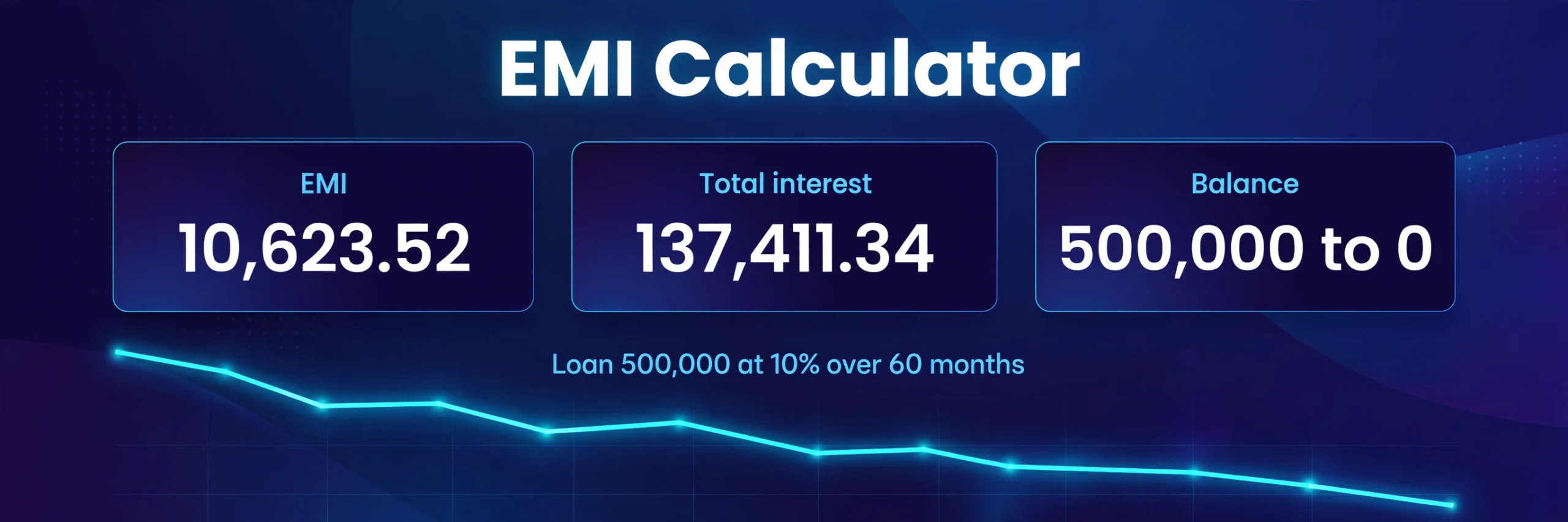
Start with the first verified test: a loan of 500,000 at 10% per year over 60 months. The monthly rate is 10 divided by 12 divided by 100, which is 0.008333. The tool applies the EMI formula (shown in full in the next section) and gives a monthly EMI of 10,623.52. Multiply that EMI by 60 months and the total payment is 637,411.34. Subtract the loan amount of 500,000 and the total interest is 137,411.34. Interest is therefore 21.56% of the total payment, since 137,411.34 divided by 637,411.34 is 0.2156.
The schedule shows where each payment goes. In month 1, the interest part is the balance of 500,000 multiplied by the monthly rate of 0.008333, which is 4,166.67. The principal part is the EMI minus that interest: 10,623.52 minus 4,166.67 gives 6,456.86. The balance falls by the principal part, so 500,000 minus 6,456.86 leaves 493,543.14. In month 2, the interest part is 493,543.14 multiplied by 0.008333, which is 4,112.86, and the principal part rises to 6,510.66, leaving a balance of 487,032.48. In month 3, the interest part is 4,058.60 and the principal part is 6,564.92, leaving 480,467.56. By month 12, the interest part has fallen to 3,549.50 and the principal part has risen to 7,074.02, leaving a balance of 418,865.94.
The last month shows how far the split has moved. In month 60, the balance before the payment is 10,535.72, so the interest part is only 87.80 and the principal part is 10,535.72, which clears the balance to 0.00. The EMI never changes, but its contents reverse: interest is 39.22% of the first payment and only 0.83% of the last one.
The yearly summary tells the same story in five rows. Year 1 pays 46,348.21 in interest and 81,134.06 in principal, for a total of 127,482.27, ending with a balance of 418,865.94. Year 2 pays 37,852.41 in interest and 89,629.86 in principal, ending at 329,236.08. Year 3 pays 28,466.99 in interest and 99,015.27 in principal, ending at 230,220.81. Year 4 pays 18,098.80 in interest and 109,383.47 in principal, ending at 120,837.34. Year 5 pays 6,644.92 in interest and 120,837.34 in principal, ending at 0.00. Each year pays the same 127,482.27 in total, but the interest share falls every year while the principal share rises.
The flat-rate comparison for this loan is stark. Flat-rate total interest is the principal multiplied by the rate multiplied by the years: 500,000 × 10% × 5 = 250,000.00. The flat EMI is the principal plus that interest, divided by the months: 750,000.00 divided by 60 = 12,500.00. The flat-rate total payment is 750,000.00, which is 112,588.66 more than the reducing-balance total of 637,411.34. The same “10%” costs 112,588.66 extra when it is charged flat instead of on the falling balance.
What is the EMI formula?
The standard reducing-balance EMI formula is EMI = P × r × (1+r)^n / ((1+r)^n − 1), where P is the loan amount, r is the monthly interest rate as a decimal (annual rate divided by 12, then divided by 100), and n is the number of monthly payments. The formula finds the single fixed payment that, after paying each month’s interest, brings the balance to exactly zero at the last payment.
Take the worked example and follow the arithmetic. P is 500,000, the annual rate is 10%, so r is 10 / 12 / 100 = 0.008333, and n is 60. First, (1+r)^60 is 1.008333 raised to the power of 60, which is 1.6453. Next, the numerator is P × r × (1+r)^n, which is 500,000 × 0.008333 × 1.6453 = 6,855.42. The denominator is (1+r)^n − 1, which is 1.6453 − 1 = 0.6453. Divide the two and the result is 6,855.42 / 0.6453 = 10,623.52. Small rounding differences in the intermediate steps can move the last few cents, which is why the tool keeps full precision inside the calculation and rounds only for display.
The formula has one special case. When the rate is zero, r is 0, and the formula would divide by zero, so the tool takes the direct route instead: EMI = principal divided by months. A loan of 120,000 at 0% over 12 months gives an EMI of 10,000.00, a total payment of 120,000.00, and total interest of 0.00, with every month paying 10,000.00 of principal and 0.00 of interest. The flat-rate comparison gives the same figures at a zero rate, because flat interest is also zero.
A spreadsheet check uses the same maths. In Excel or Google Sheets, =PMT(10%/12, 60, -500000) returns about 10,623.52, and =PMT(8%/12, 12, -100000) returns about 8,698.84, matching the two main verified tests. The minus sign makes the result positive. The IPMT and PPMT functions give the interest and principal parts for a given month, which is a useful way to check a schedule row by hand.
For the present value of money paid over time, see the time value of money calculator.
How does the amortisation schedule work?
An amortisation schedule is the month-by-month record of a reducing-balance loan. Each month, the lender first charges interest on the balance still owed, and the rest of the EMI repays principal. Because the balance falls after every payment, the interest charged next month is slightly smaller, which leaves slightly more of the same fixed EMI for principal. That is the whole mechanism: a fixed payment, a shrinking balance, a falling interest part, and a rising principal part.
The early months feel slow because the balance is at its largest, so the interest part is at its largest too. In the worked example, the first payment of 10,623.52 contains 4,166.67 of interest, which is 39.22% of the payment, and only 6,456.86 of principal. After 12 payments, the balance is still 418,865.94, which is 83.77% of the original 500,000. A borrower who checks the balance after a year of payments and finds most of the loan still there has not found an error; that is how a reducing-balance loan behaves when the rate is 10% and the tenure is 60 months.
The schedule also shows why the last payments are almost all principal. In month 60, the balance before the payment is 10,535.72, so the interest is 87.80 and the principal is 10,535.72. The final payment clears the loan exactly, and the tool adjusts the final principal part to the remaining balance so the schedule ends at 0.00 rather than leaving a few cents over or under.
Yearly totals are the same schedule added up by year, and they make the pattern easier to read on a long loan. Year 1 of the worked example pays 46,348.21 in interest, which is more than a third of the total interest of 137,411.34, even though it is only a fifth of the tenure. Year 5 pays only 6,644.92 in interest. Anyone comparing two tenures should look at these yearly rows, not only at the EMI, because the EMI hides how much of the early money goes to interest.
For how interest builds up over time on savings or debt, see the compound interest calculator.
What is the difference between reducing-balance and flat-rate interest?
Reducing-balance interest is charged only on the amount still owed, which falls every month. Flat-rate interest is charged on the full original loan amount for the whole tenure, including money already repaid. That single difference decides which quote is cheaper, and it is the reason a flat rate that looks low can cost more than a higher reducing-balance rate.
The second verified test makes the point with a one-year loan. Borrow 100,000 at 8% per year over 12 months. On a reducing balance, the EMI is 8,698.84, the total payment is 104,386.11, and the total interest is 4,386.11. The first month charges 666.67 in interest on the full 100,000, and the principal part is 8,032.18, leaving 91,967.82. By month 12, the interest part is 57.61 and the principal part is 8,641.23, clearing the balance to 0.00. On a flat basis, the total interest is 100,000 × 8% × 1 = 8,000.00, the flat EMI is 108,000.00 divided by 12 = 9,000.00, and the total payment is 108,000.00. The flat version costs 3,613.89 more in interest for the same loan, the same rate, and the same tenure.
The worked example shows the same gap at a larger scale: 10% flat on 500,000 over 5 years costs 250,000.00 in interest against 137,411.34 on a reducing balance, a difference of 112,588.66. The flat EMI is 12,500.00 against a reducing-balance EMI of 10,623.52. One way to read the comparison is to ask what flat rate would equal the reducing-balance cost. For the worked example, the reducing-balance interest of 137,411.34 spread over the original principal and five years is 137,411.34 / (500,000 × 5) = 5.50%, so 10% reducing costs the same as about 5.50% flat. For the one-year test, 4,386.11 / 100,000 = 4.39%, so 8% reducing equals about 4.39% flat. When two lenders quote different methods, compare total repayment, not the headline rate, and ask for the reducing-balance rate or the annual percentage rate before deciding.
How do tenure and interest rate change the EMI?
Tenure and rate pull the EMI in opposite directions, and the trade is not even. A longer tenure lowers the monthly EMI but raises the total interest, because interest is charged for more months. A higher rate raises both the EMI and the total interest. The quick-reference table below is computed from the same formula the tool uses, for a loan of 100,000 at 8% per year, and every row can be checked with the formula above.
| Tenure | Monthly EMI | Total payment | Total interest |
| 12 months | 8,698.84 | 104,386.11 | 4,386.11 |
| 24 months | 4,522.73 | 108,545.50 | 8,545.50 |
| 36 months | 3,133.64 | 112,810.92 | 12,810.92 |
| 60 months | 2,027.64 | 121,658.37 | 21,658.37 |
Stretching the same loan from 12 months to 60 months cuts the EMI from 8,698.84 to 2,027.64, which is less than a quarter of the original payment. The cost of that relief is visible in the last column: total interest rises from 4,386.11 to 21,658.37, nearly five times as much. The EMI falls by roughly three quarters while the interest rises by roughly five times, because the balance stays high for longer and keeps earning interest.
The rate matters just as much. At the same 60-month tenure on 500,000, the EMI is 10,623.52 at 10%. A rate one point lower or higher moves the EMI by several hundred a month and the total interest by tens of thousands over five years, so a small difference in the quoted rate is worth checking with the tool before accepting a loan. The tool itself charges no fees and adds none, so the figures it gives are the principal-and-interest figures only; the limits section below explains what is left out.
For the monthly payment on a plain loan without a schedule, see the loan calculator.
What happens if I prepay part of the loan?
Prepayment means paying extra toward the principal, beyond the regular EMI. Because reducing-balance interest is charged on the balance still owed, an extra payment lowers the balance at once, and every later month then charges interest on that smaller balance. The total interest falls, and the loan either ends sooner or the EMI falls, depending on what the lender allows. Which of those two happens is a term of the loan, not a property of the formula, so it needs to be checked with the lender before relying on it.
This calculator does not model prepayment, because it would need a prepayment amount, a month, and the lender’s rule for applying it. The site’s loan early repayment calculator covers that case: it takes a loan and an early repayment and shows how the balance, interest and tenure change. The figures in this article describe a loan repaid by equal monthly payments only, with no extra payments and no missed payments.
What mistakes do people commonly make with EMI?
The first mistake is comparing a flat rate directly with a reducing-balance rate as if they were the same kind of number. They are not. A 10% flat rate on the worked example costs 112,588.66 more than a 10% reducing-balance rate, so a flat quote has to be roughly half the reducing rate to cost the same. The flat-rate comparison box on this page exists to make that check in one step.
The second mistake is choosing a loan by the EMI alone. A longer tenure gives a smaller EMI, which feels easier month to month, but the quick-reference table shows the price: the 60-month version of a 100,000 loan at 8% costs 21,658.37 in interest against 4,386.11 over 12 months. The EMI answers whether the payment fits the month; the total interest answers what the loan costs overall. Both numbers belong in the decision.
The third mistake is entering the wrong rate. Lenders quote an annual rate, and this tool expects an annual rate. Entering a monthly rate, or entering 0.10 when the tool expects 10, gives a wrong EMI in opposite directions: one far too large, the other far too small. The rate field is labelled as an annual percentage, and the worked examples use 10 and 8 in that form.
The fourth mistake is forgetting what the EMI leaves out. This calculator covers principal and interest only. Processing fees, insurance, taxes and other lender charges are excluded, and they are real money that a borrower still pays. A loan whose EMI looks cheap can still be expensive once fees are added, so the EMI figure should be read alongside the lender’s full list of charges, not instead of it.
The fifth mistake is treating the EMI as fixed when the rate can move. The figures on this page assume the rate stays the same for the whole tenure. On a floating-rate loan, the lender can change the rate, and then the EMI or the tenure changes with it. A fixed-rate loan holds the EMI steady; a floating-rate loan does not promise that. The sanction letter or loan agreement states which kind the loan is.
What does this EMI calculator leave out?
This calculator models a reducing-balance loan repaid in equal monthly instalments at a fixed annual rate, with no fees, no insurance, no taxes, no prepayment, no missed payments, and no rate changes during the tenure. Processing fees, insurance premiums, taxes and other lender charges are excluded from every figure on the page, including the flat-rate comparison. A loan with a balloon payment at the end, a stepped EMI, or a moratorium period is a different structure and is not covered here.
The results are planning figures, not a lender’s offer. The actual EMI on a sanction letter can differ because of fees, the exact start date, the lender’s rounding, or a rate that resets during the tenure. The figures here are general information only and are not financial advice. For the terms of a real loan, the lender’s documents are the source to rely on.
What information does this tool store?
This tool works from the numbers typed into it on the page. It does not ask for a name, an email address, or any account detail, and the article itself carries no personal information. A reader who wants to keep a result can note it down separately; the tool does not need any personal detail to produce an EMI, a schedule, or a flat-rate comparison. The results are shown on the page in the labelled boxes and tables above, and the worked examples in this article use only the verified test figures listed at the end, so a reader can check the tool against a known answer before trusting it with a real loan.
For more tools in the same collection, browse the calculators category.
Frequently asked questions
FAQ 1 — How do I calculate EMI for a loan?
Use the reducing-balance formula EMI = P × r × (1+r)^n / ((1+r)^n − 1), where P is the loan amount, r is the monthly rate (annual rate divided by 12, then by 100), and n is the number of months. For 500,000 at 10% over 60 months, that gives an EMI of 10,623.52, a total payment of 637,411.34, and total interest of 137,411.34.
FAQ 2 — What is the difference between reducing-balance and flat-rate EMI?
Reducing-balance interest is charged only on the balance still owed, which falls every month, while flat-rate interest is charged on the full original loan amount for the whole tenure. For 100,000 at 8% over 12 months, the reducing-balance EMI is 8,698.84 with 4,386.11 of interest, while the flat-rate EMI is 9,000.00 with 8,000.00 of interest, a difference of 3,613.89.
FAQ 3 — Why is the interest part high in the early months?
Because interest is charged on the balance still owed, and the balance is largest at the start. In the worked example, month 1 of a 500,000 loan at 10% charges 4,166.67 in interest and repays 6,456.86 of principal, while month 60 charges only 87.80 in interest and repays 10,535.72 of principal.
FAQ 4 — Does a longer tenure lower my EMI?
Yes, but it raises the total interest. For 100,000 at 8%, the EMI is 8,698.84 over 12 months and 2,027.64 over 60 months, while total interest rises from 4,386.11 to 21,658.37. A smaller monthly payment costs more overall.
FAQ 5 — What does the amortisation schedule show?
It shows, month by month, how each EMI splits into an interest part and a principal part, and what balance remains. The first 12 months are shown in full on this page, with a yearly summary for longer tenures, so the shift from interest-heavy early payments to principal-heavy late payments is visible.
FAQ 6 — Does this EMI calculator include fees, insurance or taxes?
No. It covers principal and interest only, on a reducing balance at a fixed annual rate. Processing fees, insurance, taxes and other lender charges are excluded from the EMI, the totals, the schedule and the flat-rate comparison, and the figures are general information, not financial advice.
How do I calculate EMI for a loan?
Use the reducing-balance formula EMI = P × r × (1+r)^n / ((1+r)^n − 1), where P is the loan amount, r is the monthly rate (annual rate divided by 12, then by 100), and n is the number of months. For 500,000 at 10% over 60 months, that gives an EMI of 10,623.52, a total payment of 637,411.34, and total interest of 137,411.34.
What is the difference between reducing-balance and flat-rate EMI?
Reducing-balance interest is charged only on the balance still owed, which falls every month, while flat-rate interest is charged on the full original loan amount for the whole tenure. For 100,000 at 8% over 12 months, the reducing-balance EMI is 8,698.84 with 4,386.11 of interest, while the flat-rate EMI is 9,000.00 with 8,000.00 of interest, a difference of 3,613.89.
Why is the interest part high in the early months?
Because interest is charged on the balance still owed, and the balance is largest at the start. In the worked example, month 1 of a 500,000 loan at 10% charges 4,166.67 in interest and repays 6,456.86 of principal, while month 60 charges only 87.80 in interest and repays 10,535.72 of principal.
Does a longer tenure lower my EMI?
Yes, but it raises the total interest. For 100,000 at 8%, the EMI is 8,698.84 over 12 months and 2,027.64 over 60 months, while total interest rises from 4,386.11 to 21,658.37. A smaller monthly payment costs more overall.
What does the amortisation schedule show?
It shows, month by month, how each EMI splits into an interest part and a principal part, and what balance remains. The first 12 months are shown in full on this page, with a yearly summary for longer tenures, so the shift from interest-heavy early payments to principal-heavy late payments is visible.
Does this EMI calculator include fees, insurance or taxes?
No. It covers principal and interest only, on a reducing balance at a fixed annual rate. Processing fees, insurance, taxes and other lender charges are excluded from the EMI, the totals, the schedule and the flat-rate comparison, and the figures are general information, not financial advice.