
Bench Press Calculator
Enter the weight you lifted and the number of reps you completed, then calculate your estimated one-rep max.
Enter 1 to 10 reps for the most reliable estimate. The tool still calculates for 11 or 12 reps, and says so plainly, but estimates from sets above 10 reps are less reliable.
A bench PR calculator estimates your bench press one-rep max from a set you already lifted. Enter the weight and the reps you completed, and it gives three estimates, one from each of the Epley, Brzycki, and Lombardi formulas, plus a table of training loads as percentages of the Epley figure.
How do I use the Bench Press Calculator?
Enter the total weight you lifted, including the bar and all plates, in the weight field. Choose kg or lb to match the unit you lifted in. The formulas work in either unit, and the results come back in the same unit you entered, so a weight entered in kg gives a one-rep max in kg, and a weight entered in lb gives one in lb. Do not mix units: if the plates are marked in kg, enter kg, and if they are marked in lb, enter lb.
Then enter the number of full reps you completed with that weight. Only count reps finished with the same form as the first rep. A rep that needed a spotter to lift the bar off your chest is not a completed rep, and counting it will push the estimate higher than your real strength supports. Press the calculate button and three result boxes appear: the Epley estimate, the Brzycki estimate, and the Lombardi estimate. Below them, a table shows 100%, 90%, 80%, 70%, 60%, and 50% of the Epley figure, which are the training loads a lifter reads off when planning sets.
Use a set taken close to failure, and keep the rep count at 10 or below. The tool accepts up to 12 reps and says plainly when an estimate comes from a set above 10 reps, because those estimates are less reliable. It does not accept more than 12 reps, and it shows a plain-language error for a missing weight, a missing rep count, a weight of zero, a rep count of zero, or a rep count that is not a whole number. No result boxes appear until the inputs are valid.
What does a worked example from the live tool show?
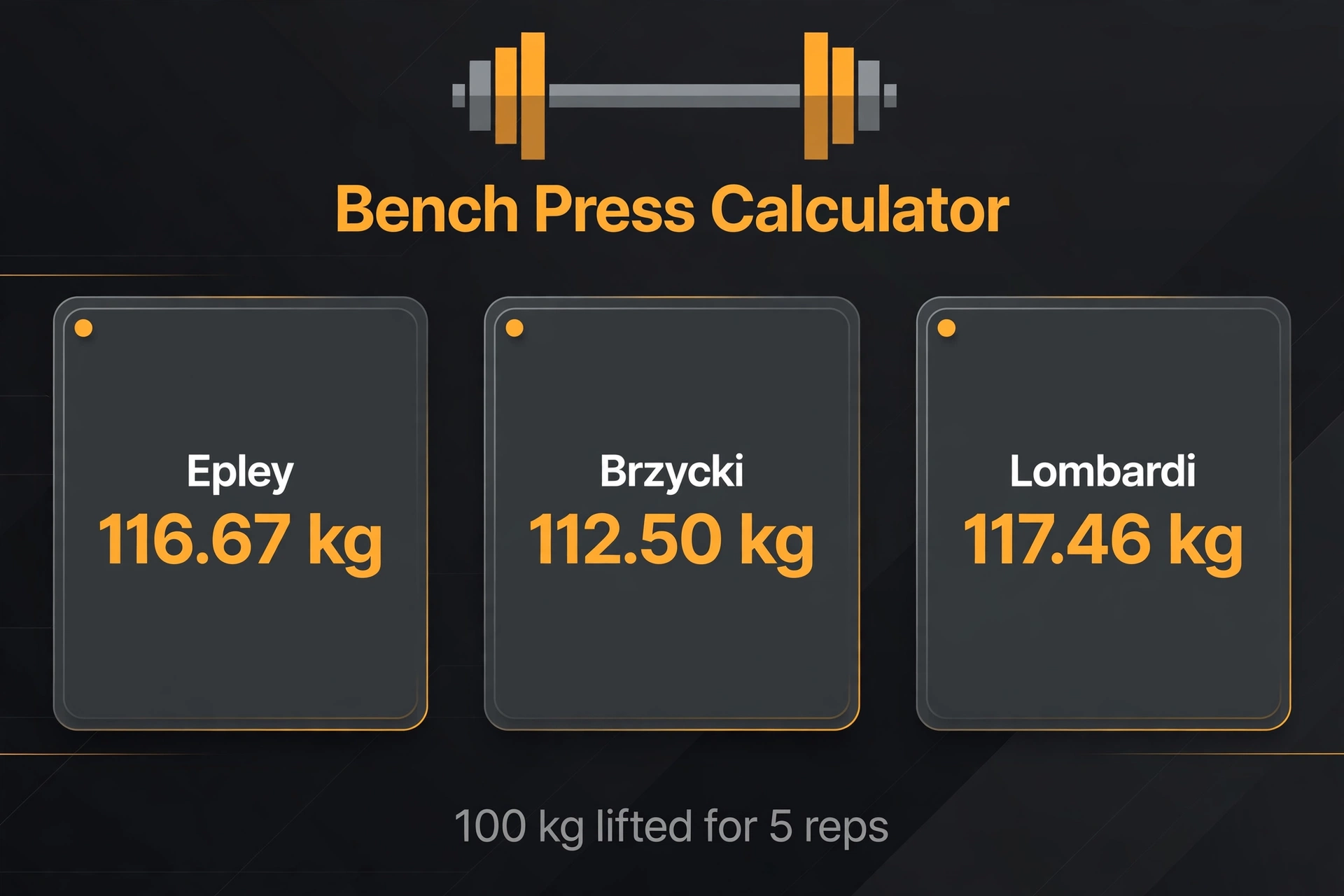
Start with the first verified test: 100 kg lifted for 5 reps. The Epley formula multiplies the weight by one plus the reps divided by 30. Five divided by 30 is 0.1667, so one plus 0.1667 is 1.1667, and 100 multiplied by 1.1667 is 116.67 kg. The Brzycki formula multiplies the weight by 36 divided by 37 minus the reps. Thirty-seven minus 5 is 32, 36 divided by 32 is 1.125, and 100 multiplied by 1.125 is 112.50 kg. The Lombardi formula multiplies the weight by the reps raised to the power of 0.10. Five raised to 0.10 is 1.1746, and 100 multiplied by 1.1746 is 117.46 kg.
The three answers for the same set are therefore 116.67 kg by Epley, 112.50 kg by Brzycki, and 117.46 kg by Lombardi. The spread between the lowest and the highest is 4.96 kg, which is about 4% of the Epley figure. That spread is normal. It does not mean one formula is broken and the others are right. It means three different fits to different groups of lifters give three slightly different answers from the same set, and the honest way to report them is to show all three.
The percentage table for this test is built from the Epley figure of 116.67 kg. One hundred percent is 116.67 kg. Ninety percent is 105.00 kg, because 116.67 multiplied by 0.90 is 105.00. Eighty percent is 93.33 kg, because 116.67 multiplied by 0.80 is 93.33. Seventy percent is 81.67 kg, because 116.67 multiplied by 0.70 is 81.67. Sixty percent is 70.00 kg, because 116.67 multiplied by 0.60 is 70.00. Fifty percent is 58.33 kg, because 116.67 multiplied by 0.50 is 58.33. Every row is the same multiplication with a different percentage, so any row can be checked by hand from the Epley figure.
A second test shows how the formulas behave at higher reps. Lift 80 kg for 8 reps and the Epley result is 101.33 kg, because 80 multiplied by one plus 8 divided by 30 is 80 multiplied by 1.2667. Brzycki gives 99.31 kg, because 80 multiplied by 36 divided by 29 is 80 multiplied by 1.2414. Lombardi gives 98.49 kg, because 80 multiplied by 8 raised to 0.10 is 80 multiplied by 1.2311. At 8 reps the order has flipped: Lombardi is now the lowest of the three, where at 5 reps it was the highest. The percentage table from the Epley figure of 101.33 kg reads 101.33 kg at 100%, 91.20 kg at 90%, 81.07 kg at 80%, 70.93 kg at 70%, 60.80 kg at 60%, and 50.67 kg at 50%.
A third test, at the edge of the reliable range, is 60 kg for 10 reps. Epley gives 80.00 kg, because 60 multiplied by one plus 10 divided by 30 is 60 multiplied by 1.3333. Brzycki also gives 80.00 kg, because 60 multiplied by 36 divided by 27 is also 60 multiplied by 1.3333. Lombardi gives 75.54 kg, because 60 multiplied by 10 raised to 0.10 is 60 multiplied by 1.2589. The percentage table from 80.00 kg is a round set of numbers: 80.00 kg, 72.00 kg, 64.00 kg, 56.00 kg, 48.00 kg, and 40.00 kg at 100% down to 50%. The fact that Epley and Brzycki agree exactly at 10 reps is not a coincidence in these numbers. It follows from the formulas themselves, and the next sections explain why.
What is a one-rep max, and what does a bench PR mean?
A one-rep max, written 1RM, is the heaviest weight a lifter can move for one complete repetition of an exercise with good form. For the bench press, that means lowering the bar to the chest and pressing it back to full arm extension once, without help and without the bar bouncing off the chest. The weight that goes up once and only once is the 1RM for that lift on that day.
A PR, short for personal record, is the best a lifter has done in a given lift. A bench PR usually means the heaviest single bench press a lifter has completed, which is the same thing as a tested 1RM. But the letters PR also get used for a rep PR, such as the heaviest weight lifted for 5 reps, which is a different number from a 1RM. This page uses PR in the one-rep sense: the bench PR is the heaviest single bench press, and the calculator estimates it from a multi-rep set so that a lifter does not have to attempt a true single to know roughly where it sits.
That distinction matters because an estimated 1RM and a tested 1RM are not the same thing. An estimate is a calculation from a set that was actually lifted. A tested 1RM is a weight that was actually pressed once. The estimate can be close, and for low-rep sets it often is, but it is still a prediction. The only way to know a true 1RM is to lift it, and the only sound way to use an estimate is to treat it as a guide for choosing training weights, not as a weight already lifted.
How does the Epley formula work?
The Epley formula is 1RM = w × (1 + r ÷ 30), where w is the weight lifted and r is the number of reps completed. It was published by strength coach Boyd Epley in 1985, in his poundage chart in the Boyd Epley Workout. It is the most widely used of the three formulas, and it is the default in many strength training apps.
The logic is linear. Every rep beyond the first is treated as worth about one-thirtieth of the weight lifted, which is about 3.3%. Lift 100 kg for 5 reps and the formula adds five thirtieths, or one-sixth, to the weight: 100 multiplied by 1.1667 is 116.67 kg. Lift the same 100 kg for 10 reps and it adds ten thirtieths, or one-third: 100 multiplied by 1.3333 is 133.33 kg. The increase is steady, one-thirtieth per rep, with no tapering as the reps climb.
That steady increase is both the formula’s strength and its weakness. It is easy to compute by hand, and it tracks real lifters well in the low-rep range of about 2 to 8 reps. But because it never tapers, it keeps adding the same amount for the eleventh, twelfth, and twentieth rep, which is why its estimates drift upward for high-rep sets. A set of 15 or 20 reps will give an Epley estimate that reads high compared with what the lifter can actually press once. Within its intended range, though, it is a practical default, which is why this page builds its percentage table from the Epley figure.
How does the Brzycki formula work?
The Brzycki formula is 1RM = w × 36 ÷ (37 − r), where w is the weight lifted and r is the number of reps completed. It was published by Matt Brzycki in 1993, in the Journal of Physical Education, Recreation and Dance, in a paper on predicting a one-rep max from reps to fatigue.
The logic is a curve rather than a straight line. As the rep count rises, the denominator 37 minus r gets smaller, so the multiplier grows faster with each added rep than it does in the Epley formula. At low reps it is the most conservative of the three formulas. For 100 kg lifted 5 times, Brzycki gives 112.50 kg, which is 4.17 kg below the Epley figure of 116.67 kg and 4.96 kg below the Lombardi figure of 117.46 kg. That conservative reading makes it useful when a lifter wants a training number that is less likely to overshoot, for example when returning from a break or when the set was not taken fully to failure.
Brzycki also has a quirk worth knowing. At 1 rep, the formula gives exactly the weight lifted: 36 divided by 36 is 1, so 100 kg for 1 rep estimates 100.00 kg. At 10 reps it gives exactly the same answer as Epley, because 36 divided by 27 is 1.3333, the same as one plus 10 divided by 30. That agreement at 10 reps is a property of the two formulas, not a coincidence in one test. Above 10 reps the Brzycki denominator keeps shrinking and the estimate climbs steeply, which is another reason the reliable range ends around 10 reps.
How does the Lombardi formula work?
The Lombardi formula is 1RM = w × r^0.10, where w is the weight lifted and r is the number of reps completed. It was published by V. P. Lombardi in 1989, in Beginning Weight Training. It is a power curve rather than a straight line or a fraction.
The exponent 0.10 means the multiplier grows quickly at first and then flattens. Going from 1 rep to 2 reps raises the multiplier from 1.0000 to 1.0718, a jump of about 7%. Going from 8 reps to 10 reps raises it only from 1.2311 to 1.2589, a jump of about 2%. That flattening is why Lombardi is the highest of the three formulas at low reps and the lowest at high reps. For 100 kg lifted 5 times it gives 117.46 kg, the highest of the three. For 60 kg lifted 10 times it gives 75.54 kg, the lowest of the three, a full 4.46 kg below the 80.00 kg that Epley and Brzycki agree on.
At 1 rep, Lombardi returns the weight itself, because 1 raised to any power is 1. So a completed single rep gives 100.00 kg by both Brzycki and Lombardi, while Epley gives 103.33 kg for the same set. That small difference is a useful reminder that the formulas are models fitted to groups of lifters, not laws of physics. A single rep needs no formula at all: the weight lifted is the weight lifted.
Why do the three formulas give different answers?
The three formulas disagree because they were fitted to different lifters with different mathematics. Epley used a straight line, Brzycki used a fraction with a shrinking denominator, and Lombardi used a power curve. Each one matches real lifters well over some rep range and less well outside it, and no single formula is the most accurate for every lifter and every rep count.
The quick-reference table below makes the disagreement visible. It shows all three estimates for a 100 kg set at 1, 2, 3, 5, 8, and 10 reps. Every figure in it comes from the same three formulas, so any row can be checked by hand.
| Reps completed (100 kg lifted) | Epley 1RM | Brzycki 1RM | Lombardi 1RM |
| 1 | 103.33 kg | 100.00 kg | 100.00 kg |
| 2 | 106.67 kg | 102.86 kg | 107.18 kg |
| 3 | 110.00 kg | 105.88 kg | 111.61 kg |
| 5 | 116.67 kg | 112.50 kg | 117.46 kg |
| 8 | 126.67 kg | 124.14 kg | 123.11 kg |
| 10 | 133.33 kg | 133.33 kg | 125.89 kg |
Three patterns in this table are worth reading. First, the spread between the highest and lowest estimate is widest at the ends and narrowest in the middle: at 5 reps the spread is 4.96 kg, while at 8 reps it is 3.56 kg. Second, Lombardi crosses from highest to lowest as the reps rise, passing the other two between 5 and 8 reps. Third, Epley and Brzycki meet at exactly 10 reps, both giving 133.33 kg, while Lombardi sits 7.44 kg below them. None of these patterns is a reason to pick one formula and ignore the others. They are a reason to show all three and to read the range they form, rather than treating any single number as exact.
Some calculators average the three formulas into one headline number. This page does not do that, because an average hides the disagreement instead of showing it. A lifter who sees 116.67, 112.50, and 117.46 kg for the same set knows the estimate carries a few kilograms of uncertainty. A lifter who sees only an average of 115.54 kg does not. The percentage table uses the Epley figure because Epley is the most widely used default, and the table says so plainly, but the other two estimates stay visible beside it.
How do I read the percentage table?
The percentage table turns an estimated 1RM into the weights for training sets. Each row is a percentage of the Epley 1RM: 100% is the estimated max itself, 90% is nine-tenths of it, and so on down to 50%. For the first test, with an Epley 1RM of 116.67 kg, the table reads 116.67 kg, 105.00 kg, 93.33 kg, 81.67 kg, 70.00 kg, and 58.33 kg.
The percentages map roughly onto training purposes that lifters recognise. Loads near 90% and above are heavy singles and low-rep sets. Loads around 80% are the middle ground where most strength sets sit. Loads around 70% suit higher-rep sets, and loads at 60% and below suit warm-ups and lighter volume work. These are broad descriptions of how percentages are commonly used, not prescriptions for any individual lifter. The table gives the weights; it does not tell any reader which row to lift.
Two practical points follow. First, round to the nearest plate before loading the bar. A table value of 93.33 kg cannot be loaded exactly with standard plates, so a lifter rounds to the nearest load the plates allow. Second, the table is only as good as the Epley figure it is built from. If the set entered was not close to failure, or the rep count was above 10, the whole table shifts with the estimate, and every row carries the same uncertainty as the headline number.
Why are high-rep estimates unreliable?
Every 1RM formula was built from low-rep sets, and every one of them drifts as the rep count climbs. The reason is that a high-rep set measures something different from a single heavy rep. A set of 15 or 20 reps tests muscular endurance and fatigue as much as it tests maximum strength, so the relationship between the weight and the reps stops following the simple pattern the formulas assume. Two lifters can press the same weight for 15 reps and have very different true one-rep maxes, because one of them is better at rep work and the other is better at single heavy efforts.
The drift also grows because small differences in the rep count matter more at high reps. Missing one rep, or counting one assisted rep, changes the estimate by a larger share when the set is long. And the formulas themselves diverge sharply above 10 reps: Epley keeps adding one-thirtieth per rep without tapering, Brzycki’s denominator keeps shrinking, and Lombardi flattens off. When three models that agree within a few kilograms at 5 reps start giving answers far apart at 15 reps, that widening gap is itself the signal that the estimate is no longer solid.
For the most reliable estimate, use a hard set of 2 to 8 reps taken close to failure, with consistent form from the first rep to the last. Sets of 9 or 10 reps still give a usable estimate, and this tool accepts them. Sets of 11 or 12 reps are calculated but flagged on the page, and anything above 12 is not accepted at all. A lifter whose only recent set is a high-rep one should treat the result as a rough figure and re-test with a heavier, lower-rep set before using it to plan training loads.
Can I use this calculator for squat and deadlift?
Yes. The three formulas are not bench-press formulas. They take a weight and a rep count and return an estimated one-rep max, and that arithmetic is the same whatever the lift. A squat set of 100 kg for 5 reps gives the same three estimates, 116.67 kg by Epley, 112.50 kg by Brzycki, and 117.46 kg by Lombardi, because the formulas do not know which lift produced the numbers. The supporting keywords for this page include squat for that reason, and the same applies to the deadlift and the overhead press.
What changes between lifts is not the arithmetic but the reliability of the estimate. Each lift has its own technique, its own sticking point, and its own fatigue pattern, so an estimate built from a bench press set says nothing about a squat max, and an estimate built from a squat set says nothing about a bench press max. Enter a set from the lift you want to estimate, and read the result as an estimate for that lift only. A lifter who wants all three lifts estimated needs three separate sets, one per lift.
There is also a safety difference between lifts that is worth stating as information. A missed bench press can pin a lifter under the bar, because the bar sits over the chest and throat with limited ways to escape. A missed squat can usually be lowered onto safety bars or dropped behind, and a missed deadlift can simply be put down. That difference does not change the formulas, but it does change what a heavy single means in practice, and it is why the note about heavy singles and spotters appears on this page.
For turning daily steps into an energy figure, see the steps to calories calculator.
What mistakes do lifters commonly make with a 1RM estimate?
The first mistake is counting reps that were not completed. A rep that needed a spotter’s hands on the bar, a rep with the bar bouncing off the chest, or a rep that stopped short of full arm extension is not a completed rep. Each extra rep counted adds about 3.3% to the Epley estimate, so two assisted reps on a 100 kg set inflate the result by about 6.67 kg. The estimate is only as honest as the rep count entered.
The second mistake is entering the weight without the bar. A standard Olympic bar weighs 20 kg, and leaving it out understates the set by 20 kg. For a 100 kg set that means entering 80 kg instead of 100 kg, which drops the Epley estimate from 116.67 kg to 93.33 kg. Always enter the total load: bar plus all plates.
The third mistake is mixing units. Entering a weight in lb while thinking in kg, or the reverse, scales every result by the same wrong factor. The tool gives results in the unit selected, so check the unit before calculating, and convert first if the plates are marked in the other unit: 1 kg is 2.20462 lb, and 1 lb is 0.453592 kg.
The fourth mistake is treating the estimate as a tested max and loading it for a single. An estimate of 116.67 kg does not mean a lifter can press 116.67 kg. It means the formulas predict that a single near that weight is plausible. Loading the full estimate for a first attempt, without a spotter and without safety arms, turns a prediction into a risk. The estimate is a planning figure, and a tested single is a separate event.
The fifth mistake is using a stale set. Strength changes over weeks of training, and an estimate built from a set lifted months ago describes the lifter from months ago. Re-test with a recent hard set when the number starts to feel out of date, and use the newest set as the basis for the percentage table.
What are the limits of an estimated one-rep max?
An estimate is a model, and every model leaves things out. The three formulas on this page know only the weight and the rep count. They do not know the lifter’s bodyweight, training age, technique, grip width, pause length, bar speed, fatigue on the day, or how close the set really was to failure. Two lifters can enter the same weight and reps and get the same three numbers while having different true maxes, because the formulas cannot see the differences between them.
The estimate is also tied to one day and one set. Strength varies from day to day with sleep, food, stress, and warm-up, so a set lifted on a good day gives a higher estimate than the same lifter would produce on a tired day. The formulas cannot correct for that. They also cannot account for equipment: a set done with a pause on the chest, a set done touch-and-go, and a set done with a lifting shirt are three different efforts, and the same weight and reps will give the same estimate for all three.
None of this makes the estimate useless. It makes it a starting point. Use it to choose training weights, to track progress over time when the same kind of set is repeated, and to compare two recent sets. Do not use it as proof of a max that was never lifted, and do not use it to set a first attempt at a weight that has never been handled. The percentage table is built from an estimate, and it inherits the estimate’s limits.
For a body-composition measure that lifters often track alongside strength, see the FFMI calculator.
For the daily calorie figure that underpins training and recovery, see the basal metabolic rate calculator.
What information does this tool store?
This tool works from the numbers typed into it on the page. It does not ask for a name, an email address, bodyweight, or any account detail, and the article itself carries no personal information. A reader who wants to keep a result can note it down separately. The results are shown on the page in the labelled boxes and the percentage table above, and the worked examples in this article use only the verified test figures listed at the end, so a reader can check the tool against a known answer before trusting it with a real set.
For more tools in the same collection, browse the calculators category.
Frequently asked questions
FAQ 1 — How do I calculate my bench press one-rep max?
Enter the weight you lifted and the reps you completed. For 100 kg lifted 5 times, the Epley formula gives 116.67 kg, Brzycki gives 112.50 kg, and Lombardi gives 117.46 kg. The tool shows all three, plus a percentage table from the Epley figure.
FAQ 2 — What is the Epley formula for one-rep max?
The Epley formula is 1RM = weight × (1 + reps ÷ 30). It was published by Boyd Epley in 1985. For 100 kg lifted 5 times, that is 100 × (1 + 5 ÷ 30) = 100 × 1.1667 = 116.67 kg.
FAQ 3 — Which one-rep max formula is the most accurate?
No single formula is the most accurate for every lifter. Epley, Brzycki, and Lombardi were fitted to different groups of lifters, and they agree within a few kilograms for hard sets of 2 to 8 reps. Showing all three, as this tool does, is more honest than trusting one number alone.
FAQ 4 — Can I use this calculator for squat and deadlift?
Yes. The formulas use only the weight lifted and the reps completed, so the same arithmetic applies to squat, deadlift, and overhead press. Enter a set from the lift you want to estimate, and read the result as an estimate for that lift only.
FAQ 5 — Why are high-rep sets bad for estimating a one-rep max?
High-rep sets test endurance and fatigue as well as maximum strength, so the link between the weight and the reps no longer follows the pattern the formulas assume. Estimates from sets above 10 reps drift upward and diverge between formulas, so a hard set of 2 to 8 reps gives the most reliable result.
FAQ 6 — Do I need a spotter to test my true one-rep max?
Heavy singles on the bench press carry a real risk, because a missed rep can pin the lifter under the bar with limited ways to escape. A tested single should not be attempted alone, and an estimated one-rep max from this calculator is not a substitute for a tested single.
How do I calculate my bench press one-rep max?
Enter the weight you lifted and the reps you completed. For 100 kg lifted 5 times, the Epley formula gives 116.67 kg, Brzycki gives 112.50 kg, and Lombardi gives 117.46 kg. The tool shows all three, plus a percentage table from the Epley figure.
What is the Epley formula for one-rep max?
The Epley formula is 1RM = weight × (1 + reps ÷ 30). It was published by Boyd Epley in 1985. For 100 kg lifted 5 times, that is 100 × (1 + 5 ÷ 30) = 100 × 1.1667 = 116.67 kg.
Which one-rep max formula is the most accurate?
No single formula is the most accurate for every lifter. Epley, Brzycki, and Lombardi were fitted to different groups of lifters, and they agree within a few kilograms for hard sets of 2 to 8 reps. Showing all three, as this tool does, is more honest than trusting one number alone.
Can I use this calculator for squat and deadlift?
Yes. The formulas use only the weight lifted and the reps completed, so the same arithmetic applies to squat, deadlift, and overhead press. Enter a set from the lift you want to estimate, and read the result as an estimate for that lift only.
Why are high-rep sets bad for estimating a one-rep max?
High-rep sets test endurance and fatigue as well as maximum strength, so the link between the weight and the reps no longer follows the pattern the formulas assume. Estimates from sets above 10 reps drift upward and diverge between formulas, so a hard set of 2 to 8 reps gives the most reliable result.
Do I need a spotter to test my true one-rep max?
Heavy singles on the bench press carry a real risk, because a missed rep can pin the lifter under the bar with limited ways to escape. A tested single should not be attempted alone, and an estimated one-rep max from this calculator is not a substitute for a tested single.