Combat Fitness Test Calculator
Enter your sex, age and your three event results, then press the button. The tool works out the points for each event, your total out of 300, your class, and whether you pass, using the published USMC scoring tables in MCO 6100.13A.
Points come from the published maximum (100 points) and minimum (40 points) for your age and sex in MCO 6100.13A, worked out by interpolation and rounded to the nearest whole point. The Marine Corps prints a full table with a row for every second and every repetition, and the printed tables govern for an official score. This tool uses the sea-level tables; tests at or above 4,500 feet use altitude-adjusted tables. Your entries stay in your browser.
The Combat Fitness Test, or CFT, is the United States Marine Corps test of combat-related fitness. It has three events — an 880-yard run, two minutes of ammunition can lifts, and a 300-yard maneuver under fire course — each scored from 40 to 100 points, for a maximum total of 300. This calculator turns your three event results into points, a total, a class, and a pass or fail, using the published scoring tables in Marine Corps Order 6100.13A.
How do I use the Combat Fitness Test Calculator?
Choose your sex first, because the scoring tables are different for male and female Marines. Then enter your age in years. The tables use eight age bands — 17–20, 21–25, 26–30, 31–35, 36–40, 41–45, 46–50, and 51 and over — and the tool picks the right band from the age you enter. A Marine who is 22 falls in the 21–25 band; a Marine who is 30 falls in the 26–30 band. If you are unsure of your exact age on the test date, the age calculator works it out in years, months and days from a date of birth.
Enter your Movement to Contact time as minutes and seconds: the time it took you to run 880 yards. Enter your Ammunition Lift result as the number of correct repetitions you completed in two minutes. Enter your Maneuver Under Fire time as minutes and seconds: the raw time on the course, before the grenade adjustment. Then choose your grenade throw result. A hit takes 5 seconds off the course time before it is scored, and a miss adds 5 seconds. The tool applies that adjustment itself and tells you the adjusted time in the note under the results.
Press the calculate button and six labelled boxes appear. The first three show the points for each event. The fourth shows your total out of 300. The fifth shows your class: 1st Class, 2nd Class, 3rd Class, or Fail. The sixth shows the result: Pass, or Fail with the reason. Under the boxes, a note repeats your age band, the maximum and minimum standards for that band in each event, and the grenade adjustment that was applied.
If an input is wrong, the tool shows a plain-language error and no results. An age below 17 is rejected, because the scoring tables start at age 17. Minutes must be 0 to 9 and seconds 0 to 59: a time of 2 minutes 75 seconds is not a time, and the tool asks you to put the extra minute in the minutes box. Repetitions must be 0 to 200. A blank box is rejected with a message naming the box.
What does a worked example look like?
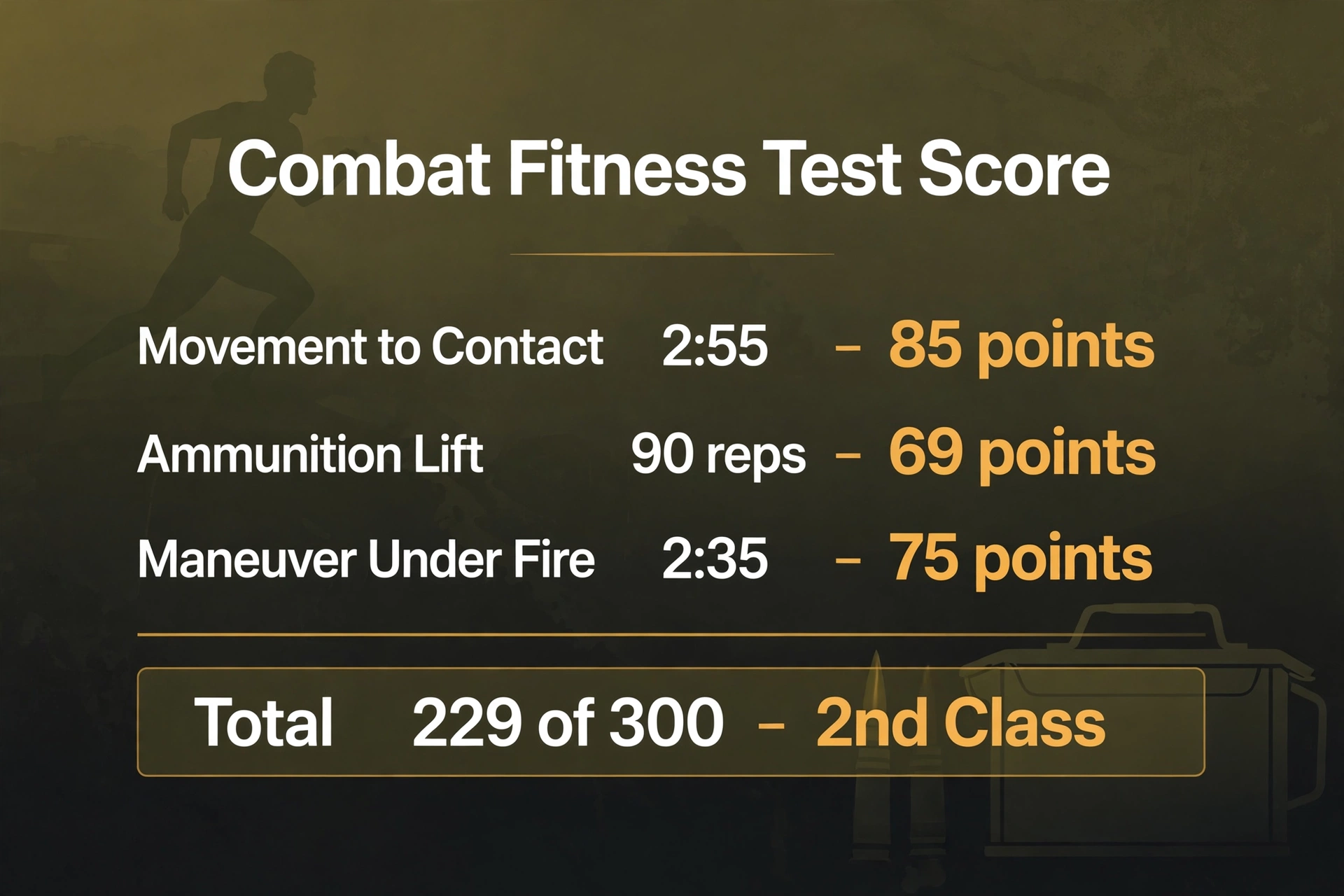
Start with the first verified test: a male Marine, 22 years old, in the 21–25 band. His Movement to Contact time is 2:55, which earns 85 points. He completes 90 ammunition lifts, which earns 69 points. His Maneuver Under Fire raw time is 2:40 and his grenade throw is a hit, so 5 seconds come off and the scored time is 2:35, which earns 75 points. The total is 85 + 69 + 75 = 229 out of 300, which is 76.3% of the maximum. That total falls in the 200–234 range, so the class is 2nd Class. Every event is above its 40-point minimum and the total is above 150, so the result is a pass.
A second test uses a female Marine, 30 years old, in the 26–30 band. Her Movement to Contact time is 3:20, which earns 94 points. She completes 55 ammunition lifts, which earns 73 points. Her Maneuver Under Fire raw time is 3:10 and her grenade throw is a miss, so 5 seconds are added and the scored time is 3:15, which earns 83 points. The total is 94 + 73 + 83 = 250 out of 300, which is 83.3% of the maximum. That total falls in the 235–300 range, so the class is 1st Class, and the result is a pass.
A third test shows how the pass rule can fail in one direction. A male Marine, 19 years old, in the 17–20 band, runs the Movement to Contact in 3:50. The minimum for his band is 3:45, so 3:50 is slower than the minimum and the event earns no points at all: the tool shows “Below minimum”. He completes 70 ammunition lifts, which earns 51 points. His Maneuver Under Fire raw time is 3:00 with a grenade hit, so the scored time is 2:55, which earns 59 points. His total is 51 + 59 = 110 out of 300, which is 36.7% of the maximum. The result is a fail, and the reason is the Movement to Contact: missing the minimum in any single event fails the whole test, whatever the other events scored.
A fourth test shows the ceiling. A male Marine, 22 years old, runs the Movement to Contact in 2:38, completes 115 ammunition lifts, and runs the Maneuver Under Fire in a raw 2:09 with a grenade hit, so the scored time is 2:04. Each of those results equals the published maximum for his band, so each earns 100 points and the total is 300 out of 300, 1st Class. A result faster than the maximum, or more lifts than the maximum, still earns 100 points: the table stops at the top.
A fifth test shows how the pass rule can fail in the other direction. The same 22-year-old male meets the published minimum in every event exactly: Movement to Contact in 3:45, 67 ammunition lifts, and Maneuver Under Fire in a raw 3:23 with a grenade hit, so the scored time is 3:18. Each event earns exactly 40 points, and the total is 40 + 40 + 40 = 120 out of 300, which is 40.0% of the maximum. The result is a fail, because 120 is below the 150-point passing total. Meeting every minimum is not enough to pass: at least 30 more points must come from at least one event.
What is the Combat Fitness Test?
The Combat Fitness Test is one of the two fitness assessments the Marine Corps runs each year, alongside the Physical Fitness Test, or PFT. Where the PFT measures general fitness, the CFT measures the kind of fitness a combat task demands: moving fast in uniform, lifting repeatedly, and carrying, crawling and dragging under time pressure. The test is taken every six months, and the CFT is the assessment for the second half of the year, running from 1 July to 31 December. The PFT covers the first half of the year.
The test is run in boots and the combat utility uniform, without body armour or load-bearing equipment. The three events are run back to back on the same day, in the same order, with three minutes of rest between events. That rest period is shorter than it used to be: it was five minutes before the current order, and it is three minutes now.
The CFT is a Marine Corps test, and its standards belong to the Marine Corps. This calculator is an independent tool built from the published tables. It is not affiliated with, endorsed by, or operated by the United States Marine Corps or the U.S. Department of Defense, and the official score of record is the one a unit records, not the figure on this page. The governing document is Marine Corps Order 6100.13A, Marine Corps Physical Fitness and Combat Fitness Tests, and the scoring tables are Tables 3-3, 3-4 and 3-5 of that order.
How is the CFT scored?
Each event is scored from 40 to 100 points against a table for the Marine’s sex and age band. The maximum performance in the table earns 100 points, and the minimum performance earns 40 points. A result between the two earns a score between 40 and 100. A result better than the maximum still earns 100, and a result worse than the minimum earns nothing in that event and fails the whole test.
The points in this tool are worked out by interpolation between the published maximum and minimum for the age and sex entered, rounded to the nearest whole point. The Marine Corps prints a full table with a row for every second and every repetition, and the interpolation was checked against 75 printed rows from the official Tables 3-3 and 3-5: it matched 69 rows exactly, and the 6 rows that differed were all in the 51-and-over bands, each by exactly 1 point. The ammunition lift table has an extra wrinkle, covered in the limits section below: one repetition can be worth more than one point, so some point totals have no row in the printed table at all. For an official score, the printed tables govern.
The three event scores are added to give a total out of 300. The class bands come from Table 3-2 of the order and are the same for every age group and both sexes: 1st Class is 235 to 300, 2nd Class is 200 to 234, 3rd Class is 150 to 199, and anything below 150 is a fail. Passing needs two things at once: a total of at least 150 points, and at least 40 points in every event. Either requirement on its own is not enough, as the worked examples above show.
The tables below give the published maximum and minimum for every age band, for both sexes, in all three events. The maximum is the result that earns 100 points, and the minimum is the result that earns 40 points. These figures are from the official MCO 6100.13A tables, and the official Movement to Contact table and the official Maneuver Under Fire table are published by the Marine Corps fitness division. The ammunition lift figures are also listed in the Marine Corps Combat Fitness Test guide on Military.com.
| Age | MTC male max / min | AL male max / min | MANUF male max / min |
|---|---|---|---|
| 17–20 | 2:40 / 3:45 | 106 / 62 | 2:07 / 3:17 |
| 21–25 | 2:38 / 3:45 | 115 / 67 | 2:04 / 3:18 |
| 26–30 | 2:39 / 3:48 | 116 / 67 | 2:05 / 3:22 |
| 31–35 | 2:42 / 3:51 | 120 / 67 | 2:10 / 3:30 |
| 36–40 | 2:45 / 3:58 | 110 / 67 | 2:16 / 3:42 |
| 41–45 | 2:52 / 4:11 | 106 / 66 | 2:23 / 3:59 |
| 46–50 | 3:01 / 4:28 | 100 / 65 | 2:40 / 4:14 |
| 51+ | 3:05 / 5:07 | 95 / 16 | 2:52 / 6:09 |
| Age | MTC female max / min | AL female max / min | MANUF female max / min |
|---|---|---|---|
| 17–20 | 3:19 / 4:36 | 66 / 30 | 2:55 / 4:53 |
| 21–25 | 3:13 / 4:41 | 74 / 30 | 2:45 / 4:34 |
| 26–30 | 3:10 / 4:45 | 75 / 30 | 2:42 / 4:40 |
| 31–35 | 3:12 / 4:46 | 72 / 30 | 2:49 / 4:44 |
| 36–40 | 3:18 / 4:55 | 70 / 30 | 2:53 / 4:56 |
| 41–45 | 3:25 / 4:58 | 62 / 28 | 2:57 / 5:01 |
| 46–50 | 3:39 / 5:26 | 53 / 26 | 3:35 / 5:06 |
| 51+ | 3:55 / 5:52 | 44 / 6 | 3:44 / 6:33 |
Two things in these tables catch the eye, and both are real. First, the 51-and-over ammunition lift minimums drop sharply: 16 repetitions for men and 6 for women, against 65 and 26 in the 46–50 band. Those figures are printed in Table 3-1 of the order and reproduced in the published tables. Second, the female 21–25 Maneuver Under Fire minimum of 4:34 is faster than the 17–20 minimum of 4:53. The tables are not a smooth slope with age: each band was set on its own, and the fastest maximums sit in the 21–25 and 26–30 bands, not in the youngest band.
To see what a total means as a share of the maximum, the percentage calculator gives the figure: 229 out of 300 is 76.3%, 250 out of 300 is 83.3%, and 120 out of 300 is 40.0%.
What are the three CFT events?
Movement to Contact is an 880-yard timed run, two laps of a standard track, run in boots and utilities. It simulates moving fast to make contact with an enemy. It is the first event, and it is a sprint rather than a distance run: the fastest times in the tables are under two and a half minutes for the youngest men. Treadmills are not used; the run is on a measured course with a wide turnaround.
Ammunition Lift is two minutes of lifting a 30-pound ammunition can from shoulder height until the elbows lock overhead, then back to chin level, as many times as possible. The can is the standard M2A1 ammunition can. A repetition only counts if the elbows lock at the top and the can comes back to chin level, and the Marine may rest by holding the can or setting it down under control. It is the second event, and it tests shoulder endurance and pacing rather than a single heavy lift: the maximums run from 95 to 120 repetitions for men and from 44 to 75 for women, depending on the age band.
Maneuver Under Fire is a 300-yard shuttle course, and it is the most involved of the three events. It combines sprints with a high crawl and a low crawl, a casualty drag and a fireman’s carry of a partner matched within 10 pounds, an ammunition can resupply run, a dummy grenade throw, and agility running, with five push-ups on the course. It is the third event, and it is timed from start to finish, with the grenade throw adjusting the time before it is scored.
What score do I need to pass the CFT?
Two numbers decide it. The total must be at least 150 out of 300, and every event must earn at least 40 points, which means meeting the published minimum in each event. Both conditions must hold at the same time.
The reason the order sets it up this way is arithmetic. Three minimums add to 120, which is 30 points short of 150. A Marine who meets every minimum exactly still fails, as the fifth worked example shows. At least 30 additional points must be earned above the minimums, spread across one or more events. A single event above its minimum can supply them: 30 extra points in one event is enough on its own, or the extra points can be split across two or three events.
The reverse trap is just as real. A total above 150 does not pass the test if one event falls below its minimum. A Marine could score 100 points in two events and miss the minimum in the third, giving a total of 200, and still fail, because the order states that failing the minimum in any one event fails the entire test regardless of the total number of points earned. The third worked example shows the smaller version of this: a total of 110 with one event below its minimum is a fail, and the reason the tool gives is the event, not the total.
The class bands sit above the pass mark. A total of 150 to 199 is 3rd Class, 200 to 234 is 2nd Class, and 235 to 300 is 1st Class. A total of 149 or below is a fail, even if every event met its minimum, because the total is short. The class and the pass are separate judgements: 3rd Class is a pass, and it is the lowest passing class.
What is a good CFT score?
A score of 235 or above earns 1st Class, and that is the line most Marines aim for: it is 78.3% of the 300-point maximum. A score of 200 to 234 earns 2nd Class, which is a solid pass at 66.7% to 78.0% of the maximum. A score of 150 to 199 earns 3rd Class, which is a pass at 50.0% to 66.3% of the maximum, but it leaves little room: a single bad event can pull a 3rd Class score below 150, and a single missed minimum fails the test outright.
The first verified test, at 229 points, is a 2nd Class score, six points short of 1st Class. The second verified test, at 250 points, is a 1st Class score with 15 points to spare. The gap between the two is 21 points, which is roughly what one strong event is worth: the second test’s Movement to Contact alone accounts for 9 of those points, and the rest comes from the other two events.
What counts as good also depends on the age band, because the tables are age-normed. A Movement to Contact time of 3:30 earns 53 points for a man aged 21–25, but the same time earns 87 points for a man aged 51 or over, because the tables expect different times at different ages. Comparing raw times across bands is misleading; comparing points is the fair comparison, and that is what the tool does.
How does the grenade throw change the score?
The dummy grenade throw sits in the middle of the Maneuver Under Fire course, and it changes the scored time by 5 seconds either way: a hit takes 5 seconds off the course time, and a miss adds 5 seconds, before the time is converted to points. Five seconds is worth roughly 4 to 5 points in most bands, because a point is worth a little over a second in the timed events.
The sixth verified test shows the swing with the same Marine and the same raw time. A female Marine, 30 years old, with a Movement to Contact time of 3:20 (94 points) and 55 ammunition lifts (73 points), runs the Maneuver Under Fire in a raw 3:10. With a grenade hit, the scored time is 3:05, which earns 88 points, and the total is 94 + 73 + 88 = 255 out of 300, which is 85.0% of the maximum. With a grenade miss, the scored time is 3:15, which earns 83 points, and the total is 94 + 73 + 83 = 250 out of 300, which is 83.3% of the maximum. The same run is worth 5 points more with a hit than with a miss, and both totals are 1st Class. A hit can also move a total across a class line: a total of 233 with a miss becomes 238 with a hit, which is the difference between 2nd Class and 1st Class.
How is the CFT different from the PFT?
The Physical Fitness Test and the Combat Fitness Test are the Marine Corps’ two annual fitness assessments, and they share a scoring shape: three events, 100 points each, 300 in total, the same class bands, and the same pass rule of 150 points with at least 40 in every event. The events are different. The PFT is pull-ups or push-ups, a plank hold, and a 3-mile run or a 5,000-metre row. The CFT is the 880-yard run, the ammunition can lift, and the maneuver under fire course. The PFT is a test of general fitness; the CFT is a test of combat tasks.
The two tests are also taken at different times of year. The PFT covers January to June, and the CFT covers July to December. A Marine takes each test once in its half of the year, so the two scores together describe a full year of fitness, and a good score on one does not carry over to the other. The tables are separate too: a PFT result must be scored against the PFT tables, and a CFT result against the CFT tables. This calculator scores the CFT only.
Does the CFT change at altitude?
Yes, for two of the three events. Tests conducted at or above 4,500 feet above sea level use altitude-adjusted scoring tables for Movement to Contact and Maneuver Under Fire, published as Tables 3-6 and 3-7 of the order. The adjusted tables allow more time: in the Movement to Contact altitude table, the maximum and minimum times are 6 seconds slower than the sea-level figures in every band. The Ammunition Lift has no altitude table, so lift repetitions are scored the same at any altitude.
This tool uses the sea-level tables only. A Marine testing at or above 4,500 feet should check the result against the altitude tables in the order, because the sea-level figures will understate the score. The note under the tool states this plainly.
What changed for Marine Corps fitness standards in 2026?
Two changes took effect on 1 January 2026, and neither of them changes the CFT — and that is the point. The first change, under MARADMIN 613/25, sets a sex-neutral 210-point minimum for Marines in combat arms specialties, scored on the male age-normed tables. That change is about the Physical Fitness Test: the announcement names the PFT and does not mention the CFT at all. No corresponding CFT change has been published, so the CFT tables on this page are still the ones in MCO 6100.13A. A combat arms Marine still needs 150 points with 40 in every event to pass the CFT, and the 210-point figure does not apply to it.
The second change is the one behind the supporting keywords for this page. Under MARADMIN 066/26, the old height and weight check, with its tape test and body fat tables, was replaced by a waist-to-height ratio standard: waist circumference measured at the navel divided by height, with a standard of 0.52 or less. That change matters for anyone searching for a USMC height and weight calculator, a USMC body fat chart, or an Army BMI calculator, because those are the tools the old system used. The CFT itself does not measure body fat or body mass index: it measures what a Marine can do in three events. Body mass index is a different measure again — weight divided by height squared — and the BMI calculator on this site works it out from height and weight. A high BMI does not by itself mean a person is unfit, because BMI cannot distinguish muscle from fat, and a Marine with a high BMI can still score 1st Class on the CFT. The CFT score, the waist-to-height ratio, and BMI are three different numbers that answer three different questions.
What mistakes do people commonly make with the CFT?
The first mistake is assuming that a total above 150 means a pass. It does not, unless every event also met its minimum. Check each event against its own minimum first, and only then look at the total.
The second mistake is the mirror image: assuming that meeting every minimum means a pass. Three minimums add to 120, which is 30 points short. A pass needs extra points above the minimums in at least one event.
The third mistake is forgetting the grenade throw. A raw Maneuver Under Fire time is not the scored time: a hit takes 5 seconds off and a miss adds 5 seconds, and that adjustment is worth roughly 4 to 5 points. Scoring the raw time gives the wrong points in both directions.
The fourth mistake is using the wrong age band. The bands are 17–20, 21–25, 26–30, and so on, and the boundaries matter: a Marine who is 25 is scored on the 21–25 tables, and a Marine who is 26 is scored on the 26–30 tables, where the maximums and minimums are different. A birthday between the test and the last check can move a Marine into a new band.
The fifth mistake is scoring a CFT result against PFT tables, or the other way round. The two tests share a scoring shape but not the tables, and the events are different. A 3-mile run time has no place in a CFT calculation, and an 880-yard time has no place in a PFT calculation.
The sixth mistake is using the 2026 combat-arms 210-point figure for the CFT. That figure applies to the PFT for combat arms Marines. The CFT pass mark is still 150 points with 40 in every event.
The seventh mistake is testing at altitude on sea-level tables. At or above 4,500 feet, the Movement to Contact and Maneuver Under Fire tables allow more time, and a sea-level score understates the result. This tool uses the sea-level tables and says so in its note.
What are the limits of this calculator?
This calculator estimates points by interpolation between the published maximum and minimum for the entered age and sex. The Marine Corps prints a full table with a row for every second and every repetition, and the interpolation was checked against 75 printed rows: it matched 69 exactly, and the 6 rows that differed were all in the 51-and-over bands, each by exactly 1 point. For an official score, the printed tables govern, and the official score of record is the one a unit enters in MCTIMS.
The ammunition lift needs its own note. In the printed table, one repetition can be worth more than one point, so some point totals have no row at all. The female 46–50 column spans 27 repetitions for 60 points, so point values are necessarily skipped: adding one repetition can jump two or three points. The tool’s interpolation can therefore return a point total that the printed table skips. The printed table governs, and a lift total near a boundary should be checked against it.
The tool uses the sea-level tables only, and it does not cover the altitude-adjusted tables for tests at or above 4,500 feet. It does not record a score, store a result, or report anything to a unit: everything runs in the browser, and nothing is uploaded. It does not give fitness or medical advice, and it does not say whether a person should attempt the test or how to train for it. A question about readiness for a record test belongs to the unit’s physical training staff or a clinician.
The figures on this page are general information about a published fitness test. Standards change: the order is updated, administrative messages are issued, and the tables on this page reflect MCO 6100.13A as published. Before a record test, check the current order and the current tables.
How can I check the tool against a known result?
The simplest check uses the first verified test. Enter Male, age 22, Movement to Contact 2 minutes 55 seconds, Ammunition Lift 90 repetitions, Maneuver Under Fire 2 minutes 40 seconds, grenade throw Hit. The tool should show Movement to Contact 85 points, Ammunition Lift 69 points, Maneuver Under Fire 75 points, a total of 229 of 300, a class of 2nd Class, and a result of Pass. The note should say the age band is 21–25, give the standards for that band, and say the grenade hit took 5 seconds off the course time, so 2:40 became 2:35 for scoring.
A second check uses the grenade swing. Enter Female, age 30, Movement to Contact 3 minutes 20 seconds, Ammunition Lift 55 repetitions, Maneuver Under Fire 3 minutes 10 seconds, grenade throw Hit. The tool should show 94 points, 73 points, 88 points, a total of 255 of 300, 1st Class, and Pass. Change only the grenade throw to Miss and run it again: the Maneuver Under Fire points should fall to 83 and the total to 250 of 300, still 1st Class.
A third check tests the maximum. Enter Male, age 22, Movement to Contact 2 minutes 38 seconds, Ammunition Lift 115 repetitions, Maneuver Under Fire 2 minutes 9 seconds, grenade throw Hit. The tool should show 100 points in every event, a total of 300 of 300, 1st Class, and Pass. A fourth check tests the failure modes: enter Male, age 22, Movement to Contact 3 minutes 45 seconds, Ammunition Lift 67 repetitions, Maneuver Under Fire 3 minutes 23 seconds, grenade throw Hit. The tool should show 40 points in every event, a total of 120 of 300, a class of Fail, and a result of Fail — below 150 points. A fifth check tests the errors: enter an age of 16 and the tool should show the error “The age must be 17 or above. The scoring tables start at age 17.” with no results, and enter 60 in a seconds box and the tool should show the error “The Movement to Contact seconds cannot be above 59. Use the minutes box for a full minute.” with no results.
The scoring tables behind the tool are the Marine Corps’ own published tables, and the maximum and minimum figures are also listed in the Marine Corps Combat Fitness Test guide on Military.com. More tools in the same collection are in the calculators category.
How many points is each result worth? (Male, 21–25 band)
Every figure in this table was computed with the same interpolation the tool uses, from the published maximum and minimum for the male 21–25 band, and every row was checked against the printed tables in MCO 6100.13A Tables 3-3, 3-4 and 3-5. The Maneuver Under Fire figures are scored times, after the grenade adjustment.
| Movement to Contact | Points | Ammunition Lift | Points | Maneuver Under Fire | Points |
|---|---|---|---|---|---|
| 2:38 | 100 | 115 reps | 100 | 2:04 | 100 |
| 2:55 | 85 | 100 reps | 81 | 2:35 | 75 |
| 3:10 | 71 | 90 reps | 69 | 2:55 | 59 |
| 3:30 | 53 | 80 reps | 56 | 3:18 | 40 |
| 3:45 | 40 | 67 reps | 40 | — | — |
Two patterns in the table are worth reading. First, a second is worth just under a point in the timed events: the Movement to Contact range is 67 seconds for 60 points, and the Maneuver Under Fire range is 74 seconds for 60 points, so a second gained or lost is usually worth a point, and sometimes worth none. Second, a repetition is worth more than a point in the ammunition lift: the range is 48 repetitions for 60 points, so each lift is worth about a point and a quarter on average, and the printed table skips some point totals. For a different age band or sex, the figures change: the same time or repetition count earns different points, because the maximum and minimum are different. That is why the tool asks for age and sex before it scores anything.
Frequently asked questions
What is a good Combat Fitness Test score?
A score of 235 or above earns 1st Class, and that is the line most Marines aim for: it is 78.3% of the 300-point maximum. A score of 200 to 234 earns 2nd Class, and a score of 150 to 199 earns 3rd Class, which is a pass but leaves little room. Anything below 150 is a fail.
What is the minimum score to pass the CFT?
Two things are needed at once: a total of at least 150 points out of 300, and at least 40 points in every event, which means meeting the published minimum in each event. Three minimums add to only 120, so at least 30 extra points must come from at least one event. Missing the minimum in any single event fails the whole test, whatever the total.
How is the CFT scored?
Each of the three events is scored from 40 to 100 points against a table for the Marine’s sex and age band, and the three scores are added for a total out of 300. The maximum performance in the table earns 100 points and the minimum earns 40 points. The class bands are 1st Class 235–300, 2nd Class 200–234, 3rd Class 150–199, and below 150 is a fail. This tool works out points by interpolation between the published maximum and minimum, rounded to the nearest whole point, and the printed tables govern for an official score.
What are the three CFT events?
Movement to Contact, an 880-yard timed run; Ammunition Lift, as many overhead lifts of a 30-pound ammunition can as possible in two minutes; and Maneuver Under Fire, a 300-yard shuttle course with crawls, a casualty drag and carry, an ammunition can run, push-ups and a grenade throw. The events are run in that order on the same day, with three minutes of rest between them.
Does the CFT change at altitude?
Yes, for two events. Tests at or above 4,500 feet use altitude-adjusted tables for Movement to Contact and Maneuver Under Fire, which allow more time: the Movement to Contact altitude table is 6 seconds slower than the sea-level figures in every band. The Ammunition Lift has no altitude table. This tool uses the sea-level tables only.
Is the CFT the same as the PFT?
No. The Physical Fitness Test and the Combat Fitness Test share a scoring shape — three events, 100 points each, 300 in total, the same class bands — but the events are different. The PFT is pull-ups or push-ups, a plank hold, and a 3-mile run or 5,000-metre row. The CFT is the 880-yard run, the ammunition can lift, and the maneuver under fire course. The PFT covers January to June and the CFT covers July to December, and a result must be scored against the tables for its own test. The 2026 combat-arms 210-point minimum applies to the PFT, not the CFT.