Compatibility Through Names
Enter two first names to see how they score in this letter-counting game. The score is for fun only: it counts letters, and it does not measure or predict real relationship compatibility.
For fun only. The score comes from counting the letters in the two names. It does not measure or predict real relationship compatibility, and no scientific claim is made for it.
A compatibility through names calculator takes two first names, counts the letters in them, and reduces those counts to a single score from 0 to 99 percent. For Alex and Sam it gives 52%, in the “A friendly fit” band. The score is a letter-counting game, for fun only: it does not measure or predict real relationship compatibility.
How do I use the Compatibility Through Names tool?
Type the first name into the first box and the second name into the second box, then click the Check compatibility button. The tool does the letter counting and shows the score, the reading band, and every step of the working.
Use first names only. A middle name or a surname changes the joined string, and therefore the counts and the score. The boxes accept letters only: numbers, spaces, hyphens, and apostrophes are cleaned out before the counting starts. Anne-Marie becomes annemarie and O’Brien becomes obrien.
The result appears in four boxes. The first box shows the score as a number from 0 to 99 percent. The second shows the reading band, the third explains what the band means in this tool, and the fourth shows the cleaned names, the letter counts in order of first appearance, and the reduction rows, so every step of the arithmetic is visible. A note under the boxes reminds you that the same names give the same score in either order.
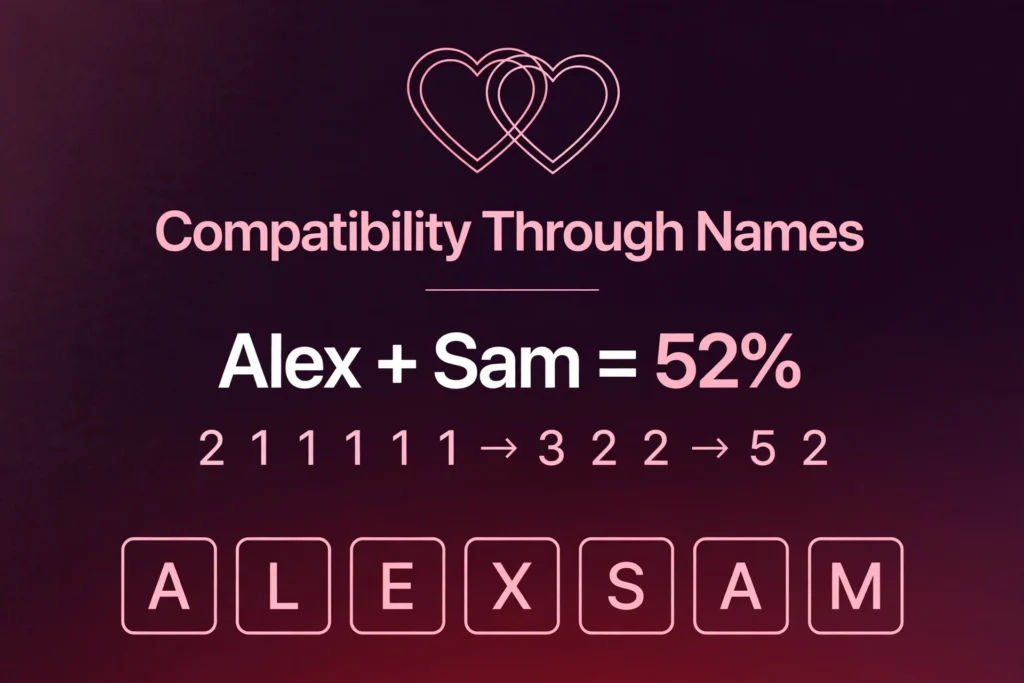
What does a worked example look like?
Take Alex and Sam. The cleaned names are alex and sam, which join to alexsam. The letter counts, in order of first appearance, are A = 2, L = 1, E = 1, X = 1, S = 1, M = 1. The first reduction row is therefore 2 1 1 1 1 1. Adding the outer pairs inward gives 2 + 1 = 3, then 1 + 1 = 2, then 1 + 1 = 2, so the second row is 3 2 2. Adding the outer pair of that row gives 3 + 2 = 5, and the middle digit 2 copies down, so the final row is 5 2. The score is 52%, in the “A friendly fit” band.
Take John and Mary. The cleaned names are john and mary, which join to johnmary. Each of the eight letters J, O, H, N, M, A, R, and Y appears once, so the first row is 1 1 1 1 1 1 1 1. Adding the outer pairs inward gives 1 + 1 = 2 four times, so the second row is 2 2 2 2. Adding the outer pairs of that row gives 2 + 2 = 4 twice, so the final row is 4 4. The score is 44%, in the “A friendly fit” band.
Take Sophia and Noah. The cleaned names are sophia and noah, which sort alphabetically to noah and sophia and join to noahsophia. The letter counts, in order of first appearance, are N = 1, O = 2, A = 2, H = 2, S = 1, P = 1, and I = 1. The first row is 1 2 2 2 1 1 1. Adding the outer pairs inward gives 1 + 1 = 2, then 2 + 1 = 3, then 2 + 1 = 3, then 2 copies down, so the second row is 2 3 3 2. Adding the outer pair of that row gives 2 + 2 = 4, and the inner pair gives 3 + 3 = 6, so the final row is 4 6. The score is 46%, in the “A friendly fit” band.
Take Alexander twice. The cleaned names are alexander and alexander, which join to alexanderalexander. The letter counts, in order of first appearance, are A = 4, L = 2, E = 4, X = 2, N = 2, D = 2, and R = 2. The first row is 4 2 4 2 2 2 2. Adding the outer pairs inward gives 4 + 2 = 6, then 2 + 2 = 4, then 4 + 2 = 6, then 2 copies down, so the second row is 6 4 6 2. Adding the outer pairs of that row gives 6 + 2 = 8 and 4 + 6 = 10, and a sum of 10 is written as the two digits 1 and 0, so the third row is 8 1 0. Adding the outer pair of that row gives 8 + 0 = 8, and the middle digit 1 copies down, so the final row is 8 1. The score is 81%, in the “A high-scoring pair” band. This example shows the two-digit-sum rule: a sum of 10 is written as 1 and 0, not as 10.
Take Anne-Marie and O’Brien. The cleaned names are annemarie and obrien, which join to annemarieobrien. The letter counts, in order of first appearance, are A = 2, N = 3, E = 3, M = 1, R = 2, I = 2, O = 1, and B = 1. The first row is 2 3 3 1 2 2 1 1. Adding the outer pairs inward gives 2 + 1 = 3, then 3 + 1 = 4, then 3 + 2 = 5, then 1 + 2 = 3, so the second row is 3 4 5 3. Adding the outer pairs of that row gives 3 + 3 = 6 and 4 + 5 = 9, so the final row is 6 9. The score is 69%, in the “A strong pairing” band. The hyphen and the apostrophe were cleaned out before the counting started.
What is a name compatibility calculator?
A name compatibility calculator is a letter-counting game that takes two names and returns a score from 0 to 99 percent. It reads the letters in the two names, counts how often each letter appears, and reduces those counts by adding the outer pairs until two digits remain. The result is a number with a reading band, and the full working is shown, so every step can be checked by hand.
The tool is built on the method above, and it follows that method exactly. The two names are cleaned to lower-case letters from A to Z, sorted alphabetically, and joined into one string. Each distinct letter is counted in the order it first appears. The row of counts is reduced by adding the outer pairs and working inward, copying the middle digit down when the row has an odd length, and writing any sum of 10 or more as two digits. The process repeats until two digits remain. A row of a single digit is the score on its own: A + A gives the row 2, and the score is 2%.
The result is the same every time for the same pair of names, because the method has no random step. The order of the names does not matter either: the tool sorts the two cleaned names alphabetically before joining them, so Alex and Sam give 52% whichever box each name is typed in. The score is always a number from 0 to 99. A score of 100 never appears, because two digits cannot make 100, and a single digit is a score from 0 to 9.
How does the letter-counting method work?
This tool uses the method the worked examples above follow. It has four steps: cleaning, ordering, counting, and reducing. Every step uses only the letters in the two names, and the full working is shown in the fourth result box, so any score can be checked by hand.
Step one is cleaning. Each name is changed to lower case, and every character that is not a letter from A to Z is removed. Spaces, hyphens, apostrophes, and numbers all disappear. Anne-Marie becomes annemarie, O’Brien becomes obrien, and 123 becomes nothing at all. If either name has no letters left after cleaning, the tool shows a plain-language error and no results.
Step two is ordering. The two cleaned names are sorted alphabetically, and the earlier name comes first. This is why the order of the names cannot change the score: alex + sam and sam + alex both join to the same string, alexsam. The sorting is a plain alphabetical sort of the two cleaned names.
Step three is counting. The two cleaned names are joined into one string, and each distinct letter in that string is counted in the order it first appears. For alexsam the counts are A = 2, L = 1, E = 1, X = 1, S = 1, and M = 1, giving the row 2 1 1 1 1 1. If a letter appears 10 or more times, its count is written as two digits: a count of 12 becomes the two digits 1 and 2 in the row.
Step four is reducing. The outer pair of the row is added, then the next pair inward, and so on, until the row is used up. If the row has an odd length, the middle digit is copied down unchanged. Any sum of 10 or more is written as two digits. The process repeats until two digits remain, and those two digits are the score. A row of a single digit is the score on its own: A + A gives the row 2, and the score is 2%.
Some name games use a variant of this method. The LOVES game counts the letters L, O, V, E, and S in the two names, and reduces that five-digit row in the same way. This tool does not use that variant: it counts every distinct letter in the two names, in the order each letter first appears, and it reduces those counts until two digits remain.
How do I read my compatibility score?
Read the score with the band table below. The bands are fixed ranges, and the score falls into exactly one band. The tool shows the band with the score, so no lookup is needed, but the table below lists every band with the reading the tool uses.
| Score | Band | What the band means in this tool |
|---|---|---|
| 0–20 | A quiet spark | The letters in these two names line up only a little in this game. It says nothing about the people behind the names. |
| 21–40 | A gentle match | The letters share a modest overlap in this game. It is a starting point for a laugh, not a verdict on two people. |
| 41–60 | A friendly fit | The letters land in the middle of the range in this game. Plenty of name pairs land here. |
| 61–80 | A strong pairing | The letters line up well in this game. It is still only a letter-counting game. |
| 81–99 | A high-scoring pair | The letters line up strongly in this game. It is still only a letter-counting game, and it says nothing about a real relationship. |
The bands exist only to give the number a reading inside the game. They are not grades, and they are not a verdict on two people. A score of 52% and a score of 44% are both in the “A friendly fit” band, and both are ordinary results for a letter-counting game.
Read the score as a game result, not as a measure of a relationship. A high score means the letters lined up well. A low score means they lined up poorly. Neither reading says anything about communication, shared values, trust, or time spent together, because none of those things are in the input. The only input is letters.
Is a name compatibility calculator accurate?
No, not as a measure of real compatibility. The tool carries out its stated letter-counting arithmetic correctly, and the same names always give the same score. But the letters in a name carry no information about personality, communication, values, or how two people treat each other. The score describes the names, not the people who carry them. It is for fun only.
The accuracy that matters here is the accuracy of the arithmetic. The cleaning, sorting, joining, counting, and reducing all follow fixed rules, and the fourth result box shows every step, so any score can be checked by hand. Alex and Sam give 52% because the rows are 2 1 1 1 1 1, then 3 2 2, then 5 2. John and Mary give 44% because the rows are 1 1 1 1 1 1 1 1, then 2 2 2 2, then 4 4. The arithmetic is exact, and the score is what the letters produce.
Do not use the score to decide anything about a real relationship. A high score does not mean two people will get on, and a low score does not mean they will not. Real compatibility comes from communication, shared values, trust, and time spent together, and none of those things are in the input. The only input is letters.
Why does the same pair of names always give the same score?
The tool has no random step in it. Cleaning, sorting, joining, counting, and reducing all follow fixed rules, so the same input always travels the same path to the same output. Alex and Sam give 52% every time, in either order, and John and Mary give 44% every time. The random number generator is a different kind of tool: it produces a new result on every run, because randomness is its purpose. This tool is the opposite: it is deterministic, which means the same input always gives the same output.
The order of the names cannot change the score, because the tool sorts the two cleaned names alphabetically before joining them. Alex + Sam and Sam + Alex both join to alexsam, and the counts and the reduction are the same either way. The score is a property of the two names together, not of the order they were typed in.
The only way to change the score is to change the letters. A different spelling, a nickname, a middle name, or a surname changes the joined string, and therefore the counts and the reduction. The same two names, spelled the same way, always give the same score.
What happens if I change a spelling or use a nickname?
The score changes, because the tool reads letters, not sounds. Two spellings that sound the same are different inputs. Sara and Sarah have different letter counts, and a nickname, a middle name, or a surname changes the joined string and therefore the counts and the reduction. Adding or removing any letter changes the arithmetic, sometimes by a lot.
Use one form of each name every time if the aim is to compare results. If Alex is entered as Alex one day and as Alexander the next, the scores will be different, because the joined strings are different. The comparison only makes sense when the input is the same.
The same rule applies to names with hyphens and apostrophes. Anne-Marie and O’Brien are cleaned to annemarie and obrien before the counting starts, so the hyphen and the apostrophe never reach the arithmetic. The cleaned form is what matters, not the form typed in.
What is the difference between this method and FLAMES?
FLAMES is another letter game that uses two names. It cancels the letters the two names share, counts what is left, and cycles through the six words Friends, Love, Affection, Marriage, Enemy, and Siblings until one word remains. The result is one of six categories, not a number. This tool does not cancel shared letters: it counts how often each letter appears across both names and reduces those counts by adding outer pairs until two digits remain.
The two methods read the same input in different ways. FLAMES asks which letters are left after the shared letters are removed, and it maps a count onto a word. This method asks how often each letter appears, and it reduces those counts to a score from 0 to 99. The score comes with the full working shown, so every step can be checked by hand, and the reading band gives the number a meaning inside the game.
Both methods are letter games, and neither measures real compatibility. A FLAMES result of Love and a score of 81% in this tool are both readings of the letters in two names, not readings of the people who carry them. Use either game for fun, and use neither to decide anything about a real relationship.
What are the limits of this tool?
The tool only reads letters. It cannot see personality, communication, values, or how two people treat each other, because none of those things are in the input. The score describes the names, not the people who carry them. A high score is a property of the letters, and a low score is a property of the letters too.
The tool only accepts first names. A middle name or a surname changes the joined string, and therefore the counts and the score, so the result is only comparable when the same form of each name is used every time. The boxes accept letters only: numbers, spaces, hyphens, and apostrophes are cleaned out before the counting starts.
The score is always a number from 0 to 99, and it is always exact for the letters given. It is not a probability, and it is not a percentage chance of anything. The percentage calculator is the tool for working out a percentage of a number, and the age calculator is the tool for working out an age from a date of birth. This tool is a letter-counting game, and its score is a game result, not a prediction.
The method is fixed, so the same names always give the same score. That is a strength for checking the arithmetic, and it is a limit for the reading: the tool cannot say anything new about two people, because it only ever reads the letters in their names. The score is what the letters produce, and nothing more.
How can I check the tool against a known pair?
The simplest check is Alex and Sam. Type Alex into the first box and Sam into the second, then click the Check compatibility button. The score is 52%, in the “A friendly fit” band. The fourth box shows the cleaned names alex + sam, the letter counts a = 2, l = 1, e = 1, x = 1, s = 1, m = 1, and the reduction rows 2 1 1 1 1 1 -> 3 2 2 -> 5 2. Type Sam first and Alex second, and the score is still 52%, because the tool sorts the two cleaned names before joining them.
A second check is John and Mary. The score is 44%, in the “A friendly fit” band. The fourth box shows the cleaned names john + mary, the letter counts j = 1, o = 1, h = 1, n = 1, m = 1, a = 1, r = 1, y = 1, and the reduction rows 1 1 1 1 1 1 1 1 -> 2 2 2 2 -> 4 4. Every letter appears once, so the first row is eight 1s, and the reduction is four pairs of 1 + 1 = 2, then two pairs of 2 + 2 = 4.
A third check is Anne-Marie and O’Brien. The score is 69%, in the “A strong pairing” band. The fourth box shows the cleaned names annemarie + obrien, the letter counts a = 2, n = 3, e = 3, m = 1, r = 2, i = 2, o = 1, b = 1, and the reduction rows 2 3 3 1 2 2 1 1 -> 3 4 5 3 -> 6 9. The hyphen and the apostrophe were cleaned out before the counting started, so the check confirms that the cleaning step works. Alexander twice is a fourth check: the score is 81%, in the “A high-scoring pair” band, and the fourth box shows the reduction rows 4 2 4 2 2 2 2 -> 6 4 6 2 -> 8 1 0 -> 8 1, with the two-digit-sum rule on show in the third row.
The BMI calculator is a different kind of check: it takes numbers, not names, and it returns a number with a band of its own. More tools are listed in the calculators category.
What does each score band mean?
Each score falls into exactly one band, and each band has a reading the tool uses. The table below lists every band with the reading the tool uses. The band is shown with the score, so no lookup is needed, but the table below lists every band in one place.
| Score | Band | What the band means in this tool |
|---|---|---|
| 0–20 | A quiet spark | The letters in these two names line up only a little in this game. It says nothing about the people behind the names. |
| 21–40 | A gentle match | The letters share a modest overlap in this game. It is a starting point for a laugh, not a verdict on two people. |
| 41–60 | A friendly fit | The letters land in the middle of the range in this game. Plenty of name pairs land here. |
| 61–80 | A strong pairing | The letters line up well in this game. It is still only a letter-counting game. |
| 81–99 | A high-scoring pair | The letters line up strongly in this game. It is still only a letter-counting game, and it says nothing about a real relationship. |
A score on a boundary belongs to the higher band. A score of 20 is in the “A quiet spark” band, and a score of 21 is in the “A gentle match” band. A score of 40 is in the “A gentle match” band, and a score of 41 is in the “A friendly fit” band. A score of 60 is in the “A friendly fit” band, and a score of 61 is in the “A strong pairing” band. A score of 80 is in the “A strong pairing” band, and a score of 81 is in the “A high-scoring pair” band.
Frequently asked questions
How is compatibility through names calculated?
The two names are cleaned to lower-case letters from A to Z, sorted alphabetically, and joined into one string. Each distinct letter is counted in the order it first appears, giving a row of digits. The row is reduced by adding the outer pairs and working inward, copying the middle digit down when the row has an odd length, and writing any sum of 10 or more as two digits. The process repeats until two digits remain, and those two digits are the score. For Alex and Sam the rows are 2 1 1 1 1 1, then 3 2 2, then 5 2, giving 52%.
Is a name compatibility calculator accurate?
No, not as a measure of real compatibility. The tool carries out its stated letter-counting arithmetic correctly, and the same names always give the same score, but the letters in a name carry no information about personality, communication, values, or how two people treat each other. The score describes the names, not the people who carry them. It is for fun only and should never be used to decide anything about a real relationship.
Why do the same two names always give the same score?
The tool has no random step in it. Cleaning, sorting, joining, counting, and reducing all follow fixed rules, so the same input always travels the same path to the same output. The order of the names cannot change the score either, because the tool sorts the two cleaned names alphabetically before joining them. Alex and Sam give 52% whichever box each name is typed in.
Does a high score mean two people are compatible?
No. A high score means the letters in the two names lined up well in this letter-counting game. It does not measure or predict real relationship compatibility, because the only input is letters. Real compatibility comes from communication, shared values, trust, and time spent together, and none of those things are in the input. A low score means the letters lined up poorly in the game, and it says just as little about the people involved.
Why does changing a spelling change the score?
The tool reads letters, not sounds, so two spellings that sound the same are different inputs. “Sara” and “Sarah” have different letter counts, and a nickname, a middle name, or a surname changes the joined string and therefore the counts and the reduction. Adding or removing any letter changes the arithmetic, sometimes by a lot. Use one form of each name every time if the aim is to compare results.
What is the difference between this method and FLAMES?
FLAMES cancels the letters the two names share, counts what is left, and cycles through the six words Friends, Love, Affection, Marriage, Enemy, Siblings until one word remains. This tool counts how often each letter appears across both names and reduces those counts by adding outer pairs until two digits remain. FLAMES gives one of six categories, while this method gives a number from 0 to 99 with the full working shown. Both are letter games, and neither measures real compatibility.