Body Recomposition Calculator
Enter your details and a goal, and the tool works out your calorie target, protein target, and a projected timeline to your target body fat percentage.
Protein is set at 2.0 g per kg of body weight, inside the 1.6–2.2 g per kg range from the Morton 2018 meta-analysis. Fat is set at 0.8 g per kg of body weight, and carbs fill the remaining calories. The timeline uses 7,700 kcal per kilogram of body fat and assumes lean mass stays the same while fat changes.
A body recomposition calculator turns your age, height, weight, body fat percentage, and activity level into a daily calorie target, a protein target, and a projected timeline to a target body fat percentage. It is built for the goal of losing fat and keeping or building muscle in the same phase, instead of cutting and bulking in turn.
How do I use the Body Recomposition Calculator?
Start with the six personal details. Choose your sex, then enter your age in years, your height in centimetres, your weight in kilograms, and your current body fat percentage. Body fat percentage is the share of your weight that is fat: at 80 kg and 25% body fat, 20 kg of your weight is fat and 60 kg is lean mass. If you do not know your body fat percentage, a tape-measure estimate or a smart scale gives a starting figure, and the limits section below explains how much error that can carry.
Then choose your activity level. The five levels use the standard multipliers that go with the Mifflin-St Jeor equation: sedentary at 1.2, lightly active at 1.375, moderately active at 1.55, very active at 1.725, and extra active at 1.9. Pick the level that matches a normal week, including both training and daily movement, not the hardest week you have ever had. A desk worker who lifts three times a week is moderately active. A labourer who also trains hard is extra active.
Then choose your goal. Lose fat takes your maintenance calories and subtracts 400 kcal a day. Build muscle takes your maintenance calories and adds 200 kcal a day. Recomposition keeps your maintenance calories exactly as they are. The three goals are explained in full in the calorie-target section below.
Finally, enter your target body fat percentage and press the calculate button. Eleven labelled boxes appear. BMR is your basal metabolic rate, the calories your body uses at rest. Maintenance calories, also called TDEE, are your BMR times your activity multiplier. The goal calorie target is the daily figure for the goal you chose. The protein target shows grams per day, the 1.6–2.2 g per kg range, and the 2.0 g per kg default. The fat and carb targets complete the daily split. Current lean mass and current fat mass show how your weight divides today. Target weight at goal body fat shows what you would weigh at your target percentage if your lean mass stayed the same. Projected fat change per week shows how much fat the daily deficit or surplus works out to each week. Estimated weeks to target body fat shows how long the fat you need to lose would take at that weekly rate.
If an input is wrong, the tool shows a plain-language error and no results. A body fat percentage of 65% is rejected because the accepted range is 3% to 60%. A weight of 0 is rejected because weight must be above 0. An age of 10 is rejected because the tool is for ages 14 to 90. If your target body fat percentage is at or below the essential-fat range — about 5% for men and about 13% for women — the tool still shows your calorie and protein targets, but the weeks box shows "—" with a warning message instead of a number. The same "—" appears when you have already reached your target, and when your goal is maintenance or a surplus, because there is no deficit to turn into a fat-loss timeline. Those cases are explained in the timeline section below.
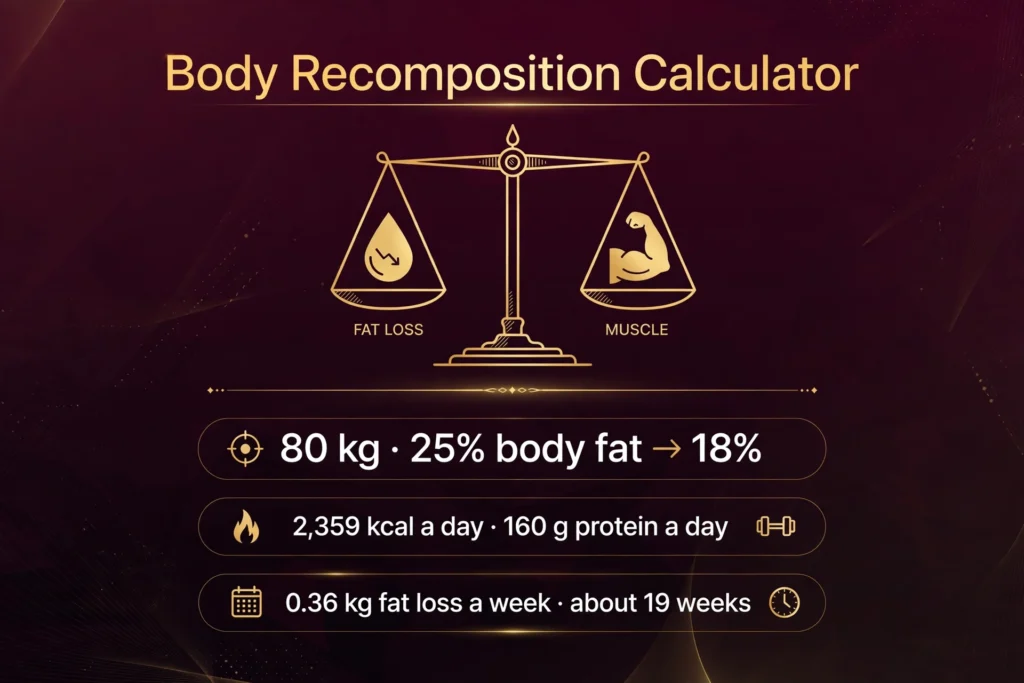
What does a worked example look like?
Take a man of 30, 180 cm tall, 80 kg, with 25% body fat, moderately active, who chooses the lose-fat goal and a target of 18% body fat. His BMR is 1,780 kcal a day: 10 times 80 is 800, 6.25 times 180 is 1,125, 5 times 30 is 150, and 800 plus 1,125 minus 150 plus 5 gives 1,780. His maintenance calories are 1,780 times 1.55, which is 2,759 kcal a day. His goal calorie target is 2,759 minus 400, which is 2,359 kcal a day.
His protein target is 2.0 g per kg times 80 kg, which is 160 g a day, with the 1.6–2.2 g per kg range shown as 128–176 g. His fat target is 0.8 g per kg times 80 kg, which is 64 g a day. His carb target is what is left: 2,359 minus 160 times 4 minus 64 times 9, divided by 4, which is 285.8 g a day. His lean mass is 80 times 0.75, which is 60 kg. His fat mass is 80 times 0.25, which is 20 kg. His target weight at 18% body fat is 60 divided by 0.82, which is 73.2 kg. His projected fat loss is 400 times 7 divided by 7,700, which is 0.36 kg a week. His estimated time to target is 6.8 kg of fat to lose divided by 0.36 kg a week, which is about 19 weeks.
The worked example matches the illustration on this page: the same 80 kg man, the same 25% to 18% change, the same 2,359 kcal target, the same 160 g of protein a day, and the same 0.36 kg a week over about 19 weeks.
What is body recomposition?
Body recomposition is the process of losing body fat and gaining muscle at the same time. The scale may move little, because fat lost and muscle gained partly cancel each other out, while body fat percentage falls. A person who goes from 80 kg at 25% body fat to 73.2 kg at 18% body fat has lost 6.8 kg of fat and kept the same 60 kg of lean mass. The weight change is 6.8 kg, but the shape change is larger than the scale suggests, because the fat lost was 20 kg and the lean mass kept was 60 kg.
Recomposition works because fat loss and muscle gain run on different rules. Fat loss needs a calorie deficit: the body burns stored fat when it takes in less energy than it uses. Muscle gain needs resistance training that gets harder over time, plus enough protein to build the new tissue. The two can happen together when the deficit is small, the protein is high, and the training is hard. A large deficit makes muscle gain harder, because the body has less energy to build with. A small deficit, or maintenance calories, leaves room for both.
Recomposition is not the same as weight loss, and it is not the same as bulking. Weight loss alone can cost muscle as well as fat, especially when protein is low and there is no resistance training. Bulking adds muscle and fat together, then cuts the fat away in a separate phase. Recomposition aims to skip the separate phases and change both at once. It is slower than a dedicated cut or a dedicated bulk, but it avoids the weight swings of cycling between them.
How is body recomposition different from weight loss?
Weight loss is a fall in scale weight. Body recomposition is a fall in body fat percentage with lean mass kept or gained. The two are not the same: a person who loses 5 kg of fat and 5 kg of muscle has lost 10 kg of weight but kept the same body fat percentage, while a person who loses 5 kg of fat and gains 2 kg of muscle has lost only 3 kg of weight but has a lower body fat percentage. The second person has recompositioned, even though the scale moved less.
The tool measures recomposition by body fat percentage, not by weight alone. It takes the current weight and body fat percentage, works out the lean mass and the fat mass, then works out the target weight at the goal body fat percentage assuming lean mass stays the same. That target weight is the scale reading that goes with the goal percentage. For the worked example, the target weight is 73.2 kg, which is the weight at 18% body fat with 60 kg of lean mass.
Weight loss alone is simpler to track, because the scale gives one number and the trend is clear. Recomposition needs two numbers — weight and body fat percentage — and both carry measurement error. A smart scale or a tape-measure estimate can be off by several percentage points, and the limits section below explains how that error moves the targets. The tool does not remove that error; it works from the numbers entered, and the results are only as good as the inputs.
How does the calculator set my calorie target?
The calorie target starts from your basal metabolic rate, or BMR, which is the energy your body uses at rest to keep your heart beating, your lungs breathing, and your body warm. The tool uses the Mifflin-St Jeor equation, which is the most widely used formula for estimating BMR from age, sex, height, and weight. The basal metabolic rate calculator on this site uses the same equation, and it explains the formula and its limits in full. For the worked example, the BMR is 1,780 kcal a day.
The tool multiplies your BMR by an activity multiplier to get your maintenance calories, also called TDEE, which is the energy you use in a full day including movement and training. The multipliers run from 1.2 for sedentary to 1.9 for extra active, with 1.55 for moderately active as the default. For the worked example, the maintenance calories are 1,780 times 1.55, which is 2,759 kcal a day. A 400 kcal deficit is about 15% of a 2,759 kcal maintenance figure, which is small enough to hold for weeks without the hunger and fatigue of a large deficit.
The three goals adjust that maintenance figure. Lose fat subtracts 400 kcal a day. Recomposition keeps maintenance exactly. Build muscle adds 200 kcal a day. The 400 kcal deficit is the figure the tool uses to project the fat-loss timeline: 400 kcal a day times 7 days is 2,800 kcal a week, and 2,800 divided by 7,700 kcal per kilogram of fat is 0.36 kg a week. The 200 kcal surplus is smaller, because a large surplus adds fat faster than muscle, and the tool does not project a timeline for a surplus: the week count is only shown when the goal creates a deficit.
The calorie target is an estimate, not a measurement. The Mifflin-St Jeor equation is right to within about 10% for most people, and the activity multiplier is a rough guide, not a precise figure. The worked example's 2,359 kcal target is a starting point: if weight and body fat percentage do not move after two weeks, the target should be adjusted by 100 to 200 kcal a day in the direction of the goal, and held for another two weeks before it is changed again.
How much protein do I need for body recomposition?
Protein is the most important part of the daily split for recomposition, because muscle is built from protein and a high intake protects lean mass while fat is lost. The tool sets protein at 2.0 g per kg of body weight a day, inside the 1.6–2.2 g per kg range from the Morton 2018 meta-analysis. For the worked example, 2.0 g per kg times 80 kg is 160 g a day, and the tool shows the 1.6–2.2 g per kg range as 128–176 g. The range matters more than the single figure: anywhere in it is enough for most lifters, and the top of the range helps when the deficit is larger.
The 1.6–2.2 g per kg range comes from a meta-analysis by Morton and colleagues, published in the British Journal of Sports Medicine in 2018, which pooled 49 studies of protein intake and resistance training. The authors found that muscle gains levelled off at about 1.6 g per kg a day, with the upper end of the confidence interval reaching 2.2 g per kg. The tool uses 2.0 g per kg as its default because it sits inside that range and leaves a margin for the days when intake is lower than planned. A person who eats less than 1.6 g per kg will still gain muscle, but more slowly, and will lose more lean mass in a deficit.
Fat is set at 0.8 g per kg of body weight, and carbs fill the remaining calories. For the worked example, fat is 0.8 times 80, which is 64 g a day, and carbs are 285.8 g a day. The split is not fixed: a person who prefers more fat and fewer carbs can move the split, as long as protein stays in range and the total stays at the calorie target. The macronutrient calculator on this site works out the same split from the same inputs, and it is the tool to use when the protein, fat, and carb figures are needed on their own.
How does the timeline projection work?
The timeline starts from the fat you need to lose, which is your current fat mass minus your target fat mass at the goal body fat percentage. Your target fat mass comes from your target weight, which is your lean mass divided by one minus your target body fat percentage as a decimal. For the worked example, the lean mass is 60 kg, the target weight is 60 divided by 0.82, which is 73.2 kg, and the target fat mass is 73.2 times 0.18, which is 13.2 kg. The fat to lose is 20 minus 13.2, which is 6.8 kg.
The weekly fat loss comes from your daily calorie deficit. A deficit of 400 kcal a day times 7 days is 2,800 kcal a week. The tool divides that by 7,700 kcal per kilogram of body fat, which is the energy stored in a kilogram of fat tissue, to get 0.36 kg a week. The 7,700 kcal figure is the standard estimate used in most weight-loss models, and it is the same figure the tool's note cites. A larger deficit gives a faster weekly loss, and a smaller deficit gives a slower one.
The week count divides the fat to lose by the weekly fat loss. For the worked example, 6.8 kg divided by 0.36 kg a week is 18.9 weeks, which the tool rounds to about 19 weeks. The rounding is to whole weeks, because a timeline in days would look more precise than it is: the 7,700 kcal figure, the activity multiplier, and the body fat percentage all carry error, and the week count is a projection, not a promise.
The timeline is only shown when three things are true: your target body fat percentage is above the essential-fat range, you still have fat to lose to reach it, and your goal creates a calorie deficit. If any of the three is false, the weeks box shows "—" and the note explains why. A target at or below essential fat gives the essential-fat warning. A target already reached gives the already-there note. A maintenance or surplus goal gives the no-deficit note. The calorie and protein targets are still shown in all three cases, because they do not depend on the timeline.
What mistakes do people commonly make with body recomposition?
The first mistake is picking the wrong activity level. A sedentary multiplier of 1.2 gives a maintenance figure far below a moderately active multiplier of 1.55: for the worked example, the BMR of 1,780 kcal gives 2,136 kcal a day at 1.2 and 2,759 kcal a day at 1.55, a gap of 623 kcal. A person who trains three times a week but picks sedentary will eat far too little and lose muscle as well as fat. A person who sits all day but picks very active will eat far too much and gain fat. Pick the level that matches a normal week, not the hardest week.
The second mistake is eating too little protein. A person who hits the calorie target but eats only 0.8 g of protein per kg will lose lean mass in a deficit, because the body breaks down muscle for energy when protein is short. The tool sets 2.0 g per kg as its default, and the range is 1.6–2.2 g per kg. A person who finds 2.0 g per kg hard to reach can aim for the bottom of the range, 1.6 g per kg, and still protect most of their lean mass.
The third mistake is chasing the scale instead of the body fat percentage. A person who gains 2 kg of muscle and loses 2 kg of fat has the same scale weight and a lower body fat percentage, and the scale alone would say nothing happened. The tool's target weight is the scale reading at the goal body fat percentage, so the scale is useful once the target is known: for the worked example, the target weight is 73.2 kg, and the scale should trend towards it. But a single weigh-in is noisy, so the trend over two weeks matters more than any one reading.
The fourth mistake is changing the plan too often. The tool's targets are a starting point, and the body takes two weeks to show a clear trend. A person who changes the calorie target every few days never gives any figure a fair test, and cannot tell which change worked. Hold the target for two weeks, measure weight and body fat percentage on the same days each week, then adjust by 100 to 200 kcal a day if the trend is wrong, and hold the new figure for another two weeks.
The fifth mistake is treating the week count as a promise. The timeline assumes lean mass stays the same, the deficit stays the same, and the 7,700 kcal figure is exact, and none of the three is true in practice. Lean mass moves, the deficit drifts as weight falls, and the energy in a kilogram of fat varies between people. The worked example's about 19 weeks is a projection from the numbers entered, not a date on a calendar. If the rate slows, the target should be re-entered with the new weight and body fat percentage, and the tool will give a fresh projection.
The sixth mistake is ignoring sleep and stress. Sleep below seven hours a night raises hunger, lowers training performance, and shifts weight loss towards lean mass rather than fat. Stress raises cortisol, which holds water and masks fat loss on the scale. Neither is an input to this tool, and neither changes the calorie target directly, but both change how the body responds to it. A person who sleeps well and trains hard will lose more fat and keep more muscle on the same calories than a person who does neither.
What are the limits of this calculator?
This calculator gives an estimate from a formula, not a measurement of your body. The Mifflin-St Jeor equation is right to within about 10% for most people, but it is less accurate for very muscular people, very lean people, and people at the extremes of height and weight. The activity multiplier is a rough guide, and the body fat percentage you enter carries its own error. The results are a starting point for a plan, not a prescription.
It does not measure your body fat percentage for you. A smart scale or a tape-measure estimate can be off by several percentage points, and a DEXA scan is the most accurate method most people can access. The BMI calculator on this site gives a rough weight category from height and weight alone, and the ideal weight calculator gives a target weight range, but neither measures body fat. The limits of the body fat figure you enter are the limits of the results you get.
It does not account for training history, muscle mass, or diet history. A beginner gains muscle faster than an experienced lifter, and a person returning after a break regains muscle faster than a person starting from scratch. A person who has dieted hard for months has a lower maintenance figure than the formula suggests, because the body adapts to a long deficit. The tool uses the same formula for everyone, and the adjustment section in the calorie-target part of this page explains how to correct for it.
It does not track your progress for you. The tool gives one set of targets from one set of inputs, and it does not remember them or update them as your weight changes. Re-enter your new weight and body fat percentage every two weeks to get fresh targets. The FFMI calculator on this site gives a fat-free mass index from the same inputs, and it is the tool to use when the question is how muscular you are for your height, rather than how much fat you carry.
It is not medical advice. The essential-fat warning is a safety limit, not a goal, and a target body fat percentage below it should not be chased without a clinician's guidance. The tool is for healthy adults and older teenagers, and it does not cover pregnancy, eating disorders, or medical conditions that change energy needs. A doctor or a registered dietitian is the right person for those cases, and the tool's targets should not replace their advice.
How can I check the tool against a known result?
The simplest check is the worked example. Enter a man of 30, 180 cm, 80 kg, 25% body fat, moderately active, lose fat, target 18%, and check the eleven boxes: BMR 1,780 kcal a day, maintenance 2,759 kcal a day, goal 2,359 kcal a day, protein 160 g a day, fat 64 g a day, carbs 285.8 g a day, lean mass 60 kg, fat mass 20 kg, target weight 73.2 kg, weekly fat change 0.36 kg a week loss, and about 19 weeks. Every box should match. If any box differs, the entered figures differ from the test, and the error is in the input rather than in the tool.
A second check uses the quick-reference table below. Enter a woman of 30, 165 cm, 65 kg, 30% body fat, moderately active, recomposition, target 24%, and check the BMR, the maintenance calories, and the protein target against the table row for 65 kg: BMR 1,370 kcal a day, maintenance 2,124 kcal a day, and protein 130 g a day. Then change the goal to lose fat only, and check the goal calorie target: 2,124 minus 400 is 1,724 kcal a day. The table gives the maintenance figure and the protein figure, and the goal figure follows from the maintenance figure by the 400 kcal rule.
A third check uses the error handling. Enter a body fat percentage of 65% and confirm the tool shows a plain-language error and no results. Enter a weight of 0 and confirm the same. Enter an age of 10 and confirm the tool refuses with the age message. Then enter a target of 4% for a man and confirm the weeks box shows "—" with the essential-fat warning, and enter a target of 30% for the worked-example man and confirm the weeks box shows "—" with the already-there note.
A fourth check uses the female recomposition case. Enter a woman of 28, 165 cm, 65 kg, 30% body fat, lightly active, recomposition, target 24%, and check the eleven boxes: BMR 1,380 kcal a day, maintenance 1,898 kcal a day, goal 1,898 kcal a day, protein 130 g a day, fat 52 g a day, carbs 227.5 g a day, lean mass 45.5 kg, fat mass 19.5 kg, target weight 59.9 kg, weekly fat change 0.00 kg a week, and the weeks box shows "—" with the no-deficit note. More tools in the same collection are in the calculators category.
Quick-reference table: maintenance calories and protein targets at moderate activity
Every row in this table was computed from the same formulas the tool uses: BMR from the Mifflin-St Jeor equation, maintenance calories as BMR times 1.55 for moderate activity, and protein at 2.0 g per kg of body weight, with the 1.6–2.2 g per kg range in brackets. The male rows use age 30 and height 180 cm. The female rows use age 30 and height 165 cm.
| Body weight | BMR (men) | Maintenance calories (men) | Protein target (men) |
|---|---|---|---|
| 60 kg | 1,580 kcal/day | 2,449 kcal/day | 120 g/day (96–132 g) |
| 70 kg | 1,680 kcal/day | 2,604 kcal/day | 140 g/day (112–154 g) |
| 80 kg | 1,780 kcal/day | 2,759 kcal/day | 160 g/day (128–176 g) |
| 90 kg | 1,880 kcal/day | 2,914 kcal/day | 180 g/day (144–198 g) |
| 100 kg | 1,980 kcal/day | 3,069 kcal/day | 200 g/day (160–220 g) |
| Body weight | BMR (women) | Maintenance calories (women) | Protein target (women) |
|---|---|---|---|
| 55 kg | 1,270 kcal/day | 1,969 kcal/day | 110 g/day (88–121 g) |
| 65 kg | 1,370 kcal/day | 2,124 kcal/day | 130 g/day (104–143 g) |
| 75 kg | 1,470 kcal/day | 2,279 kcal/day | 150 g/day (120–165 g) |
| 85 kg | 1,570 kcal/day | 2,434 kcal/day | 170 g/day (136–187 g) |
Frequently asked questions
What is body recomposition?
Body recomposition means losing fat and gaining muscle at the same time, so body fat percentage falls even if scale weight moves little. It usually pairs progressive resistance training with enough protein and a small calorie deficit or maintenance calories.
How many calories should I eat for body recomposition?
Eat at or near your maintenance calories. This tool sets the recomposition target at maintenance itself, the fat-loss target at maintenance minus 400 kcal a day, and the muscle-gain target at maintenance plus 200 kcal a day. Maintenance is estimated from your BMR times an activity multiplier.
How much protein do I need for body recomposition?
Aim for 1.6 to 2.2 g of protein per kg of body weight a day. This tool uses 2.0 g per kg as its default, so an 80 kg person gets 160 g a day. The range comes from the Morton 2018 meta-analysis, which found muscle gains levelled off at about 1.6 g per kg, with the upper end of the confidence interval reaching 2.2 g per kg.
How long does body recomposition take?
Visible changes usually start in 8 to 12 weeks, and strong changes take 6 to 12 months. This tool projects a timeline only for the fat-loss goal, from the fat to lose divided by the weekly fat loss at a 400 kcal daily deficit. At maintenance there is no deficit to project from, so no week count is shown.
Can I lose fat and gain muscle at the same time?
Yes, and it works best for beginners, returning lifters, and people starting at a higher body fat percentage. It needs resistance training that gets harder over time, enough protein, and calories near maintenance. For an experienced lifter who is already lean, it still happens, but slowly, and a dedicated cut or bulk is usually faster.
Is body recomposition better than bulking and cutting?
It depends on where you start. Recomposition is better when you want to change shape without big weight swings, when you are new to lifting, or when you are starting at a higher body fat percentage. Bulking and cutting are faster when you are already lean and experienced and want the most muscle in the least time. This tool gives you the recomposition plan; it does not claim it is the right choice for everyone.