Home Equity Line of Credit Calculator
Enter your credit limit, how much you have drawn, your rate and the two periods, and the tool works out your interest-only payment during the draw period, your higher payment once repayment starts, the interest in each phase, and the credit you still have left.
Interest-only payments do not reduce the amount you owe. The repayment payment is worked out on the full amount drawn, at the rate you entered, spread over the repayment period. Your entries stay in your browser.
A home equity line of credit, usually called a HELOC, is a revolving line of credit secured by the equity in your home. You draw money when you need it, pay interest only on the amount you have actually drawn during the draw period, and then repay the balance with principal-plus-interest payments once the repayment period starts.
What is a home equity line of credit?
A HELOC is a line of credit that uses your home as security. Equity is the value of your home minus the amount you still owe on your mortgage. If your home is worth $400,000 and your mortgage balance is $250,000, you have $150,000 of equity. A lender will usually let you borrow only part of that equity, up to a credit limit they set.
The word revolving is the key to the whole product. A HELOC works more like a credit card than like a normal loan. You are given a limit, you draw some of it, you pay some of it back, and the amount you repay becomes available to draw again — as long as you are still inside the draw period. A home equity loan is different: you receive one lump sum at the start, and you repay it in fixed monthly instalments from the first month. The Consumer Financial Protection Bureau (CFPB) draws the same line in its explainer, What is a home equity line of credit (HELOC)?, describing a HELOC as an open-end line that lets you borrow repeatedly against your home equity.
Because your home secures the line, the stakes are higher than with an unsecured loan. The CFPB puts it plainly in that same explainer: only consider a HELOC if you are confident you can keep up with the payments, because if you fall behind you could lose your home. That warning belongs at the front of any decision about a HELOC, not in the small print at the end.
HELOCs are commonly used for costs that arrive in stages or that are hard to price in advance: a renovation done room by room, a roof replaced in phases, or education costs spread over several terms. A single lump-sum loan fits a single known price better. A line fits a project where the total is uncertain and the money is needed over months or years.
How does a HELOC work during the draw period?
The draw period is the first phase of a HELOC, and it usually lasts 5 to 10 years. Ten years is the most common length, and it is the example the CFPB uses. During this period you can borrow up to your credit limit at any time, typically with special checks or a card linked to the line.
Your required payment during the draw period is usually interest only. You pay the interest that builds up on the amount you have drawn, and nothing goes toward the principal. That keeps the monthly payment low, which is exactly why the draw period feels comfortable. It also means the balance does not fall. Draw $50,000, pay interest only for ten years, and you still owe $50,000 on the first day of the repayment period.
Most lines also let you pay extra toward the principal during the draw period, even when the minimum payment does not require it. Every dollar of principal you pay down in this phase shrinks the balance that will be amortised later, which shrinks both the repayment payment and the lifetime interest. The calculator on this page assumes you pay interest only, so its repayment figure is the highest version of that payment. Paying principal early can only improve on it.
Two more draw-period rules are worth knowing before you sign. Some plans require a minimum draw each time you take money, or a minimum balance to keep outstanding. And a lender can freeze the line or cut the limit if the value of your home falls sharply or your finances change — the CFPB notes this in its HELOC guidance, and it means the credit you counted on may not be there when you reach for it.
How is the draw-period payment calculated?
The draw-period payment is the simplest calculation on a HELOC. You multiply the amount you have drawn by the annual interest rate, then divide by 12.
Monthly draw payment = amount drawn × (annual rate ÷ 12)
Only the amount drawn is charged, never the full credit limit. A $100,000 limit with $50,000 drawn at 8% costs $50,000 × 0.08 ÷ 12, which is $333.33 a month. The other $50,000 of the limit costs nothing until you draw it. Draw another $25,000 and the payment rises to $500.00 a month at the same rate. Repay $25,000 and it falls back to $333.33.
This is why the draw payment moves whenever your balance moves. Borrow more and the payment rises in the same month. Pay principal down and it falls. The rate matters just as directly: at 6% the same $50,000 draw costs $250.00 a month, and at 10% it costs $416.67. Those figures come from the same formula, and the tool above applies it to whatever numbers you enter.
Some lenders work out interest on the average daily balance rather than the balance on one day of the month. The monthly-rate version used here is very close to that in practice, and it is the version most published HELOC calculators use. If your lender charges interest daily, your statement may differ from this estimate by a few dollars.
What happens when the draw period ends?
When the draw period ends, the line closes. You can no longer draw money from it, and the repayment period begins. The CFPB says lenders often schedule repayment over 10 or 20 years, and that the monthly payment is often significantly higher once repayment starts.
Nothing about your balance changes on that day. What changes is what the payment has to do. During the draw period the payment only had to cover interest. During repayment it has to cover interest and pay the whole balance down to zero by the end of the term. That is the whole reason the payment jumps, and it jumps on one specific month with no gradual ramp-up.
Some lines end the draw period with a balloon payment instead: the entire balance comes due at once. The CFPB flags this in its HELOC booklet. If your agreement has a balloon clause, the numbers on this page do not describe your repayment — check the agreement and plan for the lump sum, because it is a very different obligation from a 20-year amortisation.
The end of the draw period is also the point where the line stops being flexible. During the draw period you could repay and re-borrow. During repayment you can only pay down. If a new cost appears after the line closes, the HELOC cannot fund it.
How is the repayment-period payment calculated?
The repayment payment is a standard amortising loan payment. It is worked out on the balance outstanding when repayment starts, at the rate in force at that time, spread over the repayment term in equal monthly payments that bring the balance to zero.
Monthly repayment payment = balance × monthly rate ÷ (1 − (1 + monthly rate)^(−number of months))
The monthly rate is the annual rate divided by 12, and the number of months is the repayment period in years times 12. With a $50,000 balance at 8% over 20 years, the monthly rate is 0.08 ÷ 12, the term is 240 months, and the payment is $418.22. The same balance over 10 years would cost $606.64 a month, and over 30 years it would cost $366.88. A shorter repayment term means a higher monthly payment but far less interest in total: $22,796.56 of repayment interest over 10 years against $82,077.62 over 30 years, on the same $50,000.
If the rate is 0%, the formula collapses to simple division: $50,000 over 240 months is $208.33 a month, with no interest at all. The calculator handles that case directly.
One point about this calculation deserves care. The repayment payment here assumes the rate you entered stays the same through repayment. HELOC rates are usually variable, so the real payment will move with the rate. Treat the repayment figure as the payment at today’s rate, and run the calculator again at a higher rate to see what a rise would do. At 10% instead of 8%, the same $50,000 over 20 years costs $482.51 a month rather than $418.22.
Why does the monthly payment jump when repayment starts?
The jump has a name in lender and regulator writing: payment shock. It is the step up from the interest-only draw payment to the principal-plus-interest repayment payment, and it is the single most misunderstood part of a HELOC.
The size of the jump depends on two things: the balance and the repayment term. On the worked example below, $50,000 at 8% jumps from $333.33 to $418.22, an increase of $84.89 a month, or 25.47%. That is a modest jump, because the repayment term is a long 20 years. Shorten the repayment term to 15 years and the same balance jumps from $375.00 to $556.21 at 7.5% — an increase of $181.21, or 48.32%. Published guides commonly describe jumps of 20% to 100% or more, and the shorter the repayment term and the larger the balance, the bigger the jump.
The reason the jump catches people out is timing. The draw payment is the number you live with for years, sometimes a decade. Budgets, habits and other spending settle around it. Then one month the payment rises by a quarter, a half, or more, and there is no new borrowing behind it — the money was spent years earlier. The CFPB has flagged this pattern as a source of financial distress for HELOC borrowers.
There is a practical defence, and it is the same one that cuts the lifetime interest: pay principal during the draw period. If you pay the repayment amount from the start — $418.22 instead of $333.33 on the example — the extra $84.89 a month goes straight to principal, the balance is smaller when repayment starts, and there is no jump at all. Even paying half the difference helps. The calculator shows both payments so you can test this directly: enter your numbers, look at the repayment payment, and ask whether your budget could carry that figure today.
How does a variable rate change your HELOC payment?
Most HELOCs carry a variable rate. That means the rate is not fixed for the life of the line. It is built from two parts: an index that tracks rates in the wider economy, most often the U.S. prime rate, plus a margin the lender adds. The margin stays the same for the life of the line; the index moves, and your rate and payment move with it.
Margins of around 1 to 2 percentage points above prime are commonly cited. The prime rate itself moves over time: the Federal Reserve’s H.15 release listed the bank prime loan rate at 7.00% on November 9, 2026. A line priced at prime plus 1 would have carried 8.00% on that day. That figure is a dated snapshot, not a current rate, and it will have moved since. Always check the current prime rate and your own margin rather than relying on any rate quoted in an article.
A rate change moves both payments. During the draw period the payment is the balance times the monthly rate, so a 2-point rise on a $50,000 balance adds $83.33 a month to the interest-only payment. During repayment the same rise lifts the amortised payment as well, and it lifts it on a balance that is no longer shrinking as fast as you might expect. Rate caps limit how far the rate can rise in one adjustment and over the life of the line, and federal rules require every variable-rate HELOC to state its maximum rate. Ask your lender for both caps and for the worst-case payment before you agree to the line.
To test a rate rise with the tool above, run your numbers once at your current rate and once 2 or 3 points higher. The difference between the two repayment payments is the amount your budget needs to absorb if rates rise.
How much of your credit line is left after you draw?
Remaining available credit is the credit limit minus the amount currently drawn. A $100,000 limit with $50,000 drawn leaves $50,000 available. Draw the full $100,000 and nothing is left until you repay some of it. Repay $20,000 of a $50,000 balance and your available credit rises from $50,000 to $70,000.
Available credit is not free money, and it is not a measure of what you can afford. It is simply the headroom on the line. The interest you pay depends only on the drawn amount, so leaving credit untouched costs nothing — but drawing it turns it into debt secured by your home, at a variable rate, with a repayment clock attached.
Two things can shrink your available credit without you drawing anything. First, the lender can reduce the limit if the home’s value falls or your finances change. Second, some lines set a minimum balance or charge fees that sit on the line. Check the agreement for annual fees, inactivity fees and early-closure fees, which are the charges the CFPB lists most often for HELOCs. None of those fees are included in this calculator, so add them to your own cost estimate if your lender charges them.
If you are comparing a HELOC with a fixed loan, the remaining-credit figure is the clearest difference between them. A fixed loan has no remaining credit: the money is paid out once and the balance only falls. A HELOC keeps the unused part available until the draw period ends, which is useful for staged costs and a risk if the availability tempts extra borrowing.
What does a $50,000 HELOC draw cost in real numbers?
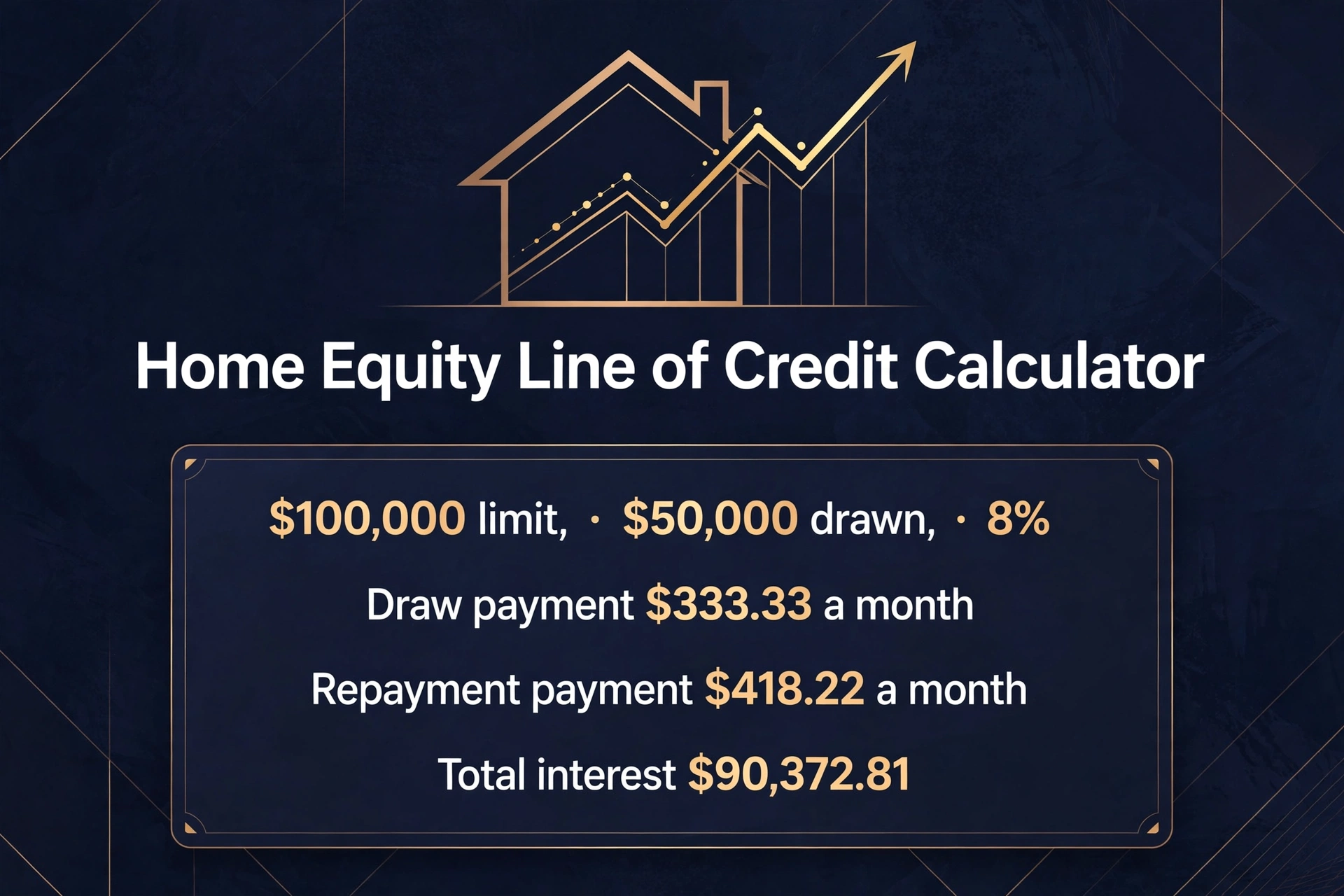
Take a $100,000 credit limit, $50,000 drawn, an 8% rate, a 10-year draw period and a 20-year repayment period. These are the figures the tool was tested with, and every number below comes from that test.
During the draw period the payment is $333.33 a month, interest only. Over 120 months that is $40,000.00 of interest, and the balance is still $50,000.00 at the end of the tenth year. Nothing has been repaid.
When repayment starts, the payment becomes $418.22 a month for 240 months. That is an increase of $84.89 a month, or 25.47%, on the same balance at the same rate. Over the repayment period the interest is $50,372.81. Add the two phases together and the total interest over the life of the line is $90,372.81. The total cost — the $50,000 drawn plus all the interest — is $140,372.81. The remaining available credit throughout is $50,000.00, because only half the limit was drawn.
A second case shows how the jump grows when the repayment term is shorter. With a $120,000 limit, $60,000 drawn at 7.5%, a 10-year draw and a 15-year repayment, the draw payment is $375.00 a month and the repayment payment is $556.21 — a jump of $181.21, or 48.32%. Draw interest is $45,000.00, repayment interest is $40,117.33, total interest is $85,117.33, and the total cost is $145,117.33. The remaining credit is $60,000.00. A shorter repayment term pushes the monthly payment up sharply even though the total interest falls.
The pattern in both cases is the same: the draw period is cheap month by month and expensive in total, because ten years of interest-only payments buy no reduction in the balance. The repayment period then has to do all the work of paying the balance off.
What would you pay at different draw amounts?
The table below uses an 8% rate, a 10-year draw period and a 20-year repayment period, with a $100,000 credit limit. Every cell was computed from the same formulas the tool uses.
| Amount drawn | Draw payment / month | Repayment payment / month | Total interest | Remaining credit |
|---|---|---|---|---|
| $25,000 | $166.67 | $209.11 | $45,186.40 | $75,000.00 |
| $50,000 | $333.33 | $418.22 | $90,372.81 | $50,000.00 |
| $75,000 | $500.00 | $627.33 | $135,559.21 | $25,000.00 |
| $100,000 | $666.67 | $836.44 | $180,745.62 | $0.00 |
The figures scale in direct proportion to the amount drawn: double the draw and both payments double. That is because the draw payment is a straight multiplication and the repayment payment is a fixed multiple of the balance at a given rate and term. The useful reading of the table is the last column. Drawing the full limit leaves no headroom for a later cost, and every extra dollar drawn adds interest in both phases — roughly $1.81 of total interest for every dollar drawn at these terms.
The repayment term matters as much as the amount. On a $50,000 draw at 8%, a 10-year repayment costs $606.64 a month and $22,796.56 of repayment interest, while a 30-year repayment costs $366.88 a month but $82,077.62 of repayment interest. The longer term feels easier each month and costs nearly $60,000 more in interest. There is no free choice here, only a trade between the monthly figure and the lifetime figure.
What mistakes do people make with a HELOC?
The first mistake is budgeting around the draw payment as if it were the real cost. It is the minimum, not the cost. The real cost is the repayment payment plus the interest paid during the draw period. Anyone who can only afford the interest-only figure is not ready for the line.
The second mistake is drawing the full limit for a cost that only needs part of it. Interest is charged on what is drawn, so a larger draw costs more every month in both phases. Draw in stages, as the cost actually arises, and the interest stays lower. A renovation that needs $30,000 now and $20,000 in a year should be drawn as $30,000 now, not $50,000 on day one.
The third mistake is treating the line as income. Because drawing is easy — a check, a card, a transfer — the money can feel like it is simply available. It is debt secured by the home, and the repayment period will arrive whether the spending was planned or not. Using a HELOC for everyday spending or for a holiday is the fastest way to turn a useful tool into a long repayment.
The fourth mistake is ignoring the rate. A variable rate means the payment you sign up for is not the payment you will pay for thirty years. Borrowers who never test a higher rate are the ones surprised by it. Run the calculator at 2 or 3 points above the current rate before you borrow, and make sure the higher repayment payment fits.
The fifth mistake is forgetting the fees and the tax position. Annual fees, appraisal fees, application fees and closing costs all add to the true cost, and none of them appear in a payment calculator. On tax, interest is deductible only when the money is used to buy, build or substantially improve the home that secures the line — not for general spending. Tax rules change and depend on your own position, so confirm them with a qualified tax professional rather than assuming a deduction.
When does a HELOC make sense — and when does it not?
A HELOC fits costs that are large, spread over time, and tied to the home. A phased renovation, a new roof followed by a kitchen a year later, or education costs spread over several terms are the usual cases. It also fits as a standby source of funds for a homeowner with steady income, a clear repayment plan, and room in the budget for the repayment payment from day one.
It fits less well when the cost is a single known amount. A fixed home equity loan or a fixed-term loan payment gives one known payment from the first month, with no jump later. If you need $40,000 for one job at one price, the certainty of a fixed payment is usually worth more than the flexibility of a line.
It also fits badly when the budget only works at the interest-only payment. If the repayment payment would strain the household budget, the line is too large or the timing is wrong. Work out how much home loan you can afford first, check your debt-to-income ratio, and size the draw to the repayment payment, not to the limit the lender offers.
A HELOC is a poor fit for spending that creates no value in the home, for consolidating debts without fixing the spending that created them, and for anyone whose income is uncertain. The home is the security, so the downside of a wrong decision is not a damaged credit score alone — it is the home itself.
How do you use this HELOC calculator?
Enter your credit limit first, then the amount you have drawn or plan to draw. Add the annual rate from your lender’s offer, the length of the draw period in years, and the length of the repayment period in years. Press Calculate.
The tool shows eight results: the draw-period payment, the repayment-period payment, the jump between them in dollars and percent, the interest in each phase, the total interest, the total cost, and the remaining available credit. If the amount drawn is above the credit limit, the tool says so and shows no results. If nothing is drawn, both payments are $0 and the full limit is shown as available.
Run the numbers three times before you decide anything: once at the rate you have been offered, once 2 points higher, and once with the repayment payment as the figure you would actually pay from the start. The first run tells you the cost today, the second tells you the cost if rates rise, and the third tells you whether paying principal early removes the jump. If the third run fits your budget, the line is affordable on its own terms. If only the first run fits, the line is affordable only while rates stay low and the draw period lasts — which is not a plan.
For the wider picture, compare the repayment payment with a business loan payment if the money is for a business purpose, and check FHA mortgage insurance (PMI) if your home loan is an FHA loan, since the mortgage sitting ahead of the HELOC shapes how much equity a lender will let you touch. The full set of calculators is on the Calculators category page.
Disclaimer
This calculator and article are for general information only. They are not financial advice, and they do not take the place of advice from a qualified financial adviser or lender. Rates, limits, fees, terms and tax treatment vary by lender and by your own position, and the figures here are estimates based on the numbers you enter. Confirm the actual terms of any home equity line of credit with the lender before you agree to it.
How is a HELOC payment calculated?
A HELOC has two different payments. During the draw period the payment is usually interest only: amount drawn × annual rate ÷ 12. A $50,000 draw at 8% costs $50,000 × 0.08 ÷ 12, which is $333.33 a month. Once the repayment period starts, the payment becomes principal plus interest, worked out with the standard amortisation formula on the balance at that time over the repayment term. The same $50,000 at 8% over 20 years costs $418.22 a month.
What happens when the draw period ends?
The line closes to new borrowing and the repayment period begins. You can no longer draw money, and your monthly payment rises because it now has to pay the balance down to zero as well as cover interest. On a $50,000 balance at 8% with a 20-year repayment term, the payment rises from $333.33 to $418.22 a month, an increase of $84.89, or 25.47%. Some lines end with a balloon payment instead, where the whole balance comes due at once — check your agreement.
Is a HELOC rate fixed or variable?
HELOC rates are usually variable. The rate is normally an index, most often the U.S. prime rate, plus a margin the lender adds, and margins of around 1 to 2 percentage points above prime are commonly cited. When the index moves, your rate and your payment move with it. Federal rules require every variable-rate HELOC to state the maximum rate it can charge, so ask your lender for the rate caps and the worst-case payment.
Do you pay interest on the full credit limit or only on what you draw?
Only on what you draw. A $100,000 limit with $50,000 drawn at 8% costs $333.33 a month in interest, and the undrawn $50,000 costs nothing. Draw more and the payment rises; repay principal and it falls. The remaining available credit is simply the limit minus the amount currently drawn.
Can you pay down principal during the draw period?
Yes, most HELOCs allow it even when the minimum payment is interest only. Every dollar of principal you pay down during the draw period shrinks the balance that will be amortised in repayment, which lowers both the repayment payment and the total interest. Paying the repayment amount from the start removes the payment jump entirely, because the balance is already falling before repayment begins.
What is the difference between a HELOC and a home equity loan?
A HELOC is a revolving line of credit: you draw money when you need it, repay it, and draw again during the draw period, and you pay interest only on what you have drawn. A home equity loan gives you one lump sum at the start and you repay it in fixed monthly instalments of principal and interest from the first month. Both are secured by your home, and both are usually second mortgages on top of your first mortgage.