Molecular Mass Finder
Type a chemical formula, for example H2O, C6H12O6 or Ca(OH)2. The tool works out the molar mass in grams per mole, the total number of atoms, and how much of the mass each element supplies.
Masses use IUPAC 2021 standard atomic weights. Isotopes are not handled. The tool reads 34 common elements and one level of parentheses.
The molecular mass of a compound is the mass of one molecule of it, found by adding up the atomic weights of every atom in its formula. This tool does that arithmetic for you: type a formula such as H2O and it returns the molar mass in grams per mole, the total atom count, and the share of the mass each element supplies.
How do I use the Molecular Mass Finder?
Type a chemical formula into the box at the top of the page. Use the standard way of writing formulas: an element symbol starts with a capital letter, with a lowercase second letter where one is needed, and a number after a symbol says how many atoms of that element are present. H2O is water, C6H12O6 is glucose, NaCl is table salt, and Ca(OH)2 is calcium hydroxide. Spaces do not matter, so “Ca(OH)2” and “Ca (OH)2” give the same result. Press the button and three labelled boxes appear: the molar mass in grams per mole, the total number of atoms in one formula unit, and the number of distinct elements. Below the boxes, a table lists each element in the order it appears in the formula, with its atom count, its atomic weight, its mass contribution, and its percentage of the total mass.
If the formula cannot be read, the tool shows a plain-language error and no results. An empty box asks you to type a formula. A formula that starts with a lowercase letter, such as h2o, is rejected because element symbols start with a capital letter. A symbol the tool does not know, such as Xy in Xy2, is rejected as an unknown element symbol. A closing parenthesis with no matching opening parenthesis, as in H2O), is rejected as unbalanced. An opening parenthesis that never closes, as in Ca(OH, is rejected the same way. A number with nothing in front of it, as in 2H2O, is rejected because a number must follow an element symbol or a closing parenthesis. A dot, as in a hydrate written CuSO4·5H2O, is rejected because the tool does not read hydrate notation. Each error message says what is wrong in plain words, so the fix is usually a single correction to the formula.
What does a worked example look like?
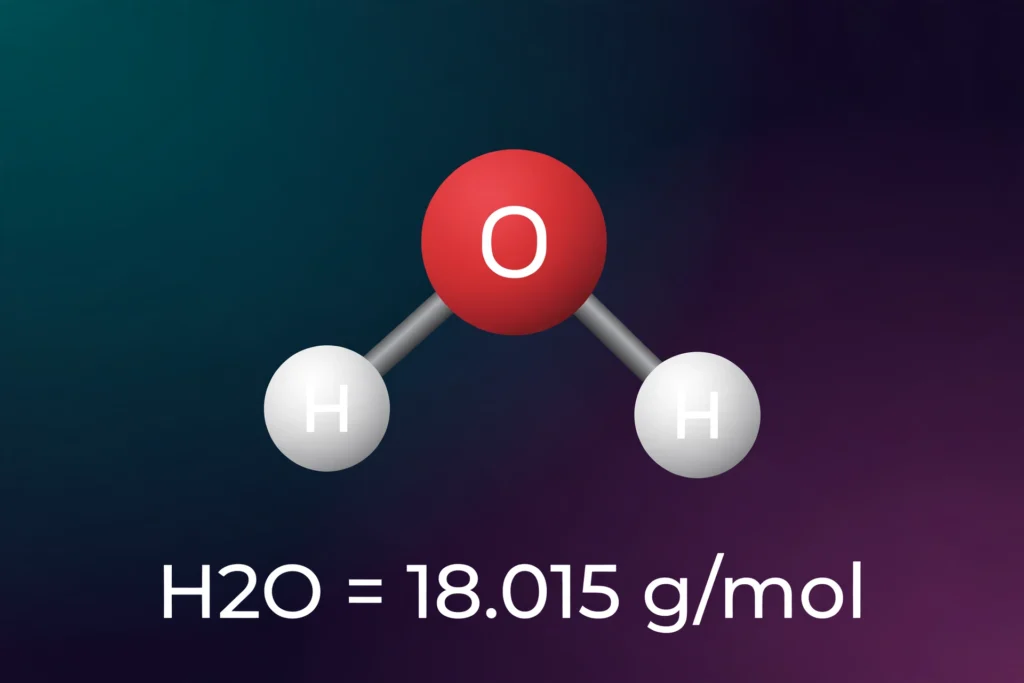
Start with water, the first verified test. The formula H2O means two hydrogen atoms and one oxygen atom. Look up the atomic weights: hydrogen is 1.008 and oxygen is 15.999. Multiply each weight by its atom count: two hydrogens give 2 × 1.008 = 2.016, and one oxygen gives 1 × 15.999 = 15.999. Add the contributions: 2.016 + 15.999 = 18.015 g/mol. The tool shows 18.015 g/mol, 3 atoms, and 2 elements. The breakdown table shows hydrogen contributing 2.016 g/mol, which is 11.19% of the mass, and oxygen contributing 15.999 g/mol, which is 88.81%.
A second test uses parentheses. Calcium hydroxide is written Ca(OH)2, and the 2 after the closing parenthesis applies to everything inside the parentheses, not only to the last symbol. The OH group appears twice, so the formula contains one calcium atom, two oxygen atoms and two hydrogen atoms: five atoms in total. The arithmetic is 1 × 40.078 for calcium, 2 × 15.999 = 31.998 for oxygen, and 2 × 1.008 = 2.016 for hydrogen. Add them: 40.078 + 31.998 + 2.016 = 74.092 g/mol. The breakdown table shows calcium at 54.09% of the mass, oxygen at 43.19% and hydrogen at 2.72%.
A third test uses a larger molecule. Glucose is C6H12O6: six carbons, twelve hydrogens and six oxygens, twenty-four atoms in total. Six carbons give 6 × 12.011 = 72.066. Twelve hydrogens give 12 × 1.008 = 12.096. Six oxygens give 6 × 15.999 = 95.994. Add them: 72.066 + 12.096 + 95.994 = 180.156 g/mol. The breakdown table shows carbon at 40.00% of the mass, hydrogen at 6.71% and oxygen at 53.28%. The three percentages add to 99.99% rather than 100.00% because each one is rounded to two decimal places; the unrounded values add to exactly 100%.
A quick check with whole-number weights confirms the method before any decimal places are involved. Round the weights to hydrogen 1, carbon 12, oxygen 16 and nitrogen 14. Water becomes 2 × 1 + 16 = 18, close to the precise 18.015. Glucose becomes 6 × 12 + 12 × 1 + 6 × 16 = 72 + 12 + 96 = 180, close to the precise 180.156. Carbon dioxide becomes 12 + 2 × 16 = 44, close to the precise 44.009. Ammonia becomes 14 + 3 × 1 = 17, close to the precise 17.031. If a whole-number check lands far from the tool’s figure, the formula was typed wrong, not the arithmetic.
What is molecular mass, and how is it different from molar mass?
Molecular mass is the mass of one molecule. Molar mass is the mass of one mole of molecules. The two are the same number expressed in different units: the molecular mass of water is 18.015 atomic mass units, written u, and the molar mass of water is 18.015 grams per mole, written g/mol. Molecular weight is an older name for the same quantity, and relative molecular mass, written Mr, is the same number again with no units at all. The tool reports grams per mole because that is the unit used in stoichiometry, the part of chemistry that works out how much of each substance a reaction needs or produces.
A mole is a counted quantity, like a dozen, but far larger. One mole of anything contains exactly 6.02214076 × 10²³ particles, a number called Avogadro’s number. That number is exact because it was fixed by definition in the 2019 revision of the International System of Units. So one mole of water molecules weighs 18.015 grams, and that 18.015 grams contains 6.02214076 × 10²³ water molecules. Two moles of water weigh 36.030 grams, and half a mole weighs 9.008 grams. The same number links the single molecule and the weighable sample, which is why molar mass is the figure a balance can check: weigh out 18.015 grams of water and you hold one mole of it.
The distinction matters when units are compared. A molecular mass quoted in daltons, written Da, is the same number again: water is 18.015 Da per molecule. A mass quoted in kilograms per mole is the same number divided by 1,000: water is 0.018015 kg/mol. None of these change the molecule; they only change the unit attached to the number. The mass converter turns grams into kilograms and other mass units when a result needs to be quoted in a different unit.
How do I read a chemical formula?
A chemical formula is a compact list of what a compound contains. Each element is written as a symbol of one or two letters. The first letter is always a capital letter, and a second letter, where one exists, is always lowercase. H is hydrogen, O is oxygen, C is carbon, N is nitrogen, Na is sodium, Cl is chlorine, Ca is calcium and Fe is iron. The capitalisation is part of the symbol: Na is sodium, while NA would be read as nitrogen followed by a symbol A that does not exist, and na would be read as no element at all. That is why the tool rejects lowercase first letters instead of guessing what was meant.
A number written straight after a symbol is a subscript, and it says how many atoms of that element are present. In H2O, the 2 belongs to hydrogen, so there are two hydrogen atoms and one oxygen atom: the oxygen has no number, which means one. In C6H12O6, the numbers say six carbons, twelve hydrogens and six oxygens. In CH4, the 4 belongs to hydrogen, so there is one carbon and four hydrogens. In NaCl there are no numbers at all, which means one sodium atom and one chlorine atom.
Parentheses group symbols together, and a number after a closing parenthesis multiplies the whole group. In Ca(OH)2, the OH group is multiplied by 2, giving two oxygens and two hydrogens alongside the one calcium. In CaCO3 there are no parentheses, so the 3 belongs to oxygen alone: one calcium, one carbon and three oxygens. The order of the symbols does not change the result, because the tool adds by element: OH2 and H2O both contain one oxygen and two hydrogens, and both give 18.015 g/mol. What a formula does not say is how the atoms are arranged, what charge the compound carries, or what state it is in. Ethanol, C2H5OH, and dimethyl ether, written CH3OCH3, both contain two carbons, six hydrogens and one oxygen, so both have a molar mass of 46.069 g/mol, even though they are different substances with different properties. The formula gives the composition, and the composition gives the mass; nothing more.
Where do atomic weights come from?
Atomic weights come from the periodic table, and the values on the periodic table come from measurement. Most elements occur in nature as a mix of isotopes: atoms of the same element with different numbers of neutrons and therefore different masses. The atomic weight of an element is the weighted average of its isotopes, weighted by how common each isotope is in natural material. Chlorine is the clearest example. Its two stable isotopes have mass numbers 35 and 37, yet the atomic weight of chlorine is 35.45, between the two. That is because about three quarters of natural chlorine is chlorine-35 and about a quarter is chlorine-37, so the average sits closer to 35 than to 37.
The body that publishes the reference values is the International Union of Pure and Applied Chemistry, known as IUPAC, through its Commission on Isotopic Abundances and Atomic Weights. Its Table of Standard Atomic Weights 2021 is the source for the values this tool uses. The scale is set by carbon-12, which is assigned an atomic weight of exactly 12 by definition. Every other atomic weight is measured against that fixed point.
Some elements do not have a single fixed value. For twelve elements, including hydrogen, carbon and oxygen, the mix of isotopes varies enough between natural samples that IUPAC reports a range rather than one number: hydrogen [1.00784, 1.00811], carbon [12.0096, 12.0116] and oxygen [15.99903, 15.99977]. The conventional values used in this tool — hydrogen 1.008, carbon 12.011, oxygen 15.999 — sit inside those ranges and are the values most tables print. A sample of water from an unusual source could have a molar mass a fraction of a thousandth of a gram per mole away from 18.015, but for classroom work, lab work and stoichiometry the conventional values are the standard.
That choice of values explains a difference a reader may notice. This tool uses the abridged IUPAC 2021 weights, so four of its figures sit a fraction in the third decimal place away from tables that use fuller-precision weights. Sulfuric acid, H2SO4, is 98.072 g/mol here and 98.079 g/mol in tables that use sulfur 32.065 and oxygen 15.9994 instead of the abridged 32.06 and 15.999. Calcium carbonate is 100.086 g/mol here and 100.087 g/mol elsewhere. Calcium hydroxide is 74.092 g/mol here and 74.093 g/mol elsewhere. Ethanol is 46.069 g/mol here and 46.068 g/mol elsewhere. The largest gap, for sulfuric acid, is 0.007 g/mol, and rounded to one decimal place every one of these pairs gives the same figure. The tool states its weights openly so that any difference can be traced to its source rather than mistaken for an error.
How do I work out the mass percent of each element?
Mass percent says how much of a compound’s mass belongs to each element. The rule is one division per element: take that element’s mass contribution, divide it by the molar mass, and multiply by 100. Written as a formula, it is:
Mass percent of an element = (mass contribution of that element ÷ molar mass) × 100
Take water. Hydrogen contributes 2.016 g/mol and the molar mass is 18.015 g/mol, so hydrogen is (2.016 ÷ 18.015) × 100 = 11.19% of the mass. Oxygen contributes 15.999 g/mol, so oxygen is (15.999 ÷ 18.015) × 100 = 88.81%. The two figures add to 100.00%. In plain terms, a 100-gram sample of water contains 11.19 grams of hydrogen and 88.81 grams of oxygen.
Take calcium carbonate, CaCO3, the main substance in limestone and chalk. Calcium contributes 40.078 g/mol out of 100.086 g/mol, which is 40.04%. Carbon contributes 12.011 g/mol, which is 12.00%. Oxygen contributes 47.997 g/mol, which is 47.96%. A 100-gram sample of calcium carbonate therefore contains 40.04 grams of calcium, 12.00 grams of carbon and 47.96 grams of oxygen. The breakdown table on this page does the division for every element, so the percentages are visible beside the contributions they came from. For the arithmetic itself, the percentage calculator works out any share of a total in the same way.
Mass percent is the figure that connects a formula to a weighed sample. A chemist who needs 10 grams of calcium from calcium carbonate divides 10 by 0.4004, the decimal form of 40.04%, and gets 24.98 grams of calcium carbonate to weigh out. A student checking a reaction works backwards: if a sample of a compound is 40.04% calcium, 12.00% carbon and 47.96% oxygen, the formula behind it is CaCO3. The percentages also give a fast check on a result. If the percentages in the breakdown table do not add to 100%, allowing for rounding in the last decimal place, then either a contribution or the total is wrong, and the formula is worth retyping.
What mistakes do people commonly make?
The first mistake is typing a lowercase first letter. The letter h on its own is not hydrogen; the symbol is H, capital first. Typing h2o gives an error, and the fix is to use the capital letter. The same applies to every symbol: o is not oxygen, and na is not sodium. The tool rejects these rather than guessing, because guessing would risk a wrong answer presented as a right one.
The second mistake is mixing up the letter O with the number 0. Water is H2O, with the letter O at the end. Typed as H20, with a zero, the formula means twenty hydrogen atoms and no oxygen at all, which the tool reads as 20.160 g/mol with no error, because H20 is a readable formula even though it is not the intended one. The result looks plausible and is wrong. Reading the formula back before pressing the button catches this: if the last character should be a letter, it must look like one.
The third mistake is forgetting the parenthesis multiplier. Calcium hydroxide is Ca(OH)2, and the 2 doubles both the oxygen and the hydrogen. Typed as CaOH2, without parentheses, the formula means one calcium, one oxygen and two hydrogens, which gives 58.093 g/mol instead of the correct 74.092 g/mol. The error is 16 grams per mole, which is a whole oxygen atom missing. Whenever a formula has parentheses, the number after the closing parenthesis belongs to the whole group, and the atom count in the tool’s boxes should be checked against that rule: Ca(OH)2 has five atoms, not four.
The fourth mistake is using mass numbers instead of atomic weights. The mass number of chlorine is 35, because its most common isotope has 35 protons and neutrons combined, but the atomic weight of chlorine is 35.45, because natural chlorine is a mix of isotopes. Using 35 gives table salt, NaCl, as 22.990 + 35 = 57.99 g/mol instead of the correct 58.44 g/mol. The same error shrinks every compound that contains chlorine, bromine or any element whose atomic weight sits far from a whole number. Atomic weights come from the periodic table; mass numbers come from counting protons and neutrons in one isotope, and they are not the same quantity.
The fifth mistake is confusing moles with mass. One mole of water weighs 18.015 grams, but 18.015 grams is not 18.015 molecules, and one mole is not one gram. The number 18.015 only becomes a mass when it is attached to grams per mole, and it only becomes a count when it is attached to moles. A student who needs 2 moles of water must weigh 36.030 grams, not 2 grams, and a student who has 36.030 grams of water holds 2 moles, not 36.030 moles.
The sixth mistake is expecting the tool to read a hydrate. Copper sulfate pentahydrate is written CuSO4·5H2O, with a raised dot joining the salt to five water molecules. The tool does not read the dot, so it shows an error. The workaround is to work out the two parts separately and add them: copper sulfate, CuSO4, is 63.546 + 32.06 + 4 × 15.999 = 159.602 g/mol, and five waters are 5 × 18.015 = 90.075 g/mol, so the hydrate is 159.602 + 90.075 = 249.677 g/mol. The dot is a real part of the formula, and the tool’s refusal to read it is a limit, not a fault in the formula.
What are the limits of this tool?
The tool reads 34 common elements: H, B, C, N, O, F, Na, Mg, Al, Si, P, S, Cl, K, Ca, Fe, Co, Ni, Cu, Zn, Br, Ag, I, Ba, Hg, Pb, Li, Mn, Cr, He, Ne, Ar, Sr and Sn. Any element outside that list gives an unknown element error, even when the symbol is spelled correctly. A formula containing an element the tool does not know cannot be calculated here, and the fix is a fuller periodic table rather than a different spelling.
It handles one level of parentheses only. A formula with nested parentheses, such as Ca((OH)2), gives an error, and so does a formula with square brackets, which some textbooks use for complex ions. It does not read charges, so an ion written SO4 with a 2− charge must be typed as the neutral group SO4, and the charge itself is ignored by the tool rather than calculated. It does not read coefficients, so 2H2O, meaning two water molecules, gives an error because the leading number has nothing in front of it; the molar mass of one water molecule is 18.015 g/mol either way, and two moles weigh 36.030 grams.
It does not handle isotopes. Heavy water, D2O, uses D as the symbol for deuterium, a hydrogen isotope, and D is not an element symbol in the tool’s table, so it gives an unknown element error. The result is always the average molar mass from standard atomic weights, never the mass of one particular isotope mix. It also gives no safety information and no advice on handling chemicals: it is an arithmetic tool for a formula, and the numbers it gives say nothing about whether a substance is safe to touch, heat or mix.
How can I check the tool against a known compound?
The simplest check uses water. Type H2O. The tool should show 18.015 g/mol, 3 atoms and 2 elements, with hydrogen at 11.19% and oxygen at 88.81%. Every box and every row should match. If any figure differs, the formula typed is not H2O, and the error is in the input rather than in the tool.
A second check uses whole-number weights. Type C6H12O6 and compare the tool’s 180.156 g/mol with the whole-number estimate of 180. Type CO2 and compare 44.009 g/mol with the estimate of 44. Type NH3 and compare 17.031 g/mol with the estimate of 17. If the tool’s figure is close to the whole-number estimate, the formula was read correctly. If it is far away, a subscript or a parenthesis was mistyped.
A third check uses the quick-reference table below. Pick a row, type the formula, and check the molar mass box against the table. NaCl should give 58.440 g/mol, CH4 should give 16.043 g/mol, H2SO4 should give 98.072 g/mol, and CaCO3 should give 100.086 g/mol. A fourth check uses moles. Divide a sample mass by the molar mass and the answer should be the number of moles: 100 grams of calcium carbonate divided by 100.086 g/mol is 0.999 moles, 50 grams of table salt divided by 58.440 g/mol is 0.856 moles, 10 grams of glucose divided by 180.156 g/mol is 0.0555 moles, and 25 grams of calcium carbonate divided by 100.086 g/mol is 0.250 moles. To quote a molar mass in kilograms per mole instead of grams per mole, divide by 1,000: water is 0.018015 kg/mol, and the mass converter does that conversion.
The authoritative source for the figures in this article is the IUPAC Table of Standard Atomic Weights 2021, which sets the reference values for atomic masses worldwide. More tools in the same collection are in the calculators category, including the surface area calculator for a different kind of measurement.
What is the molar mass of common compounds?
The table below gives the molar mass of the eight compounds this page uses as its examples, with the atom counts beside them. The two largest are glucose, at 180.156 g/mol, and calcium carbonate, at 100.086 g/mol. The two smallest are methane, at 16.043 g/mol, and ammonia, at 17.031 g/mol. Water, at 18.015 g/mol, sits between them.
| Compound | Formula | Atoms | Molar mass (g/mol) |
|---|---|---|---|
| Water | H2O | 3 | 18.015 g/mol |
| Carbon dioxide | CO2 | 3 | 44.009 g/mol |
| Sodium chloride | NaCl | 2 | 58.440 g/mol |
| Ammonia | NH3 | 4 | 17.031 g/mol |
| Methane | CH4 | 5 | 16.043 g/mol |
| Glucose | C6H12O6 | 24 | 180.156 g/mol |
| Sulfuric acid | H2SO4 | 7 | 98.072 g/mol |
| Calcium carbonate | CaCO3 | 5 | 100.086 g/mol |
Two patterns in the table are worth reading. First, the atom count and the molar mass do not move together: glucose has the most atoms, 24, and the largest mass, 180.156 g/mol, but sulfuric acid has only 7 atoms and a larger mass, 98.072 g/mol, than calcium carbonate, which has 5 atoms and a mass of 100.086 g/mol, and the heaviest single atom in the table is calcium, at 40.078 g/mol, which is why a formula with one calcium atom can outweigh a formula with several light atoms. Second, the molar mass of a compound is not a measure of how large its molecules look: methane, CH4, has 5 atoms and a mass of 16.043 g/mol, while water, H2O, has 3 atoms and a mass of 18.015 g/mol, so the smaller molecule is the heavier one. A reader who wants a compound that is not in the table should type its formula into the tool, which will work it out from the same weights.
Frequently asked questions
How do I find the molecular mass of a compound?
Write the formula, look up each element’s atomic weight, multiply it by the number of atoms of that element, and add the results. For water, H2O, that is 2 × 1.008 for hydrogen plus 1 × 15.999 for oxygen, which is 2.016 + 15.999 = 18.015 g/mol. This tool does the same steps for you: type the formula and it shows the molar mass, the atom count and the breakdown by element, so you can check each contribution against the table.
Is molecular mass the same as molar mass?
They are the same number in different units. The molecular mass of water is 18.015 atomic mass units, written u, and the molar mass of water is 18.015 grams per mole, written g/mol. Molecular weight is an older name for the same quantity, and relative molecular mass, written Mr, is the same number again with no units. One mole of water contains 6.02214076 × 10²³ molecules and weighs 18.015 grams, which is how the two units connect.
How do I calculate molecular mass with parentheses?
Multiply the whole group inside the parentheses by the number after them. In Ca(OH)2, the OH group appears twice, so count two oxygens and two hydrogens alongside the one calcium: 1 × 40.078 + 2 × 15.999 + 2 × 1.008 = 74.092 g/mol. The common mistake is to apply the 2 to the last symbol only, which gives CaOH2 at 58.093 g/mol, a whole oxygen atom short. This tool reads one level of parentheses, so type the formula with its brackets and it applies the multiplier to the whole group.
Why does another table give a slightly different molar mass for the same compound?
Because atomic weights are averages, and different tables round them differently. This tool uses the abridged IUPAC 2021 weights, so four of its figures sit a fraction in the third decimal place away from tables that use fuller-precision weights: sulfuric acid is 98.072 g/mol here and 98.079 g/mol elsewhere, calcium carbonate is 100.086 g/mol here and 100.087 g/mol elsewhere, calcium hydroxide is 74.092 g/mol here and 74.093 g/mol elsewhere, and ethanol is 46.069 g/mol here and 46.068 g/mol elsewhere. The largest gap is 0.007 g/mol, and rounded to one decimal place every pair gives the same figure. The tool states its weights openly so that any difference can be traced to its source rather than mistaken for an error.
How do I work out the mass percent of an element?
Divide that element’s mass contribution by the molar mass and multiply by 100. For water, hydrogen contributes 2.016 g/mol out of 18.015 g/mol, so hydrogen is (2.016 ÷ 18.015) × 100 = 11.19% of the mass. Oxygen contributes 15.999 g/mol, so oxygen is (15.999 ÷ 18.015) × 100 = 88.81%. The two figures add to 100.00%. The breakdown table on this page shows each element’s contribution and percentage beside its atom count, so the division is visible without working it out by hand.
What formulas can this tool not read?
It reads 34 common elements and one level of parentheses. It cannot read hydrates such as CuSO4·5H2O, because the dot is not part of a formula the tool understands. It cannot read nested parentheses such as Ca((OH)2), or square brackets used for complex ions. It cannot read charges, so an ion written SO4 with a 2− charge must be typed as the neutral group SO4. It cannot read coefficients, so 2H2O gives an error because the leading number has nothing in front of it. And it cannot read an element outside its table of 34, even when the symbol is spelled correctly. For a hydrate, work out the salt and the waters separately and add them: copper sulfate pentahydrate is 159.602 + 5 × 18.015 = 249.677 g/mol.