
Volume Solver
Volume Solver
Enter lengths in centimetres. Volume is shown in cubic centimetres and litres.
Box
Cylinder
Sphere
Cone
A volume solver finds how much three-dimensional space a shape holds. Enter the lengths in centimetres for a box, cylinder, sphere or cone, and this tool gives the volume in cubic centimetres and in litres.
How do I use the volume solver?
First choose the shape you want to measure. The box section asks for length, width and height, the cylinder and cone sections ask for radius and height, and the sphere section asks for the radius only.
Enter each length in centimetres. The tool only accepts numbers. If you leave a field blank, the tool does not invent a value. It asks you to enter the missing length, and it shows no result until the missing value is supplied.
Press the button for that shape, and the volume appears below it in cubic centimetres and in litres. Each shape is calculated on its own, so you can work through more than one shape on the same page without the results interfering with each other.
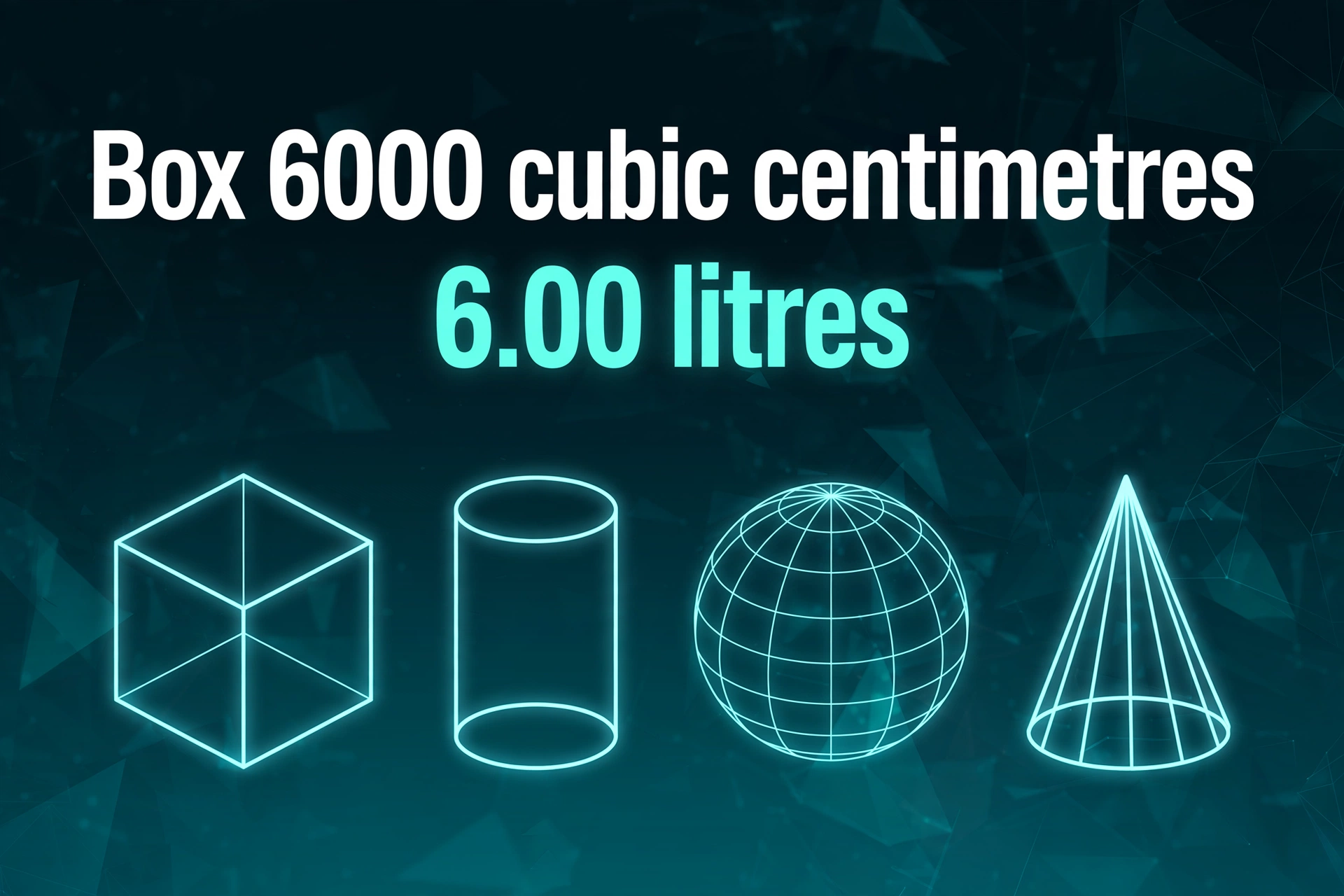
A worked example from the live tool
These five examples were checked against the tool. Each one uses the worked examples printed by the tool itself, so the figures below match the results you will see when you enter the same inputs.
Test 1 — Box: 10 x 20 x 30 cm
The box volume is 10 × 20 × 30 = 6,000 cm³. Dividing by 1,000 gives 6.00 litres, so a 10 cm by 20 cm by 30 cm box holds 6,000 cm³, or 6.00 litres.
Test 2 — Cylinder: radius 5 cm, height 12 cm
The cylinder volume is π × 5² × 12 = 942.48 cm³. Dividing by 1,000 gives 0.94 litres, so the cylinder holds 942.48 cm³, or 0.94 litres.
Test 3 — Sphere: radius 7 cm
The sphere volume is (4/3) × π × 7³ = 1,436.76 cm³. Dividing by 1,000 gives 1.44 litres, so the sphere holds 1,436.76 cm³, or 1.44 litres.
Test 4 — Cone: radius 6 cm, height 15 cm
The cone volume is (1/3) × π × 6² × 15 = 565.49 cm³. Dividing by 1,000 gives 0.57 litres, so the cone holds 565.49 cm³, or 0.57 litres.
Test 5 — Invalid: radius -2 cm
Entering -2 in the radius field of the cylinder section shows the message 'The radius must be zero or more.' No volume is shown, so a negative radius is never treated as a valid length.
Notice how close the cylinder and cone results are in the worked examples, even though the numbers are different. The cylinder in Test 2 has a radius of 5 cm and a height of 12 cm, giving 942.48 cm³. The cone in Test 4 has a radius of 6 cm and a height of 15 cm, giving 565.49 cm³. The cone is wider and taller, yet its volume is smaller, because the cone formula divides the cylinder result by three.
The worked example for the box is the one shown in the illustration above, where a 10 cm by 20 cm by 30 cm box is labelled 6000 cubic centimetres, 6.00 litres.
Quick reference: volume in cubic centimetres and litres
| Shape | Inputs (cm) | Volume (cm³) | Volume (litres) |
|---|---|---|---|
| Box | 10 × 20 × 30 | 6,000.00 | 6.00 |
| Cylinder | r = 5, h = 12 | 942.48 | 0.94 |
| Sphere | r = 7 | 1,436.76 | 1.44 |
| Cone | r = 6, h = 15 | 565.49 | 0.57 |
Volumes are shown to two decimal places. A litre is 1,000 cm³, so a litre is also 10 cm × 10 cm × 10 cm.
What are the four volume formulas and what does each term mean?
The four formulas used here are length × width × height for a box, πr²h for a cylinder, (4/3)πr³ for a sphere, and (1/3)πr²h for a cone. Each formula is applied with lengths in centimetres, so the answer comes out in cubic centimetres.
Why is the box formula length × width × height?
A box is a rectangular prism, and its volume is the product of its three side lengths. If you multiply a 10 cm length by a 20 cm width you get a floor area of 200 cm². Multiplying that area by a height of 30 cm fills the box, giving 6,000 cm³. The same three numbers in a different order give the same volume, so it does not matter which side you call the length and which you call the width.
Why does the cylinder formula use πr²h?
A cylinder is a circle stretched up to a height. Its base area is πr², and multiplying that area by the height h fills the cylinder. The worked example uses r = 5 cm, so the base area is π × 25 = 78.54 cm². Multiplying by a height of 12 cm gives 942.48 cm³. The base area of a cylinder is the same idea as the floor area of a box, with a circle instead of a rectangle.
Why does the sphere formula use (4/3)πr³?
A sphere is a ball, and every point on its surface is the same distance from its centre. The formula (4/3)πr³ uses the radius cubed, so the volume grows quickly when the radius grows. The worked example uses r = 7 cm, giving (4/3) × π × 343 = 1,436.76 cm³. The sphere holds more than twice the volume of the box in the worked example, even though the box is 30 cm long, because the sphere is a single compact shape whose radius is 7 cm in every direction.
Why does the cone formula divide by three?
A cone is a cylinder that tapers to a point, and its volume is exactly one third of the cylinder with the same base and height. The worked example uses r = 6 cm and h = 15 cm. The cylinder with those measurements would hold π × 36 × 15 = 1,696.46 cm³, and dividing by three gives 565.49 cm³ for the cone. The same division by three applies to a pyramid compared with a prism, and it is why the cone in the worked example holds less than the cylinder even though it is wider and taller.
The four formulas use centimetres for every length, and the answer is in cubic centimetres. Divide by 1,000 to get litres, as the worked examples show.
Why does doubling every side multiply volume by 8?
Volume is a three-dimensional measure, so doubling a length does not double the volume. It doubles the volume in each of the three directions at once, so the volume is multiplied by 2 × 2 × 2 = 8.
Take the worked example box, which is 10 cm by 20 cm by 30 cm and holds 6,000 cm³. Doubling every side gives a box of 20 cm by 40 cm by 60 cm, and its volume is 20 × 40 × 60 = 48,000 cm³, which is eight times the original 6,000 cm³. The same factor of eight applies to a sphere, a cylinder or a cone when every length is doubled.
The factor is eight because the volume depends on three lengths multiplied together. A single doubled length doubles the volume, two doubled lengths multiply it by four, and three doubled lengths multiply it by eight. The same rule means that halving every length divides the volume by eight, and tripling every length multiplies it by twenty-seven.
What if I measured in metres instead of centimetres?
Use centimetres for this tool, because the tool expects lengths in centimetres and gives volumes in cubic centimetres and litres. If your measurements are in metres, convert them to centimetres first by multiplying each length by 100. A length of 0.1 m becomes 10 cm, and 0.2 m becomes 20 cm, so a box of 0.1 m by 0.2 m by 0.3 m is the same as a box of 10 cm by 20 cm by 30 cm. Entering metres as if they were centimetres gives a volume one million times too small, because each of the three lengths is one hundred times too small.
For converting lengths and areas, see the geometry calculator, which covers the rectangle area and circle area used by these volume formulas.
Where would I use a volume solver in everyday life?
Volume is a practical measure for containers, rooms and materials. Here are five common uses:
- Storage and moving: the volume of a box tells you how much it holds, and comparing the volume of several boxes helps you choose the right size for packing.
- Cooking and baking: a recipe in millilitres can be compared with a jug or a bowl in litres, and a volume in litres tells you whether a container will hold the mixture.
- Gardening and building: soil, compost and concrete are often sold by volume, so the volume of a bed or a slab tells you how much material to buy.
- Water and aquariums: the volume of a tank in litres tells you how much water it holds, and a 60-litre tank is about 60,000 cm³.
- Fuel and storage tanks: a cylindrical tank volume in litres tells you how much fuel or water it can hold, and the same formula is used for drums and pipes.
For estimating material quantities, see the dirt calculator, which works out the volume of soil or aggregate needed for a project.
What mistakes most often give the wrong volume?
The most common mistakes are easy to avoid once you know them:
- Using the diameter instead of the radius: the radius is half the diameter, so a diameter of 10 cm means a radius of 5 cm. Using 10 cm as the radius makes the cylinder volume four times too large.
- Mixing units: entering some lengths in centimetres and others in millimetres makes the volume wrong by a factor of one thousand, because a millimetre is one tenth of a centimetre.
- Forgetting the cone's division by three: using πr²h for a cone gives three times the correct volume, so the cone must be divided by three.
- Squaring the radius before multiplying by the height: the cylinder formula is πr²h, so the radius is squared first, then multiplied by π and by the height. Multiplying the radius by the height first gives a different, wrong result.
- Reading cubic centimetres as litres: a volume of 6,000 cm³ is 6.00 litres, not 6,000 litres. The tool shows both, so check the units on each result.
What does this tool not cover?
This tool covers a box, a cylinder, a sphere and a cone, with lengths in centimetres and results in cubic centimetres and litres. It does not cover pyramids, prisms with other bases, or irregular shapes that cannot be described by a single formula. It also does not cover the surface area of a shape, or the volume of a shape whose dimensions are given in different units. For more calculators, see the Calculators category.
If you need the area of a rectangle or a circle first, the geometry calculator covers those areas, and the same areas are used in the volume formulas on this page.
Is my data kept private?
Yes. The tool runs in your browser and stores nothing. The lengths you enter are not sent to the site, saved in a database, or shared with any other service. Closing the page clears the fields.
Frequently asked questions
FAQ 1 — What is a volume solver?
A volume solver is a tool that calculates how much three-dimensional space a shape holds. This volume solver covers a box, a cylinder, a sphere and a cone. You enter the lengths in centimetres, and the tool gives the volume in cubic centimetres and in litres.
FAQ 2 — How do I calculate the volume of a box?
Multiply the length by the width and by the height, all in centimetres. A box of 10 cm by 20 cm by 30 cm has a volume of 10 × 20 × 30 = 6,000 cm³, which is 6.00 litres.
FAQ 3 — How do I calculate the volume of a cylinder, sphere and cone?
Use πr²h for a cylinder, (4/3)πr³ for a sphere, and (1/3)πr²h for a cone, with the radius and height in centimetres. A cylinder with a radius of 5 cm and a height of 12 cm holds 942.48 cm³, a sphere with a radius of 7 cm holds 1,436.76 cm³, and a cone with a radius of 6 cm and a height of 15 cm holds 565.49 cm³.
FAQ 4 — Why is a cone one third of a cylinder?
A cone tapers to a point, and the volume of a cone is exactly one third of the cylinder with the same base and height. The cone in the worked example has a radius of 6 cm and a height of 15 cm, and its volume of 565.49 cm³ is one third of the 1,696.46 cm³ the matching cylinder would hold.
FAQ 5 — How do I convert cubic centimetres to litres?
Divide the volume in cubic centimetres by 1,000. A volume of 6,000 cm³ is 6.00 litres, and a volume of 942.48 cm³ is 0.94 litres. One litre is 1,000 cm³, which is the same as a cube of 10 cm by 10 cm by 10 cm.
FAQ 6 — What happens if I enter zero, a negative number, or a diameter instead of a radius?
Entering zero gives a volume of zero for that shape, because a length of zero means the shape has no extent in that direction. Entering a negative number shows a message asking for a value of zero or more, and no volume is shown. Entering a diameter instead of a radius gives a volume four times too large, so halve the diameter to get the radius before you enter it.
What is a volume solver?
A volume solver is a tool that calculates how much three-dimensional space a shape holds. This volume solver covers a box, a cylinder, a sphere and a cone. You enter the lengths in centimetres, and the tool gives the volume in cubic centimetres and in litres.
How do I calculate the volume of a box?
Multiply the length by the width and by the height, all in centimetres. A box of 10 cm by 20 cm by 30 cm has a volume of 10 × 20 × 30 = 6,000 cm³, which is 6.00 litres.
How do I calculate the volume of a cylinder, sphere and cone?
Use πr²h for a cylinder, (4/3)πr³ for a sphere, and (1/3)πr²h for a cone, with the radius and height in centimetres. A cylinder with a radius of 5 cm and a height of 12 cm holds 942.48 cm³, a sphere with a radius of 7 cm holds 1,436.76 cm³, and a cone with a radius of 6 cm and a height of 15 cm holds 565.49 cm³.
Why is a cone one third of a cylinder?
A cone tapers to a point, and the volume of a cone is exactly one third of the cylinder with the same base and height. The cone in the worked example has a radius of 6 cm and a height of 15 cm, and its volume of 565.49 cm³ is one third of the 1,696.46 cm³ the matching cylinder would hold.
How do I convert cubic centimetres to litres?
Divide the volume in cubic centimetres by 1,000. A volume of 6,000 cm³ is 6.00 litres, and a volume of 942.48 cm³ is 0.94 litres. One litre is 1,000 cm³, which is the same as a cube of 10 cm by 10 cm by 10 cm.
What happens if I enter zero, a negative number, or a diameter instead of a radius?
Entering zero gives a volume of zero for that shape, because a length of zero means the shape has no extent in that direction. Entering a negative number shows a message asking for a value of zero or more, and no volume is shown. Entering a diameter instead of a radius gives a volume four times too large, so halve the diameter to get the radius before you enter it.