Bowling Handicap Calculator
Enter your bowling average and your league’s basis score and handicap percentage. The tool works out your handicap pins per game, your handicap over a series, and your score with the handicap added.
The handicap is rounded down to the nearest whole number. If your average is at or above the basis score, your handicap is 0. The basis and percentage are set by your league, so check your league rules and enter the values your league uses.
A bowling handicap is a number of bonus pins added to your game score so bowlers of different skill levels can compete on equal terms. With a basis of 200 and a percentage of 90%, a bowler averaging 150 gets a handicap of 45 pins per game.
How do I use the Bowling Handicap Calculator?
Enter your bowling average in the first box. Your average is your pins per game over your league games, so a bowler who usually scores around 150 enters 150. Enter your league’s basis score in the second box. The basis is already filled in as 200, which is the most common recreational default, but change it to whatever your league uses: 210 and 220 are both common. Enter the handicap percentage in the third box. It is already filled in as 90, which is the most common percentage, but change it to 80 or 100 if that is what your league uses.
The fourth box holds the number of games in the series, already filled in as 3, because most league nights are three games. It is used only for the series total, so leave it at 3 unless your series is a different length. The fifth box is optional: enter a game score, such as 170, to see that score with the handicap added. If you leave it blank, the handicapped-score box shows “—” and the other three boxes still work.
Press the calculate button and four labelled boxes appear. The first box is your handicap pins per game. The second box is your handicap over the whole series, which is the per-game handicap multiplied by the number of games. The third box repeats your scratch average, which is your average with no handicap added. The fourth box is your game score with the handicap added, when you entered one. Under the boxes, a note shows the working: the basis minus your average, multiplied by the percentage, and the result rounded down.
If an input is wrong, the tool shows a plain-language error and no results. An average of 0 is rejected because an average must be above 0. An average above 300 is rejected because 300 is the highest possible score in one game. A percentage of 110 is rejected because the percentage must be between 0 and 100. A series of 0 games or 11 games is rejected because the number of games must be a whole number from 1 to 10. A game score above 300 is rejected for the same reason as an average above 300.
What does a worked example look like?
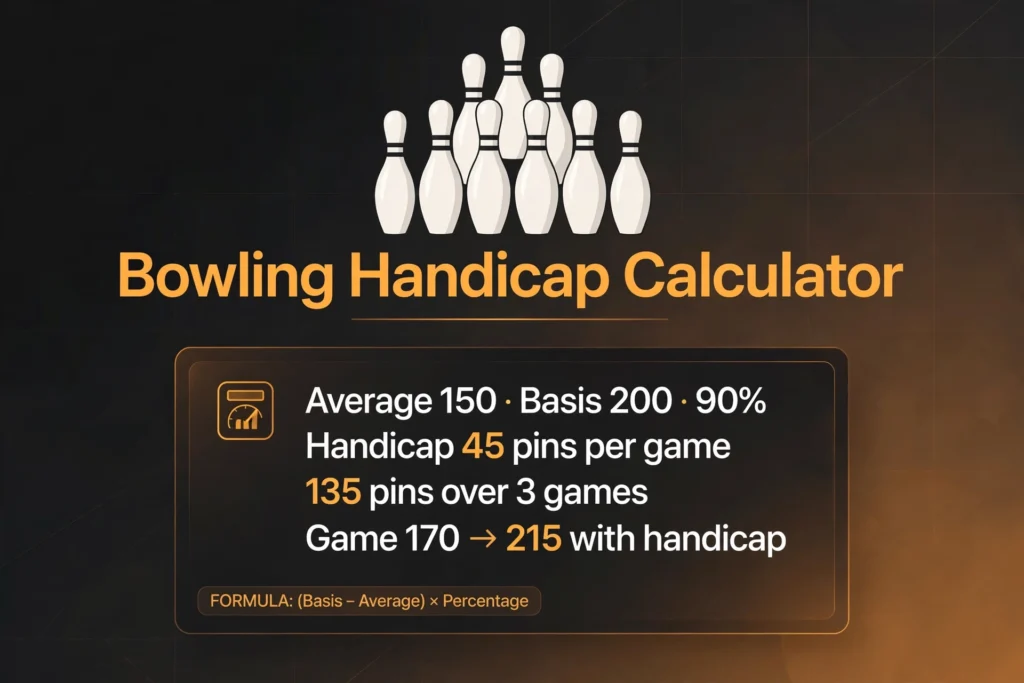
Start with the first verified test. A bowler averages 150, the league uses a basis of 200 and a percentage of 90%, the series is 3 games, and the bowler’s game score is 170. Subtract the average from the basis: 200 − 150 = 50. Multiply by the percentage: 50 × 0.90 = 45. The handicap is 45 pins per game. Over a 3-game series the handicap is 45 × 3 = 135 pins. The bowler’s scratch series, with no handicap, is 150 × 3 = 450 pins, and the handicapped series is 450 + 135 = 585 pins. The single game of 170 becomes 170 + 45 = 215 with the handicap added.
A second test uses a higher basis and a lower percentage. A bowler averages 180, the league uses a basis of 210 and a percentage of 80%, the series is 3 games, and the game score is 190. Subtract the average from the basis: 210 − 180 = 30. Multiply by the percentage: 30 × 0.80 = 24. The handicap is 24 pins per game, 72 pins over the 3-game series, and the game of 190 becomes 190 + 24 = 214.
A third test shows what happens when the average is above the basis. A bowler averages 210 in a league with a basis of 200 and a percentage of 90%. The difference, 200 − 210, is −10, and a negative handicap would take pins away, which no league does. The tool treats the difference as 0, so the handicap is 0 pins per game and 0 over the series. A game score of 220 stays 220 with the handicap added. This bowler bowls scratch, which means with no handicap at all.
A fourth test shows the rounding rule. A bowler averages 165 in a league with a basis of 210 and a percentage of 90%. The difference is 210 − 165 = 45, and 45 × 0.90 = 40.5. The handicap is rounded down to 40 pins per game, not up to 41. Over 3 games that is 120 pins, and a game of 180 becomes 180 + 40 = 220. A league that rounds to the nearest whole number would give 41 pins here instead of 40, which is the one-pin difference the rounding note in the tool warns about.
A fifth test uses the 90% of 220 setup that many sanctioned leagues use. A bowler averages 155 with a basis of 220 and a percentage of 90%. The difference is 220 − 155 = 65, and 65 × 0.90 = 58.5, rounded down to 58 pins per game. Over 3 games that is 174 pins, and a game of 175 becomes 175 + 58 = 233.
What is a bowling handicap?
A bowling handicap is a number of bonus pins added to a bowler’s actual score. Its purpose is to place bowlers of different skill levels on as equal a footing as possible, so that a bowler averaging 150 and a bowler averaging 200 can compete in the same league and both have a real chance to win. The United States Bowling Congress (USBC), the body that sanctions league play in the United States, defines handicapping as the means of placing bowlers and teams of varying degrees of bowling skill on as equitable a basis as possible for competition against each other.
Bowling without a handicap is called scratch bowling. In scratch bowling the score on the lanes is the final score, and the bowler with the highest average almost always wins. That works for a tournament of players at a similar level, but it makes a mixed league pointless for the weaker bowlers, because no amount of good play on their part can close a 50-pin gap in average. A handicap closes most of that gap without closing all of it, which is the point of the percentage: at 90%, a 50-pin gap in average becomes a 45-pin handicap, so the weaker bowler still has to bowl a little above their own average to beat a stronger bowler who bowls their own average.
Handicaps apply to teams as well as to individual bowlers. A team’s handicap is the sum of its players’ handicaps. If three bowlers on a team have handicaps of 45, 24 and 61 pins per game, the team handicap is 45 + 24 + 61 = 130 pins per game, and 390 pins over a 3-game series. Team handicaps are added to the team’s total in the same way, so a team of weaker bowlers can compete with a team of stronger bowlers on the same basis. This tool works out one bowler’s handicap at a time; for a team, run it once per bowler and add the results.
A handicap is not a judgement on a bowler. A large handicap does not mean a bowler is bad at the game, and a zero handicap does not mean a bowler is the best in the league. It is a scoring adjustment tied to an average, and it moves as the average moves: when a bowler improves, the average rises and the handicap falls, which is how the system is meant to work.
How is a bowling handicap calculated?
The formula has three parts: the basis score, the bowler’s average, and the handicap percentage. The steps are always the same. First, subtract the average from the basis score. Second, multiply the result by the handicap percentage, written as a decimal. Third, round the result down to the nearest whole number. Written as a formula, it is:
Handicap = (Basis score − Average) × Percentage
Take a bowler averaging 142 in a league with a basis of 210 and a percentage of 90%. Subtract the average from the basis: 210 − 142 = 68. Multiply by the percentage: 68 × 0.90 = 61.2. Round down to the nearest whole number: 61 pins per game. That bowler adds 61 pins to every game score. A game of 160 becomes 160 + 61 = 221, and a 3-game series of 480 scratch becomes 480 + 183 = 663 with the handicap added, because 61 × 3 = 183.
The rounding step is where calculators disagree, so it is worth stating plainly in words rather than hiding it in the arithmetic. Most sources round the handicap down, which means dropping the decimal part: 61.2 becomes 61, and 40.5 becomes 40. At least one calculator page rounds to the nearest whole number instead, so 40.5 would become 41 there and 61.2 would still become 61. This tool rounds down, which is the most widely cited convention. If your league rounds to the nearest whole number, your handicap can differ from this tool’s figure by at most 1 pin, and only when the unrounded result has a decimal part of 0.5 or more.
The formula also explains why the handicap is never negative. When the average is above the basis, the subtraction gives a negative number, and multiplying a negative number by a percentage stays negative. Leagues do not subtract pins from a good bowler’s score, so the result is treated as 0 instead. A bowler whose average equals the basis also gets 0: the difference is 0, and 0 multiplied by any percentage is still 0.
What is the basis score, and which value should my league use?
The basis score is the reference score every bowler in the league is measured against. It is set by the league, and it is meant to sit above the best average in the league, so that every bowler gets some handicap except the very best. The values most often used are 200, 210, 220 and 230. Recreational leagues most often use 200 or 210. Competitive and USBC-sanctioned leagues more often use 220, sometimes with a lower percentage to go with it.
There is no single USBC-mandated basis score. The USBC sets the framework for handicapping in sanctioned leagues, and each league sets its own basis score and percentage within that framework. That is why different pages call different setups “standard”: one page’s standard is 90% of 200, another’s is 90% of 220, and a third’s is 80% of 230. All three are real setups used by real leagues. The right values for a reader are the ones written in their own league’s rules, not the ones on any calculator’s default settings. This tool defaults to 200 and 90% because that pair is the most widely cited recreational default, and both fields are editable so any league’s values can be entered.
The choice of basis changes every handicap in the league. Take a bowler averaging 150. At 90% of 200 the handicap is (200 − 150) × 0.90 = 45 pins. At 90% of 210 it is (210 − 150) × 0.90 = 54 pins. At 90% of 220 it is (220 − 150) × 0.90 = 63 pins. Raising the basis by 10 pins raises this bowler’s handicap by 9 pins. That is why a league cannot change its basis mid-season on a whim: it would change every bowler’s handicap at once, and league rules fix the basis and percentage for the season.
A league that sets its basis too low creates a problem of its own. If the basis is 200 and a bowler averages 205, that bowler gets a handicap of 0 and bowls scratch, while a bowler averaging 195 gets (200 − 195) × 0.90 = 4 pins. The gap between them is nearly closed, which is the point, but the 205 bowler has no cushion at all. A basis of 210 or 220 avoids that by sitting above every average in the league, so every bowler gets a handicap and every bowler’s score moves with the same formula.
What does the handicap percentage mean?
The handicap percentage is the share of the gap between the basis and the average that the league awards as handicap. It is usually 80%, 90% or 100%. The percentage is the league’s answer to a fairness question: how much of the skill gap should the handicap erase? At 100%, the gap is erased in full. At 90%, a tenth of the gap stays unadjusted. At 80%, a fifth of it stays.
Take a bowler averaging 170 in a league with a basis of 220. At 100% the handicap is (220 − 170) × 1.00 = 50 pins. At 90% it is (220 − 170) × 0.90 = 45 pins. At 80% it is (220 − 170) × 0.80 = 40 pins. The three settings give handicaps 10 pins apart, and that spread matters across a season: the 100% bowler needs only to match their own average to tie a scratch bowler who matches theirs, while the 80% bowler needs to beat their own average by a clear margin to do the same.
Most leagues use 90%. It is the most widely cited percentage across the sources checked for this page, and it balances the two sides of the fairness question: it gives weaker bowlers a real chance while leaving stronger bowlers a small built-in edge, because the unadjusted 10% of the gap still favours the higher average. A league that wants a friendlier game for newcomers may use 100%. A league that wants to reward raw skill more, such as a competitive or tournament league, may use 80%. The percentage and the basis are chosen together: common pairs are 90% of 200, 90% of 210, 90% of 220, and 80% of 220 or 230. To work out what share of the basis your own average represents, the percentage calculator gives the figure: an average of 150 is 75% of a 200 basis, and an average of 180 is 90% of a 200 basis.
How do leagues use handicaps in a season?
A handicap is only as good as the average behind it, so leagues start by establishing each bowler’s average. A bowler’s first average is usually set after a small number of games — three games are commonly cited as the minimum for a first average — and a longer run of games is often required before an average counts for awards. The exact number is a league rule, so a reader who is joining a league should ask the league secretary how many games establish an average in that league. To work out an average from a set of game scores, add the scores and divide by the number of games; the mean median mode calculator does that arithmetic.
Once the season is under way, the league recalculates averages regularly, usually weekly, as new games are added to each bowler’s record. The handicap moves with the average. A bowler who improves from 150 to 160 over the first month of a league using 90% of 220 sees the handicap fall from (220 − 150) × 0.90 = 63 pins to (220 − 160) × 0.90 = 54 pins. The bowler is scoring more scratch pins and receiving fewer handicap pins, and the two changes roughly balance. A bowler whose average falls sees the reverse: fewer scratch pins and more handicap pins.
The basis score and the percentage do not move with the averages. They are fixed for the season in the league’s rules, and changing them mid-season needs the league’s agreement under its own bylaws. That stability is what makes the system fair over a season: every bowler’s handicap is worked out from the same two fixed numbers and their own changing average, so no bowler gains or loses from a rule change halfway through.
Handicaps also decide team results. Each bowler’s game score plus their handicap gives their handicapped game score, and the team’s handicapped total is the sum of its bowlers’ handicapped scores. A team whose bowlers average 150, 170 and 190, in a league using 90% of 200, has handicaps of 45, 27 and 9 pins per game, which is 81 pins per game for the team and 243 pins over a 3-game series. The opposing team’s handicaps are worked out the same way, and the team with the higher handicapped total wins the game. The scratch totals still matter for records and for individual awards, which is why both figures are kept.
How do I work out my bowling average?
A bowling average is total pins divided by the number of games bowled. Add up every score, then divide by the count of games. A bowler who scores 165, 213 and 182 in three games has a total of 560 pins, and 560 ÷ 3 = 186.67, which the league records as a whole-number average under its own rounding rule. A bowler who scores 480 across three games averages 160, because 480 ÷ 3 = 160. The same arithmetic works for any number of games: 3,600 pins across 20 games is an average of 180, because 3,600 ÷ 20 = 180.
Only official league games count towards a league average. Practice games, games bowled in another league, and games bowled before joining the league do not count, unless the league’s rules say otherwise. That is why a bowler’s league average can differ from the average they would quote to a friend: the league average is a record kept by the league secretary from the league’s own score sheets, not a memory of every game ever bowled. The mean median mode calculator adds a set of scores and divides by the count, which is the same arithmetic.
An average built on few games is less reliable than one built on many. Three games can set a first average, but one unusually good or bad night moves a three-game average by a lot, while the same night barely moves a thirty-game average. That is why leagues update averages weekly rather than fixing them at the start of the season, and why a bowler’s handicap can change noticeably in the first weeks before settling down as more games accumulate.
What is a good bowling average?
A good average depends on who is asking and what they compare it with. The ranges most often cited in bowling guides put beginners around 70 to 100, casual bowlers who play once or twice a month in the low 100s to the high 160s, regular league bowlers around 170 to 190, and elite or tournament-level bowlers at 210 and above. These are commonly cited ranges from bowling guides, not a USBC table, and a reader should treat them as a rough map rather than a verdict.
A 150 average is solid for a recreational bowler. It sits well above the casual range, and a bowler averaging 150 is knocking down most pins, converting single-pin spares often, and throwing the occasional strike. At 90% of 200, a 150 average carries a handicap of 45 pins per game, which is the worked example at the top of this article. A 170 average is a good league average, and at 90% of 200 it carries a handicap of 27 pins. A 190 average is a strong league average, with a handicap of 9 pins at 90% of 200. A 200 average in a league with a 200 basis carries no handicap at all, and a 210 average in the same league also carries none.
The handicap system itself gives a practical way to read an average: the handicap tells a bowler how far their average sits from the league’s basis. A handicap of 45 at 90% of 200 means the average is 50 pins below the basis. A handicap of 9 means the average is 10 pins below it. As the average climbs towards the basis, the handicap shrinks towards 0, and reaching 0 is the visible sign that a bowler has reached the level the league set as its reference.
What mistakes do people commonly make with bowling handicaps?
The first mistake is using a guessed average instead of an established one. A bowler who guesses 160 when their league average is 145 gets a handicap of (200 − 160) × 0.90 = 36 pins instead of (200 − 145) × 0.90 = 49 pins, which is 13 pins a game short. The handicap must come from the recorded average, not from a bowler’s sense of their own game.
The second mistake is forgetting the percentage. The difference between the basis and the average is not the handicap; it is the number the percentage is applied to. A bowler averaging 150 with a basis of 200 has a difference of 50 pins, and at 90% the handicap is 45, not 50. The five missing pins are the 10% the league deliberately leaves unadjusted.
The third mistake is rounding the wrong way. Most leagues round the handicap down, so 40.5 becomes 40. A bowler who rounds up to 41 takes a pin they were not given, and a bowler who rounds to the nearest whole number in a league that rounds down does the same whenever the decimal part is 0.5 or more. The tool states its rounding rule in the note under the results, and the league’s own rule is the one that counts.
The fourth mistake is expecting a negative handicap. A bowler averaging above the basis gets 0, not a negative number, and no pins are subtracted from their score. A bowler averaging 210 in a 200-basis league bowls scratch, and a game of 220 stays 220.
The fifth mistake is using another league’s settings. A bowler who plays in two leagues, one using 90% of 200 and one using 80% of 220, has two different handicaps. A 170 average gives (200 − 170) × 0.90 = 27 pins in the first league and (220 − 170) × 0.80 = 40 pins in the second. Entering the wrong league’s basis and percentage gives a wrong handicap, and the fix is to check the league rules rather than to trust memory.
The sixth mistake is applying the handicap to a series incorrectly. The handicap is per game, so a 45-pin handicap over a 3-game series is 135 pins, not 45. Adding the per-game figure once to a 3-game total short-changes the bowler by 90 pins. The tool’s series box exists for exactly this reason: it multiplies the per-game handicap by the number of games.
The seventh mistake is confusing the handicap with the average. A handicap of 45 does not mean the bowler averages 45, and a handicap of 0 does not mean the bowler averages 0. The handicap is the bonus added to the score; the average is the score the bowler usually bowls without it. Both numbers describe the same bowler, and they sit in different boxes in the tool for that reason.
What are the limits of this calculator?
This calculator works out one bowler’s handicap from one average, one basis and one percentage. It does not know your league’s rules, and league rules are what decide the result in the end. If your league caps the handicap at a maximum number of pins, this tool does not apply that cap, because the cap is a league rule and the tool has no field for it: check the result against the cap yourself. If your league rounds to the nearest whole number instead of rounding down, the tool’s figure can differ by 1 pin, as the rounding section explains.
It does not work out a team handicap directly. A team’s handicap is the sum of its players’ handicaps, so run the tool once for each bowler and add the results, as the team section above shows. It also does not establish an average: it takes the average as an input, and an average that is guessed or out of date gives a handicap that is wrong by the same margin. Work out the average from the league’s recorded scores first, and use the mean median mode calculator for the arithmetic if that helps.
It does not cover handicap systems other than the basis-and-percentage system. Some leagues and tournaments use different systems, such as a flat handicap per bowler or a system based on a bowler’s highest game, and this tool’s formula does not apply to those. It also does not cover other bowling formats: the formula and the basis values in this article are for tenpin bowling, which is the format the USBC governs, and they do not carry over to fivepin, ninepin or candlepin bowling, which have their own scoring and their own handicap customs.
Finally, it gives no advice on how to bowl or how to improve an average. It is an arithmetic tool for a scoring adjustment, and the numbers it gives are only as sound as the average, basis and percentage entered into it. For other average-based figures, the GPA calculator works out a grade point average from course grades, and the grade calculator with weights works out a weighted course grade.
How can I check the tool against a known league setup?
The simplest check uses the first verified test. Enter an average of 150, a basis of 200 and a percentage of 90, with 3 games and a game score of 170. The tool should show 45 pins per game, 135 pins over the 3-game series, a scratch average of 150, and a score with handicap of 215 pins. Every box should match. If any box differs, the entered average, basis or percentage differs from the test, and the error is in the input rather than in the tool.
A second check uses a different league setup. Enter an average of 180, a basis of 210 and a percentage of 80, with 3 games and a game score of 190. The tool should show 24 pins per game, 72 pins over the series, a scratch average of 180, and a score with handicap of 214 pins. A third check uses the zero case: enter an average of 210 with a basis of 200 and a percentage of 90, and the tool should show 0 pins per game and 0 over the series, with a game score of 220 staying 220.
A fourth check uses the quick-reference table below. Pick an average from the table, enter it with the table’s basis and percentage, and check the per-game handicap box against the table row. A 160 average at 90% of 200 should give 36 pins, and the same average at 80% of 210 should give 40 pins. A fifth check tests the rounding rule: enter an average of 165 with a basis of 210 and a percentage of 90, and the tool should show 40 pins, not 41, because 40.5 is rounded down.
The authoritative source for the figures in this article is the United States Bowling Congress, which sets the framework for handicapping in sanctioned league play, and the worked examples on Bowlingball.com’s handicap guide, which states the USBC definition of handicapping and works the same formula with a basis of 200 and a percentage of 90. More tools in the same collection are in the calculators category.
What is my handicap at common averages?
Every row in this table was computed from the same formula the tool uses: handicap = (basis − average) × percentage, rounded down to the nearest whole number. Bowlers at or above the basis receive a handicap of 0. Averages are shown in steps of 10 from 120 to 200; for an average between two rows, use the calculator above.
| Average | 90% of 200 | 80% of 210 |
|---|---|---|
| 120 | 72 | 72 |
| 130 | 63 | 64 |
| 140 | 54 | 56 |
| 150 | 45 | 48 |
| 160 | 36 | 40 |
| 170 | 27 | 32 |
| 180 | 18 | 24 |
| 190 | 9 | 16 |
| 200 | 0 | 8 |
Two patterns in the table are worth reading. First, each 10-pin rise in average cuts the handicap by 9 pins at 90% of 200 and by 8 pins at 80% of 210, which is the percentage applied to the 10-pin step. Second, the two settings agree exactly at an average of 120, where both give 72 pins, and then separate: at an average of 200, 90% of 200 gives 0 while 80% of 210 still gives 8, because the 210 basis sits 10 pins higher. A bowler who moves between two leagues using these two settings can read both handicaps off the same row.
Frequently asked questions
How do I calculate my bowling handicap?
Subtract your average from your league’s basis score, then multiply the result by the handicap percentage. With a basis of 200, an average of 150 and a percentage of 90%, the handicap is (200 − 150) × 0.90 = 45 pins per game. Most leagues round the result down to the nearest whole number.
What does 90% of 200 mean in bowling?
It means the league’s basis score is 200 and the handicap percentage is 90%. Your handicap is 90% of the difference between 200 and your average. A bowler averaging 160 gets (200 − 160) × 0.90 = 36 pins per game, and a bowler averaging 180 gets (200 − 180) × 0.90 = 18 pins per game.
What happens if my average is higher than the basis score?
Your handicap is 0. A negative handicap would take pins away from your score, and no league does that, so the result is treated as 0 instead. A bowler averaging 210 in a league with a basis of 200 bowls scratch, which means with no handicap added.
Is a higher handicap better?
No. A higher handicap means a lower average, because the handicap is the gap between your average and the basis score, multiplied by the percentage. A bowler averaging 120 has a handicap of 72 pins at 90% of 200, while a bowler averaging 190 has a handicap of 9 pins. As your average improves, your handicap falls, and reaching a handicap of 0 means your average has reached the league’s basis score.
How often does my handicap change?
It changes whenever your average changes. Leagues usually recalculate averages weekly as new games are added to your record, and your handicap is worked out again from the new average. The basis score and the percentage stay fixed for the season, so only your average moves the handicap. A bowler who improves from 150 to 160 in a league using 90% of 220 sees the handicap fall from 63 pins to 54 pins.
What is a good bowling handicap?
There is no single good handicap, because the handicap is tied to the average. At 90% of 200, a beginner averaging 120 has a handicap of 72 pins, a recreational bowler averaging 150 has 45 pins, a regular league bowler averaging 170 has 27 pins, and a strong league bowler averaging 190 has 9 pins. The useful reading is the trend: if your handicap is falling over the season, your average is rising.