
Shingle Calculator
Shingle Calculator
This calculator runs in your browser. Nothing is uploaded or stored.
This is a material estimate for field shingles only. Starter strip, hip and ridge cap, underlayment, flashing and vents are ordered separately. Check the shingle wrapper for bundles per square and confirm with your supplier or roofer before ordering. Working on a roof is dangerous. This page estimates materials only and does not cover safe roof work.
A shingle calculator works out how many roofing squares and shingle bundles you need from your roof's length, width, pitch and a waste allowance. Enter those five values and it returns a material estimate for field shingles, so you can order with a clear figure in hand rather than a rough guess.
How do I use the shingle calculator?
Start with the footprint of the roof, measured in feet. Length is the longer horizontal run of the roof section you are covering, and width is the other horizontal run. These are ground-plan measurements, not measurements taken along the slope, so a tape run across the eaves and up over the ridge would give you a different and larger number. If the roof has more than one section, work out each section on its own and add the results together, because a single rectangle rarely describes a whole house.
Next, enter the roof pitch as the rise per 12 inches of run. A roof described as 6/12 rises 6 inches for every 12 inches of horizontal run, so you enter 6. A flat roof has a rise of 0. If you do not know your pitch, measure the rise over a 12-inch level run in the attic or from a rafter, or ask your roofer, since guessing the pitch is one of the easiest ways to get the whole estimate wrong.
Then enter a waste percentage. Waste covers the shingles cut off at edges, valleys, hips and around penetrations, plus the occasional damaged piece. The guidance by roof shape later in this article helps you pick a figure. Finally, check the bundles-per-square value. It defaults to 3, which suits most standard and architectural shingles, but heavier designer lines can need 4 or 5, so always check the wrapper of the product you plan to buy. Press Calculate Shingles and read the six result boxes: footprint area, pitch factor, roof area, roof area with waste, roofing squares and bundles to order.
What is a roofing square?
A roofing square is a unit of roof area equal to 100 square feet. Roofers, suppliers and manufacturers all use it, which is why shingles are sold and quoted by the square rather than by the individual piece. A roof of 1,500 square feet is 15 squares, and a roof of 1,475.80 square feet with waste is also 15 squares once the figure is rounded up, because squares are always counted in whole numbers. You cannot order part of a square, so rounding up is built into the tool rather than left to chance.
The square also makes comparing quotes easier. When one supplier quotes per square and another quotes per bundle, the calculator bridges the gap: divide the area with waste by 100 and round up to get squares, then multiply by bundles per square to get bundles. Knowing both figures means you can check a delivery against the order and spot a shortfall before work starts.
How does roof pitch change the area?
A pitched roof has more surface than its footprint, because the slope is longer than the flat run beneath it. The pitch factor corrects for that difference. It is calculated as the square root of 1 plus the square of the rise divided by 12, written as √(1 + (rise/12)²). For a flat roof the rise is 0, so the factor is 1 and the roof area equals the footprint. As the pitch steepens, the factor grows, and so does the area you must cover.
The table below shows the factor for common pitches, all computed from the same formula. You can use it to sense-check the tool's output: a 6/12 roof always multiplies the footprint by 1.1180, and a steep 12/12 roof multiplies it by 1.4142, which is more than 40 percent extra area over the footprint.
| Roof pitch | Pitch factor |
|---|---|
| 3/12 | 1.0308 |
| 4/12 | 1.0541 |
| 6/12 | 1.1180 |
| 8/12 | 1.2019 |
| 12/12 | 1.4142 |
This is also why measuring along the slope gives a different answer from measuring the footprint. The slope measurement already includes the pitch effect, so feeding it into the calculator as if it were the footprint would apply the factor a second time and overstate the area. Use footprint measurements with this tool and let the pitch factor do its job once. For more on roof geometry, see the Geometry Calculator.
A worked example from the live tool
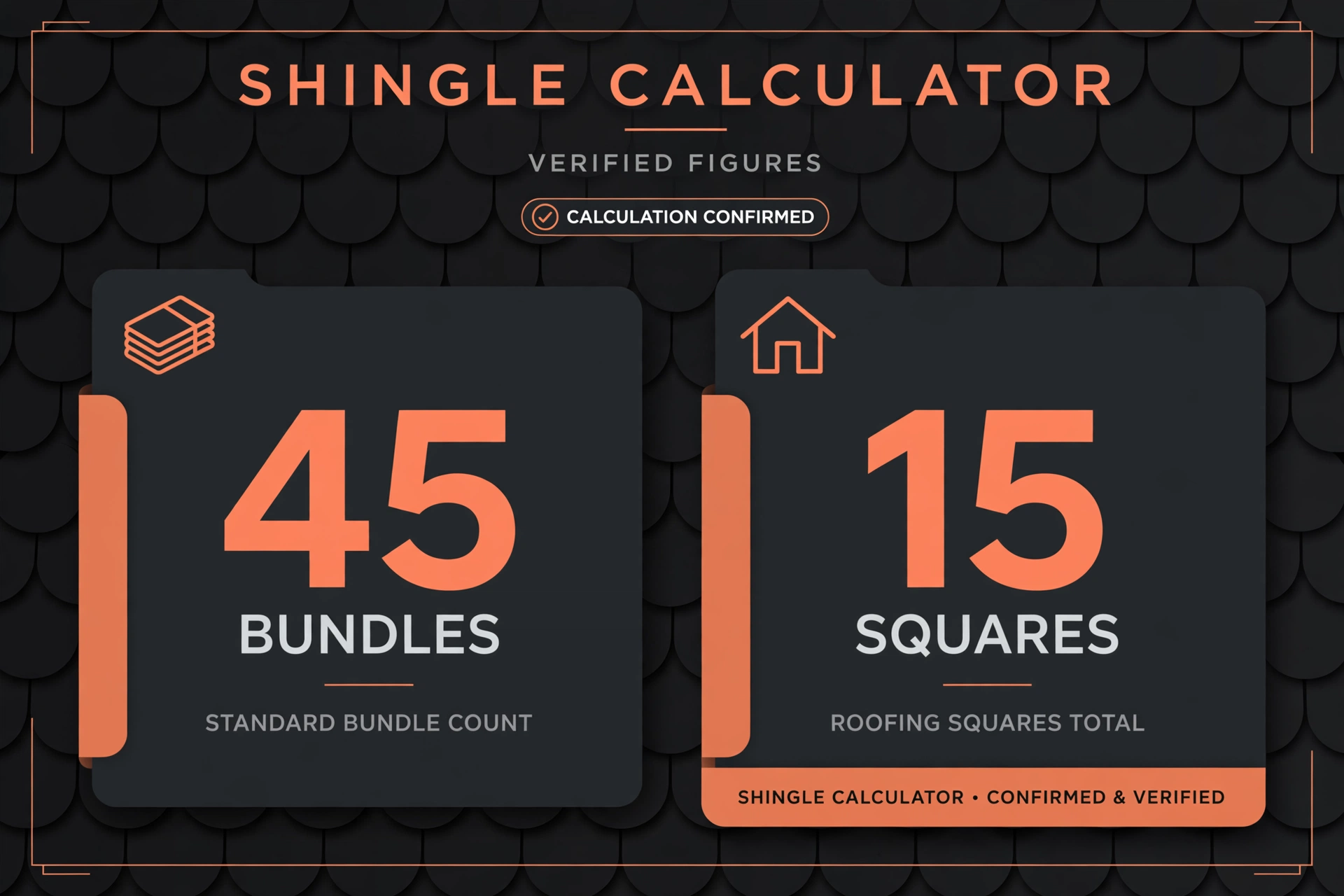
Take a simple gable roof measuring 40 feet by 30 feet, with a 6/12 pitch, 10 percent waste and 3 bundles per square. The footprint is 40 × 30 = 1,200.00 square feet. The pitch factor for 6/12 is √(1 + (6/12)²) = 1.1180. Multiplying gives a roof area of 1,341.64 square feet. Adding 10 percent waste brings the area to 1,475.80 square feet. Dividing by 100 gives 14.758 squares, which rounds up to 15 whole squares, and 15 × 3 gives 45 bundles to order.
A second test shows how pitch and waste move the result. A 50-foot by 30-foot roof at 8/12 with 15 percent waste starts from a footprint of 1,500.00 square feet. The 8/12 factor is 1.2019, so the roof area is 1,802.78 square feet, and with 15 percent waste it becomes 2,073.19 square feet. That divides into 20.73 squares, rounded up to 21 squares, giving 63 bundles at 3 per square. The steeper pitch and the higher waste allowance together add 18 bundles compared with a flat reading of the same footprint, which is exactly the kind of shortfall that leaves a crew waiting for a top-up delivery.
A third test checks the low end. A 30-foot by 20-foot roof at 4/12 with no waste has a footprint of 600.00 square feet and a factor of 1.0541, giving a roof area of 632.46 square feet. With 0 percent waste the area stays at 632.46 square feet, which rounds up from 6.32 to 7 squares and 21 bundles. Even with no waste allowance, the rounding step matters: ordering 6 squares would leave the last 32.46 square feet uncovered. For other material estimates for a building project, see the Figure Concrete for Slab Calculator.
How much waste should I add for my roof shape?
Waste is not a fixed number, and the right figure depends on how much cutting the roof shape forces. A simple gable roof, which is two plain rectangles meeting at a ridge, wastes the least, and about 10 percent is a reasonable allowance. The cuts are mostly at the eaves, rakes and ridge, with few angled pieces to discard.
A hip roof, where all four sides slope down to the walls, needs more, and about 15 percent is the usual allowance. Every hip edge produces angled cuts, and the offcuts from one side rarely fit neatly on another. If the roof is cut up, with valleys, dormers, skylights, chimneys or several different planes, the waste climbs higher again, because each valley and penetration creates its own set of trimmed pieces. For such roofs, choosing an allowance above 15 percent is sensible, and a roofer who has seen the roof can refine the figure.
The point of the waste setting is to give you a choice rather than a hidden assumption. Some online tools bake in a single percentage without saying so, which hides the difference between a plain gable and a complex roof. Here the percentage is visible and adjustable, so you can match it to the roof in front of you and see the bundle count change as you do.
How many bundles are in a roofing square?
For standard 3-tab shingles and most architectural (laminate) shingles, there are 3 bundles per square. That is the figure the calculator uses by default, and it is the figure behind the quick table below. Heavier designer or premium lines can pack differently, with 4 or 5 bundles per square, because thicker or larger shingles cover less area per bundle.
This is the one input you should never guess. The bundle count per square is printed on the shingle wrapper and in the manufacturer's product information, and it varies between product lines from the same maker. Enter the figure from the wrapper of the exact product you intend to buy, not from a general rule, and the bundle total will follow from the squares the tool already calculated.
How many bundles do I need for common roof areas?
The table below gives a quick reference for a flat roof area with 10 percent waste at 3 bundles per square. Read across from the roof area to find the squares and bundles. Remember that these figures start from the roof area after the pitch factor has already been applied, not from the footprint, so a pitched roof of the same footprint will need more.
| Roof area (with 10% waste) | Roofing squares | Shingle bundles (3 per square) |
|---|---|---|
| 1,000 sq ft | 11 | 33 |
| 2,000 sq ft | 22 | 66 |
| 3,000 sq ft | 33 | 99 |
To check the first row: 1,000 square feet with 10 percent waste is 1,100 square feet, which is exactly 11 squares, and 11 × 3 is 33 bundles. The table is a shortcut for estimating, but for an actual order, run your own measurements through the tool, because your pitch and waste allowance will shift the figures.
What does this estimate not include?
This calculator estimates field shingles only, meaning the main shingles that cover the broad planes of the roof. Several other materials are part of a real roofing job and are ordered separately. Starter strip goes along the eaves and rakes to seal the first course. Hip and ridge cap shingles finish the hips and the ridge line. Underlayment sits beneath the shingles across the whole roof. Flashing seals the junctions around chimneys, walls, skylights and valleys. Vents, pipe boots and other penetrations each need their own pieces.
None of these are counted in the bundle total, so do not treat the result as a complete shopping list. A supplier or roofer can price the extras once they know the roof's length of ridge and hips, the number of penetrations and the underlayment type. Checking the shingle wrapper for bundles per square and confirming the final order with your supplier or roofer before ordering is the safest last step, especially since bundle counts differ between product lines.
What mistakes do people make when ordering shingles?
The most common mistake is using the footprint instead of the sloped area. A 40-by-30-foot footprint is 1,200 square feet, but at 6/12 the roof itself is 1,341.64 square feet, so ordering on the footprint alone leaves more than a square uncovered before waste is even considered. The pitch factor exists precisely to close that gap, and skipping it is the fastest way to run short.
The second mistake is forgetting waste altogether. Even a plain roof produces offcuts, and a roof with valleys or dormers produces many more. Entering 0 percent waste on a complex roof guarantees a second delivery. The third mistake is rounding squares down. A result of 14.76 squares is not 14 squares; it is 15, because the remaining 0.76 of a square still has to be covered. This tool always rounds up, so the mistake cannot creep in through the arithmetic.
The fourth mistake is using the wrong bundles-per-square figure, usually by assuming 3 when a designer product needs 4 or 5. That error multiplies across the whole order: on a 20-square roof, the difference between 3 and 4 per square is 20 bundles. Finally, people sometimes forget that the estimate covers field shingles only and arrive on site without starter strip or ridge cap. Keeping the excluded items in mind when placing the order avoids that surprise.
What are the limits of this calculator?
This calculator treats the roof as rectangles described by length, width, pitch and waste. It does not model irregular shapes, curved sections, or roofs where the pitch changes across the roof, and for those cases each section should be measured and calculated separately, then added together. It also does not measure your roof for you: the quality of the result depends on the accuracy of the length, width and pitch you enter, so a measurement error carries straight through to the bundle count.
The waste guidance is a planning aid, not a manufacturer specification, and the bundle-per-square default is a common figure, not a substitute for the wrapper of the product you buy. Prices are not estimated, because shingle prices vary by product, region and supplier, and delivery quantities may be rounded by the supplier. The result is a material estimate for planning and ordering field shingles, and confirming it with your supplier or roofer before ordering remains the right final check. For another material estimate for a building project, see the Dirt Calculator.
Why this page shows its working
Many top results for this kind of tool give a bundle number without showing how it was reached, and some round squares down instead of up. That leaves a reader unable to check the answer or to adjust it when their roof is steeper or more cut up than the example. This page closes that gap by showing the pitch-factor derivation with a full pitch table, waste guidance that varies by roof shape, and squares always rounded up to whole numbers. Every figure in the worked examples comes from the live tool's own tests, listed below, so the arithmetic can be followed step by step from footprint to bundles. More tools of this kind are listed in the Calculators hub.
How many bundles of shingles do I need for a 1,500 sq ft roof?
It depends on pitch and waste. A 50 ft × 30 ft roof at 8/12 with 15% waste gives 2,073.19 sq ft with waste, 21 squares and 63 bundles at 3 per square. Run your own pitch and waste through the tool for your roof.
What is a roofing square?
A roofing square is 100 square feet of roof area. A 1,475.80 sq ft roof with waste rounds up to 15 squares, and at 3 bundles per square that is 45 bundles.
How does roof pitch affect how many shingles I need?
A steeper pitch increases the roof area above the footprint. The pitch factor for 6/12 is 1.1180 and for 8/12 it is 1.2019, so the same footprint needs more shingles as the pitch rises.
How much waste should I add when ordering shingles?
About 10% for a simple gable roof, about 15% for a hip roof, and higher for cut-up roofs with valleys or dormers. Enter your chosen percentage in the tool so the bundle count reflects your roof shape.
How many bundles are in a square of shingles?
Standard 3-tab and most architectural shingles are commonly 3 bundles per square, while heavier designer lines can be 4 or 5. Check the shingle wrapper for the exact product you plan to buy.
Does the calculator include ridge cap and starter shingles?
No. This is an estimate for field shingles only. Starter strip, hip and ridge cap, underlayment, flashing and vents are ordered separately, and you should confirm the full order with your supplier or roofer before ordering.