Get Out Of Debt Calculator
Enter up to three debts: a name, the balance, the APR and the minimum monthly payment for each. Leave Debt 2 or Debt 3 blank to skip it. Add any extra amount you can pay each month on top of the minimums, choose snowball or avalanche, and the tool works out your debt-free date, the total interest, the total you will pay, and how much you save against paying only the minimums.
Debt 1
Debt 2 (optional)
Debt 3 (optional)
The minimums you enter stay fixed for the whole plan. Each month, every debt is charged interest at its APR divided by 12, then every debt receives its minimum payment, then all money left over goes to the target debt. When a debt is paid off, its minimum rolls into the next target debt, so your total monthly payment stays the same until the last debt is gone. The “vs minimums only” figures compare your plan with paying each minimum on its own, with no extra payment and no rollover of freed minimums. This tool gives general information for planning. It is not financial advice and it does not tell you which debts to pay first.
A get out of debt calculator is a free debt calculator that builds a payoff plan across several debts at once: it works out your debt-free date, the total interest you will pay, and the order to clear each debt, from the balances, APRs, minimum payments, extra amount and method you enter. It answers the question most people with more than one debt actually ask, which is not what one loan costs, but when all of it ends and what it costs in total.
How do I use the Get Out Of Debt Calculator?
Start by listing your debts. For each one, enter the name as you want it to appear in the payoff order table, the balance you owe today, the APR, and the minimum monthly payment. Take all four figures from your latest statement or your lender’s online account, not from memory: the balance is what you owe today, the APR is the yearly rate printed on the statement, and the minimum is the smallest payment the lender asks for each month. Debt 1 is required. Debt 2 and Debt 3 are optional — leave the balance blank and the tool skips that debt entirely. If you have more than three debts, combine the two smallest into one entry only if they carry the same APR, entering their combined balance and their two minimums added together, or run the tool once for the three largest and treat the rest as part of the extra payment. The tool covers up to three debts, and that limit is stated so the result is never mistaken for a plan covering debts that were never entered.
Enter the extra monthly payment next. This is the amount you can pay every month on top of all the minimums, and it is the single most powerful input in the tool. It is already filled in as $150, which is the figure used in the worked example below, but change it to your own number. Enter 0 if you cannot pay anything extra: the tool still works, and it still shows a plan, because the rollover of freed minimums does some of the work on its own. The extra payment is the amount that goes to the target debt each month, together with any minimum freed by a debt already paid off.
Choose the payoff method last. Debt snowball means the smallest balance first, whatever the interest rates are. Debt avalanche means the highest APR first, whatever the balances are. Snowball is already selected. The two methods are explained in full below, and the tool shows you what the other method would have cost, so you can see the price of your choice in dollars before you commit to it.
Press the calculate button and six labelled boxes appear. The first box is the debt-free date: the calendar month and year the last debt reaches zero, counted from the day you use the page. The second box is the number of months that takes. The third box is the total interest paid across all the debts. The fourth box is the total you will pay, which is the starting balances plus the total interest. The fifth and sixth boxes are the saving against paying only the minimums: how many fewer months, and how much less interest, than the minimums-only baseline. Under the boxes, a line compares your method with the other one, and a note states the total debt, the total monthly payment, and the rule that the payment stays the same every month. Below that, a table lists the payoff order: each debt, its starting balance and APR, the month it is paid off with the calendar date, and the interest paid on that debt alone.
If an input is wrong, the tool shows a plain-language error and no results. A balance of 0 is rejected because a debt with nothing owed does not belong in the plan. An APR below 0 is rejected because a rate cannot be negative, while an APR of 0 is allowed and describes a 0% bill or a promotional rate. A minimum payment of 0 is rejected because every debt in the plan needs a minimum to be paid each month. A negative extra payment is rejected, and a blank extra payment is read as 0. There is one error that deserves attention, because it describes a real situation rather than a typing mistake: if your total monthly payment does not cover the interest charged in the first month, the tool refuses to show a plan and tells you to increase the extra payment. A plan built on a payment smaller than the interest would show balances growing forever, and a meaningless figure is worse than no figure. The check section below shows that case with real numbers.
What does a worked example look like?
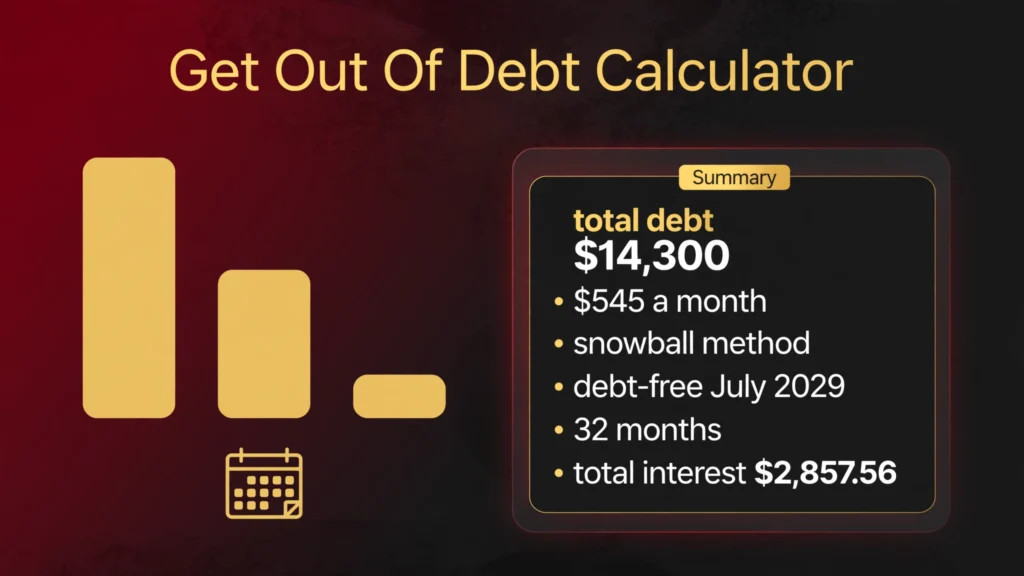
Take three debts that match the examples used across the top search results, so the arithmetic can be checked line by line. A store card of $900 at 18% APR with a $35 minimum. A credit card of $5,400 at 24% APR with a $160 minimum. A personal loan of $8,000 at 9% APR with a $200 minimum. The total owed is $14,300, the minimums come to $395 a month, and the extra payment is $150, which is 38.0% of the minimums, so the total paid each month is $545.
Month 1 with the snowball shows how the arithmetic works. The store card charges $13.50 of interest, so the balance rises to $913.50 before the $35 minimum is paid, leaving $878.50. The credit card charges $108.00, rising to $5,508.00, then the $160 minimum leaves $5,348.00. The personal loan charges $60.00, rising to $8,060.00, then the $200 minimum leaves $7,860.00. The first month’s interest is $181.50, and the total owed falls to $13,936.50. The extra $150 and the rollover both go to the store card, so it is the first to reach zero.
With the snowball, the plan takes 32 months and the debt-free date is July 2029. The total interest is $2,857.56 and the total paid is $17,157.56. The interest is 16.65% of the total paid and 19.98% of the amount borrowed. The payoff order is the store card first, in month 6, which is May 2027, with $41.63 of interest; then the credit card, in month 23, which is October 2028, with $1,555.44 of interest; then the personal loan, in month 32, which is July 2029, with $1,260.49 of interest. The three interest figures add to the total: $41.63 + $1,555.44 + $1,260.49 = $2,857.56.
With the avalanche the first month is different, because the extra $150 goes to the credit card at 24% instead of the store card. The store card, paid only its $35 minimum, falls to $878.50, the credit card, paid its $160 minimum plus the $150 extra, falls to $5,198.00, and the personal loan falls to $7,860.00. The total after the first month is still $13,936.50, because the amount paid in the month is the same $545. The plan still takes 32 months, and the debt-free date is still July 2029, but the total interest is $2,778.92 and the total paid is $17,078.92, which is $78.64 less than the snowball. The payoff order is the credit card first, in month 22, which is September 2028, with $1,305.61 of interest; then the store card, in month 23, which is October 2028, with $217.94 of interest; then the personal loan, in month 32, which is July 2029, with $1,255.37 of interest.
Paying only the minimums, with no extra and no rollover, takes 57 months, and the debt-free date is August 2031. The total interest is $5,474.03 and the total paid is $19,774.03. The snowball saves 25 months and $2,616.47 of interest, which is 47.8% of the interest the minimums-only plan charges. The avalanche saves the same 25 months and $2,695.11, which is 49.2%. The interest on the minimums-only plan is 38.3% of the amount borrowed. Paid on minimums alone, the store card takes 33 months, the personal loan 48 months, and the credit card 57 months, which is why the credit card sets the date.
What is the debt snowball method?
The debt snowball is the method of paying the smallest balance first, whatever the interest rates are, while paying only the minimum on every other debt. Each time a debt reaches zero, the whole payment that was going to it — its minimum plus any extra — is rolled onto the next smallest debt, so the amount aimed at the target grows as debts are cleared. The method is named for the way the payment snowballs. Ramsey Solutions’ debt calculator describes the same three steps: list smallest to largest, attack the smallest, roll the payment forward.
The snowball is a behaviour method, not an arithmetic one. In the worked example, it costs $78.64 more in interest than the avalanche, and it still finishes in the same 32 months, because the gap between the smallest balance and the highest APR happens to be small. The method trades a little interest for an early win: the store card is cleared in month 6, which is 16 months before the avalanche clears anything at all. That early win is the whole point, and it is also the whole cost.
The rollover is what makes the snowball fast. In month 7, after the store card is gone, the credit card receives its own $160 minimum, plus the $35 minimum freed from the store card, plus the $150 extra, which is $345 a month. In month 23, after the credit card is gone, the personal loan receives the whole $545 a month. The extra payment is what cuts the months, and the rollover is what keeps the total payment at $545 even as debts disappear.
The snowball fits when the smallest debt can be cleared in a few months, because then the early win arrives quickly, and when the interest-rate gap is small, because then the extra interest is small. It does not fit when the smallest debt is a large one, because then there is no early win, or when the rate gap is large. With one debt only, there is no ordering to choose, and the two methods give the same plan.
What is the debt avalanche method?
The debt avalanche is the method of paying the highest APR first, whatever the balances are, while paying only the minimum on every other debt. Each time a debt reaches zero, the whole payment that was going to it is rolled onto the next highest APR, in the same way as the snowball. The method is named for the way it attacks the most expensive debt first, and it is the cheapest ordering for a fixed monthly payment.
The avalanche is the arithmetic answer, and on a fixed monthly payment no other ordering costs less interest. In the worked example it saves $78.64 over the snowball, because it aims the extra $150 at 24% instead of 18% from the first month. The saving is real, but it is $2.46 a month over 32 months, which is small against the $545 a month being paid. The result is the same debt-free date, July 2029, and the same 32 months, and the saving is the only difference between the two plans.
The avalanche’s weakness is that it gives no early win when the highest APR is also the largest balance. In the worked example, the credit card is both the highest APR and the largest balance, so nothing is paid off until month 22, which is 16 months after the snowball clears the store card. A plan that shows no finished debt for almost two years is harder to stay with, and a missed month costs more than $78.64 of interest. The tool reports the payoff order so the wait can be seen before it is chosen.
A 0% balance is the one case where the avalanche’s logic flips. If the largest debt charges 0%, the avalanche still targets the highest APR first, which is the smaller debt, so it pays the 0% balance last. In the test case in the checking section below, the snowball clears the 0% medical bill in month 4 and the avalanche clears it in month 8, and the avalanche costs $20.17 less overall. The difference is the interest on the card, and it is small either way.
Snowball or avalanche: which should I choose?
Look at the numbers first, because they are usually closer than the advice suggests. In the worked example, the avalanche saves $78.64 over 32 months, which is $2.46 a month. In the student-debt example below, the avalanche saves $401.71 over 20 months, which is $20.09 a month, because the rate gap there is 19.49 points instead of 6. The cost of choosing the snowball is the rate gap times the balance times the months, so a large gap on a large balance is the only case where the choice matters much. A comparison at CalcTools, using $9,500 across three debts with a $600 payment, puts the gap at $41.92 over 30 months, which is the same pattern: a small saving for the avalanche.
Look at the first payoff date second, because that is what you will feel. The snowball clears the store card in month 6. The avalanche clears nothing until month 22. In the student-debt example the snowball clears the student loan in month 10 and the avalanche clears the credit card in month 13, so the gap is only three months there. If the first payoff is months away under both methods, the choice is arithmetic. If one method gives a win in a few months and the other gives nothing for a year, the win is worth more than the interest it costs.
The choice does not matter at all when the APRs are the same, when there is only one debt, or when the rate gap is small. The extra payment and the rollover matter far more than the method: $150 extra saves 25 months and more than $2,600 of interest, while the method saves $78.64. Raise the extra payment first, and choose the method second.
Why do minimum payments take so long?
A minimum payment is set just above the interest, so most of it is interest and only a little comes off the balance. On the credit card in the worked example, the first month charges $108.00 of interest, and the $160 minimum takes only $52.00 off the balance. On the store card, the first month charges $13.50 and the $35 minimum takes $21.50 off. The personal loan is the only one that moves quickly, because its rate is 9% and its minimum is $200 against $60.00 of interest.
The numbers show the cost. Paying only the minimums on the three test debts takes 57 months and costs $5,474.03 of interest, which is 38.3% of the amount borrowed. The credit card alone takes 57 months and costs $3,681.35 of interest, the personal loan takes 48 months and costs $1,547.10, and the store card takes 33 months and costs $245.58. The credit card sets the date because it is the slowest to clear, and it is also the most expensive.
The minimums-only figure in the tool is not the same as paying $0 extra with the rollover. With $0 extra but the rollover still applied, the plan takes 50 months and costs $5,279.22, because each debt that clears still hands its minimum to the next. The rollover alone saves 7 months and $194.81 against minimums only. The saving of 25 months and $2,616.47 that the $150 extra gives is the extra payment and the rollover together, and the table in the next section separates them.
A minimum can also be too small to work at all. A $5,000 balance at 24% charges $100.00 of interest in the first month, so a $50 minimum does not cover the interest and the balance grows. The tool refuses that case rather than showing a plan that never ends. The same arithmetic is behind the debt-to-income ratio, which divides the monthly debt payments by the monthly income: a debt to income calculator works out whether the payments fit the income before the payoff plan is built.
How much difference does an extra payment make?
The extra payment is the input that moves the date, and the first dollars move it most. The table below runs the same three debts, the same $395 of minimums, and the same snowball and avalanche methods, changing only the extra payment. The extra payment is paid in every month for the whole plan, so $150 extra over 32 months is $4,800 paid in, and it saves $2,616.47 of interest and 25 months of payments.
| Extra a month | Snowball: months | Snowball: interest | Avalanche: months | Avalanche: interest |
|---|---|---|---|---|
| $0 | 50 | $5,279.22 | 50 | $5,279.22 |
| $50 | 42 | $4,072.37 | 42 | $3,989.22 |
| $100 | 36 | $3,344.39 | 36 | $3,258.09 |
| $150 | 32 | $2,857.56 | 32 | $2,778.92 |
| $250 | 26 | $2,236.27 | 26 | $2,173.95 |
| $400 | 21 | $1,706.16 | 21 | $1,660.09 |
Three patterns stand out. The first $50 does the most work: it cuts 8 months and $1,206.85 of interest off the plan with no extra payment. The next $50 cuts 6 months and $727.98, and the step from $250 to $400 cuts 5 months and $530.11, so each extra dollar buys less time than the one before it. The two methods finish in the same number of months at every level, because the months are set by the total paid, not by which debt is targeted. The gap between the methods grows with the extra payment in dollars, from $83.15 at $50 to $86.30 at $100, then falls to $78.64 at $150, $62.32 at $250 and $46.07 at $400, because a larger payment finishes sooner and leaves less time for the rate gap to matter.
The table is the answer to how much extra to pay. $50 a month saves $1,206.85 and 8 months, which is a return of about $24 for every $1 paid in the first year. $100 a month saves $1,934.83 and 14 months. The amount that can be paid every month for two or three years matters more than the amount that can be paid once, because the plan only works if the payment keeps coming. A payment that cannot be sustained is worse than a smaller one that can, because the plan that stops halfway is the minimums-only plan.
Can I use this calculator for student debt?
Yes. A student loan fits in any debt slot like any other debt, with its balance, APR and minimum monthly payment. Take a student loan of $2,400 at 5.5% APR with a $50 minimum, next to a credit card of $3,200 at 24.99% APR with a $90 minimum. The total owed is $5,600, the minimums come to $140 a month, and the extra payment is $200, so the total paid each month is $340.
With the snowball, the student loan is paid first, because it is the smaller balance. It is cleared in month 10, which is September 2027, with $60.10 of interest. The credit card is cleared in month 20, which is July 2028, with $970.82 of interest. The plan takes 20 months, and the total interest is $1,030.92, so the total paid is $6,630.92. With the avalanche, the credit card is paid first, because it carries the highest APR. It is cleared in month 13, which is December 2027, with $474.30 of interest. The student loan is cleared in month 19, which is June 2028, with $154.90 of interest. The plan takes 19 months, and the total interest is $629.21, so the total paid is $6,229.21. The avalanche saves $401.71, which is 39.0% of the snowball’s interest. Paying only the minimums on the same two debts takes 66 months, which is May 2032, and costs $3,006.52 of interest, so the snowball saves 46 months and $1,975.60, which is 65.7% of the interest.
Two things about student debt do not fit the tool. Income-based payments change the minimum when the income changes, and the tool keeps the minimum fixed. Deferment, forbearance and forgiveness stop or cancel payments, and the tool assumes payments continue every month until the balance reaches zero. A student loan with a fixed minimum and a fixed APR, and no forgiveness, fits the tool exactly. The avalanche leaves the student loan until last in this example, because the card’s APR is higher, so the loan that is usually the larger of the two in real life is paid first here only because it is the smaller balance.
What does this calculator leave out?
The calculator assumes the APR on each debt stays fixed for the whole plan. A 0% introductory rate that ends after 12 months, a variable rate that moves, or a rate that rises after a missed payment, all change the interest. A card that charges 0% for a year and then 24.99% is a different debt in the second year. The plan the tool shows is the plan for the APRs entered today.
The calculator also assumes the minimum stays fixed and that no new charges, fees or missed payments appear. A new charge on a card that is being paid off extends the plan, because the balance the extra payment is aimed at grows again. A missed payment adds a fee and can raise the APR. A debt that is charged off or sent to collections is a different problem, and this tool does not model it.
A mortgage does not belong in this tool, because a mortgage is secured, has a term of years, and is paid with a fixed monthly payment that is set by the loan, not by a minimum. A mortgage that is paid off early is a different calculation: a loan early repayment calculator works out how much an extra payment saves on a loan with a fixed term. The same applies to a car loan or a personal loan with a fixed term: a loan calculator works out the monthly payment and the total interest for the term.
The months the tool reports are whole months, and the interest is the APR divided by 12, charged once a month on the balance at the start of the month. A lender that charges daily interest will produce a figure a few dollars different, because the balance falls a little each day instead of once a month. The tool rounds each month’s interest to the cent, so the total can differ by a cent from a calculation that rounds only at the end: in the student-debt example below, the avalanche interest is $629.21 in the tool and $629.20 when the monthly figures are added without rounding. A payoff quote from a lender is the figure to use for the final payment, because interest is charged up to the day the money arrives.
How can I check the tool against a known case?
Enter one debt and work it out by hand. A single debt of $5,000 at 19.99% APR with a $250 minimum, and no extra payment, takes 25 months, and the debt-free date is December 2028. The total interest is $1,132.29 and the total paid is $6,132.29. The first month charges $83.29 of interest, so the balance rises to $5,083.29 and the $250 payment takes it to $4,833.29. The formula for the months is the natural log of the payment divided by the payment minus the monthly interest, divided by the natural log of one plus the monthly rate: log($250 ÷ ($250 − $83.29)) ÷ log(1 + 0.1999 ÷ 12) = 24.53, which rounds up to 25 months. The last payment is the balance left after 24 payments of $250, which is $132.29. The interest is 18.46% of the total paid.
Enter the three debts from the worked example and check the totals. The snowball gives the debt-free date of July 2029, 32 months, and $2,857.56 of interest, with a total paid of $17,157.56. The store card is cleared in month 6, the credit card in month 23, and the personal loan in month 32. The avalanche also gives 32 months and July 2029, with $2,778.92 of interest, and the credit card is cleared in month 22. The avalanche costs $78.64 less.
Enter a 0% debt and check the ordering. A medical bill of $400 at 0% APR with a $50 minimum, next to a credit card of $2,500 at 22% APR with a $60 minimum, and $50 extra, gives a snowball plan of 23 months with $630.60 of interest, and the medical bill is cleared in month 4, which is March 2027. The avalanche gives 22 months with $610.43 of interest, and the medical bill is cleared in month 8, which is July 2027. The snowball interest is $630.60 when the monthly figures are added without rounding, and $630.59 when each month is rounded to the cent, so the tool’s figure is a cent higher than the hand calculation. The avalanche’s month-1 interest is $45.83, which is the only interest charged in the first month, because the medical bill charges nothing.
Enter a minimum that does not cover the interest and check the refusal. A $5,000 balance at 24% APR with a $50 minimum charges $100.00 of interest in the first month, so the tool shows an error and no results. Enter $0 extra with the three test debts and check the rollover: the plan takes 50 months and costs $5,279.22, which is 7 months and $194.81 better than paying only the minimums, which takes 57 months and costs $5,474.03. The saving of 25 months and $2,616.47 that the $150 extra gives is the extra payment and the rollover together. A percentage calculator works out the share: $2,857.56 is 16.65% of the total paid of $17,157.56. The calculators category lists the other calculators on this site.
This tool gives estimates, not financial advice. The figures are exact for the inputs entered and the assumptions above, and they are the figures to check against. A lender’s payoff quote, which includes interest charged up to the day the money arrives, is the figure to use for the final payment. A non-profit credit counsellor can check a plan that involves debts in collections, a mortgage in arrears, or a payment that does not fit the income. This page was not reviewed by a qualified financial adviser, and no statement on it is a recommendation to take on or pay off debt in a particular way.
Frequently asked questions
How does a get out of debt calculator work?
It simulates your debts month by month. Each month it charges one month of interest on every open debt at APR ÷ 12, pays every minimum, and sends all the money left over — your extra payment plus any minimum freed by a debt already paid off — to one target debt. It repeats that until every balance reaches zero, then reports the months taken, the debt-free date, the total interest and the total paid. The target is the smallest balance for the snowball and the highest APR for the avalanche.
What is the difference between the debt snowball and the debt avalanche?
The snowball targets the smallest balance first, whatever the interest rates are, and clears a whole debt sooner. The avalanche targets the highest APR first, whatever the balances are, and always costs the least interest of any ordering for a fixed monthly payment. In the worked example on this page, both finish in 32 months, but the avalanche costs $78.64 less in interest. The snowball gives you a paid-off account in month 6; the avalanche gives you nothing paid off until month 22.
How long will it take to get out of debt?
It depends on the total owed, the rates, the minimums and the extra you can pay. Three debts totalling $14,300 with $395 of minimums and $150 extra take 32 months with either method. Paying only the minimums on the same debts takes 57 months. Two debts totalling $5,600 with $140 of minimums and $200 extra take 20 months with the snowball and 19 months with the avalanche, against 66 months on minimums only. Enter your own figures to get your own date.
Can I get out of debt by paying only the minimums?
Yes, if the minimum is above the monthly interest, but it takes much longer and costs much more. On the three test debts, minimums only take 57 months and cost $5,474.03 in interest, against 32 months and $2,857.56 with $150 extra. If the minimum is at or below the monthly interest — for example a $50 payment on a $5,000 balance at 24%, which charges $100.00 of interest in the first month — the balance never falls, and this tool refuses to show a plan for that case.
How much extra should I pay each month?
Any amount helps, and the first $50 helps the most. On the three test debts, $50 extra cuts 8 months and $1,206.85 of interest off the plan with no extra payment; $100 extra cuts 14 months and $1,934.83; $400 extra cuts 29 months and $3,573.06. The amount you can pay every month for two or three years matters more than the amount you can pay once, because the plan only works if the payment keeps coming.
Does this calculator work for student debt?
Yes. A student loan fits in any debt slot like any other debt, with its balance, APR and minimum monthly payment. A student loan of $2,400 at 5.5% with a $50 minimum next to a credit card of $3,200 at 24.99% with a $90 minimum, with $200 extra, takes 20 months and $1,030.92 of interest with the snowball and 19 months and $629.21 with the avalanche. The tool assumes a fixed minimum and a fixed APR, so it does not model income-based payments, deferment or forgiveness.