Tire Size Calculator
Enter the three numbers from your tire sidewall — width, aspect ratio and rim diameter — and the tool works out the sidewall height, overall diameter, circumference and revolutions per mile and per kilometre. Add a second size to compare it with the first and see the diameter difference, the speedometer error and your true speed.
Stock tire (the size fitted now)
New tire (optional — fill all three to compare)
Overall diameter = rim diameter + 2 × sidewall height, with the sidewall height converted from millimetres to inches (1 inch = 25.4 mm). Circumference = π × overall diameter. Revolutions per mile = 63,360 ÷ circumference in inches. The figures are nominal geometry from the size code: real tires of the same size can differ by a few millimetres between brands, and a loaded, worn tire rolls on a slightly smaller radius.
A dia wheel is a wheel diameter: the number after the R in a tire size code, such as the 17 in 225/45R17, which is the diameter of the rim the tire fits. This calculator works out the full tire size from that code — sidewall height, overall diameter, circumference and revolutions per mile — and compares two sizes to show the diameter difference and the speedometer error.
How do I use the Tire Size Calculator?
Read the three numbers off the tire sidewall first. The size code is printed in raised letters, usually in the form 205/55R16. The first number is the width in millimetres, the second is the aspect ratio as a percentage, and the last number, after the R, is the rim diameter in inches. Enter those three numbers in the stock tire boxes: width, aspect ratio, rim diameter. Press the calculate button and five labelled boxes appear: sidewall height in millimetres and inches, overall diameter in inches and millimetres, circumference in inches, revolutions per mile, and revolutions per kilometre. A note under the boxes repeats the result in one sentence, with the size written out as a code.
To compare two sizes, fill in the three new-tire boxes as well. The tool then shows a second set of boxes: the new tire's overall diameter, the diameter difference in inches and as a percentage, the speedometer error percentage, your true speed at the speedometer reading you entered, and the new tire's revolutions per mile with the stock figure in brackets. The speedometer reading box defaults to 60 mph when left blank, so a comparison with no speed entered still shows the true speed at 60 mph. A note under the comparison says whether the new size sits inside the usual plus-or-minus 3% guide or outside it, and what that means for the speedometer.
If an input is wrong, the tool shows a plain-language error and no results. A blank width, aspect ratio or rim diameter is rejected, because all three numbers are needed for the calculation. A width below 100 mm or above 500 mm is rejected, an aspect ratio below 20 or above 100 is rejected, and a rim diameter below 8 inches or above 30 inches is rejected. Filling in only one or two of the new-tire boxes is rejected, with a message telling you to fill all three or leave all three blank. A speedometer reading of 0 or below, or above 200 mph, is rejected. A blank speedometer reading is not an error: it is treated as 60 mph.
What does a worked example look like?
Start with the first verified test, a single size. A 205/55R16 tire has a sidewall height of 205 × 55 ÷ 100 = 112.75 mm, which is 112.75 ÷ 25.4 = 4.44 inches. The overall diameter is the 16-inch rim plus two sidewalls: 16 + 2 × 4.44 = 24.88 inches, or 631.9 mm. The circumference is π × 24.88 = 78.16 inches. The tire turns 63,360 ÷ 78.16 = 810.7 times per mile, and 503.7 times per kilometre. This matches the worked example published by Calculator Park for the same size, which gives 631.9 mm, 1,985 mm of circumference and 810.7 revolutions per mile.
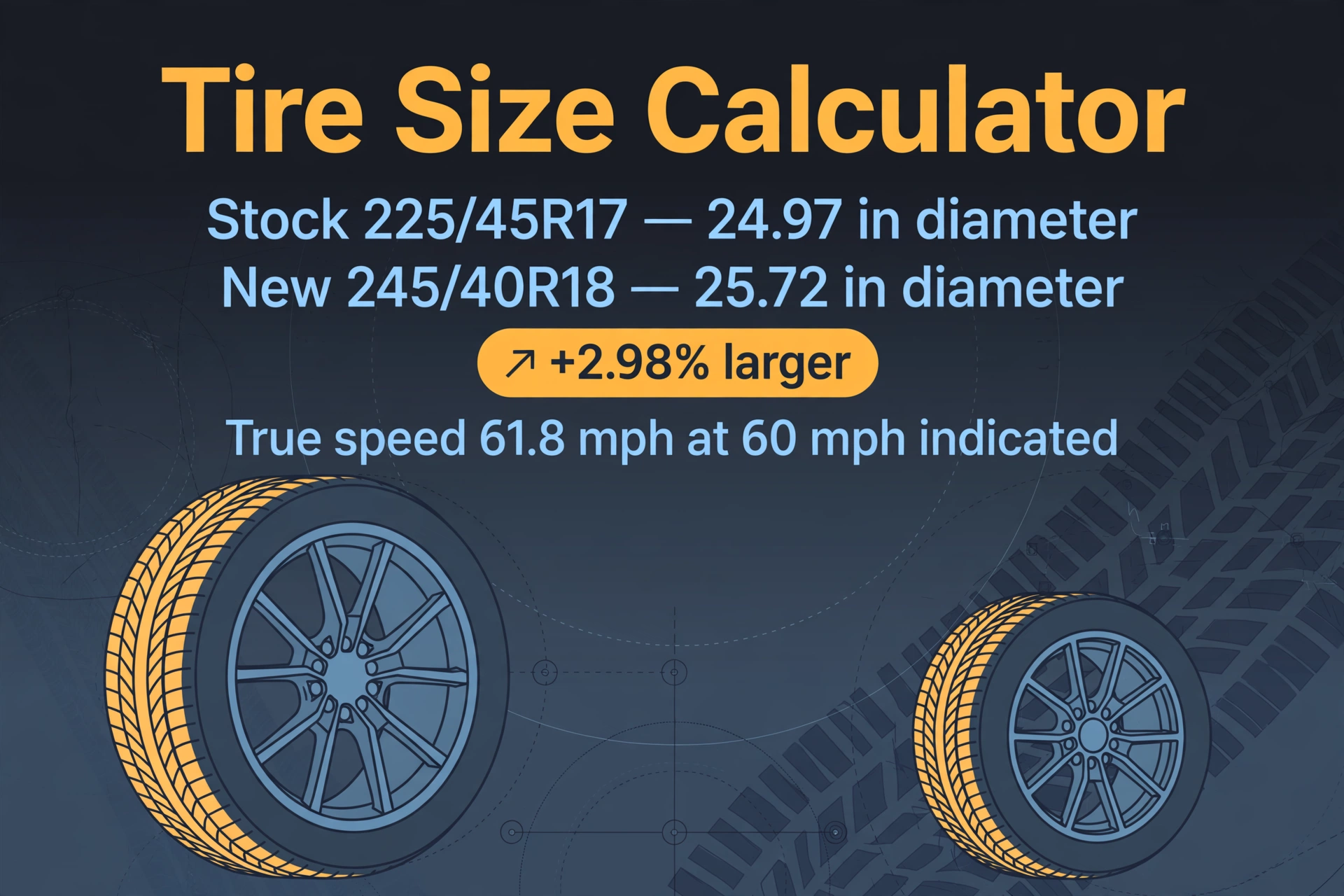
A second test is the plus-size comparison people search for most. The stock tire is 225/45R17: a sidewall of 225 × 45 ÷ 100 = 101.25 mm (3.99 inches), an overall diameter of 17 + 2 × 3.99 = 24.97 inches (634.3 mm), a circumference of 78.45 inches, and 807.6 revolutions per mile. The new tire is 245/40R18: a sidewall of 245 × 40 ÷ 100 = 98 mm (3.86 inches), an overall diameter of 18 + 2 × 3.86 = 25.72 inches (653.2 mm), a circumference of 80.79 inches, and 784.2 revolutions per mile. The diameter difference is 25.72 − 24.97 = 0.74 inches, which is 0.74 ÷ 24.97 × 100 = 2.98% larger. At 60 mph on the speedometer the true speed is 60 × 25.72 ÷ 24.97 = 61.8 mph. At 30 mph indicated it is 30.9 mph, and at 70 mph indicated it is 72.1 mph. The new size sits inside the usual plus-or-minus 3% guide, so the speedometer stays near accurate, but it still reads 1.8 mph low at 60 mph. The ride height also rises by half the diameter difference, which is 0.37 inches.
A third test uses a golf cart tire. A 205/50-10 has a sidewall of 205 × 50 ÷ 100 = 102.5 mm (4.04 inches), an overall diameter of 10 + 2 × 4.04 = 18.07 inches (459 mm), a circumference of 56.77 inches, and 1,116.1 revolutions per mile. That matches the published golf cart tire chart, which lists a 205/50-10 as 18 inches tall and 8 inches wide: the calculator gives 18.07 inches, which is 0.07 inches above the chart's rounded figure. The golf cart section below explains the two size formats cart tires use.
A fourth test checks the tool against an independent published figure. A 225/50R17 has a sidewall of 112.5 mm (4.43 inches), an overall diameter of 25.86 inches (656.8 mm), a circumference of 81.24 inches, and 779.9 revolutions per mile. SolveTutor publishes exactly those three figures for the same size — 25.858 inches, 81.236 inches and 779.9 revolutions per mile — so the tool's arithmetic matches an independent source to the decimal places shown.
A fifth test compares two truck sizes. The stock tire is 275/55R20: a sidewall of 151.25 mm (5.95 inches), an overall diameter of 31.91 inches (810.5 mm), a circumference of 100.25 inches, and 632.0 revolutions per mile. The replacement is 265/70R17: a sidewall of 185.5 mm (7.30 inches), an overall diameter of 31.61 inches (802.8 mm), a circumference of 99.29 inches, and 638.1 revolutions per mile. The difference is 31.61 − 31.91 = −0.30 inches, which is −0.95%. At 65 mph indicated the true speed is 65 × 31.61 ÷ 31.91 = 64.4 mph, so the speedometer reads 0.6 mph high. These figures match the comparison published by TireCalculator.net for the same two sizes: 31.91 and 31.61 inches, 100.25 and 99.29 inches of circumference, and 632 and 638 revolutions per mile.
A sixth test shows a near-perfect match. A 215/55R17 has an overall diameter of 26.31 inches (668.3 mm), a circumference of 82.66 inches and 766.5 revolutions per mile. A 235/45R18 has an overall diameter of 26.33 inches (668.7 mm), a circumference of 82.71 inches and 766.1 revolutions per mile. The difference is 0.02 inches, which is 0.06%, and the true speed at 60 mph indicated is 60.0 mph — the speedometer is effectively unchanged. UbifyTools publishes the same pair as 26.31 and 26.33 inches with a 0.02-inch difference, so this is a change of wheel size with almost no change in overall diameter, which is the point of plus-sizing.
A seventh test shows what happens outside the guide. A 205/55R16 stock tire against a 225/65R17 replacement gives diameters of 24.88 and 28.52 inches, a difference of 3.64 inches, which is 14.62% larger. At 60 mph indicated the true speed is 68.8 mph. The tool reports this as more than 3% larger than stock and outside the usual guide, with the speedometer reading low and clearance and gearing changing.
What does “dia wheel” mean?
“Dia” is short for diameter, and “dia wheel” is a search for the diameter of a wheel and the tire that fits it. The wheel diameter is the diameter of the rim, measured across the wheel from one bead seat to the opposite bead seat, in inches. It is the number after the R in a tire size code: in 225/45R17 the wheel diameter is 17 inches, which means the tire is made to mount on a 17-inch wheel. The tire's inner bead must match that diameter exactly, so a 225/45R17 tire fits a 17-inch wheel and no other size.
The wheel diameter is only one of three numbers that fix the tire's size. The width and the aspect ratio decide the sidewall height, and the sidewall height decides the overall diameter, which is the height of the whole inflated tire. Two tires with the same wheel diameter can have very different overall diameters: a 225/45R17 stands 24.97 inches tall, while a 225/65R17 stands 28.52 inches tall, and both fit a 17-inch wheel. That is why a search for “dia wheel” leads to a tire size calculator rather than a single number: the wheel diameter is the starting point, and the calculator works out everything that follows from it.
How do I read a tire size code?
Take 205/55R16 as the example, because it is one of the most common sizes on the road. The 205 is the section width in millimetres: the width of the tire from sidewall to sidewall at its widest point, measured in millimetres. The 55 is the aspect ratio: the sidewall height as a percentage of the width, so this sidewall is 55% of 205 mm. The R means radial construction, which is how more than 98% of modern tires are built. The 16 is the wheel diameter in inches: the tire fits a 16-inch wheel.
A full sidewall marking usually carries more than those three numbers. A letter before the width gives the vehicle class: P for passenger, LT for light truck, ST for special trailer, and T for a temporary spare. After the rim diameter come the load index and the speed rating, for example 95V, where 95 is a code for the maximum load the tire can carry and V is a code for the maximum speed it is rated for. This calculator does not use the load index or the speed rating, because they do not change the tire's dimensions, but a replacement tire should carry a load index and speed rating at least as high as the original. The markings are defined by the tire size standard, and the Tire and Rim Association sets the dimensional standards for tire and rim matching in North America, with the European Tyre and Rim Technical Organisation setting the equivalent standards in Europe.
How is tire diameter calculated?
The formula has four steps, and the worked example below uses the 205/55R16 from the first test so every number can be checked. First, the sidewall height: Sidewall Height (mm) = Width × Aspect Ratio ÷ 100. For 205/55R16 that is 205 × 55 ÷ 100 = 112.75 mm. Second, convert the sidewall height to inches, because the rim diameter is given in inches: Sidewall Height (in) = Sidewall Height (mm) ÷ 25.4. For this tire that is 112.75 ÷ 25.4 = 4.44 inches. The figure 25.4 is exact: one inch is defined as 25.4 millimetres, as set out in the National Institute of Standards and Technology's guide to the International System of Units. Third, the overall diameter: Overall Diameter (in) = Rim Diameter + 2 × Sidewall Height (in). The sidewall is counted twice, once above the rim and once below it, because the rim sits inside the tire. For this tire that is 16 + 2 × 4.44 = 24.88 inches. Fourth, the circumference: Circumference = π × Overall Diameter, which is 3.1416 × 24.88 = 78.16 inches. And the revolutions per mile follow from the circumference: Revolutions per Mile = 63,360 ÷ Circumference, because one mile is 63,360 inches, which gives 63,360 ÷ 78.16 = 810.7.
Written as one line, the diameter formula is: Diameter (in) = Rim + 2 × (Width × Aspect ÷ 100) ÷ 25.4. The same result comes from working in millimetres throughout: Diameter (mm) = Rim × 25.4 + 2 × Width × Aspect ÷ 100, which for 205/55R16 is 16 × 25.4 + 2 × 112.75 = 406.4 + 225.5 = 631.9 mm, and 631.9 ÷ 25.4 = 24.88 inches. Either route gives the same answer, and the tool uses the inch route so the diameter it shows lines up with the rim size people already think in.
What is the difference between wheel diameter and overall tire diameter?
Wheel diameter is the size of the metal rim only. It is measured across the wheel from bead seat to bead seat — the shelf inside the rim where the tire's bead seats and seals when inflated — not from the outer edge of the rim. Overall tire diameter is the height of the whole inflated tire, from the ground to the top of the tread, which is the rim diameter plus two sidewalls. The difference between the two is the tire's sidewall height, counted twice.
The distinction matters because the two numbers answer different questions. The wheel diameter answers the fitment question: which rim does this tire mount on. The overall diameter answers the driving questions: how tall does the vehicle sit, how far does it travel in one turn of the wheel, and what does the speedometer read. Changing the wheel diameter alone does not change the overall diameter if the aspect ratio falls to match, which is the whole idea of plus-sizing: a 215/55R17 and a 235/45R18 both stand about 26.3 inches tall, even though one fits a 17-inch wheel and the other an 18-inch wheel. Confusing the two is the most common error in tire sizing, and the next section shows the size of that error in inches.
How does tire size change the speedometer?
A speedometer does not measure speed directly. It counts how fast the wheels turn and multiplies by the circumference of the tire the vehicle was built with, because each turn of the wheel moves the vehicle forward by one circumference. When the tire's circumference changes, the same number of turns covers a different distance, and the speedometer reading drifts by the same percentage as the diameter.
The error percentage is the diameter difference as a percentage: Speedometer Error (%) = (New Diameter − Stock Diameter) ÷ Stock Diameter × 100. The true speed is: True Speed = Indicated Speed × New Diameter ÷ Stock Diameter. For the plus-size example above, the error is +2.98%, so at 60 mph indicated the true speed is 61.8 mph, at 30 mph indicated it is 30.9 mph, and at 70 mph indicated it is 72.1 mph. The speedometer reads low, because the larger tire covers more ground per turn than the speedometer expects. For the truck example, the error is −0.95%, so at 65 mph indicated the true speed is 64.4 mph: the speedometer reads high, because the smaller tire covers less ground per turn.
The odometer drifts by the same percentage, and over a long distance the gap adds up. With the plus-size change, 10,000 miles shown on the odometer is 10,000 × 25.72 ÷ 24.97 = 10,298 true miles, so the vehicle has travelled 298 miles more than the odometer shows. With the truck change, 10,000 miles shown is 10,000 × 31.61 ÷ 31.91 = 9,905 true miles, so it has travelled 95 miles fewer than the odometer shows. That matters for service intervals, which are set in miles, and for a used vehicle's recorded mileage. To work out the percentage error itself, the percentage calculator gives the share or the change between two numbers.
What is the 3% rule for plus-sizing?
Plus-sizing means fitting a larger wheel and a lower-profile tire so the overall diameter stays nearly the same. A +1 plus-size moves the wheel up one inch and drops the aspect ratio to match: a 225/45R17 to a 245/40R18 is a +1 step, and it gives a diameter of 25.72 inches against 24.97 inches stock, which is 2.98% larger. A +2 step moves two inches. The widely used guide is to keep the new overall diameter within about 3% of the original, and the tool says so in its note: inside 3% the speedometer stays near accurate, and outside 3% it does not.
The 3% guide is a rule of thumb, not a safety limit, and it does not cover everything a fitment decision needs. The 3% band for a 225/45R17 stock tire runs from 24.22 to 25.72 inches, so the 245/40R18 at 25.72 inches sits exactly at the top edge of the band. The band for a 205/55R16 runs from 24.13 to 25.62 inches. A size inside the band can still rub against the wheel arch or suspension if the tire is wider, because the guide only covers diameter, not width or offset. A size outside the band changes more than the speedometer: ground clearance rises or falls by half the diameter change, the gearing changes because each turn of the wheel covers a different distance, and the load on the suspension and brakes changes. Before buying, check the vehicle owner's manual for the approved sizes, and check the load index and speed rating, which must be at least as high as the original tire's.
Can I use this calculator for golf cart tires?
Yes. Golf cart tires use the same two size formats as car tires, and the calculator handles the metric format. A 205/50-10 is read the same way as a car size: 205 mm wide, an aspect ratio of 50, and a 10-inch wheel. The dash instead of the R does not change the arithmetic. The calculator gives an overall diameter of 18.07 inches, a circumference of 56.77 inches, and 1,116.1 revolutions per mile, and the published golf cart tire chart lists a 205/50-10 as 18 inches tall and 8 inches wide, so the two agree within 0.07 inches.
Cart tires also come in an inch format that gives the overall diameter directly: 18x8.50-8 means 18 inches of overall diameter, 8.50 inches of width, and an 8-inch wheel. Standard cart tire diameters commonly run from 18 to 23 inches, with 18x8.50-8, 20x10-10 and 22x11-10 as common sizes, and most stock carts come with tires around 18 inches in diameter. For an inch-format size, the overall diameter is already the first number, so the calculator is not needed for that figure — but the metric format still needs it, and the comparison mode still shows what a larger cart tire does to the cart's speed. A larger cart tire raises the cart's true speed for the same motor speed, in the same proportion as the diameter change, and it needs a lift kit to clear the body on most carts.
One more cart figure comes from a foam-fill chart rather than from this calculator. Some suppliers fill cart and industrial tires with foam instead of air, and they publish charts giving the ounces of foam per tire. One manufacturer's chart lists 32 ounces (946 millilitres) of foam for a 205/50-10 tire. Charts differ between makers, so use the chart of the supplier whose foam you are buying, and treat the figure as that maker's specification, not as a result of the diameter calculation.
What mistakes do people commonly make with tire sizes?
The first mistake is reading the wheel diameter as the overall diameter. A 225/45R17 does not stand 17 inches tall: it stands 24.97 inches tall, because the 17 inches is the rim and the two sidewalls add 7.97 inches on top of it. The wheel diameter is the smallest of the three numbers that matter, not the tire's height.
The second mistake is using the width as the sidewall height. The sidewall is a percentage of the width, not the width itself. For a 225/45R17 the sidewall is 45% of 225 mm, which is 101.25 mm, not 225 mm. Using the width as the sidewall gives a diameter of 17 + 2 × (225 ÷ 25.4) = 34.72 inches, which is 9.75 inches too tall and plainly wrong for a passenger car tire.
The third mistake is treating the aspect ratio as a measurement in millimetres. The 45 in 225/45R17 is 45%, a ratio, not 45 mm. The sidewall in millimetres is 225 × 45 ÷ 100 = 101.25 mm, and the same tire with an aspect ratio of 65 would have a sidewall of 146.25 mm and an overall diameter of 28.52 inches.
The fourth mistake is assuming that two tires with the same size code have exactly the same diameter. They do not, quite. The figures in this article are nominal geometry from the size code, and real tires of the same size can differ by a few millimetres between brands and models, because tread depth, construction and rim width all play a part. A loaded, worn tire also rolls on a slightly smaller radius than a new one. Use the tire maker's specification sheet for tight clearance checks, and treat the calculator's figures as the nominal size, not a measurement of a specific tire.
The fifth mistake is changing the diameter without thinking about the speedometer and the odometer. A 2.98% larger tire makes the speedometer read 1.8 mph low at 60 mph, which is small, but a 14.62% larger tire makes it read 8.8 mph low at the same speed, which is enough to matter for speed limits and for the recorded mileage. The comparison mode exists so that error is visible before the tires are bought.
The sixth mistake is forgetting the load index and the speed rating. The size code decides the dimensions, but the load index decides how much weight the tire can carry and the speed rating decides how fast it can safely run. A tire with the right dimensions and too low a load index is the wrong tire. Only fit sizes approved for the vehicle, with a load index and speed rating at least as high as the original.
The seventh mistake is assuming a comparison site or a wheel-fitment search has checked clearance. Sites that compare wheel sizes, including the well-known WillTheyFit style of comparison, show diameter, circumference and speedometer differences, which is the same arithmetic as this calculator. They do not know how much room your wheel arches have, what offset your wheels carry, or what bolt pattern your hubs use. Diameter is one of several fitment measurements, and the others need checking against the vehicle, not against a calculator.
What are the limits of this calculator?
This calculator works out nominal geometry from the size code only. It does not measure a real tire, and it does not allow for tread depth, construction, rim width, load or wear, so a real tire can differ by a few millimetres from the figures shown. It does not check clearance, offset, bolt pattern, centre bore or brake clearance, and it does not say whether a size is approved for a vehicle. It does not handle flotation-size tires such as 33x12.50R15, where the first number is already the overall diameter in inches, or historical tire size formats. It does not use the load index or the speed rating, and it does not give advice on which tire to buy.
The speedometer figures assume the speedometer was accurate on the stock size. Most production speedometers read slightly high by design, so the true speed after a change can differ from the figure shown by the small margin the factory built in. The figures are estimates for planning a size change, not a measurement of a vehicle, and a question about whether a size is safe or legal for a specific vehicle belongs to the vehicle maker, the tire maker, or a qualified mechanic. If new wheels and tires are being bought on credit, the loan calculator works out what borrowing for them would cost, and if they are on sale, the discount calculator works out the price after the reduction.
How can I check the tool against a known size?
The simplest check uses the first verified test. Enter a width of 205, an aspect ratio of 55 and a rim diameter of 16, and leave the new-tire boxes blank. The tool should show a sidewall height of 112.75 mm (4.44 in), an overall diameter of 24.88 in (631.9 mm), a circumference of 78.16 in, 810.7 revolutions per mile and 503.7 revolutions per kilometre, with the note “A 205/55R16 tire stands 24.88 inches tall, turns 810.7 times per mile, and covers 78.16 inches in one full turn.” Every box should match.
A second check uses the plus-size comparison. Enter a stock tire of 225/45R17 and a new tire of 245/40R18, with a speedometer reading of 60. The tool should show a new tire overall diameter of 25.72 in (653.2 mm), a diameter difference of 0.74 in, a diameter difference of 2.98%, a speedometer error of 2.98%, a true speed of 61.8 mph, and new tire revolutions per mile of 784.2 against a stock figure of 807.6, with the note “At 60 mph on the speedometer, your true speed is 61.8 mph. Within the usual plus-minus 3% guide: the new size is close enough to stock that the speedometer stays near accurate.”
A third check uses the golf cart tire. Enter a width of 205, an aspect ratio of 50 and a rim diameter of 10. The tool should show an overall diameter of 18.07 in (459 mm), a circumference of 56.77 in, and 1,116.1 revolutions per mile. A fourth check tests the errors: enter a width of 0 and the tool should show the error “The tire width must be at least 100 mm. Check the first number on the sidewall.” with no results, and enter a new tire width of 245 with the other two new-tire boxes blank and the tool should show the error “Please enter the new aspect ratio (a number from 20 to 100), or leave all three new-tire boxes blank.” with no results.
The formulas behind the tool are the standard tire size formulas set out in the guides this article draws on, including Calculator Park's tire size calculator, which gives the diameter, circumference and revolutions-per-mile formulas with the 205/55R16 worked example, SolveTutor's tire size calculator, which works the 225/50R17 example through to 25.858 inches and 779.9 revolutions per mile, and TireCalculator.net's comparison, which compares 275/55R20 with 265/70R17. The inch and mile conversions follow the National Institute of Standards and Technology's Special Publication 811, which defines the inch as 25.4 millimetres. The wheel diameter definition follows TireGrades' guide to wheel diameter, and the golf cart sizes follow the GolfProGuides golf cart tire size chart. More tools in the same collection are in the calculators category.
How big are common tire sizes?
Every figure in this table was computed from the same formulas the tool uses: Sidewall Height = Width × Aspect Ratio ÷ 100, Overall Diameter = Rim + 2 × Sidewall Height ÷ 25.4, Circumference = π × Overall Diameter, Revolutions per Mile = 63,360 ÷ Circumference. All nine sizes were recomputed with Node.
| Tire size | Sidewall height | Overall diameter | Circumference | Revs per mile | Revs per km |
|---|---|---|---|---|---|
| 195/65R15 | 126.75 mm | 24.98 in (634.5 mm) | 78.48 in | 807.4 | 501.7 |
| 205/55R16 | 112.75 mm | 24.88 in (631.9 mm) | 78.16 in | 810.7 | 503.7 |
| 225/45R17 | 101.25 mm | 24.97 in (634.3 mm) | 78.45 in | 807.6 | 501.8 |
| 225/50R17 | 112.5 mm | 25.86 in (656.8 mm) | 81.24 in | 779.9 | 484.6 |
| 225/65R17 | 146.25 mm | 28.52 in (724.3 mm) | 89.58 in | 707.3 | 439.5 |
| 265/70R17 | 185.5 mm | 31.61 in (802.8 mm) | 99.29 in | 638.1 | 396.5 |
| 275/55R20 | 151.25 mm | 31.91 in (810.5 mm) | 100.25 in | 632.0 | 392.7 |
| 245/40R18 | 98 mm | 25.72 in (653.2 mm) | 80.79 in | 784.2 | 487.3 |
| 205/50-10 (golf cart) | 102.5 mm | 18.07 in (459 mm) | 56.77 in | 1,116.1 | 693.5 |
Two patterns in the table are worth reading. First, three sizes that look different stand almost the same height: 195/65R15 at 24.98 inches, 205/55R16 at 24.88 inches and 225/45R17 at 24.97 inches are all within a tenth of an inch of each other, which is why a car can move between them by changing the wheel and the aspect ratio together. Second, revolutions per mile fall as diameter rises: the golf cart tire turns 1,116.1 times per mile, the passenger sizes turn around 780 to 811 times, and the truck sizes turn 632 to 638 times, because each turn covers more ground. For a size not in the table, enter its three numbers in the tool rather than scaling from a nearby size, because the aspect ratio changes the answer faster than the width does.
Frequently asked questions
What does "dia wheel" mean?
"Dia" is short for diameter, and "dia wheel" is a search for the diameter of a wheel and the tire that fits it. The wheel diameter is the number after the R in a tire size code, such as the 17 in 225/45R17, and it is the diameter of the rim the tire mounts on. This calculator takes that code and works out the full tire size: sidewall height, overall diameter, circumference and revolutions per mile.
How do I calculate tire diameter?
Work out the sidewall height first: Sidewall Height = Width × Aspect Ratio ÷ 100. Then add two sidewalls to the rim diameter, converting millimetres to inches: Overall Diameter (in) = Rim + 2 × Sidewall Height ÷ 25.4. For a 205/55R16, the sidewall is 205 × 55 ÷ 100 = 112.75 mm, which is 4.44 inches, and the diameter is 16 + 2 × 4.44 = 24.88 inches.
How much does a bigger tire change the speedometer?
By the same percentage as the diameter change. Changing from 225/45R17 to 245/40R18 makes the diameter 2.98% larger, so at 60 mph on the speedometer the true speed is 61.8 mph. Changing from 275/55R20 to 265/70R17 makes the diameter 0.95% smaller, so at 65 mph indicated the true speed is 64.4 mph. Enter both sizes in the comparison mode to see the error for any pair.
Can I put bigger tires on my car?
A small change is usually fine if the tire clears the wheel arches and suspension, and the widely used guide is to keep the new overall diameter within about 3% of the original. A 225/45R17 to 245/40R18 change is 2.98% larger and sits at the top edge of that band. Check the vehicle owner's manual for approved sizes, and use a load index and speed rating at least as high as the original tire's. Diameter is only one fitment measurement: width, offset and bolt pattern matter too.
What size tires fit a golf cart?
Most stock golf carts come with tires around 18 inches in overall diameter, commonly 18x8.50-8, which means 18 inches tall, 8.50 inches wide, on an 8-inch wheel. In metric format, a 205/50-10 gives an overall diameter of 18.07 inches, a circumference of 56.77 inches and 1,116.1 revolutions per mile, which matches the published cart tire chart's 18-inch figure. Larger cart tires, such as 20x10-10 or 22x11-10, usually need a lift kit to clear the body.
How many revolutions per mile does a 205/55R16 tire make?
It makes 810.7 revolutions per mile, and 503.7 revolutions per kilometre. The circumference is 78.16 inches, and one mile is 63,360 inches, so 63,360 ÷ 78.16 = 810.7. A larger tire turns fewer times per mile: a 225/50R17 turns 779.9 times, and a 275/55R20 turns 632.0 times.