Pythagorean Theorem Calculator Angle
Enter any two sides of a right triangle, or one side and one acute angle, then press the button. The tool finds the missing side, both acute angles, the area and the perimeter.
Fill in any two of the three sides and leave the third blank.
Angle A is the angle opposite leg a, and angle B is the angle opposite leg b. The right angle is always 90°, so the two acute angles always add up to 90°. All lengths must use the same unit. Your entries stay in your browser.
The Pythagorean theorem calculator angle tool finds the missing side and both acute angles of a right triangle. Enter any two sides, or one side and one acute angle, and it works out the rest: all three sides, both acute angles, the area and the perimeter.
How do I use the Pythagorean Theorem Calculator Angle?
First choose what you know. The dropdown at the top of the tool offers two ways in: “Two sides” or “One side and one angle”. Pick the one that matches your measurements, and the tool shows only the boxes you need.
In “Two sides” mode there are three boxes: leg a, leg b and hypotenuse c. The legs are the two shorter sides that meet at the right angle. The hypotenuse is the longest side, opposite the right angle. Fill in any two of the three boxes and leave the third blank — that blank one is the side the tool will find. Enter 3 and 4 as the legs and leave the hypotenuse blank, and the tool returns 5. Enter 3 as a leg and 5 as the hypotenuse and leave the other leg blank, and the tool returns 4. Enter all three and the tool asks you to leave one blank, because it needs to know which side is unknown.
In “One side and one angle” mode there are three boxes: the side you know, which side it is, and angle A in degrees. Angle A is the angle opposite leg a, and it must be more than 0 and less than 90 degrees. Tell the tool which side you entered — leg a, leg b, or the hypotenuse — because the arithmetic is different for each. If the known side is leg a, the tool divides it by the sine of angle A to get the hypotenuse and by the tangent of angle A to get leg b. If it is the hypotenuse, the tool multiplies it by the sine of angle A to get leg a and by the cosine of angle A to get leg b.
Press the calculate button and seven labelled boxes appear: leg a, leg b, hypotenuse c, angle A, angle B, the area and the perimeter. Under the boxes, a note shows the angle check — angle A plus angle B equals 90° — and the square check, a² + b² against c², so you can see the theorem holding in your own numbers.
If an input is wrong, the tool shows a plain-language error and no results. A side of 0 or less is rejected, because a triangle side cannot be zero or negative. A hypotenuse shorter than a leg is rejected, because the hypotenuse of a right triangle is always its longest side. An angle of 0 or 90 degrees is rejected in angle mode, because an acute angle must sit strictly between the two. A blank box is rejected with a message naming what is missing. All lengths must use the same unit: if you measured one side in metres and another in centimetres, convert them to one unit first. The angle converter turns degrees into radians or gradians if a textbook or a drawing gives you a different unit.
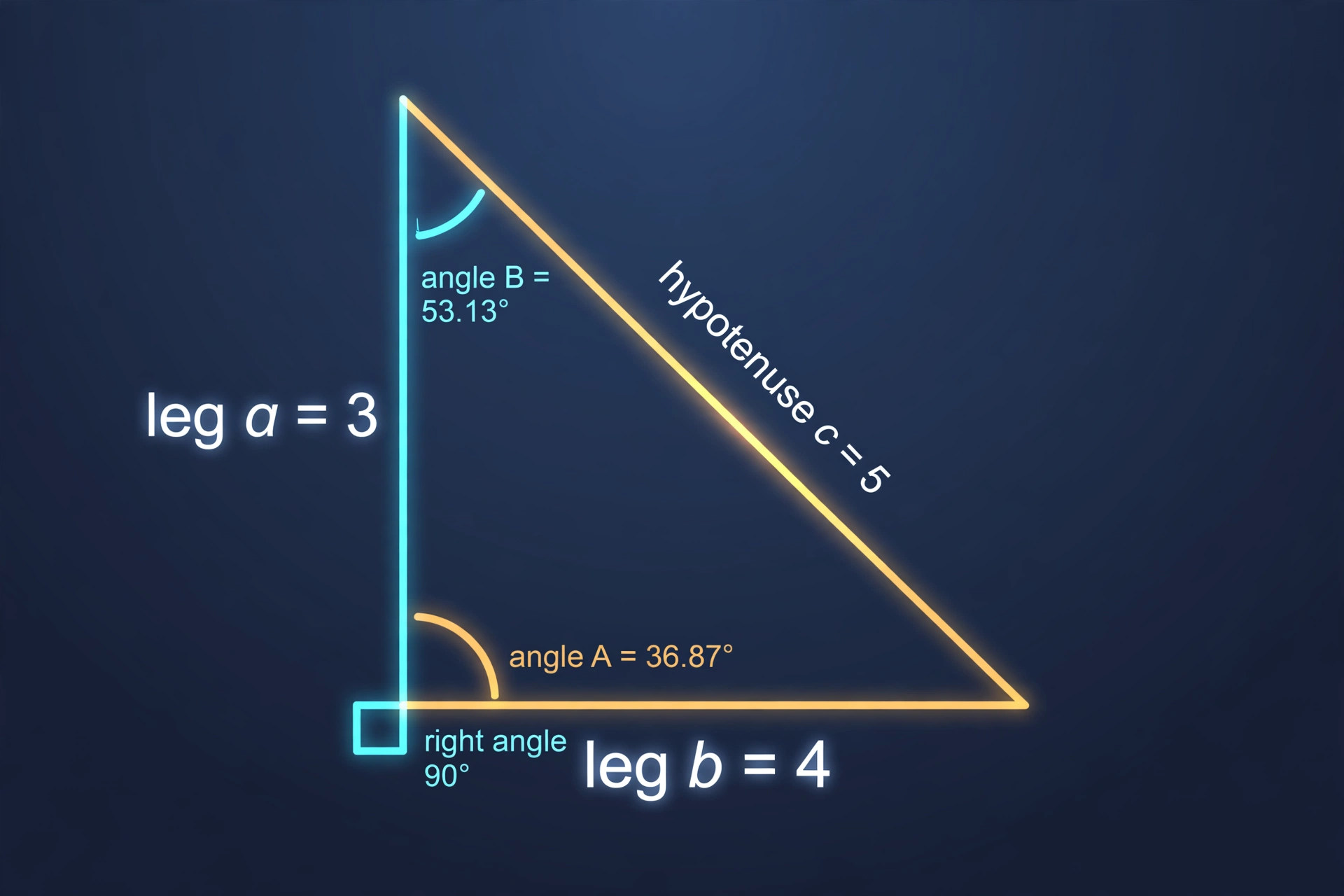
What does a worked example look like?
Start with the triangle every textbook opens with: legs of 3 and 4. Enter leg a = 3 and leg b = 4 and leave the hypotenuse blank. The hypotenuse is the square root of 3² + 4², which is the square root of 9 + 16, which is the square root of 25, which is 5. Angle A, opposite leg a, is arctan(3 / 4), which is 36.87°. Angle B is 90° − 36.87°, which is 53.13°. The area is half of 3 × 4, which is 6 square units. The perimeter is 3 + 4 + 5, which is 12 units. The note under the results shows the check: 36.87° + 53.13° = 90°, and 3² + 4² = 25, which equals 5².
A second example uses the 5-12-13 triple. Enter leg a = 5 and leg b = 12. The hypotenuse is the square root of 25 + 144, which is the square root of 169, which is 13. Angle A is arctan(5 / 12), which is 22.62°. Angle B is 90° − 22.62°, which is 67.38°. The area is half of 5 × 12, which is 30 square units. The perimeter is 5 + 12 + 13, which is 30 units. The 12 in this triple is the leg b that makes the triangle work: 5² + 12² = 25 + 144 = 169 = 13².
A third example starts from one side and one angle instead of two sides. Switch to “One side and one angle” mode, enter the hypotenuse c = 10, and angle A = 30°. Leg a is 10 × sin(30°), which is 10 × 0.5, which is 5. Leg b is 10 × cos(30°), which is 8.66. Angle B is 90° − 30°, which is 60°. The area is half of 5 × 8.66, which is 21.65 square units. The perimeter is 5 + 8.66 + 10, which is 23.66 units. The same triangle can be reached from the other direction: enter legs 5 and 8.66 in two-sides mode and the tool returns the hypotenuse 10 and the angles 30° and 60° again.
A fourth example shows the triangle with two equal acute angles. Enter leg a = 10 and leg b = 10. The hypotenuse is the square root of 100 + 100, which is the square root of 200, which is 14.14. Both acute angles are arctan(10 / 10), which is arctan(1), which is 45°. The area is half of 10 × 10, which is 50 square units. The perimeter is 10 + 10 + 14.14, which is 34.14 units. This is the 45-45-90 triangle: two equal legs, two equal angles of 45°, and a hypotenuse that is always the leg length times the square root of 2.
What is the Pythagorean theorem?
The Pythagorean theorem states that in a right triangle, the square of the hypotenuse equals the sum of the squares of the other two sides. Written as a formula, with a and b as the legs and c as the hypotenuse, it is a² + b² = c². It is named after Pythagoras, a Greek mathematician, and it holds for every right triangle on a flat surface, whatever its size.
The theorem runs in three directions. If you know both legs, the hypotenuse is the square root of a² + b²: with legs 3 and 4, the hypotenuse is the square root of 25, which is 5. If you know the hypotenuse and one leg, the missing leg is the square root of c² minus the known leg squared: with a hypotenuse of 5 and a leg of 3, the other leg is the square root of 25 − 9, which is the square root of 16, which is 4. If you know all three sides, the theorem tests whether the triangle is right-angled at all: 3² + 4² = 25 = 5², so the triangle with sides 3, 4 and 5 has a right angle opposite the side of 5.
The labelling matters, and it is the same on every page that uses the theorem. The right angle sits between the two legs, and the hypotenuse sits opposite it. Angle A is the angle opposite leg a, and angle B is the angle opposite leg b. Swapping the labels of the two legs swaps the two angles with them: in the 3-4-5 triangle, angle A is 36.87° because it sits opposite the leg of 3, and angle B is 53.13° because it sits opposite the leg of 4. If you called the leg of 4 “leg a” instead, the angles would swap, and the triangle would be the same triangle described from the other side.
The theorem only applies to right triangles. Feed it a triangle without a right angle and it gives a wrong answer without complaint. For triangles with no right angle, the correct relationship is the law of cosines, which adds a correction term that disappears when the angle is 90°. The geometry calculator on this site works out the area and perimeter of a triangle from its base and height, which is a different job from finding its angles — it never uses the theorem, and it never returns an angle.
How do I calculate the angles of a right triangle?
A right triangle has three angles that add up to 180°. One of them is the right angle at 90°, so the other two — the acute angles — always add up to 90°. That single fact does half the work: once you know one acute angle, the other is 90° minus the first. If angle A is 36.87°, angle B is 90° − 36.87° = 53.13°.
To find the first acute angle from the sides, use an inverse trigonometric function. Angle A, opposite leg a, equals arctan(a / b): the angle whose tangent is the ratio of the opposite leg to the adjacent leg. It also equals arcsin(a / c) and arccos(b / c), and all three give the same answer. For the 3-4-5 triangle, arctan(3 / 4) = 36.87°, arcsin(3 / 5) = 36.87°, and arccos(4 / 5) = 36.87°. The tool uses arctan, and the note under the results shows the square check so you can confirm the sides first.
The same idea works backwards. If you know angle A and one side, the other sides follow from sine, cosine and tangent. With angle A = 30° and a hypotenuse of 10, leg a is 10 × sin(30°) = 5 and leg b is 10 × cos(30°) = 8.66, as the third worked example shows. With angle A = 36.87° and leg a = 3, the hypotenuse is 3 / sin(36.87°) = 5 and leg b is 3 / tan(36.87°) = 4, which returns the 3-4-5 triangle from a single side and a single angle.
A useful check on any angle answer is the sum. The two acute angles must add to exactly 90°, and all three angles must add to 180°. If your two acute angles add to 91° or 89°, something went wrong — usually a leg and the hypotenuse were mixed up, or the angle was entered in radians instead of degrees. The tool shows the sum in its note, so the check is in front of you on every calculation.
What are the common right triangle triples?
A Pythagorean triple is a set of three whole numbers that satisfies a² + b² = c² exactly. The smallest and best known is 3-4-5, and builders have used it for centuries to check that a corner is square. The table below gives the four most useful triples, with their angles, area and perimeter, all worked out with the same arithmetic the tool uses.
| Leg a | Leg b | Hypotenuse c | Angle A | Angle B | Area | Perimeter |
|---|---|---|---|---|---|---|
| 3 | 4 | 5 | 36.87° | 53.13° | 6 | 12 |
| 5 | 12 | 13 | 22.62° | 67.38° | 30 | 30 |
| 8 | 15 | 17 | 28.07° | 61.93° | 60 | 40 |
| 7 | 24 | 25 | 16.26° | 73.74° | 84 | 56 |
Two patterns in the table are worth reading. First, the angles are fixed for each triple: every 3-4-5 triangle has angles of 36.87° and 53.13°, whatever its size, because scaling all three sides by the same factor leaves the ratios — and therefore the angles — unchanged. A 6-8-10 triangle has the same angles as a 3-4-5 triangle. Second, the 5-12-13 row is the only one where the area and the perimeter are the same number, 30, which is a coincidence of the numbers rather than a rule. The 8-15-17 triple gives the largest area of the four for its perimeter, because its legs are closer in length, and a right triangle with legs close together encloses more area than a long thin one with the same perimeter.
Multiples of a triple are triples too. Double 3-4-5 and you get 6-8-10: 6² + 8² = 36 + 64 = 100 = 10², with the same angles of 36.87° and 53.13°. Double 5-12-13 and you get 10-24-26, with the same angles of 22.62° and 67.38°. This is why the 3-4-5 rule works at any scale on a building site: measure 3 units along one wall and 4 along the other, and the diagonal between the marks must be 5 units if the corner is square — whether the unit is a foot, a metre, or a pace.
Not every right triangle is a triple. Legs of 6 and 9 give a hypotenuse of the square root of 36 + 81, which is the square root of 117, which is 10.82, with angles of 33.69° and 56.31°, an area of 27 square units and a perimeter of 25.82 units. The tool handles those triangles exactly the same way; the answers simply do not come out as whole numbers.
How do I use one side and one angle to solve a triangle?
Sometimes you know an angle and only one side — a roof pitch measured with an angle finder, or a ramp whose slope you measured. That is enough to solve the whole triangle, because one acute angle plus one side fixes the shape completely, and the theorem fixes the rest.
The method depends on which side you know. If you know the hypotenuse, multiply it by the sine of angle A to get leg a, and by the cosine of angle A to get leg b. With a hypotenuse of 10 and angle A of 30°, leg a is 5 and leg b is 8.66. If you know leg a, divide it by the sine of angle A to get the hypotenuse, and by the tangent of angle A to get leg b. With leg a = 3 and angle A = 36.87°, the hypotenuse is 5 and leg b is 4. If you know leg b, multiply it by the tangent of angle A to get leg a, and divide it by the cosine of angle A to get the hypotenuse. With leg b = 4 and angle A = 53.13°, leg a is 5.33 and the hypotenuse is 6.67, with angle B at 36.87°.
The angle you enter must be the angle opposite the leg you call “a”. If your drawing labels the known angle at the other corner, swap the labels of the two legs before you enter the numbers, or enter the other angle: the angle at the far corner of a 3-4-5 triangle is 53.13° when measured from one end and 36.87° when measured from the other. The tool assumes angle A sits opposite leg a, and the note under the results shows both angles so you can confirm you labelled the triangle the way you meant to.
Where does this help in real life?
The oldest practical use is squaring a corner. A builder setting out a foundation, a fence, or a concrete slab marks 3 units along one edge and 4 units along the edge that should be square to it, then measures the diagonal between the two marks. If the diagonal is 5 units, the corner is square. If it is longer or shorter, the corner is off, and the size of the error tells the builder which way to adjust. That is the concrete calculator triangle: the 3-4-5 rule applied with a tape measure, and it works because the theorem is exact, not approximate. Larger multiples work the same way — 6-8-10 for a bigger slab, 9-12-15 for a long wall — and the angles stay at 36.87° and 53.13° at every scale.
Roof pitch is a second everyday use. A roof with a rise of 5 and a run of 12 has a rafter length of 13, from the 5-12-13 triple, and the angle the rafter makes with the horizontal is arctan(5 / 12), which is 22.62°. A steeper roof with a rise of 8 and a run of 15 has a rafter of 17 and an angle of 28.07°. Knowing the angle matters when cutting rafters and when checking that a roof matches its plans, and the same arithmetic gives the rafter length from the rise and the run alone.
Ramps and ladders are a third. A ramp that rises 3 units over a run of 4 has a slope length of 5 and an angle of 36.87° to the ground. A ladder leaning against a wall forms a right triangle with the wall and the ground: if the foot of the ladder sits 4 units from the wall and the top rests 3 units up, the ladder is 5 units long and leans at 53.13° to the ground. Safety guidance for ladders is usually given as an angle — roughly 75° to the ground — and the tool turns that angle and one measured side into the full triangle, so you can check whether the foot is placed too far out.
Navigation and surveying use the same geometry at a larger scale. A course sailed 5 units east and 12 units north leaves you 13 units from where you started, on a bearing whose angle from north is arctan(5 / 12), which is 22.62°. The theorem is also how a distance between two points on a map is worked out from the east-west and north-south differences: the differences are the legs, and the straight-line distance is the hypotenuse.
What mistakes do people commonly make with the Pythagorean theorem?
The first mistake is using the theorem on a triangle that has no right angle. The theorem only holds when one angle is exactly 90°. A triangle with sides 2, 3 and 4 is not right-angled — 2² + 3² = 13, which is not 4² = 16 — and no rearrangement of the formula will give a correct answer for it. Check for the right angle first, or use the law of cosines.
The second mistake is treating a leg as the hypotenuse. The hypotenuse is always the longest side, opposite the right angle. If you enter 5 as a leg and 4 as the hypotenuse, the tool refuses, because a hypotenuse shorter than a leg cannot form a right triangle. The same error in hand arithmetic is quieter: taking the square root of a negative number, or getting a hypotenuse shorter than a leg, and carrying on regardless.
The third mistake is mixing up which angle is which. Angle A sits opposite leg a, and angle B sits opposite leg b. In the 3-4-5 triangle, the angle opposite the side of 3 is 36.87° and the angle opposite the side of 4 is 53.13°. Reading the angle off the wrong side gives the complement — the other acute angle — and the error is easy to miss because both answers look plausible and both add to 90° with the other angle.
The fourth mistake is entering an angle in radians when the tool expects degrees, or the reverse. An angle of 0.64 radians is 36.87°, and entering 0.64 as degrees gives a triangle that is nearly flat. If a result looks wildly wrong, check the unit first. The angle converter turns radians into degrees before you enter them.
The fifth mistake is mixing units between sides. Entering one leg in metres and the other in centimetres gives a hypotenuse in neither unit, and the angles come out wrong too, because the ratio between the legs is wrong by a factor of a hundred. Convert every side to the same unit before entering anything.
The sixth mistake is forgetting that the two acute angles must add to 90°. It is the fastest check there is: if your two acute angles add to anything else, at least one of them is wrong. The tool shows the sum in its note on every calculation.
What are the limits of this calculator?
This calculator solves right triangles only. It assumes one angle is exactly 90° and that the triangle lies on a flat surface. On a curved surface, such as the surface of the Earth over a long distance, the angles of a triangle add to more than 180° and the theorem does not hold; surveyors working over kilometres use spherical geometry instead.
Results are rounded to two decimal places, which is precise enough for building, schoolwork and everyday measuring. The rounding can make the square check look slightly off in the last digit — for example, a hypotenuse of 10.82 squared is 117.07 rather than exactly 117 — because 10.82 is the rounded form of the square root of 117. That is a display effect, not an error in the arithmetic.
The tool does not measure anything for you. It works from the numbers you enter, so a wrong measurement gives a wrong answer that still looks tidy. Measure twice, and check the result against the angle sum and the square check the tool shows. It also does not give building, engineering or safety advice: a roof, a ramp or a structure designed from these numbers still needs to meet the rules and standards that apply where it is built. The figures on this page are general information about a mathematical relationship, and the tool runs entirely in your browser — nothing you enter is uploaded or stored.
The square root curve calculator on this site works with square roots in a different setting, and the percentage calculator turns a result into a share of a total — for example, 36.87° as a share of 90° is 40.97%.
How can I check the tool against a known result?
The simplest check uses the 3-4-5 triangle. Choose “Two sides”, enter leg a = 3 and leg b = 4, and leave the hypotenuse blank. The tool should show leg a 3, leg b 4, hypotenuse c 5, angle A 36.87°, angle B 53.13°, area 6 square units and perimeter 12 units. The note should say the angles add to 90° and that 3² + 4² = 25, which equals 5².
A second check uses one leg and the hypotenuse. Enter leg a = 3 and hypotenuse c = 5, and leave leg b blank. The tool should return the same triangle: leg b 4, angles 36.87° and 53.13°, area 6 and perimeter 12.
A third check uses one side and one angle. Switch to “One side and one angle”, enter the hypotenuse c = 10, choose “Hypotenuse c”, and enter angle A = 30°. The tool should show leg a 5, leg b 8.66, angle A 30°, angle B 60°, area 21.65 square units and perimeter 23.66 units.
A fourth check tests the errors. Enter leg a = 5 and hypotenuse c = 4: the tool should show the error “The hypotenuse must be longer than leg a. A hypotenuse shorter than a leg cannot form a right triangle.” with no results. Enter angle A = 90 in angle mode: the tool should show the error “Angle A must be less than 90 degrees. The two acute angles of a right triangle add up to 90.” with no results. Leave all three side boxes blank in two-sides mode: the tool should show the error “Enter any two of the three sides and leave the unknown side blank.” with no results.
More tools in the same collection are in the calculators category.
Frequently asked questions
How do I calculate the angles of a right triangle?
Use an inverse trigonometric function on the sides you know. Angle A, opposite leg a, equals arctan(a / b), which also equals arcsin(a / c) and arccos(b / c). The other acute angle is 90° minus the first, because the two acute angles of a right triangle always add to 90°. For legs of 3 and 4, angle A is arctan(3 / 4) = 36.87° and angle B is 53.13°.
How do I find the angle of a right triangle if I know one side and one angle?
If you know one acute angle, the other is 90° minus that angle, so no trigonometry is needed for the angles at all. The sides follow from sine, cosine and tangent: with a hypotenuse of 10 and angle A of 30°, leg a is 10 × sin(30°) = 5 and leg b is 10 × cos(30°) = 8.66.
What is the Pythagorean theorem formula?
The formula is a² + b² = c², where a and b are the two legs that meet at the right angle and c is the hypotenuse, the longest side opposite the right angle. It gives the hypotenuse as the square root of a² + b², and a missing leg as the square root of c² minus the known leg squared.
What are the angles of a 3-4-5 triangle?
The angles are 36.87° and 53.13°, plus the right angle of 90°. Angle A, opposite the leg of 3, is arctan(3 / 4) = 36.87°, and angle B, opposite the leg of 4, is 53.13°. Every triangle with sides in the ratio 3:4:5 has these same angles, whatever its size.
What are the angles of a 45-45-90 triangle?
Both acute angles are 45°. A 45-45-90 triangle has two equal legs, so the two acute angles are equal, and they must add to 90°. The hypotenuse is always the leg length times the square root of 2: legs of 10 and 10 give a hypotenuse of 14.14, an area of 50 square units and a perimeter of 34.14 units.
Can I use the Pythagorean theorem on any triangle?
No. The theorem only applies to right triangles, where one angle is exactly 90°. A triangle without a right angle needs the law of cosines instead, which adds a correction term that disappears when the angle is 90°. Using a² + b² = c² on any other triangle gives a wrong answer.