VA Loan Down Payment Calculator
VA Loan Down Payment Calculator
Work out your VA loan down payment, funding fee and monthly payment — with no down payment required and no monthly mortgage insurance.
A VA loan down payment calculator works out what a VA-backed home loan costs with the down payment you choose. Enter the home price, down payment, whether this is your first or a later VA loan, the term and the rate, and it shows the loan amount, the VA funding fee, the total amount financed and the monthly principal-and-interest payment.
What is a VA loan down payment calculator?
A VA loan down payment calculator is a tool for working out the numbers on a home loan backed by the U.S. Department of Veterans Affairs. It takes the home price and the down payment you plan to make, applies the VA funding-fee rate that fits your down payment and your history with the benefit, and gives you the loan amount, the one-time funding fee, the total amount financed and the monthly principal-and-interest payment.
It is different from a plain loan calculator in one important way: the funding fee. A VA loan has no required down payment and no monthly mortgage insurance, so the usual down-payment maths — 20% to avoid PMI, a smaller loan for a smaller payment — does not apply in the same way. What changes with the down payment on a VA loan is the funding fee. Put nothing down and the fee is 2.15% of the loan on first use, or 3.3% on a later use. Put 5% down and it falls to 1.5% for both. Put 10% down and it falls to 1.25% for both. That fee is the heart of the calculation, and it is what this tool is built around.
The calculator covers purchase loans. It does not cover cash-out refinances or streamline refinances, which have their own fee rates, and it does not add property tax, homeowners insurance or HOA dues to the monthly payment — the payment shown is principal and interest only. Those costs still apply to the home, and your lender's Loan Estimate will show them, but they are set by your county, your insurer and your neighbourhood, not by the VA.
Do VA loans require a down payment?
No, not in the usual case. A VA loan is one of the only mortgages in the United States that allows a borrower to buy a home with no down payment at all. With full entitlement — meaning you have not used the benefit before, or you have used it and the loan has been paid off in full and the entitlement restored — there is no required down payment and, since January 2020, no VA loan limit. The VA's own words are that you do not have a loan limit, as long as you can afford the loan amount and the property appraisal supports the purchase price of the home.
The VA notes that nearly 90% of VA-backed loans are made with no down payment, which tells you how the benefit is normally used. That does not mean a down payment is never a good idea — the funding fee falls when you put money down, and the monthly payment falls with it — but it does mean the down payment is a choice, not a requirement, for most eligible buyers.
Before you settle on a price, the Home Loan Affordability Calculator works out how much home your income can carry, so you can see whether the price you have in mind fits your budget before you start weighing the down payment.
What is the VA funding fee?
The VA funding fee is a one-time payment that a veteran, service member or survivor pays on a VA-backed or VA direct home loan. It goes to the VA, not to the lender, and it helps keep the program running without cost to taxpayers — the reason the program can offer no down payment and no monthly mortgage insurance. You pay it when the loan closes, either in cash at closing or by including it in the loan and paying it off over time. On a purchase loan, only the funding fee can be financed into the loan amount; every other closing cost must be paid at closing.
The fee is a percentage of the loan amount, not of the purchase price. That matters: a $10,000 down payment on a $200,000 home reduces the loan to $190,000, and the fee is charged on that $190,000. The VA's own example works exactly this way — a first-time buyer with a $200,000 home and a $10,000 (5%) down payment pays a fee of $2,850, which is 1.5% of the $190,000 loan amount.
The rate comes from a chart published by the VA, effective April 7, 2023, and still current when checked on November 19, 2026. For purchase and construction loans, the rate depends on two things: how much you put down, and whether this is your first or a later use of the benefit. The table below is that chart.
How much is the VA funding fee?
The table below gives the funding fee in dollars for three home prices at each down-payment tier, for first use and for subsequent use. Every figure was computed from the VA chart with the same formula this calculator uses.
| Home price | Down payment | Loan amount | First-use fee | Subsequent-use fee |
| $300,000 | 0% ($0) | $300,000.00 | $6,450.00 (2.15%) | $9,900.00 (3.30%) |
| $300,000 | 5% ($15,000) | $285,000.00 | $4,275.00 (1.50%) | $4,275.00 (1.50%) |
| $300,000 | 10% ($30,000) | $270,000.00 | $3,375.00 (1.25%) | $3,375.00 (1.25%) |
| $400,000 | 0% ($0) | $400,000.00 | $8,600.00 (2.15%) | $13,200.00 (3.30%) |
| $400,000 | 5% ($20,000) | $380,000.00 | $5,700.00 (1.50%) | $5,700.00 (1.50%) |
| $400,000 | 10% ($40,000) | $360,000.00 | $4,500.00 (1.25%) | $4,500.00 (1.25%) |
| $500,000 | 0% ($0) | $500,000.00 | $10,750.00 (2.15%) | $16,500.00 (3.30%) |
| $500,000 | 5% ($25,000) | $475,000.00 | $7,125.00 (1.50%) | $7,125.00 (1.50%) |
| $500,000 | 10% ($50,000) | $450,000.00 | $5,625.00 (1.25%) | $5,625.00 (1.25%) |
Two patterns stand out. First, the fee falls steeply with the down payment: on a $400,000 home, the first-use fee drops from $8,600.00 at 0% down to $5,700.00 at 5% down and $4,500.00 at 10% down. Second, the gap between first use and subsequent use exists only below 5% down. At 5% and at 10%, a repeat borrower pays exactly the same fee as a first-time borrower. The 3.3% rate is a low-down-payment penalty for repeat users, not a permanent surcharge.
One more point from the table: the fee is charged on the loan amount after the down payment, so a bigger down payment shrinks the fee twice — once through the lower rate, and once through the smaller loan the rate applies to.
How does the down payment change the funding fee?
The down payment changes the fee in two steps, at 5% and at 10% of the home price. Below 5%, the fee is 2.15% on first use and 3.3% on subsequent use. From 5% up to just under 10%, it is 1.5% for both. At 10% or more, it is 1.25% for both. The tier changes exactly at those marks — a down payment of 4.99% on a $400,000 home still pays 2.15% (or 3.3%), while 5.00% pays 1.5%.
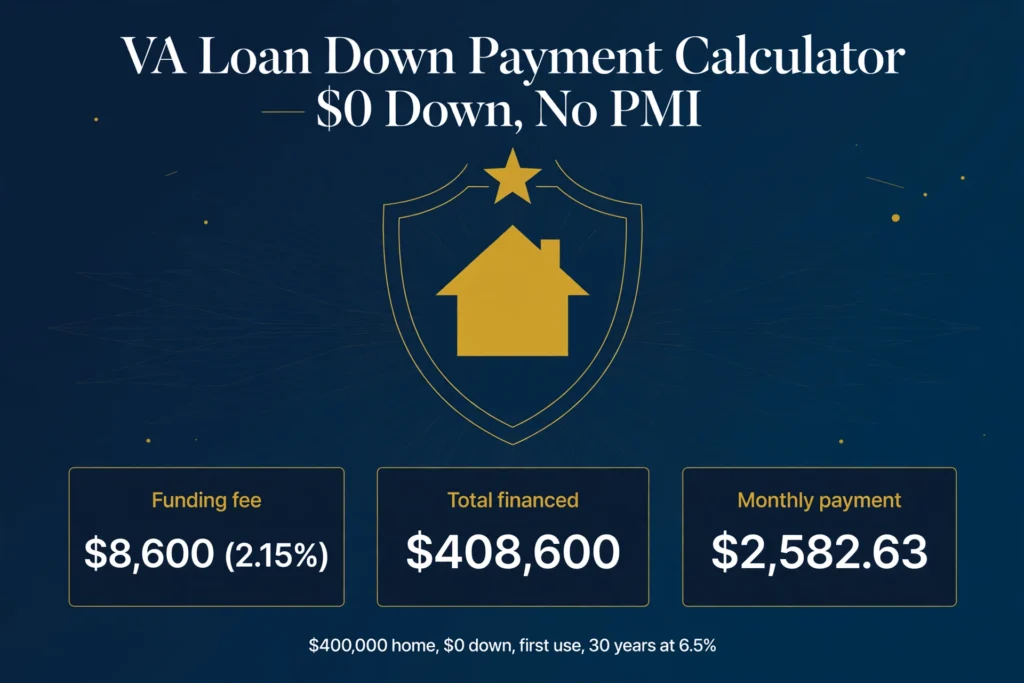
Take a $400,000 home at 6.5% over 30 years. With no money down on first use, the fee is $8,600.00, the amount financed is $408,600.00 and the monthly principal-and-interest payment is $2,582.63. Put 5% down ($20,000) and the fee falls to $5,700.00, the amount financed falls to $385,700.00 and the monthly payment falls to $2,437.89. That is $2,900.00 less in fee, $144.74 less every month, and $29,207.69 less interest over the life of the loan — $521,146.78 against $491,939.09.
The same 5% down payment does even more for a repeat borrower. With no money down on subsequent use, the fee on that $400,000 home is $13,200.00 and the monthly payment is $2,611.71. With 5% down, the fee is $5,700.00 and the payment is $2,437.89 — the same figures as a first-time borrower, because the 1.5% tier applies to both. The saving is $7,500.00 in fee and $173.82 a month.
At 10% down the gains get smaller. On a $500,000 home, 10% down ($50,000) gives a fee of $5,625.00 at 1.25%, against $7,125.00 at 5% down — a saving of $1,500.00 in fee. The monthly payment at 6.5% over 30 years is $2,879.86. The 5%-to-10% step is worth taking when the cash is available, but the 0%-to-5% step is the one that changes the numbers most.
Does a VA loan have PMI?
No. A VA loan never has private mortgage insurance, and never has a monthly mortgage insurance premium, at any down payment — even at 0% down. The VA home loan program does not require monthly mortgage insurance, and the one-time funding fee is the charge that takes its place. That is the trade at the centre of the program: no monthly insurance bill, ever, in exchange for a single fee at closing.
The difference adds up. An FHA loan with a small down payment carries monthly mortgage insurance, and the PMI Calculator FHA shows what that adds to a monthly payment — which can add tens of thousands of dollars over the life of a 30-year loan. A conventional loan with less than 20% down carries PMI until the borrower reaches 20% equity, usually several years of monthly payments. On a VA loan, the insurance line is simply zero from the first payment to the last, and the monthly figure this calculator shows is the whole principal-and-interest payment.
That does not mean the funding fee is free money. Financing the fee means paying interest on it for 30 years, so the $8,600.00 fee on a $400,000 home at 6.5% costs more than $8,600.00 by the time the loan is paid off. But the fee is paid once, while PMI is paid every month, and for most buyers the VA structure still comes out ahead — which is why the comparison matters more than either number on its own.
What does first use and subsequent use mean?
First use means this is the first time you have used your VA home loan benefit. Subsequent use — sometimes called "after first use" — means you have used it before, even if that earlier loan is paid off. The distinction matters only at low down payments: below 5% down, the funding fee is 2.15% on first use and 3.3% on subsequent use. At 5% down or more, the two are identical.
There is one exception worth knowing. If the only VA loan you used in the past was to buy a manufactured home, the VA still charges you the first-time funding fee. The VA spells this out on its funding-fee page, and it is the one case where a repeat user is treated as a first-time user.
Subsequent use is not the same as partial entitlement, though the two often come up together. You can be a subsequent user with full entitlement restored — for example, you sold the first home and paid the loan off — in which case no down payment is required and only the higher fee rate applies. Or you can be a subsequent user with entitlement still tied up in a home you own, which is when a down payment can become required. The two questions — what fee rate applies, and is a down payment required — are separate, and the calculator answers the first one.
Who does not pay the VA funding fee?
Some borrowers pay no funding fee at all. You are exempt if you receive VA compensation for a service-connected disability, or if you are eligible for that compensation but receive retirement or active-duty pay instead. Surviving spouses who receive Dependency and Indemnity Compensation are exempt. Service members with a proposed or memorandum rating before the loan closing date, for a pre-discharge claim, are exempt. Active-duty members who provide evidence of a Purple Heart on or before the closing date are exempt.
The exemption is worth a real amount of money. On a $400,000 home with no money down at 6.5% over 30 years, an exempt borrower finances $400,000.00 instead of $408,600.00, and the monthly payment is $2,528.27 instead of $2,582.63 — $54.36 less a month, and $10,968.83 less interest over the term. Tick the exemption box in the calculator to see your own figures with the fee at $0.
If a disability rating comes through after closing, with an effective date before the closing date, a refund of the fee may be possible — the VA says to contact your VA regional loan centre in that case. A rating that arrives after closing with no retroactive effective date does not create a refund.
How is the monthly VA loan payment worked out?
The monthly principal-and-interest payment uses the standard amortisation formula: M = P · r(1 + r)ⁿ / ((1 + r)ⁿ − 1), where P is the total amount financed, r is the monthly interest rate (the annual rate divided by 12) and n is the number of monthly payments (the term in years times 12). If the rate is 0%, the payment is simply the amount financed divided by the number of months.
The amount financed is where the VA maths enters the formula. It is the loan amount — home price minus down payment — plus the funding fee. On a $400,000 home with no money down on first use, the loan is $400,000.00, the fee is $8,600.00, and the amount financed is $408,600.00. At 6.5% over 30 years, that gives a monthly payment of $2,582.63 and total interest of $521,146.78. The fee adds $54.36 a month to the payment compared with an exempt borrower financing $400,000.00, whose payment is $2,528.27.
The term changes the payment more than the rate does. The same $408,600.00 at 6.5% costs $2,582.63 a month over 30 years and $3,559.34 a month over 15 years — $976.71 more each month — but the total interest falls from $521,146.78 to $232,082.05, a saving of $289,064.73. Half a point of rate matters too: at 6.0% over 15 years the payment is $3,448.00, which is $111.34 less a month than at 6.5%.
For a plain loan with no VA features, the Loan Calculator works out the monthly payment on any amount, rate and term, using the same formula.
When would a VA loan still need a down payment?
There are three situations where a VA loan can still require a down payment, even though the program is famous for not needing one.
The first is partial entitlement. The VA guarantees 25% of the loan. With full entitlement, that guarantee has no cap, so no down payment is needed. With part of your entitlement still tied up in a home you own, the guarantee is capped, and the gap is closed with cash: the down payment is 25% of the amount by which the price exceeds the zero-down maximum, which is your remaining entitlement times four. The VA's own example makes this concrete — a veteran with $50,000 of entitlement already used, buying in a county with a $900,000 one-unit limit, has $175,000 of entitlement available, which supports a $700,000 loan with no money down. At $800,000 the down payment is $25,000, because $800,000 times 25% is $200,000 and $175,000 of that is already covered by entitlement.
The second is a price above the appraised value. The VA lends against the lower of the sales price and the appraised value. If the appraisal comes in below the price you agreed, the difference has to be covered — usually in cash, or by renegotiating the price.
The third is a price above the county conforming loan limit when entitlement is partial. The 2026 limits adopted by the VA are $832,750 for a one-unit property in most counties and $1,249,125 in high-cost counties. With full entitlement, the limit does not force a down payment; with partial entitlement, the amount above the zero-down maximum does.
In each case, the exact down payment comes from your Certificate of Eligibility and your lender, not from a calculator. This tool shows what a down payment of your choosing does to the fee and the payment; it does not work out entitlement, which needs your own VA records.
Is putting money down on a VA loan worth it?
It depends on what the money would otherwise do, and on whether you are exempt from the fee. Three cases cover most buyers.
If you are a subsequent user putting nothing down, 5% down is the strongest move in the program. On a $400,000 home it cuts the fee from $13,200.00 to $5,700.00 — a $7,500.00 saving — and the monthly payment by $173.82. Few uses of $20,000 in cash return that much that quickly.
If you are a first-time buyer, 5% down still pays: $2,900.00 less fee and $144.74 less a month on a $400,000 home. The 10% step is smaller — $1,200.00 less fee than 5% down on the same home — so it is worth doing when the cash is spare, but not worth draining savings for.
If you are exempt from the fee, the case for putting money down is weaker, because there is no fee tier to cut. A down payment still lowers the loan and the monthly payment — on a $400,000 home, 20% down gives a loan of $320,000.00 and a monthly payment of $2,047.90 at 6.5% over 30 years — but the saving comes only from borrowing less, not from a lower fee rate. Keeping the cash for moving costs, repairs or an emergency fund is often the better use.
One use of a down payment that is rarely worth it is chasing 20% down to avoid a fee. A conventional buyer puts 20% down to avoid PMI; on a VA loan there is no PMI to avoid, and the fee at 10% down is already at its lowest tier of 1.25%. Going from 10% to 20% down on a $400,000 home saves only $500.00 in fee — the fee falls from $4,500.00 to $4,000.00 — while tying up another $40,000 in cash. If you already own the home and want to turn equity into cash, the Refi Calculator With Cash Out works out the cash-out refinance numbers.
How do you use this VA loan down payment calculator?
Enter the home price, then the down payment — either as a dollar amount or as a percentage of the price, and the two stay in step: change one and the other follows. Choose first use or subsequent use, pick the loan term and enter the interest rate from your Loan Estimate. If you are exempt from the funding fee, tick the exemption box and the fee drops to $0. Press the button, or just keep typing — the results update as you change any field.
The results show the down payment in dollars and as a share of the price, the loan amount, the funding fee rate and the fee in dollars, the total amount financed, the monthly principal-and-interest payment and the total interest over the term. A note under the results explains what the fee tier means for your numbers — for example, that putting 5% down would cut a 3.30% subsequent-use fee to 1.50%.
The defaults — a $400,000 home, no down payment, first use, 30 years at 6.5% — give a loan of $400,000.00, a fee of $8,600.00 at 2.15%, an amount financed of $408,600.00 and a monthly payment of $2,582.63, so you can see a worked result before typing anything. You can find more mortgage and home-buying tools in the calculators collection.
Worked example
Take a $400,000 home with no down payment, a first VA loan, 30 years at 6.5%. The loan amount is $400,000.00. The down payment is 0%, which is under 5%, so the first-use funding fee rate is 2.15%. The fee is $400,000.00 × 2.15% = $8,600.00. The total amount financed is $400,000.00 + $8,600.00 = $408,600.00. The monthly principal-and-interest payment is $2,582.63, and the total interest over 30 years is $521,146.78.
Now the same home with 5% down — $20,000. The loan amount is $380,000.00. At 5% down the fee rate is 1.50%, so the fee is $380,000.00 × 1.50% = $5,700.00. The amount financed is $385,700.00, the monthly payment is $2,437.89 and the total interest is $491,939.09. The $20,000 down payment saves $2,900.00 in fee, $144.74 a month, and $29,207.69 in interest.
A third case shows the subsequent-use difference. The same $400,000 home with no money down, but a second VA loan, pays a fee of 3.30% — $13,200.00 — and finances $413,200.00, giving a monthly payment of $2,611.71. That is $4,600.00 more in fee and $29.08 more a month than the first-use case. With 5% down, the subsequent-use figures are identical to the first-use figures: a fee of $5,700.00 and a payment of $2,437.89.
Finally, the exempt case. The same $400,000 home with no money down and an exemption pays no fee at all, finances $400,000.00, and the monthly payment is $2,528.27 — $54.36 less a month than the fee-paying first-use case.
What mistakes do people make with VA loan down payments?
The first mistake is thinking the fee is charged on the home price. It is charged on the loan amount — the price minus the down payment. A buyer who works out 2.15% of $400,000 gets $8,600.00 by luck when the down payment is zero, but the same maths on a $400,000 home with $20,000 down gives $8,600.00 when the real fee is $5,700.00 — wrong by $2,900.00, because the rate is 1.5% and it applies to $380,000.00, not $400,000.00.
The second mistake is treating the funding fee like PMI and trying to avoid it with 20% down. There is no PMI on a VA loan, and the fee never falls below 1.25% for a paying borrower — a 20% down payment on a $400,000 home still carries a $4,000.00 fee. The only way to pay no fee is an exemption.
The third mistake is forgetting that the fee is usually financed, which means paying interest on it. The $8,600.00 fee on a $400,000 home at 6.5% over 30 years adds $54.36 a month and $10,968.83 in interest. Paying the fee in cash at closing avoids that interest — worth considering when the cash is available.
The fourth mistake is ignoring the subsequent-use rate. A buyer who used a VA loan years ago and now buys with nothing down pays 3.3%, not 2.15% — $13,200.00 instead of $8,600.00 on a $400,000 home. Checking the use box before budgeting avoids a surprise at closing.
The fifth mistake is budgeting for the monthly payment shown here and forgetting the rest of the housing cost. This calculator shows principal and interest only. Property tax, homeowners insurance and HOA dues are real monthly costs that sit on top of the figure, and the seller's contribution to closing costs is capped at 4% of the home's reasonable value — so the cash needed at closing is more than the down payment alone.
This page gives general information about VA loans and how the numbers work. It is not financial advice, and it does not take your full situation into account. Funding-fee rates come from the VA chart effective April 7, 2023, checked against VA.gov on November 19, 2026; rates can change, and your Certificate of Eligibility and your lender's Loan Estimate are the final word on your figures.
Do VA loans require a down payment?
No, not usually. With full entitlement, a VA loan allows you to buy a home with no down payment at all, and since January 2020 there is no VA loan limit. A down payment can still be required when your entitlement is partial, when the price is above the appraised value, or when the price exceeds the zero-down maximum for your remaining entitlement.
How much is the VA funding fee?
For a purchase loan, the fee is 2.15% of the loan amount on first use with less than 5% down, and 3.3% on subsequent use with less than 5% down. It falls to 1.5% with 5% or more down and to 1.25% with 10% or more down, for first and subsequent use alike. On a $400,000 loan with no money down, that is $8,600.00 on first use and $13,200.00 on subsequent use. The rates come from the VA chart effective April 7, 2023.
Is there PMI on a VA loan?
No. A VA loan never has private mortgage insurance or a monthly mortgage insurance premium, at any down payment — even at 0% down. The one-time funding fee takes the place of monthly mortgage insurance. That is why the monthly payment on a VA loan is principal and interest only, with no insurance line.
Can you put money down on a VA loan?
Yes. You can put down any amount you like, and the down payment lowers both the loan amount and the funding-fee rate: 5% down cuts the fee to 1.5%, and 10% down cuts it to 1.25%. On a $400,000 home, 5% down ($20,000) saves $2,900.00 in fee and $144.74 a month on first use, compared with no money down.
Who does not pay the VA funding fee?
Veterans receiving VA compensation for a service-connected disability, those eligible for it but receiving retirement or active-duty pay instead, surviving spouses receiving Dependency and Indemnity Compensation, service members with a proposed or memorandum rating before closing on a pre-discharge claim, and active-duty members with evidence of a Purple Heart on or before closing. Everyone else pays the fee, even with a 20% down payment.
What is the VA loan limit for 2026?
The 2026 conforming loan limits adopted by the VA are $832,750 for a one-unit property in most counties and $1,249,125 in high-cost counties. With full entitlement, the limit does not force a down payment — the VA sets no loan limit in that case. With partial entitlement, the limit sets the zero-down maximum: your remaining entitlement times four.