Student Loan Calculator
Student Loan Calculator
Work out your monthly payment, the interest that builds up in school, and how fast extra payments clear the loan.
Grace period after leaving school: 6 months (federal Direct Loans). Private loan grace terms vary — check your lender’s terms.
A student loan calculator estimates your monthly payment, the interest that builds up while you are in school, and how long the loan takes to clear. Enter the loan type, the balance at disbursement, the interest rate, the months in school and the repayment term, and it shows the interest accrued in school and during the six-month grace period, the balance at repayment start, the standard monthly payment, the total interest and the total paid — plus how much sooner an extra monthly payment clears the loan.
How much is a student loan payment?
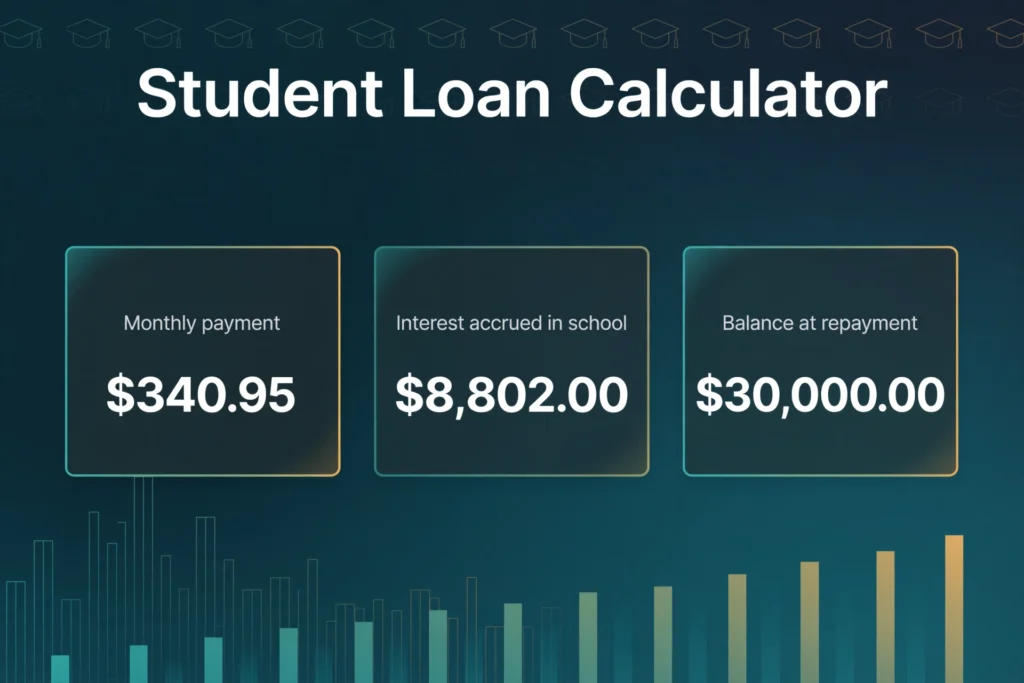
The payment depends on three numbers: the balance entering repayment, the interest rate, and the repayment term. The formula is M = P × r ÷ (1 − (1 + r)^−n), where P is the balance entering repayment, r is the annual interest rate divided by 12, and n is the number of monthly payments. A $30,000 balance at 6.52% over 10 years (120 payments) gives a monthly payment of $340.95. The same balance over 20 years gives $224.03 a month — a smaller payment, but the total interest rises from $10,913.92 to $23,766.08.
The balance entering repayment is not always the amount borrowed. On an unsubsidized loan, interest builds up during school and the grace period, and that interest still has to be paid even though it is not added to the principal. On a private loan, the interest usually is added to the principal, so the payment is worked out on a larger figure. The worked example below shows both cases with the same starting point, so the difference is easy to see.
A quick way to judge a payment is the rule of about $100 a month for every $10,000 borrowed at 5% over 10 years. The table below gives the exact figure for each $10,000 borrowed at four rates, so you can scale it to any balance: multiply by 3 for a $30,000 loan, or by 2.5 for $25,000.
| Annual rate | 10-year term: monthly payment | 10-year term: total interest | 20-year term: monthly payment | 20-year term: total interest |
| 5% | $106.07 | $2,727.86 | $66.00 | $5,838.94 |
| 6.52% | $113.65 | $3,637.97 | $74.68 | $7,922.03 |
| 8% | $121.33 | $4,559.31 | $83.64 | $10,074.56 |
| 10% | $132.15 | $5,858.09 | $96.50 | $13,160.52 |
These figures are per $10,000 borrowed, before any interest that builds up in school. At 6.52% over 10 years, a $30,000 loan costs $113.65 × 3 = $340.95 a month — the same figure the tool gives for the main worked example. Undergraduates leave college with about $29,560 in combined federal and private student loan debt, according to the College Board, which at 6% over 10 years works out at roughly $328 a month.
How does interest build up while you are in school?
It depends on the loan type. On a Direct Unsubsidized Loan, interest starts accruing on the day the money is first disbursed, even though no payment is due while you are in school. Federal Direct Loans charge interest daily, and this tool uses the monthly equivalent — the annual rate divided by 12 — which gives near-identical results for a fixed monthly payment. For a $30,000 loan at 6.52%, the interest is $163.00 a month. Over 48 months in school plus the 6-month grace period, that is 54 months, or $8,802.00.
On a Direct Subsidized Loan, nothing builds up. The government pays the interest while the borrower is enrolled at least half-time, during the six-month grace period, and during a deferment. The balance at repayment start is exactly the amount borrowed: a $20,000 subsidized loan enters repayment at $20,000.00, with no accrued interest to clear.
On a private loan, interest also accrues from disbursement, and the lender’s terms decide what happens to it. Most private lenders add unpaid interest to the principal when repayment starts. A $25,000 private loan at 9% over 36 months in school plus the 6-month grace period builds up $7,875.00 of interest — $187.50 a month for 42 months — and repayment starts at $32,875.00. From that point on, interest is charged on the $7,875.00 as well, which is why the private loan in the worked example costs more than a federal loan of the same size at a lower rate.
What is the grace period, and what happens when it ends?
The grace period is the time after you graduate, leave school, or drop below half-time enrolment before you must start making loan payments. For federal Direct Subsidized and Direct Unsubsidized Loans, it is six months. Your first payment is usually due in the seventh month after you leave school.
The grace period is not a pause on interest. On a subsidized loan the government keeps paying the interest through it, so the balance stays flat. On an unsubsidized loan the interest keeps accruing for those six months — $978.00 on a $30,000 loan at 6.52% — and it is added to the amount you must pay back. On a private loan the grace period, if there is one at all, follows the lender’s terms, and some private loans require payments while you are still in school. If you return to school at least half-time before the grace period ends, you get the full six-month grace period again when you eventually leave.
Does unpaid interest get added to your loan balance?
For federal Direct Loans held by the U.S. Department of Education, not any more. A federal rule that took effect on 1 July 2023 removed interest capitalisation — the adding of unpaid interest to the principal — in every situation not required by law, including when a borrower enters repayment. The unpaid interest stays as a separate balance that your monthly payments clear before they reduce the principal, and it is included in the total paid this tool shows. It does not earn interest of its own, because it was never added to the principal.
Three situations still add unpaid interest to the principal on federal loans: the end of a deferment on a loan without an interest subsidy, which covers a borrower who goes back to school at least half-time after entering repayment; leaving Income-Based Repayment; and consolidating federal loans. Older commercially held FFEL loans follow different rules and can still add interest when repayment starts, so check the loan type before assuming the new rule applies.
For private loans, the lender’s terms govern, and most private lenders do add unpaid interest to the principal at repayment start. That is the assumption this tool uses for private loans, and the result box labelled “Added to principal (capitalised)” shows the amount. The difference is real money: on the $25,000 private loan at 9% in the worked example, the $7,875.00 of interest becomes part of the $32,875.00 repayment balance, and interest is charged on it for the next ten years.
What is the difference between subsidized, unsubsidized and private loans?
A Direct Subsidized Loan is a federal loan for undergraduate students who show financial need. The government pays the interest while the borrower is in school at least half-time, during the grace period, and during a deferment. It is the cheapest loan to carry through school, because the balance never grows before repayment starts.
A Direct Unsubsidized Loan is a federal loan open to undergraduate, graduate and professional students, with no need to show financial need. The borrower is responsible for all the interest, from the day of the first disbursement. The rate is fixed for the life of the loan — 6.52% for undergraduate loans first disbursed between 1 July 2026 and 30 June 2027 — and the loan carries the federal protections: income-driven repayment plans, deferment and forbearance, and the six-month grace period.
A private loan comes from a bank, credit union or online lender. Rates are usually higher and can be variable, the loan is based on credit, and the federal protections do not apply: no income-driven plans, no federal forgiveness, and grace and capitalisation terms set by the lender. The trade-off is that private loans can cover costs above the federal borrowing limits. For loans first disbursed on or after 1 July 2026, federal loans are repaid on the Tiered Standard Plan, which sets the maximum term from the total Direct Loan balance, or on the Repayment Assistance Plan. This tool models a fixed term you choose, which matches the older 10-year standard plan and any fixed term a private lender offers.
How do you work out payments on more than one student loan?
Most borrowers leave school with several loans: one for each year, often a mix of subsidized and unsubsidized, sometimes plus a private loan. This tool models one loan at a time, and that is the honest way to handle it, because each loan has its own balance, rate and in-school history. Run each loan through the tool separately, then add the monthly payments together. The total is what leaves your bank account each month, and the payoff month for each loan is the month that loan clears — your total payment falls as each loan is paid off.
For a single combined estimate, use the weighted-average interest rate: multiply each loan’s balance by its rate, add those figures together, and divide by the total balance. Three loans — $10,000 at 5%, $15,000 at 7% and $5,000 at 6.5% — give ($500 + $1,050 + $325) ÷ $30,000 = 6.25% on a combined $30,000. Enter the combined balance and the weighted-average rate in the tool for a rough combined payment, then run each loan separately for the exact figures. Federal consolidation works the same way: the new rate is the weighted average rounded up to the nearest one-eighth of one percent (0.125%). Private refinancing is different — it replaces the loans with a new loan at a rate based on your credit, and refinancing federal loans with a private lender ends the federal protections for good, including income-driven repayment and forgiveness eligibility.
Does paying interest while you are in school save money?
It depends on the loan type, and the answer is not the same for federal and private loans. For a Direct Unsubsidized loan, paying the interest as it accrues costs $8,802.00 during school and grace on the $30,000 example, and the total paid during repayment is $40,913.92. Add the $8,802.00 paid in school and the all-in total is $49,715.92 — exactly the same as letting the interest build up. It does not cut the total, because under the rule in effect since 1 July 2023 the unpaid interest was never going to be added to the principal. What it does is spread the cost: $163.00 a month while studying instead of a larger amount to clear after graduation, and a lower balance of unpaid interest hanging over the first years of repayment.
For a private loan, the same choice does save money. Paying the interest as it accrues stops it being added to the principal, so the repayment balance stays at the amount borrowed and no interest is ever charged on the interest. On the $25,000 private loan at 9%, paying $187.50 a month during the 42 months of school and grace keeps the repayment balance at $25,000.00 instead of $32,875.00. For a subsidized loan the question does not arise: there is no interest to pay while you are in school.
How much does an extra payment save?
Extra payments go to the principal once the month’s interest is covered, so every extra dollar shortens the loan and cuts the interest charged on the balance that remains. On the main example — $30,000 at 6.52% over 10 years, a $340.95 standard payment — adding $100 a month clears the loan in 86 months instead of 120. That is 34 months sooner, and it saves $3,359.17 in interest. The total paid falls from $49,715.92 to $46,356.74.
On the private loan example — $25,000 at 9%, repayment balance $32,875.00, a $416.45 standard payment — adding $50 a month clears it in 101 months instead of 120, which is 19 months sooner and saves $3,026.30 in interest. The saving is smaller than the federal example even though the rate is higher, because the extra payment is half the size. The size of the extra payment matters more than the rate: a steady extra amount, even a modest one, beats an occasional large one, because it cuts the balance every single month.
One warning applies to extra payments. Some servicers treat an extra payment as paying the next month early rather than reducing the principal, which blunts the saving. When you send extra money, say in writing that it should go to the principal, and check the next statement to confirm the balance fell by the full amount. If you already know the balance you will repay and only want the plain monthly figure, the Loan Calculator gives the same standard payment without the school and grace steps. If you know the monthly payment and the balance but not the rate, the Rate Calculator works the rate out from those two numbers. And if you know the payment, the rate and the term but not the balance, the What’s Missing Calculator finds the missing number.
How do you use this student loan calculator?
Choose the loan type first: Direct Unsubsidized, Direct Subsidized, or Private. Enter the loan balance at disbursement — the amount borrowed, not the amount you owe now, because the tool adds the in-school interest for you. Enter the annual interest rate, the months in school, and the repayment term in years. Choose whether to let the interest build up or pay it as it accrues, and add an extra monthly payment if you plan to pay more than the standard amount. The grace period is fixed at 6 months, which is the federal rule for Direct Loans.
The tool shows seven results. “Interest accrued in school + grace” is the interest that built up before repayment started. “Added to principal (capitalised)” is $0.00 for federal Direct Loans under the current rule, and the full accrued amount for private loans. “Balance at repayment start” is the figure the monthly payment is worked out on. “Standard monthly payment” is the fixed payment that clears the loan in the chosen term. “Total interest in repayment” and “Total paid” cover the repayment period, and the timeline line underneath says how many months the loan takes, and how much sooner an extra payment clears it.
If the student loan is one debt among several, the Get Out Of Debt Calculator lays out a payoff order across all of them, so you can see which debt to clear first and what the combined timeline looks like. The EMI Calculator shows the same monthly-instalment arithmetic with a month-by-month schedule, which is useful if you want to see each payment split between interest and principal. You can find more calculators like this one in the calculators section.
What does a worked example look like?
Take a student who borrows $30,000 as a Direct Unsubsidized Loan at 6.52% and spends 48 months in school. Interest of $163.00 a month builds up for 48 months in school plus the 6-month grace period — 54 months in total — which comes to $8,802.00. Because this is a federal loan, that interest is not added to the principal, so repayment starts at $30,000.00. Over a 10-year term the standard payment is $340.95 a month, the interest paid in repayment is $10,913.92, and the total paid is $49,715.92: the $30,000.00 principal, plus $10,913.92 of repayment interest, plus the $8,802.00 of interest from school and grace. Paying $100 extra a month clears it in 86 months and saves $3,359.17.
Now the same starting point as a subsidized loan. A $20,000 Direct Subsidized Loan at 6.52% over the same 48 months in school accrues $0.00, because the government pays the interest. Repayment starts at $20,000.00, the payment is $227.30 a month, the repayment interest is $7,275.94, and the total paid is $27,275.94.
And as a private loan. A $25,000 private loan at 9% over 36 months in school builds up $7,875.00 of interest — $187.50 a month for 42 months including grace — and that interest is added to the principal, so repayment starts at $32,875.00. The payment is $416.45 a month, the repayment interest is $17,098.59, and the total paid is $49,973.59. The private loan borrows $5,000 less than the federal example yet costs slightly more in total, because the rate is higher and the interest is charged on the interest.
Finally, the term trade-off. Stretching the $30,000 federal example from 10 years to 20 years cuts the payment from $340.95 to $224.03, but the repayment interest more than doubles, from $10,913.92 to $23,766.08, and the total paid rises from $49,715.92 to $62,568.08. A longer term buys a smaller monthly payment at a large total cost, which is worth knowing before choosing it.
What mistakes do people make with student loans?
The first mistake is budgeting for the amount borrowed and forgetting the interest that builds up before repayment starts. On an unsubsidized loan that interest is real money — $8,802.00 on a $30,000 loan over four years of school — and it has to be paid even though it never joins the principal. Run the numbers from disbursement, not from graduation, so the first bill holds no surprise.
The second mistake is assuming unpaid interest gets added to the principal on a federal loan. That was the rule before 1 July 2023, and much of the guidance written before then still says so. Under the current rule it does not happen when repayment starts. The interest still has to be paid, but it does not earn interest of its own, which is why paying it early does not cut the total on a federal loan.
The third mistake is choosing the longest term by default. A 20-year term feels easier month to month, but on a $30,000 loan at 6.52% it costs $12,852.16 more than the 10-year term. Take the longest term only if the shorter payment genuinely does not fit the budget, and add extra payments when income allows.
The fourth mistake is treating all the loans as one number. Each loan has its own rate, and the most expensive loan deserves the extra payments first. Adding the payments together hides which loan is costing the most. Run each loan separately, and put spare money toward the highest rate.
The fifth mistake is refinancing federal loans with a private lender for a lower rate without counting what is lost. The rate may fall, but the federal protections end for good: income-driven repayment, deferment, forbearance and forgiveness eligibility all go with the loan. A lower payment on paper can be a worse deal if income drops later.
This page gives general information about how student loan payments, interest and payoff timelines work. It is not financial advice, and it does not take your full situation into account. Loan terms, interest rates and federal rules change, so check your loan documents and your account on studentaid.gov before making a decision.
How much is a student loan payment?
It depends on the balance entering repayment, the interest rate and the term. A $30,000 Direct Unsubsidized Loan at 6.52% over 10 years has a standard payment of $340.95 a month, with $10,913.92 of interest in repayment. A $20,000 subsidized loan at the same rate and term costs $227.30 a month. Enter your own figures in the tool above for an exact payment.
Does interest build up on a subsidized student loan while I am in school?
No. On a Direct Subsidized Loan, the government pays the interest while you are enrolled in school at least half-time, during the six-month grace period, and during a deferment. The balance at repayment start is exactly the amount borrowed. On a Direct Unsubsidized Loan, interest accrues from the day the money is first disbursed, and on a private loan it accrues under the lender’s terms.
Does unpaid interest get added to my loan balance when repayment starts?
For federal Direct Loans held by the U.S. Department of Education, no — not since 1 July 2023. A federal rule removed capitalisation when a borrower enters repayment, so unpaid interest stays as a separate balance that your payments clear first. It still has to be paid, but it does not earn interest of its own. For private loans, most lenders do add unpaid interest to the principal, so check your lender’s terms.
How do I work out payments on more than one student loan?
Run each loan through the tool separately, then add the monthly payments together. Each loan has its own balance, rate and in-school history, so a single combined figure hides which loan costs the most. For a rough combined estimate, use the weighted-average rate: multiply each balance by its rate, add those figures, and divide by the total balance. Three loans of $10,000 at 5%, $15,000 at 7% and $5,000 at 6.5% give a weighted average of 6.25% on $30,000.
How much does an extra $100 a month save on a student loan?
On a $30,000 Direct Unsubsidized Loan at 6.52% over 10 years, with a standard payment of $340.95, adding $100 a month clears the loan in 86 months instead of 120 — 34 months sooner — and saves $3,359.17 in interest. The total paid falls from $49,715.92 to $46,356.74. On a $25,000 private loan at 9%, adding $50 a month saves $3,026.30 and 19 months.
How long is the grace period on a student loan?
For federal Direct Subsidized and Direct Unsubsidized Loans, the grace period is six months after you graduate, leave school, or drop below half-time enrolment. No payment is due during it, but interest keeps accruing on unsubsidized loans — $978.00 over six months on a $30,000 loan at 6.52%. On a subsidized loan the government pays the interest through the grace period. Private loan grace periods follow the lender’s terms and vary.