
Dividing Decimals Calculator
Dividing Decimals Calculator
Divide one decimal number by another and see the long-division working, step by step, with the quotient given to the precision you choose — free, in your browser, nothing uploaded. If the division finishes exactly, the tool says so; if it does not, the last digit is rounded and the tool says that too.
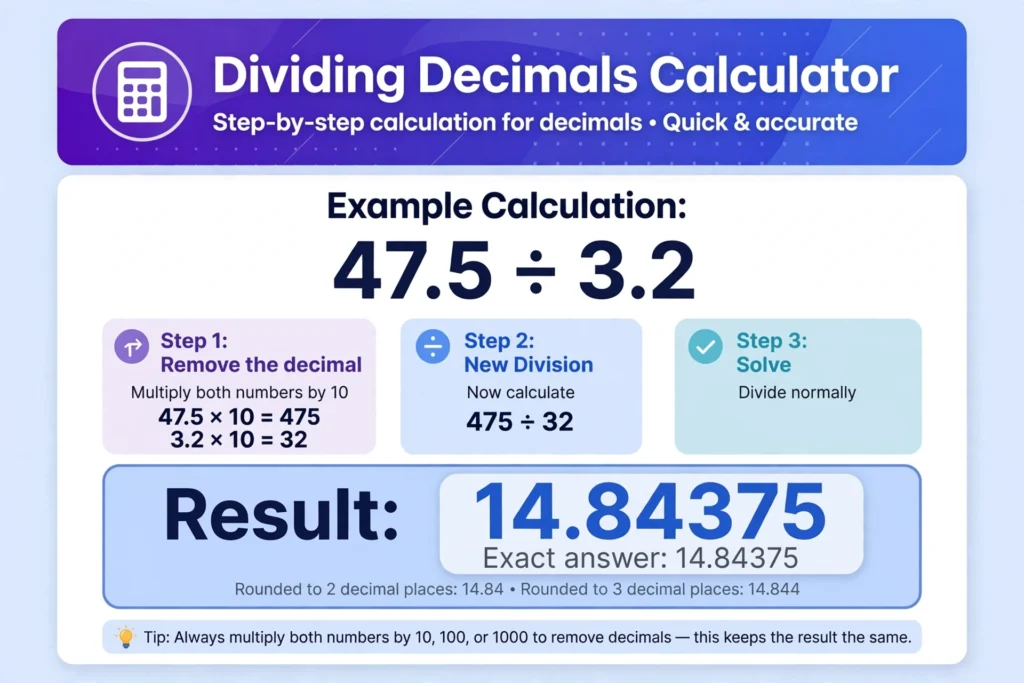
47.5 / 3.2 at 5 places is 14.84375 exact. At 2 places, 10 / 3 is 3.33 rounded, and it does not terminate.
Dividing decimals is where confident arithmetic students slow down: the decimal points have to go somewhere, the divisor refuses to be a whole number, and the answer seems to trail off forever. This dividing decimals calculator removes the mystery by doing the division the honest way — it clears the decimals first, then performs real long division in front of you, one step at a time, showing each running value, each quotient digit, and each remainder. You choose how many decimal places the answer should carry. If the division finishes exactly, the tool says it terminates and shows the final remainder of zero. If it does not finish, the tool rounds the last digit properly — looking at the digit beyond, as rounding requires — and tells you it has done so. No silently truncated answers, no unexplained points.
The method the tool displays is the method worth learning, because dividing a decimal by a decimal is not a new skill: it is whole-number long division wearing a disguise. Multiplying both numbers by the same power of ten — 10, 100, 1000 — moves both decimal points equally, and a division’s answer does not change when dividend and divisor are scaled by the same amount. After that one move, 47.5 ÷ 3.2 has become 475 ÷ 32, and everything that follows is the long division you already know, continued past the decimal point by bringing down zeros. The steps on this page show that process exactly, digit by digit, which makes the tool as useful for checking a method as for checking an answer.
What It Is
A quotient of two decimals is a fraction in disguise: 47.5 ÷ 3.2 is 475/32 once both numbers are scaled by 10, and its value, 14.84375, is exact. Some decimal divisions terminate like this — the remainder eventually hits zero and the answer is complete. Others never terminate: 10 ÷ 3 gives 3.333…, and 2 ÷ 3 gives 0.666…, repeating forever. A calculator that divides decimals therefore has two honest duties: produce the digits correctly, and state clearly whether the answer shown is exact or rounded, and to how many places. This tool does both. It performs the long division with exact whole-number arithmetic at every step — the running values and remainders it displays are the true integers of the paper method, never floating-point guesses — and it finishes with a plain statement: the division terminates exactly, or the answer is rounded (or cut off) at the precision you chose.
The precision choice is part of the honesty. Money usually needs two decimal places, measurements three or four, and coursework whatever the question demands. Rather than printing fifteen digits and letting you guess which matter, the tool lets you set 2, 3, 4, 5, 6, 8, or 10 decimal places. Behind the scenes it always computes one digit more than you asked for, because correct rounding is impossible without it: to round 0.666… to four places you must know the fifth digit is 6, which rounds the fourth up, giving 0.6667 rather than the truncated 0.6666. That single extra digit is the difference between a rounded answer and merely a chopped one, and the tool’s note tells you which of the two you are looking at — although by design, whenever rounding occurs it is the proper kind, and the “cut off” wording appears only when the extra digit was small enough that rounding changed nothing.
Long division itself deserves a sentence of respect. It is an algorithm in the full sense: a finite procedure of divide, multiply, subtract, bring down, repeated until the remainder is zero or enough digits exist. Each step’s correctness can be checked locally — quotient digit times divisor, subtracted from the running value, leaves a remainder smaller than the divisor — and this tool’s step list is precisely that audit trail. When a student asks why we bring down a zero after the decimal point, the answer is visible in the steps here: the remainder 27 becomes 270 because the dividend’s next digit, past its end, is 0, and the division simply continues into tenths, hundredths, and beyond.
How to Use the Calculator
Using the tool takes less than a minute. Follow these steps:
- Enter the dividend, the number being divided. The live test uses 47.5.
- Enter the divisor, the number you are dividing by. The live test uses 3.2. The divisor must not be zero — division by zero is undefined, and the tool will say so rather than invent an answer.
- Choose the number of decimal places for the answer. The live test uses 5. Choose 2 for money, more for measurements or coursework that demands precision.
- Press “Divide”. Read the quotient at the top.
- Read the working below it: first the clearing step that turns your division into a whole-number one, then each long-division step with its running value, quotient digit, and remainder, then the note stating whether the answer terminated exactly or was rounded, and to how many places.
A good learning habit: before pressing the button, estimate. For 47.5 ÷ 3.2, reason that 48 ÷ 3 = 16, so the answer should be a little under 16 — and 14.84375 is. Estimation will not give you the digits, but it catches the commonest disaster, a misplaced decimal point, which no amount of careful digit-work can rescue. If the tool’s answer and your estimate disagree wildly, one of the inputs is probably mistyped.
Worked Examples
Example 1: 47.5 ÷ 3.2, the live test
This is the test used to check the tool, and every step of it is shown. First, clear the decimals: multiplying both numbers by 10 turns 47.5 ÷ 3.2 into 475 ÷ 32, with the answer unchanged. Now the long division. Take digits of 475 until the running value reaches 32: 47 ÷ 32 = 1 remainder 15 — the first quotient digit is 1. Bring down the 5: 15 × 10 + 5 = 155; 155 ÷ 32 = 4 remainder 27 — the second digit is 4, and the whole-number part is complete at 14. The remainder is not zero, so the division continues into decimals. Remainder 27 × 10 = 270; 270 ÷ 32 = 8 remainder 14 — first decimal digit 8. Remainder 14 × 10 = 140; 140 ÷ 32 = 4 remainder 12 — digit 4. Remainder 12 × 10 = 120; 120 ÷ 32 = 3 remainder 24 — digit 3. Remainder 24 × 10 = 240; 240 ÷ 32 = 7 remainder 16 — digit 7. Remainder 16 × 10 = 160; 160 ÷ 32 = 5 remainder 0 — digit 5, and the remainder is zero, so the division terminates exactly. The quotient is 14.84375, complete in five decimal places, not a rounding. Five decimal places were requested and exactly five were needed — a satisfying test, and a reminder that decimal divisions with divisors like 32 (a power of 2 times the scaling) often terminate.
Example 2: 10 ÷ 3, the division that never ends
Choose 4 decimal places. The clearing step is unnecessary — both numbers are whole — and the division runs: 10 ÷ 3 = 3 remainder 1; then remainder 1 × 10 = 10; 10 ÷ 3 = 3 remainder 1, and the same step repeats forever, because the remainder 1 recurs. The digits are 3.3333…, and the fifth digit would also be 3, so rounding at four places changes nothing: the answer is 3.3333, with the tool noting it is cut off at four decimal places. This is the honest way to present a repeating decimal at finite precision. The exact answer is the fraction 10/3; every finite decimal version is an approximation, and the tool labels it as one.
Example 3: 2 ÷ 3, where rounding actually bites
Again at 4 decimal places: 2 ÷ 3 = 0 remainder 2; remainder 2 × 10 = 20; 20 ÷ 3 = 6 remainder 2; and the 6s repeat: 0.6666…. The fifth digit is 6, which is 5 or more, so the fourth digit rounds up from 6 to 7, and the answer is 0.6667 — the tool states that it was rounded and names the digit that caused it. Compare Example 2: there, truncation and rounding agreed; here they differ in the last place, and only the version computed with the extra digit — 0.6667 — is correct to four decimal places. This pair of examples is the whole case for the tool’s design: it always computes one digit beyond your precision because that digit decides the last digit you see.
Example 4: Money division, 19.99 ÷ 4
Four friends split a 19.99 bill. At 2 decimal places: clearing by 100 gives 1999 ÷ 4. Long division: 19 ÷ 4 = 4 remainder 3; bring down 9: 39 ÷ 4 = 9 remainder 3; bring down 9: 39 ÷ 4 = 9 remainder 3; decimal steps continue the pattern, remainder 3 × 10 = 30; 30 ÷ 4 = 7 remainder 2; 20 ÷ 4 = 5 remainder 0. The exact quotient is 4.9975, and rounded to two places — the third digit is 7, so round up — each share is 5.00. The example shows why money division needs the exact value before rounding: four shares of 5.00 total 20.00, one cent more than the bill, an artefact of rounding that someone quietly absorbs. Knowing the exact 4.9975 makes that cent visible instead of mysterious.
Why Some Divisions Terminate and Others Repeat
Whether a division terminates is decided by the divisor’s prime factors after the fraction is reduced. A fraction in lowest terms terminates exactly when its denominator has no prime factors other than 2 and 5 — the factors of 10 — because our number system is built on tens. 475/32 terminates because 32 is 2 × 2 × 2 × 2 × 2. 10/3 and 2/3 repeat because 3 is neither 2 nor 5, and no power of ten is divisible by 3, so the remainders cycle instead of vanishing. 1/6 repeats for the same reason (6 = 2 × 3, and the 3 is the problem), while 1/25 terminates (25 = 5 × 5) at 0.04. This is worth knowing when you choose a precision: for repeating answers, more decimal places means closer, never exact, and the correct professional habit is to carry the fraction or a generous precision through intermediate work and round only at the end. The tool supports that habit by offering up to 10 decimal places and by always telling you which kind of answer you have.
Common Mistakes
The first common mistake is moving only one decimal point: turning 47.5 ÷ 3.2 into 475 ÷ 3.2, or into 47.5 ÷ 32, changes the value of the division — both numbers must be scaled by the same power of ten, which is exactly what the tool’s first step shows. The second is misplacing the decimal point in the answer, writing 1.484375 or 148.4375 for the live test; estimation (the answer should sit a little under 16) catches this instantly, which is why the how-to section insists on it. The third is truncating and calling it rounding: 0.6666 for 2 ÷ 3 at four places is wrong, not merely imprecise, because true rounding looks at the next digit and gives 0.6667. The fourth is stopping the long division at the decimal point and reporting a remainder as if it were part of the answer, the classic “14 remainder 27” left unfinished; the division continues by bringing down zeros, as the steps show. The fifth is dividing in the wrong order: 3.2 ÷ 47.5 is a different question (about 0.067368) from 47.5 ÷ 3.2, and word problems disguise the order — “shared among” divides the shared thing by the count of people. The sixth is attempting division by zero because a problem’s numbers were miscopied; the tool refuses, correctly, since no quotient exists.
Limits: What This Tool Does and Does Not Do
This tool divides one decimal number by another using exact whole-number long division after clearing decimals, and shows every step. You choose the answer’s precision from 2 to 10 decimal places; the tool computes one digit beyond it to round correctly, and states plainly whether the result is exact, rounded, or cut off at your chosen precision. It does not continue decimal steps forever for repeating answers — no finite display could — and for very long dividends it may hide later steps behind a note while still reporting the complete quotient for the integer part and the requested decimal places. Inputs should be plain decimals: digits with at most one decimal point, with an optional leading minus sign. Fractions, percentages, and numbers in scientific notation are not accepted as typed input; convert them first (a percentage by dividing by 100, a fraction by dividing its numerator by its denominator — this tool will happily do that division for you). Division by zero is rejected with an explanation. Within those limits, the displayed long-division steps are the genuine algorithm run on your numbers: each running value, quotient digit, and remainder is the true one, and the final remainder of zero in a terminating division is a proof, not a claim.
Privacy: Your Numbers Stay in Your Browser
Every number you enter into this dividing decimals calculator stays in your browser. Nothing is uploaded to a server, nothing is stored, and there is no account to create. The calculation runs entirely on your own device, whether the division is a homework exercise, a bill split, or a measurement conversion. Closing the page removes your inputs, and no one else sees them. This browser-only design is the same principle behind the other free tools on Your Smart Kit: a simple tool that does one job well, keeps your data private, and gives an answer you can check.
When does a division terminate, and when does it repeat?
Simplify the fraction first. If the simplified denominator has only 2s and 5s, the division terminates; any other prime factor makes it repeat.
| Decimal places | Rounded | Truncated |
| 2 places | 3.33 | 3.33 |
| 3 places | 3.333 | 3.333 |
| 4 places | 3.3333 | 3.3333 |
Frequently Asked Questions
How do you divide decimals by decimals?
Multiply both numbers by the same power of ten — enough to make the divisor a whole number — then do ordinary long division, continuing past the decimal point by bringing down zeros. Scaling both numbers equally never changes the quotient: 47.5 ÷ 3.2 and 475 ÷ 32 have the same answer, 14.84375.
Why does the calculator ask for decimal places?
Because many divisions never terminate: 10 ÷ 3 is 3.333… forever. A finite answer must state its precision, so you choose how many decimal places to keep, and the tool rounds the last one correctly using one extra computed digit.
What is the difference between rounding and truncating?
Truncating cuts digits off; rounding looks at the first cut digit and increases the last kept digit when that cut digit is 5 or more. For 2 ÷ 3 at four places, truncation gives 0.6666 and correct rounding gives 0.6667. This tool always rounds.
How can I tell if a division will terminate?
Reduce the division to a fraction in lowest terms. It terminates exactly when the denominator’s only prime factors are 2 and 5. Denominators like 32, 25, and 40 terminate; denominators containing 3, 6, 7, or 9 repeat.
Where does the decimal point go in the answer?
In long division it sits in the quotient directly above its position in the scaled dividend — but since this tool clears decimals first and divides whole numbers, the point appears naturally when the integer part is exhausted and the remainders continue. Estimation confirms the placement: 47.5 ÷ 3.2 must be near 16, so 14.84375 is plausible and 1.484375 is not.
Can the divisor be zero if the dividend is also zero?
No. Division by zero is undefined for every dividend, including zero, because no number times zero gives a non-zero dividend, and every number times zero gives zero. The tool rejects a zero divisor with an explanation.
Related Tools on Your Smart Kit
If you found the dividing decimals calculator useful, you may also like the other free calculators on Your Smart Kit, including the long subtraction calculator and long addition calculator for the other paper algorithms with their steps shown, the rational calculator for exact fraction arithmetic, and the greater than less than fractions calculator for comparing two fractions. Each runs in your browser, free, with no sign-up, and each is built on the same principle: a simple tool that does one job well, keeps your data private, and gives an answer you can check. Try the dividing decimals calculator at the top of this page with 47.5 ÷ 3.2, and watch a decimal division turn back into the long division you already know.