
Ohms Law Calculator
Enter exactly two values and leave the other two blank. The tool names the pair you used and solves all four values.
An ohms law calculator finds the missing electrical values in a resistive DC circuit from two values you already know. Enter any two of voltage, current, resistance and power, and it returns all four, so you can check a result without rearranging formulas by hand.
How do I use the Ohms Law Calculator?
Start by deciding which two values you know with confidence. Type the first value into its matching box, type the second value into its matching box, and leave the other two boxes blank. Use volts for voltage, amperes for current, ohms for resistance and watts for power, because the tool reads each box in that unit only. Press Calculate Ohms Law, then read the four result boxes: Voltage, Current, Resistance and Power. If you enter one value, three values, four values, a negative value, or a combination that would divide by zero, the tool shows this message instead: "Please enter exactly two values, all zero or more, with no division by zero." Change the entry to exactly two values that pass those checks, then calculate again. After a result appears, check that the two values you entered match the matching result boxes, and that the solved values look plausible for the circuit you had in mind. If a solved value looks wrong, the usual cause is a unit slip, such as entering milliamperes where amperes were expected, or a wrong pair, such as entering power where resistance was intended. Fix the entry and run the calculation again rather than adjusting the answer by hand.
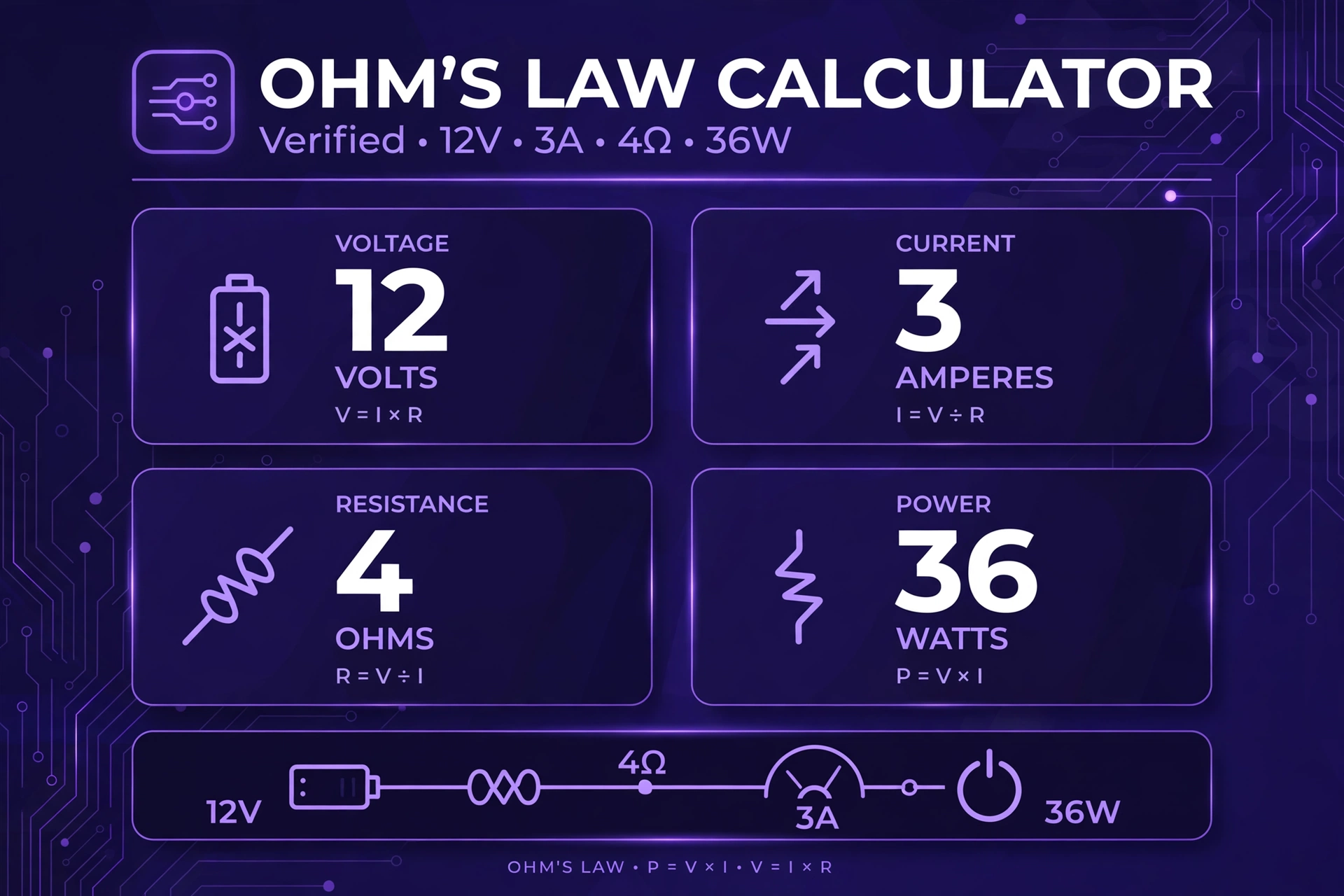
What does a worked example from the live tool show?
Take Test 1 from the verified live tests. Enter Voltage 12 and Resistance 4, and leave Current and Power blank. The pair used is Voltage plus Resistance, so Current equals Voltage divided by Resistance, which is 12 divided by 4, giving 3.00 A. Power then equals Voltage multiplied by Current, which is 12 multiplied by 3, giving 36.00 W. The four result boxes therefore read Voltage 12.00 V, Current 3.00 A, Resistance 4.00 ohms and Power 36.00 W. That chain matters because it shows every step in order: the known pair first, the first solved value second, and the final value last. Test 3 gives a larger-scale check with the same logic. Enter Voltage 120 and Current 15, and leave Resistance and Power blank. The pair used is Voltage plus Current, so Resistance equals Voltage divided by Current, which is 120 divided by 15, giving 8.00 ohms. Power equals Voltage multiplied by Current, which is 120 multiplied by 15, giving 1800.00 W. The four result boxes therefore read Voltage 120.00 V, Current 15.00 A, Resistance 8.00 ohms and Power 1800.00 W. Together, the two examples show that the same two formulas handle a small circuit and a larger one, and that the tool always returns the full set of four values rather than only the one value you asked about first.
How does the maths behind Ohm's law work?
Ohm's law links voltage, current and resistance in one short relation: V equals I multiplied by R. Voltage, written as V and measured in volts, is the electrical push in the circuit. Current, written as I and measured in amperes, is the rate of flow. Resistance, written as R and measured in ohms, is the opposition to that flow in a resistive part of the circuit. If current rises while resistance stays the same, voltage rises in step. If resistance rises while current stays the same, voltage also rises in step. Rearranging the same relation gives the other two forms: I equals V divided by R, and R equals V divided by I. Power adds a second relation: P equals V multiplied by I, with power measured in watts. Power describes the rate at which electrical energy is converted, for example into heat or light, in the resistive part of the circuit. Once any two of the four values are known, the two relations can be combined to find the other two, which is why this calculator asks for exactly two values and no more. The worked examples above follow that pattern exactly: one relation gives the first missing value, and the second relation, or the same relation used a second time, gives the last value.
What are all twelve formulas for Ohm's law and power?
Each unknown value can be found from three different known pairs, which gives twelve formulas in total. The table below lists every unknown, the pair that is known, and the formula that finds the unknown from that pair.
| Unknown | Known pair | Formula |
|---|---|---|
| Voltage (V) | Current and Resistance | V equals I multiplied by R |
| Voltage (V) | Power and Current | V equals P divided by I |
| Voltage (V) | Power and Resistance | V equals the square root of P multiplied by R |
| Current (I) | Voltage and Resistance | I equals V divided by R |
| Current (I) | Power and Voltage | I equals P divided by V |
| Current (I) | Power and Resistance | I equals the square root of P divided by R |
| Resistance (R) | Voltage and Current | R equals V divided by I |
| Resistance (R) | Voltage and Power | R equals V squared divided by P |
| Resistance (R) | Power and Current | R equals P divided by I squared |
| Power (P) | Voltage and Current | P equals V multiplied by I |
| Power (P) | Voltage and Resistance | P equals V squared divided by R |
| Power (P) | Current and Resistance | P equals I squared multiplied by R |
Read the table by row: find the value you want in the first column, find the pair you know in the second column, then use the formula in the third column. If you know a different pair for the same unknown, use that row instead; the result should agree when the known values belong to the same circuit and the same units are used throughout.
What unit mistakes should I watch for?
Unit mistakes cause more wrong answers than formula mistakes, because the arithmetic can be correct while the input is scaled wrongly by a factor of 1,000. This calculator expects amperes, not milliamperes, ohms, not kilohms, and watts, not milliwatts or kilowatts. Convert first, then enter the converted value. To convert milliamperes to amperes, divide by 1,000. To convert amperes to milliamperes, multiply by 1,000. To convert kilohms to ohms, multiply by 1,000. To convert ohms to kilohms, divide by 1,000. To convert milliwatts to watts, divide by 1,000. To convert watts to milliwatts, multiply by 1,000. To convert kilowatts to watts, multiply by 1,000. To convert watts to kilowatts, divide by 1,000.
| Conversion | Rule | Example |
|---|---|---|
| Milliamperes to amperes | Divide by 1,000 | 200 mA equals 0.20 A |
| Amperes to milliamperes | Multiply by 1,000 | 3 A equals 3,000 mA |
| Kilohms to ohms | Multiply by 1,000 | 4 kilohms equals 4,000 ohms |
| Ohms to kilohms | Divide by 1,000 | 8 ohms equals 0.008 kilohms |
| Milliwatts to watts | Divide by 1,000 | 1,000 mW equals 1 W |
| Watts to milliwatts | Multiply by 1,000 | 36 W equals 36,000 mW |
| Kilowatts to watts | Multiply by 1,000 | 1 kW equals 1,000 W |
| Watts to kilowatts | Divide by 1,000 | 1,800 W equals 1.8 kW |
A single missed conversion changes the answer by a factor of 1,000, so check the unit on each known value before you type it. The Electrical Unit Converter can help with unit changes, and the Unit Converter covers unit changes more widely. Keep the unit label beside each number in your notes as well, so a later reader can see whether a value was in milliamperes or amperes, ohms or kilohms, watts or kilowatts.
How does a unit conversion change a worked result?
Consider a conversion-only example, worked from the same formulas and not presented as a tool test. Convert 200 mA to amperes by dividing by 1,000, which gives 0.20 A. Then, only if that current flows at 5 V, power equals V multiplied by I, which is 5 multiplied by 0.20, giving 1.00 W. The condition matters: the 5 V figure and the 0.20 A figure must belong to the same circuit at the same time for the power result to hold. If the current was measured at a different voltage, the 1.00 W result does not follow. This example also shows why the conversion step comes first. Entering 200 where amperes were expected would give a power result 1,000 times too large, while entering 0.20 after conversion gives the result that matches the stated voltage and current. When a known value arrives in milliamperes, kilohms, milliwatts or kilowatts, convert it, write down the converted value with its new unit, and only then enter it in the calculator.
When does Ohm's law not apply directly?
Ohm's law in the form used here applies directly to resistive DC circuits, where resistance stays steady as voltage and current change. It does not apply directly to non-ohmic devices, where resistance changes with voltage, current, temperature or light, so a single resistance value does not describe the device across its range. It also does not apply directly to AC circuits with reactance, where inductance or capacitance shifts the relation between voltage and current and where power factor enters the power calculation. In those cases, the simple relations V equals I multiplied by R and P equals V multiplied by I do not capture the full behaviour, and a different model is needed. This page stays inside its stated scope: resistive DC circuits where Ohm's law holds directly. If a device or circuit falls outside that scope, treat a result from this calculator as a rough check at best, and use a model that fits that device or circuit instead.
What are the most common mistakes with Ohm's law?
The first common mistake is entering more than two values, or entering values that do not belong to the same circuit, then treating the output as a check on a real circuit. The calculator solves the numbers it is given, so mixed values give a tidy-looking answer that does not describe any single circuit. The second mistake is a unit slip, covered above, where milliamperes, kilohms, milliwatts or kilowatts are entered without conversion. The third mistake is dividing by zero, for example entering Current 0 with Voltage, or Resistance 0 with Voltage, and expecting a finite resistance or current in return. The tool rejects those cases with the error message stated above, because division by zero has no finite result here. The fourth mistake is reading power as if it were energy: watts describe a rate, while energy over time is a separate quantity, so a wattage figure on its own does not state how much energy was used. The fifth mistake is mixing up the pair used: for example, using Power plus Resistance formulas when the known values were Voltage plus Current. Naming the pair before calculating, as this tool does, helps catch that slip. A related slip is rounding too early. Keep full figures through the steps and round only for display, as the tool does with two decimal places, so a small rounding difference does not grow through the second formula.
What are the limits of this calculator?
This calculator handles one resistive DC case at a time, with exactly two known values and the other two solved from them. It does not model circuits with several resistors, series or parallel combinations, non-ohmic devices, AC reactance, power factor, temperature change, or changing resistance. It does not check whether a component can handle the calculated power, whether a voltage or current is suitable for a given part, or whether any installation work is appropriate. Those questions sit outside this tool, and this page gives no advice on them. The calculator also accepts zero values where the arithmetic allows them, for example Current 0 with Resistance, which gives Voltage 0 and Power 0, but a zero entry should still reflect a real measured or stated condition rather than a blank left as zero. For a quick related calculation on shares and changes, see the Percentage Calculator. For more tools in the same group, see the Calculators hub.
Why does this page show every pair and formula?
Top results often solve one quantity or hide which pair was used, so a reader cannot easily repeat the working or check a different pair. This page takes a different approach: it accepts any two of the four values, names the pair used, and shows all twelve formulas plus unit conversions. That way, a reader who knows Voltage and Resistance, a reader who knows Current and Power, and a reader who knows any other pair can each follow the same page and see the exact route to the full set of four values. The verified tests below use the same route, so the article, the formulas and the tool results agree with each other.
What are the answers to common questions about this calculator?
What two values can I enter in the ohms law calculator?
Enter any two of voltage, current, resistance and power, and leave the other two blank. For example, entering V 12 and R 4 gives I 3.00 A and P 36.00 W.
What happens if I enter the wrong number of values?
The tool shows this message: Please enter exactly two values, all zero or more, with no division by zero. Enter exactly two values that pass those checks, then calculate again.
What result do Voltage 120 and Current 15 give?
The pair used is Voltage plus Current. Resistance is 8.00 ohms and Power is 1800.00 W.
What result do Current 2 and Resistance 6 give?
The pair used is Current plus Resistance. Voltage is 12.00 V and Power is 24.00 W.
What result do Power 100 and Resistance 25 give?
The pair used is Resistance plus Power. Current is 2.00 A and Voltage is 50.00 V.
Do I need to convert milliamperes or kilohms before entering them?
Yes. The tool expects amperes, ohms and watts, so convert first. As a conversion-only example, 200 mA equals 0.20 A, and only if that current flows at 5 V, power equals V multiplied by I, giving 1.00 W.