
Running Pace Calculator
Running Pace Calculator
A. Pace and speed from a run
B. Race times from a target pace
A running pace calculator turns a run into a pace, or a pace into race times. Enter a distance and a total time to get pace per kilometre and per mile, plus speed in kilometres per hour and miles per hour. Or enter a target pace in minutes per kilometre to see predicted times for 5 km, 10 km, a half marathon and a marathon.
How do I use the running pace calculator?
Use Section A if you have already run. Enter the distance in kilometres, then enter the total time as separate hours, minutes and seconds. Press Calculate pace. The tool gives pace per kilometre, pace per mile, and speed in both km/h and mph. Use Section B if you are planning a race. Enter a target pace as minutes and seconds per kilometre, then press Calculate race times. The tool lists predicted times for 5 km, 10 km, a half marathon (21.0975 km) and a marathon (42.195 km). The two sections are independent. You do not need to fill in both sections to use either one.
Enter time as separate boxes, not as a decimal. A run of 50 minutes is entered as 0 hours, 50 minutes and 0 seconds. A run of 1 hour, 30 minutes and 0 seconds is entered as 1, 30 and 0. That separation matters, because time in this tool is handled in whole seconds, and a decimal such as 1.30 does not mean 1 hour and 30 minutes. The section below on that mistake explains why, and what happens if a decimal is used instead.
If a distance or a time is zero, or if a field is left blank where a value is needed, the tool shows a plain message instead of a result. A distance of zero cannot give a pace, because pace divides time by distance, and a time of zero cannot give a pace either, because no time has passed. The tool does not guess a missing value. It asks for the missing value, and that is the correct behaviour for a calculator that claims to be exact.
A worked example from the live tool
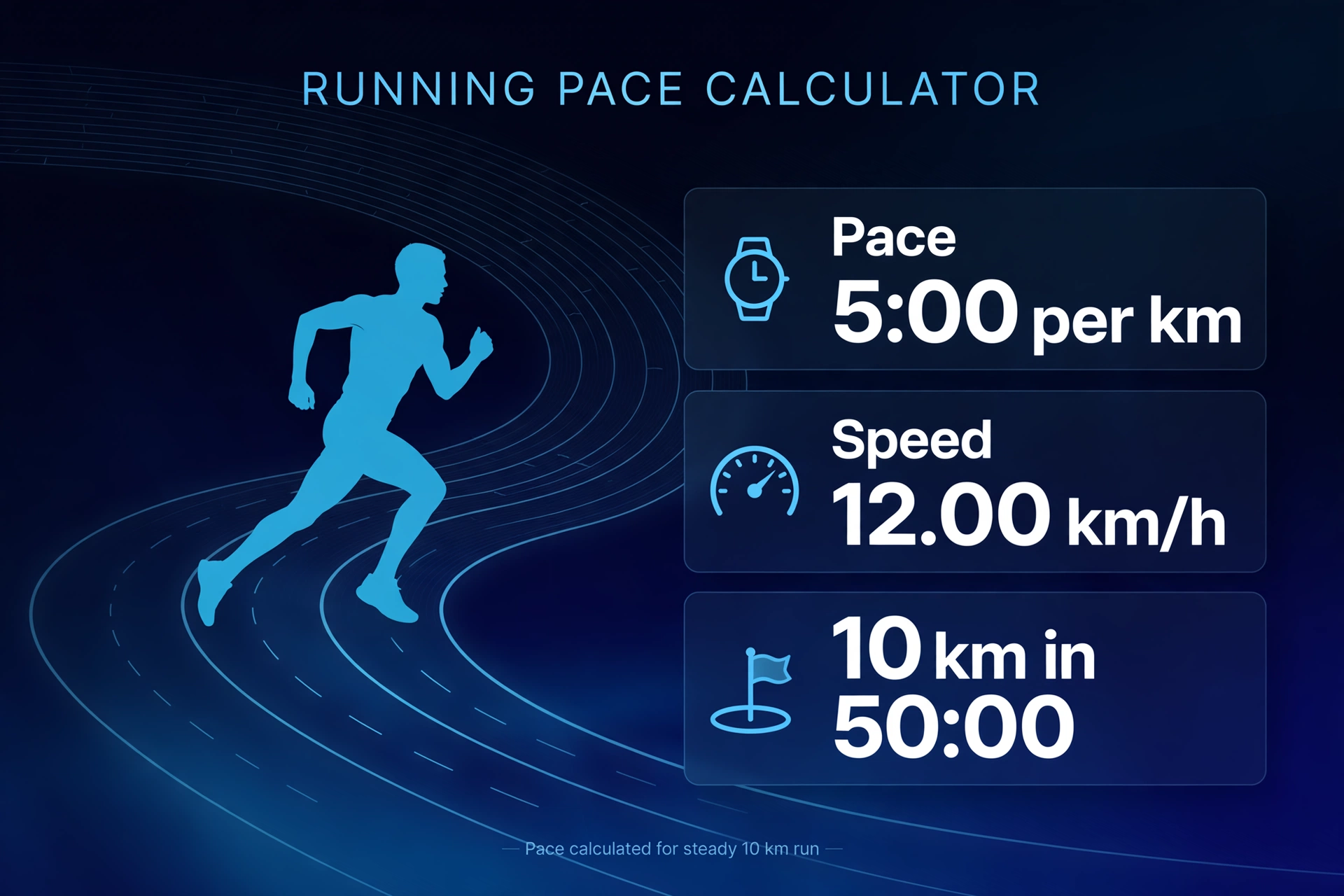
Take a run of 10 km in 50 minutes. Enter 10 for distance, and 0 hours, 50 minutes and 0 seconds for time. The total time is 3,000 seconds, or 50 minutes. Pace per kilometre is total minutes divided by distance: 50 divided by 10 is 5 minutes per kilometre, shown as 5:00 min/km. Pace per mile uses the mile distance: 10 km divided by 1.609344 is 6.213712 miles. Fifty minutes divided by 6.213712 is 8.046722 minutes per mile, which is 8 minutes and 2.803 seconds, rounded in the tool to 8:03 min/mile. Speed is distance divided by time in hours: 50 minutes is 0.833333 hours, so 10 divided by 0.833333 is 12.00 km/h, and 6.213712 divided by 0.833333 is 7.456454 mph, rounded to 7.46 mph.
That worked example is Test 1 in the verified tests table at the end of this page, and it matches the second test as well. A run of 5 km in 25 minutes gives the same pace: 25 divided by 5 is 5 minutes per kilometre, and the speed is again 12.00 km/h. That is expected. Two runs at the same pace give the same pace and speed, whatever the distance, because pace and speed describe the rate, not the total. The totals differ — 50 minutes against 25 minutes — but the rate is the same, and the tool shows that clearly.
A Section B example shows the reverse direction. Enter a target pace of 6 minutes and 0 seconds per kilometre. That is 360 seconds per kilometre. A marathon is 42.195 km, so 360 multiplied by 42.195 is 15,190.2 seconds. Dividing by 3,600 gives 4 hours, with 790.2 seconds remaining. Dividing 790.2 by 60 gives 13 minutes, with 10.2 seconds remaining, rounded to 10 seconds. The predicted marathon time is therefore 4:13:10. The same pace gives 30:00 for 5 km, 1:00:00 for 10 km, and 2:06:35 for a half marathon. All four figures come from the same multiplication — pace in seconds per kilometre multiplied by distance in kilometres — and the tool formats each total as hours, minutes and seconds.
How is pace calculated, and what is the difference between pace and speed?
Pace is time per unit of distance. If a run takes T minutes and covers D kilometres, pace per kilometre is T divided by D, in minutes per kilometre. Pace per mile uses the same total time divided by the distance in miles, where distance in miles is distance in kilometres divided by 1.609344. Speed is the reverse relationship: distance per unit of time. If the same run takes H hours, speed in km/h is D divided by H, and speed in mph is distance in miles divided by H. Pace and speed describe the same run from opposite directions, and that is why a faster run has a lower pace number and a higher speed number. A pace of 4:00 min/km is faster than a pace of 6:00 min/km, because it takes less time for each kilometre, while its speed, 15.00 km/h, is higher than the 10.00 km/h that goes with 6:00 min/km.
The conversion between kilometres and miles is fixed: 1 mile is 1.609344 km, exactly. That exact figure is used in the tool, not the rounded 1.61, because a small rounding in the conversion becomes a visible difference in pace per mile over a long run. For a 10 km run in 50 minutes, the exact conversion gives 8:03 min/mile, as shown above. A rounded conversion would give a slightly different second figure, and a tool that claims exact results should not introduce that error. The same exact conversion is used in reverse in Section B, although Section B works in minutes per kilometre and therefore does not need a mile conversion at all.
Why does entering 1.30 hours give a wrong answer?
Because 1.30 hours, as a decimal, means 1 hour plus 0.30 of an hour, and 0.30 of an hour is 18 minutes, not 30 minutes. A run of 1 hour and 30 minutes is 1.5 hours as a decimal, not 1.30 hours. A reader who types 1.30 into a single hours box, thinking of it as hours and minutes, will get a total time of 1 hour and 18 minutes, which is 12 minutes short of the intended 1 hour and 30 minutes. The pace will then be faster than it should be, because the same distance is divided by a shorter time. This tool avoids that trap by asking for hours, minutes and seconds in separate boxes. There is no single decimal box to misread. Enter 1 hour, 30 minutes and 0 seconds, and the tool adds them as 3,600 plus 1,800 plus 0, which is 5,400 seconds, exactly.
The same trap appears with pace. A pace written as 5.30 min/km, if read as a decimal, means 5 minutes plus 0.30 of a minute, which is 18 seconds, giving 5:18 min/km. A pace of 5 minutes and 30 seconds per kilometre is 5:30 min/km, which is 5.5 minutes per kilometre as a decimal. Section B therefore asks for minutes and seconds separately, just as Section A asks for hours, minutes and seconds separately. The colon format in the results — 5:00, 8:03, 4:13:10 — is not a decimal. It is a time format, and it should be read as minutes and seconds, or hours, minutes and seconds, not as a decimal point.
What does the quick-reference table show?
The table below lists four common paces, with the speed that goes with each pace, and the time for 5 km and 10 km at that pace. It is a check, not a replacement for the tool: if a tool result disagrees with this table at the same pace, the tool result should be checked, because the table figures are computed from the same formulas.
| Pace (min/km) | Speed (km/h) | 5 km time | 10 km time |
|---|---|---|---|
| 4:00 | 15.00 | 20:00 | 40:00 |
| 5:00 | 12.00 | 25:00 | 50:00 |
| 6:00 | 10.00 | 30:00 | 1:00:00 |
| 7:00 | 8.57 | 35:00 | 1:10:00 |
Read the table across a row to see the trade-off. At 4:00 min/km, a runner covers 5 km in 20 minutes and 10 km in 40 minutes, at 15.00 km/h. At 7:00 min/km, the same distances take 35 minutes and 70 minutes, at 8.57 km/h. The speed figures are 60 divided by pace in minutes: 60 divided by 4 is 15, 60 divided by 5 is 12, 60 divided by 6 is 10, and 60 divided by 7 is 8.571…, rounded to 8.57. That formula — speed equals 60 divided by pace in minutes per kilometre — is a useful mental check. If a pace of 5:00 min/km is entered, the speed should be 12.00 km/h, not 10 or 15, and the table shows why.
What mistakes do people make with running pace?
The first mistake is the decimal-time mistake described above: reading 1.30 as 1 hour and 30 minutes, or 5.30 as 5 minutes and 30 seconds. The second mistake is mixing kilometres and miles. A pace of 5:00 min/km is not the same as a pace of 5:00 min/mile. The mile pace is slower in time per unit, because a mile is longer than a kilometre: 5:00 min/km corresponds to 8:03 min/mile, as in the worked example. A runner who reports a mile pace as a kilometre pace, or the reverse, will misstate their speed by a large amount. The tool shows both paces side by side so the two are not confused, but the reader still needs to read the unit beside each figure.
The third mistake is treating a predicted race time as a promise. Section B multiplies a target pace by a race distance, and it assumes the same pace is held for the whole race. Real races include hills, wind, fatigue, water stops, and a start that is rarely at full pace. A predicted marathon time of 4:13:10 at 6:00 min/km is the time that pace would give if held exactly, not a guarantee that a runner will hold it. The prediction is useful for planning — for choosing a start corral, for setting a watch, for judging whether a goal is realistic — but it is not a forecast of what will happen on the day.
The fourth mistake is averaging paces by adding them and dividing by two. If a runner runs 5 km at 5:00 min/km and then 5 km at 7:00 min/km, the average pace for the 10 km is not 6:00 min/km. The first half takes 25 minutes and the second takes 35 minutes, giving 60 minutes for 10 km, which is indeed 6:00 min/km in this symmetric case, but that coincidence hides the rule. The correct average pace is total time divided by total distance, not the average of the pace figures, because pace is a ratio. With unequal distances, the simple average of paces gives the wrong answer, while total time divided by total distance always gives the right one. This tool avoids the mistake by working from total time and total distance in Section A, rather than from pace figures.
What are the limits of this tool?
This tool calculates pace, speed and predicted race times from the numbers entered. It does not measure a run, track a runner, or adjust for terrain, weather, altitude, or fatigue. It does not give training advice, and it does not recommend a target pace for any individual runner. A pace that is realistic for one runner may be unrealistic for another, and the tool has no information about fitness, health, or experience. Predicted race times assume a constant pace, which is a simplification, and they should be read as planning figures, not as promises.
The tool also rounds seconds in its pace and time formats. Pace seconds are rounded to the nearest whole second, and race times are rounded to the nearest whole second. That rounding can move a figure by up to half a second, which is negligible for planning but worth noting if a result is compared with a more precise calculation elsewhere. The underlying arithmetic uses full precision before rounding, so the rounded display is the only rounding in the tool.
What information does this tool store or share?
None. The calculator runs in the browser, and the distance, time and pace entered are used only to produce the result on the same page. No account is needed, no run is sent to a server, and no history is stored by this page. Closing the page ends the session. For the general time, distance, and speed relationship behind these formulas, see the time distance speed calculator. For converting a total time between units before entering it, see the minutes calculator. For more tools in the same collection, browse the calculators category.
FAQ
1. How do I calculate my running pace?
Divide total time by distance. For example, 50 minutes for 10 km gives 5:00 min/km, because 50 divided by 10 is 5. In miles, the same run is 8:03 min/mile, because 10 km is 6.213712 miles and 50 divided by 6.213712 is 8.046722 minutes, or 8 minutes and 2.803 seconds, rounded to 8:03.
2. What is the difference between pace and speed?
Pace is time per distance, such as minutes per kilometre. Speed is distance per time, such as kilometres per hour. A faster run has a lower pace number and a higher speed number. A pace of 5:00 min/km corresponds to a speed of 12.00 km/h, because 60 divided by 5 is 12.
3. How do I convert pace per km to pace per mile?
Multiply the pace per kilometre by 1.609344, or divide total minutes by distance in miles. For example, 5:00 min/km multiplied by 1.609344 gives 8.046722 min/mile, shown as 8:03 min/mile.
4. What time would I run a marathon at 6:00 min/km?
At 6:00 min/km, a marathon of 42.195 km takes 4:13:10, because 360 seconds per kilometre multiplied by 42.195 is 15,190.2 seconds, which is 4 hours, 13 minutes and 10 seconds after rounding. The same pace gives 30:00 for 5 km, 1:00:00 for 10 km, and 2:06:35 for a half marathon.
5. Why does entering 1.30 hours give a wrong pace?
Because 1.30 as a decimal means 1 hour plus 0.30 of an hour, which is 18 minutes, not 30 minutes. A run of 1 hour and 30 minutes is 1.5 hours as a decimal. This tool asks for hours, minutes and seconds in separate boxes, so the mistake cannot happen if the boxes are used as labelled.
6. Does the tool store my runs?
No. The calculation runs in the browser, and no distance, time or pace is sent to a server or stored by this page. Closing the page ends the session.
Disclaimer
This page gives general information about running pace and predicted race times. It is not training advice, medical advice, or a personal coaching plan. Predicted times assume a constant pace and do not account for terrain, weather, altitude, or fatigue. If you are starting a new training programme or have a health condition, speak to a qualified professional first.
How do I calculate my running pace?
Divide total time by distance. For example, 50 minutes for 10 km gives 5:00 min/km, because 50 divided by 10 is 5. In miles, the same run is 8:03 min/mile, because 10 km is 6.213712 miles and 50 divided by 6.213712 is 8.046722 minutes, or 8 minutes and 2.803 seconds, rounded to 8:03.
What is the difference between pace and speed?
Pace is time per distance, such as minutes per kilometre. Speed is distance per time, such as kilometres per hour. A faster run has a lower pace number and a higher speed number. A pace of 5:00 min/km corresponds to a speed of 12.00 km/h, because 60 divided by 5 is 12.
How do I convert pace per km to pace per mile?
Multiply the pace per kilometre by 1.609344, or divide total minutes by distance in miles. For example, 5:00 min/km multiplied by 1.609344 gives 8.046722 min/mile, shown as 8:03 min/mile.
What time would I run a marathon at 6:00 min/km?
At 6:00 min/km, a marathon of 42.195 km takes 4:13:10, because 360 seconds per kilometre multiplied by 42.195 is 15,190.2 seconds, which is 4 hours, 13 minutes and 10 seconds after rounding. The same pace gives 30:00 for 5 km, 1:00:00 for 10 km, and 2:06:35 for a half marathon.
Why does entering 1.30 hours give a wrong pace?
Because 1.30 as a decimal means 1 hour plus 0.30 of an hour, which is 18 minutes, not 30 minutes. A run of 1 hour and 30 minutes is 1.5 hours as a decimal. This tool asks for hours, minutes and seconds in separate boxes, so the mistake cannot happen if the boxes are used as labelled.
Does the tool store my runs?
No. The calculation runs in the browser, and no distance, time or pace is sent to a server or stored by this page. Closing the page ends the session.