Surface Area Calculator
Choose a 3D solid, enter its dimensions in one unit, and choose that unit. All dimensions must use the same unit.
For the cylinder, sphere, and cone, enter the radius, not the diameter. For the cone, enter the straight-up height; the tool works out the slant height itself.
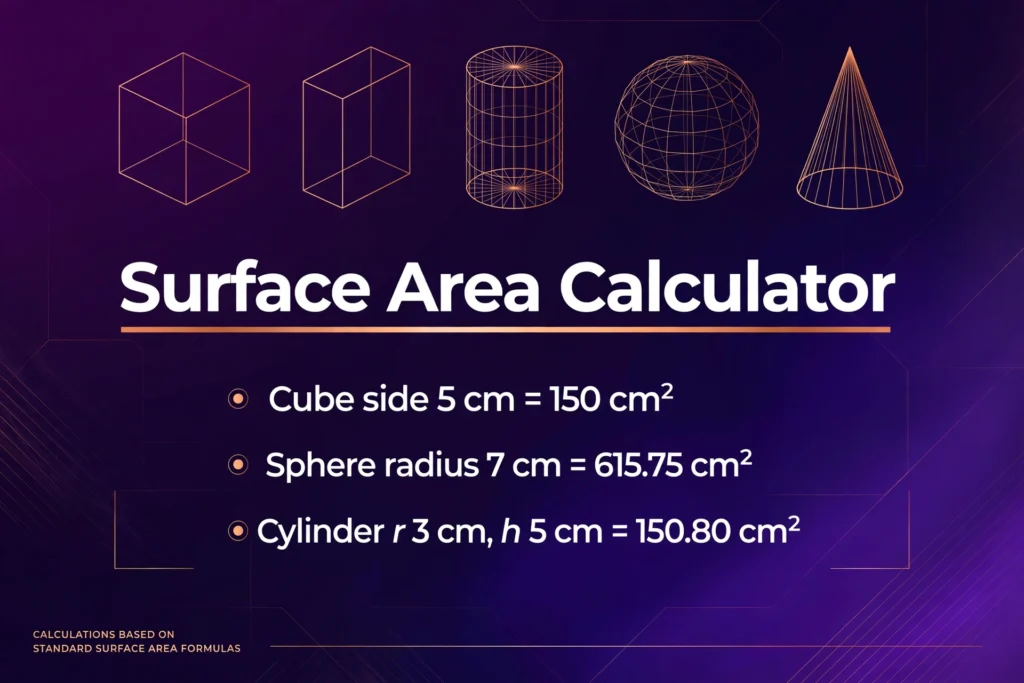
A surface area calculator finds the total outside area of a 3D solid: how much material it would take to cover, wrap, or paint the whole object. For a cube with a side of 5 cm it gives 150 cm², because a cube has six square faces of 25 cm² each.
How do I use the Surface Area Calculator?
Choose a shape from the dropdown at the top of the tool: cube, rectangular prism, cylinder, sphere, or cone. Only the inputs for that shape are shown, so a cube asks for one side length while a rectangular prism asks for length, width, and height. Pick a unit — cm, m, in, or ft — and enter every dimension in that one unit. The unit carries through to the results, so dimensions in cm give a total surface area in cm² and a volume in cm³.
Press the calculate button and labelled boxes appear. The first box is the total surface area, which is the figure for covering, wrapping, or painting the whole solid. The second box is the lateral surface area, which is the side faces only and is hidden for a sphere, because a sphere has no separate lateral figure. The third box is the volume, shown only as a labelled reference so that it is not confused with the surface area. The fourth box names the formula the tool used, so the figure can be checked by hand.
If an input is wrong, the tool shows a plain-language error and no results. A side length of 0 is rejected, because a dimension must be greater than zero. A negative radius is rejected in the same way, and a blank input is rejected with a message asking for a number. The error names the input it refers to, so the correction is obvious: enter a positive number in the box named in the message, and press calculate again.
What does a worked example look like?
Start with the cube, the simplest shape. Enter a cube with side 5 cm. One face is 5 × 5, which is 25 cm². A cube has six faces, so the total is 6 × 25, which is 150 cm². The lateral area, the four side faces, is 4 × 25, which is 100 cm². The volume is 5 × 5 × 5, which is 125 cm³. The tool shows all four boxes: total 150 cm², lateral 100 cm², volume 125 cm³, and the formula 6s².
Next, a rectangular prism with length 4 cm, width 3 cm, and height 2 cm. The three face pairs are length × width, which is 4 × 3 = 12 cm², length × height, which is 4 × 2 = 8 cm², and width × height, which is 3 × 2 = 6 cm². Each pair appears twice, so the total is 2 × (12 + 8 + 6), which is 52 cm². The lateral area, the four side faces, is 2 × (4 + 3) × 2, which is 28 cm². The volume is 4 × 3 × 2, which is 24 cm³. The tool shows total 52 cm², lateral 28 cm², volume 24 cm³, and the formula 2(lw + lh + wh).
Next, a cylinder with radius 3 cm and height 5 cm. The curved side unrolls into a rectangle whose width is the circumference, 2π × 3, and whose height is 5, so the lateral area is 2π × 3 × 5, which is 30π, or 94.25 cm². The two circular ends are each π × 9, which is 28.27 cm², so together they add 56.55 cm². The total is 94.25 + 56.55, which is 150.80 cm². The volume is π × 9 × 5, which is 141.37 cm³. The tool shows total 150.80 cm², lateral 94.25 cm², volume 141.37 cm³, and the formula 2πr(r + h).
Next, a sphere with radius 7 cm. The formula is 4π × r², so the total is 4π × 49, which is 196π, or 615.75 cm². The volume is (4/3)π × 343, which is 1436.76 cm³. The tool shows total 615.75 cm², volume 1436.76 cm³, and the formula 4πr², and it hides the lateral box, because a sphere has no separate lateral figure.
Last, a cone with radius 3 cm and height 4 cm. The height entered is the straight-up height, and the tool works out the slant height first: √(3² + 4²) is √25, which is 5 cm. The curved side is π × 3 × 5, which is 47.12 cm². The base is π × 9, which is 28.27 cm². The total is 47.12 + 28.27, which is 75.40 cm². The volume is (1/3)π × 9 × 4, which is 37.70 cm³. The tool shows total 75.40 cm², lateral 47.12 cm², volume 37.70 cm³, and the formula πr(r + l), l = √(r² + h²).
What is surface area?
Surface area is the total area of the outside of a three-dimensional solid, measured in square units such as cm², m², in², or ft². It answers one question: how much flat material would cover the whole object, with no gaps and no overlaps, if the object were wrapped in it. A cube with side 5 cm has a surface area of 150 cm², because six faces of 25 cm² each add to 150. A sphere with radius 7 cm has a surface area of 615.75 cm², because the curved surface, spread flat, would cover that much.
Every solid in this tool is made of parts whose areas are already known. A cube is six squares. A rectangular prism is three pairs of rectangles. A cylinder is two circles and one rectangle, the rectangle being the curved side unrolled. A sphere is one curved surface whose area Archimedes showed to be four times the area of its great circle. A cone is one circle and one sector of a larger circle, the sector being the curved side unrolled. The tool adds the parts, and the total is the surface area.
Surface area is a two-dimensional measure applied to a three-dimensional object, which is why the unit is always squared: cm², m², in², or ft². It is not a length, and it is not a volume. A cube with side 5 cm has a surface area of 150 cm² and a volume of 125 cm³, and those two figures are different in kind as well as in size. The rest of this page explains each solid's formula, how to use the total and the lateral figures, and the mistakes that give a wrong answer.
How is surface area different from volume?
Surface area measures the outside of a solid. Volume measures the space inside it, or the space it takes up, and it is measured in cubic units such as cm³, m³, in³, or ft³. A cube with side 5 cm has a surface area of 150 cm² and a volume of 125 cm³. The two figures answer different questions: how much material to cover the object, and how much the object holds or takes up. Painting a cube is a surface area problem, and filling a cube is a volume problem.
The two figures also grow at different rates. Double the side of a cube from 5 cm to 10 cm and the surface area goes from 150 cm² to 600 cm², which is four times as much, while the volume goes from 125 cm³ to 1000 cm³, which is eight times as much. That is the square law and the cube law: area scales with the square of the size, and volume scales with the cube. The quick-reference table below shows the same pattern for a sphere: radius 5 gives 314.16 cm², and radius 10 gives 1256.64 cm², which is four times as much, while the volume goes from 523.60 cm³ to 4188.79 cm³, which is eight times as much.
The live volume solver covers volume on its own. This page shows volume next to surface area only as a labelled reference, so the two can be compared for the same dimensions without opening a second tool. The volume box is labelled as volume, and the total surface area box is the figure to use for covering, wrapping, or painting.
How is surface area different from the area of a flat shape?
The area of a flat shape covers one two-dimensional region: the area of a rectangle, a circle, or a triangle. Surface area adds together the areas of all the faces of a solid. A rectangle 5 cm by 5 cm has an area of 25 cm². A cube built from six such squares has a surface area of 150 cm². The flat area is one face; the surface area is the whole outside.
The live geometry calculator covers flat shapes only: rectangle area and perimeter, circle area and circumference, and triangle area and perimeter. It does not handle solids at all, and a reader who wants the area of one face should use it, then multiply by the number of faces for a cube, or add the faces for a box, or use this page's tool for the whole solid. The worked example above shows each solid's faces added in full.
What is the surface area formula for a cube?
A cube has six identical square faces, so its total surface area is six times the area of one face: SA = 6s², where s is the side length. Its lateral surface area is the four side faces, leaving out the top and bottom: LA = 4s². Its volume is s³. The formulas come from the standard reference OpenStax Prealgebra, which gives S = 6s² and V = s³ for a cube.
For a cube with side 5 cm, one face is 25 cm², the total is 6 × 25 = 150 cm², the lateral area is 4 × 25 = 100 cm², and the volume is 125 cm³. For a cube with side 2 cm, one face is 4 cm², the total is 6 × 4 = 24 cm², the lateral area is 4 × 4 = 16 cm², and the volume is 8 cm³. Both rows appear in the quick-reference table below.
What is the surface area formula for a rectangular prism?
A rectangular prism, which most people call a box, has three pairs of rectangular faces. Its total surface area is SA = 2(lw + lh + wh), where l is the length, w is the width, and h is the height. Each pair appears twice, which is why the formula multiplies the sum by 2. Its lateral surface area is the four side faces: LA = 2(l + w)h, which leaves out the top and the bottom. Its volume is lwh.
For a box 4 cm long, 3 cm wide, and 2 cm high, the three pairs are 12, 8, and 6 cm², and the total is 2 × (12 + 8 + 6) = 52 cm². The lateral area is 2 × (4 + 3) × 2 = 28 cm², and the volume is 4 × 3 × 2 = 24 cm³. For a box 5 cm long, 4 cm wide, and 3 cm high, the total is 2 × (20 + 15 + 12) = 94 cm², the lateral area is 2 × (5 + 4) × 3 = 54 cm², and the volume is 5 × 4 × 3 = 60 cm³. Both rows appear in the quick-reference table below.
What is the surface area formula for a cylinder?
A closed cylinder has two circular ends and one curved side. Its total surface area is SA = 2πr² + 2πrh, which factors to SA = 2πr(r + h), where r is the radius and h is the height. The 2πr² term is the two ends, each πr², and the 2πrh term is the curved side, which unrolls into a rectangle of width 2πr and height h. Its lateral surface area is the curved side alone: LA = 2πrh. Its volume is πr²h.
For a cylinder with radius 3 cm and height 5 cm, the lateral area is 2π × 3 × 5 = 94.25 cm², the two ends add 56.55 cm², and the total is 150.80 cm². The volume is π × 9 × 5 = 141.37 cm³. For a cylinder with radius 4 cm and height 10 cm, the lateral area is 2π × 4 × 10 = 251.33 cm², the two ends add 100.53 cm², and the total is 351.86 cm². The volume is π × 16 × 10 = 502.65 cm³. Both rows appear in the quick-reference table below.
What is the surface area formula for a sphere?
A sphere has one continuous curved surface, and its total surface area is SA = 4πr², where r is the radius. Its volume is (4/3)πr³. The standard reference gives S = 4πr² and V = (4/3)πr³ for a sphere. There is no separate lateral figure, because there are no flat faces to leave out, so the tool hides the lateral box for a sphere.
For a sphere with radius 7 cm, the total is 4π × 49 = 615.75 cm² and the volume is 1436.76 cm³. For a sphere with radius 5 cm, the total is 4π × 25 = 314.16 cm² and the volume is 523.60 cm³. For a sphere with radius 10 cm, the total is 4π × 100 = 1256.64 cm² and the volume is 4188.79 cm³. All three rows appear in the quick-reference table below.
What is the surface area formula for a cone?
A right circular cone has a circular base and a curved side that tapers to a point. Its total surface area is SA = πr² + πrl, which factors to SA = πr(r + l), where r is the base radius and l is the slant height. The slant height is the distance along the sloped surface from the rim of the base to the tip, and it comes from the Pythagorean theorem: l = √(r² + h²), where h is the straight-up height. Its volume is (1/3)πr²h, exactly one-third of a cylinder with the same base and height. The standard reference gives V = (1/3)πr²h for a cone, and the surface area formula follows from the base plus the curved side.
For a cone with radius 3 cm and height 4 cm, the slant height is √(9 + 16) = 5 cm, the curved side is π × 3 × 5 = 47.12 cm², the base is π × 9 = 28.27 cm², and the total is 75.40 cm². The volume is (1/3)π × 9 × 4 = 37.70 cm³. For a cone with radius 5 cm and height 12 cm, the slant height is √(25 + 144) = 13 cm, the curved side is π × 5 × 13 = 204.20 cm², the base is π × 25 = 78.54 cm², and the total is 282.74 cm². The volume is (1/3)π × 25 × 12 = 314.16 cm³. Both rows appear in the quick-reference table below.
When should I use total surface area and when should I use lateral surface area?
Use the total surface area when the whole outside of the solid needs covering: painting a closed box, wrapping a gift, coating a ball, or working out the sheet metal for a closed tank. Every face counts, including the top, the bottom, and both ends. The cube with side 2 m has a total of 24 m², so painting all six faces needs 24 m² of coverage. The cylinder with radius 4 m and height 10 m has a total of 351.86 m², so coating the whole closed tank needs 351.86 m².
Use the lateral surface area when the bases are not part of the job. The label around a can covers only the curved side, not the top and bottom lids: for a can with radius 3 cm and height 5 cm, the label area is the lateral area, 94.25 cm², not the total of 150.80 cm². The wallpaper around the four walls of a room is a lateral area, because the floor and ceiling are not wallpapered. A tube that is open at both ends also uses the lateral area only.
The open-top case sits between the two. A bucket, an open box, or a tank with no lid needs the lateral area plus one base, not two. For an open cylinder with radius 3 cm and height 5 cm, that is the lateral area 94.25 cm² plus one circular base π × 9 = 28.27 cm², which is 122.52 cm². This tool reports the closed total, so for an open-top job take the lateral figure from the tool and add one base by hand: πr² for a cylinder or cone, lw for a box, s² for a cube. For a tiling job on a floor, the tile square foot calculator works out how many tiles a flat area needs.
What mistakes do people commonly make when finding surface area?
The first mistake is using the diameter where the formula needs the radius. A sphere with a diameter of 14 cm has a radius of 7 cm, and its surface area is 4π × 49 = 615.75 cm². Enter 14 as the radius and the tool gives 4π × 196 = 2463.01 cm², which is four times too much, because the radius is squared. The tool asks for the radius and says so in the label, and the sphere section of this page says the same, but a diameter read from a drawing is the most common wrong input in the whole topic.
The second mistake is entering the slant height of a cone where the tool asks for the straight-up height, or the other way round. A cone with radius 3 cm and straight-up height 4 cm has a slant height of 5 cm, and the two heights give different totals: 75.40 cm² with the straight-up height entered, and 83.23 cm² with the slant height entered as if it were the straight-up height. The tool asks for the straight-up height and says so in the label, and it works out the slant height itself, so the slant height should never be typed into the height box.
The third mistake is mixing units inside one calculation. A cylinder with radius 3 in and height 5 cm does not have a surface area of 150.80 in any unit: the radius and the height must be in the same unit before the formula is applied. Convert first, then calculate: 3 in is 7.62 cm, so the cylinder in cm has radius 7.62 and height 5, and its total is 2π × 7.62 × 12.62 = 604.30 cm². The unit converter is the tool for that step, and the tool on this page asks for one unit and applies it to every dimension.
The fourth mistake is leaving out a face. A closed cylinder has two circular ends, and a cone has a base, and forgetting either one gives a lateral figure where a total was wanted. A cylinder with radius 3 cm and height 5 cm has a lateral area of 94.25 cm² and a total of 150.80 cm², and the difference is the two ends, 56.55 cm². A cone with radius 3 cm and height 4 cm has a lateral area of 47.12 cm² and a total of 75.40 cm², and the difference is the base, 28.27 cm². The tool shows both figures, so the right one can be picked, and the formula box names which figure is which.
The fifth mistake is treating a rounded figure as exact. The tool rounds to two decimal places, and the rounded figure is what the formula box shows, but the unrounded figure is what the next step of a calculation should use. A sphere with radius 1 cm has a surface area of 12.566370614 cm², and the tool shows 12.57 cm². Multiplying the rounded 12.57 by 4 gives 50.28, while the exact figure multiplied by 4 is 50.27, which is the sphere with radius 2 cm. The difference is small, but it grows with the number of steps, so keep the unrounded figure for the working and round only the answer.
The sixth mistake is reading the volume box as a surface area. The tool shows the volume next to the surface area as a labelled reference, and the volume is in cubic units, but a reader in a hurry can copy the wrong box. A cube with side 5 cm has a surface area of 150 cm² and a volume of 125 cm³, and the two boxes sit side by side. The volume box is labelled 'Volume (for reference — not surface area)', and the total surface area box is the figure for covering, wrapping, or painting.
How can I check the tool against a known shape?
The simplest check uses a cube, where the arithmetic can be done by hand. Enter a cube with side 5 cm and check the four boxes: total 150 cm², lateral 100 cm², volume 125 cm³, formula 6s². Every box should match. If any box differs, the entered side differs from the test, and the error is in the input rather than in the tool.
A second check uses the sphere. Enter a sphere with radius 7 cm and check the total: 615.75 cm². By hand, 4 × π × 49 is 615.752, which rounds to 615.75. The volume box should read 1436.76 cm³, and the lateral box should not appear at all, because a sphere has no separate lateral figure.
A third check uses the cylinder example most references use. Enter a cylinder with radius 4 cm and height 10 cm and check the total: 351.86 cm², the lateral area 251.33 cm², and the volume 502.65 cm³. Then pick a row from the quick-reference table below, enter those dimensions, and check the total against the row. A fourth check uses the error handling: enter a side of 0 for a cube and confirm the tool shows a plain-language error and no results, then enter a radius of −3 for a sphere and confirm the same. More tools in the same collection are in the calculators category.
What are the limits of this calculator?
This calculator covers five solids: cube, rectangular prism, cylinder, sphere, and cone. It does not cover square pyramids, triangular prisms, frustums, capsules, hemispheres, or ellipsoids. Those shapes need their own formulas — a square pyramid needs the slant height of its triangular faces, and a frustum needs two radii — so a reader who needs one of them should use a calculator built for that shape.
It does not handle composite solids, such as a cylinder with a hemisphere on top, or a box with a hole cut through it. A composite solid must be split into its parts, each part worked out on its own, and the parts added, with any faces that join the parts and are no longer on the outside taken away. It also does not subtract openings, such as a window in a wall or a door in a tank, and it does not model wall thickness: the figures use the outside dimensions entered, so an inside lining needs the inside dimensions entered instead.
It does not solve for a missing dimension. Given a target surface area, it cannot work backwards to the radius or side length that would give it; the reader must enter the dimensions and read the area. It also does not convert between unit systems inside the calculation: all dimensions must be entered in one unit, and the result is given in the square of that unit. A reader who needs a result in a different unit can convert the dimensions first, or convert the result afterwards, remembering that the conversion factor squares.
It gives the area of the outside surface only. It does not estimate the cost of paint, paper, or sheet material, the number of coats, or the waste from cutting, and it does not allow for overlap, seams, or offcuts. To work out what share of a material budget a figure represents, the percentage calculator gives the figure: a label of 94.25 cm² on a sheet of 1000 cm² is 9.43 percent of the sheet. The results are for the dimensions entered and nothing else, and they carry no qualified-review claim.
What is the surface area of common sizes at a glance?
Every row in this table was computed from the same formulas the tool uses, and every figure was recomputed with Node while drafting. All areas are in square units of the unit used for the dimensions: a size in cm gives cm², a size in m gives m².
| Shape | Size | Total surface area |
|---|---|---|
| Cube | s = 1 | 6 |
| Cube | s = 2 | 24 |
| Cube | s = 3 | 54 |
| Cube | s = 4 | 96 |
| Cube | s = 5 | 150 |
| Cube | s = 10 | 600 |
| Rectangular prism | 1 × 1 × 1 | 6 |
| Rectangular prism | 2 × 2 × 2 | 24 |
| Rectangular prism | 2 × 3 × 4 | 52 |
| Rectangular prism | 3 × 4 × 5 | 94 |
| Rectangular prism | 5 × 5 × 5 | 150 |
| Rectangular prism | 10 × 5 × 2 | 160 |
| Cylinder | r = 1, h = 1 | 12.57 |
| Cylinder | r = 2, h = 3 | 62.83 |
| Cylinder | r = 3, h = 5 | 150.80 |
| Cylinder | r = 4, h = 10 | 351.86 |
| Cylinder | r = 5, h = 10 | 471.24 |
| Sphere | r = 1 | 12.57 |
| Sphere | r = 2 | 50.27 |
| Sphere | r = 3 | 113.10 |
| Sphere | r = 4 | 201.06 |
| Sphere | r = 5 | 314.16 |
| Sphere | r = 10 | 1256.64 |
| Cone | r = 1, h = 1 (slant 1.41) | 7.58 |
| Cone | r = 2, h = 3 (slant 3.61) | 35.22 |
| Cone | r = 3, h = 4 (slant 5) | 75.40 |
| Cone | r = 4, h = 3 (slant 5) | 113.10 |
| Cone | r = 5, h = 12 (slant 13) | 282.74 |
Two patterns in the table are worth noting. First, the cube with side 5 and the rectangular prism 5 × 5 × 5 both give 150, because a 5 × 5 × 5 prism is a cube. Second, doubling a size multiplies the surface area by four: the cube goes from 150 at side 5 to 600 at side 10, and the sphere goes from 314.16 at radius 5 to 1256.64 at radius 10. That is the square law from the volume section, visible in the table itself.
Frequently asked questions
How do I find the surface area of a cube?
Multiply the side length by itself to get one face, then multiply by six for the six faces: SA = 6s². For a cube with side 5 cm, one face is 25 cm² and the total is 6 × 25 = 150 cm². The lateral area, the four side faces only, is 4 × 25 = 100 cm².
What is the surface area formula for a cylinder?
For a closed cylinder the total is SA = 2πr(r + h), where r is the radius and h is the height. The curved side is 2πrh and the two circular ends add 2πr². For a cylinder with radius 3 cm and height 5 cm, the total is 2π × 3 × 8 = 150.80 cm², and the lateral area alone is 94.25 cm².
What is the difference between surface area and volume?
Surface area measures the outside of a solid in square units, and volume measures the space inside it in cubic units. A cube with side 5 cm has a surface area of 150 cm² and a volume of 125 cm³. Surface area tells you how much material covers the object, and volume tells you how much it holds.
What is lateral surface area?
Lateral surface area is the area of the side faces only, leaving out the base or bases. For a cube it is 4s², for a rectangular prism it is 2(l + w)h, for a cylinder it is 2πrh, and for a cone it is πrl. Use it for a label around a can or the walls of a room, where the top and bottom are not covered. A sphere has no separate lateral figure.
Do I use the radius or the diameter in the surface area formulas?
Use the radius, which is half the diameter. The sphere formula 4πr², the cylinder formula 2πr(r + h), and the cone formula πr(r + l) all take the radius. A sphere with a diameter of 14 cm has a radius of 7 cm and a surface area of 615.75 cm²; entering 14 as the radius gives 2463.01 cm², which is four times too much.
How is this calculator different from the geometry calculator?
The geometry calculator covers flat 2D shapes only: rectangle area and perimeter, circle area and circumference, and triangle area and perimeter. This surface area calculator covers the total outside area of 3D solids — cube, rectangular prism, cylinder, sphere, and cone — which no 2D tool can give. The volume solver covers volume only, so it cannot give a surface area either.