SBLOC Calculator
SBLOC Calculator
Work out your maximum credit line, monthly interest-only payment and margin-call level.
An SBLOC calculator shows how much you can borrow against an investment portfolio, what the monthly interest-only payment would be, and how far the portfolio could fall before a margin call. Enter your portfolio value, the loan-to-value your lender allows, the interest rate and the amount you plan to draw, and it returns your maximum credit line, your monthly and annual interest, your remaining borrowing capacity and the portfolio value at which a margin call would trigger.
What is an SBLOC?
An SBLOC, or securities-based line of credit, is a revolving line of credit secured by the investments in a taxable brokerage account. You pledge stocks, bonds, mutual funds or exchange-traded funds as collateral, and the lender gives you a credit line you can draw on when you need cash. The investments stay in your account and keep earning dividends, interest and market gains while the line is open.
The point of an SBLOC is to get cash without selling. Selling investments triggers capital gains tax on the profit, and it takes money out of the market. Borrowing against the portfolio instead leaves the holdings in place, so there is no sale and no capital gains tax at the time of borrowing. The borrowed money is not treated as taxable income, because you have an equal obligation to repay it.
An SBLOC is a line of credit, not a lump-sum loan. You draw only what you need, when you need it, and you pay interest only on the amount actually drawn. If you repay part of the balance, that capacity becomes available to draw again. Most SBLOCs have no fixed repayment schedule for the principal: you pay interest, usually monthly, and repay the principal on your own timetable, as long as the collateral stays above the lender’s required level.
SBLOCs go by several names. Schwab calls its version a Pledged Asset Line. Other firms call it a securities-backed line of credit, a pledged asset loan, or a Lombard loan in European private banking. The structure is the same in each case: a portfolio-secured, revolving, interest-only line of credit.
How does an SBLOC calculator work?
An SBLOC calculator takes five numbers and turns them into the four answers that matter. It starts with your portfolio value and multiplies it by the maximum loan-to-value to find the largest credit line the lender would offer. Then it takes the amount you plan to draw and works out the interest-only payment from the annual rate. Then it subtracts the amount drawn from the maximum line to show what is still available. Finally, it divides the amount drawn by the maintenance threshold to find the portfolio value where a margin call would trigger.
Each step uses one simple formula, and each formula answers a different question. The maximum line answers “how much could I borrow?” The monthly payment answers “what would it cost each month?” The remaining capacity answers “how much is left?” The margin-call value answers “how much trouble am I in if the market falls?” A calculator that only shows the maximum line leaves the most important question — the margin-call level — unanswered.
The tool on this page runs all four steps at once and updates as you change any input. Raise the loan-to-value and the maximum line grows. Raise the amount drawn and the monthly payment, the current loan-to-value and the margin-call value all rise with it. That is the point of modelling the numbers before talking to a lender: the trade-off between borrowing more and keeping a safety buffer becomes visible in one view.
How much can you borrow against your portfolio?
How much you can borrow depends on what you hold, not just how much you hold. Lenders assign a loan-to-value, also called an advance rate, to each type of security. The steadier the asset, the higher the advance rate. The SEC and FINRA give typical advance rates of 50% to 65% for equities, 65% to 80% for corporate bonds, and up to 95% for U.S. Treasuries. Across the industry, FINRA puts the typical range at 50% to 95% of portfolio value.
For a diversified portfolio of stocks and funds, advance rates of 50% to 70% are commonly cited. A $500,000 portfolio of diversified equities at 50% supports a $250,000 line; at 70% it supports $350,000. A portfolio heavy in investment-grade bonds might qualify for 70% to 90%, while U.S. Treasuries can reach 90% to 95%. These are commonly cited ranges, not a fixed rule. Each lender sets its own rates, and the rate it offers you depends on the exact holdings.
Concentration cuts the other way. A portfolio built around one or two stocks is riskier for the lender, because a single bad earnings report can cut the collateral sharply. Lenders often apply a stricter loan-to-value to the part of a holding above a concentration limit, commonly around 10% of the portfolio, or exclude a volatile or thinly traded stock from the eligible collateral altogether. A $500,000 portfolio split across 30 blue-chip stocks will almost always support more borrowing than the same amount held in a single small company.
The table below shows the maximum credit line for four portfolio sizes at the three loan-to-value levels most often cited for diversified equity portfolios. The figures come from the same formula this calculator uses.
| Portfolio value | At 50% LTV | At 60% LTV | At 70% LTV |
|---|---|---|---|
| $100,000 | $50,000 | $60,000 | $70,000 |
| $250,000 | $125,000 | $150,000 | $175,000 |
| $500,000 | $250,000 | $300,000 | $350,000 |
| $1,000,000 | $500,000 | $600,000 | $700,000 |
Two conditions sit underneath these numbers. First, most firms require a minimum portfolio to open an SBLOC at all, commonly $100,000, with higher minimums at some private banks. Second, only taxable brokerage accounts qualify. Retirement accounts such as IRAs and 401(k) plans cannot be pledged as collateral, because the rules that govern tax-advantaged accounts do not allow it.
How is the monthly interest-only payment worked out?
An SBLOC is usually interest-only, which means the monthly payment covers the interest on the amount drawn and nothing else. The principal stays where it is until you choose to repay it. The formula is simple: multiply the amount drawn by the annual interest rate, then divide by 12. A $100,000 draw at 8% costs $8,000 a year, or $666.67 a month.
The rate itself is variable. It is built from a benchmark index, usually the Secured Overnight Financing Rate (SOFR), plus a spread set by the lender. The spread shrinks as the line gets larger and the borrower gets stronger. As of May 2026, with SOFR around 4.3% to 4.5%, typical all-in SBLOC rates for well-qualified borrowers were about 6.2% to 7.5%. SOFR moves daily, so the rate on your line moves with it, and the monthly payment moves too.
The table below shows the monthly interest-only payment on each $100,000 drawn at four common rates. The figures come from the same formula this calculator uses.
| Annual rate | Monthly payment | Annual interest |
|---|---|---|
| 6% | $500.00 | $6,000.00 |
| 7% | $583.33 | $7,000.00 |
| 8% | $666.67 | $8,000.00 |
| 9% | $750.00 | $9,000.00 |
Interest-only payments keep the monthly cost low, and that is part of the appeal. It is also the trap. Because nothing is repaid, the balance never falls on its own. A $100,000 draw at 8% costs $666.67 every month, month after month, and the $100,000 is still owed at the end. If the rate rises to 9%, the payment rises to $750.00 a month with no change in the amount borrowed. Budget for the payment at a higher rate than today’s, not at today’s rate alone.
Interest on an SBLOC is generally not tax-deductible when the loan is for personal use, because the interest is personal interest. There is a narrow exception: interest may be deductible when the proceeds are traced to a taxable investment or business purpose, under the rules in IRS Publication 550 and Form 4952. A home purchase does not qualify, because the loan is secured by the portfolio rather than the home. This is general information about how the rules are usually described, not tax advice, and the treatment depends on the facts of each case.
What is a margin call, and when does one happen?
A margin call, also called a maintenance call, is the lender’s demand to restore the collateral ratio when the pledged portfolio has fallen too far. Every SBLOC has a maintenance threshold: the highest loan-to-value the lender will tolerate once the line is open. When the portfolio value drops far enough that the loan-to-value crosses that threshold, the lender issues a call.
Meeting a call means one of three things: deposit more cash, pledge additional securities, or repay part of the loan. The window to act is short, typically two to three days. If you cannot meet the call, the lender can sell your securities and keep the cash to satisfy it. The SEC and FINRA are clear on this point: the firm can often sell without giving you any notice, and the sale can happen at the worst moment — after a market fall, when prices are low.
The maintenance threshold is set by the lender, not by the borrower. FINRA Rule 4210 sets a minimum maintenance margin of 25% of the current market value of the pledged securities, and most brokerages impose a higher house requirement, commonly 30% to 40% on the equity side. For an SBLOC, the lender expresses the threshold as a maximum loan-to-value, commonly 70% to 75% for a diversified equity portfolio. The tool on this page lets you enter the threshold your lender uses, because the number changes the answer.
A margin call is not a theoretical risk. It is the main risk of an SBLOC, and it is the reason the SEC and FINRA issued a joint investor alert about these products. A portfolio can fall 40% and recover within a year, but a margin call in the middle of that fall forces sales at the bottom, and the loss from those sales does not recover. The forced sale can also create the capital gains tax the loan was meant to avoid.
How far can your portfolio fall before a margin call?
The portfolio value at which a margin call triggers is a single number, and it comes from dividing the amount drawn by the maintenance threshold. If you have drawn $100,000 and the maintenance threshold is 70%, the margin-call value is $100,000 ÷ 0.70, which is $142,857.14. If the portfolio falls to that value, the lender can issue a call. The buffer is the fall from the current value to that trigger: from $500,000 down to $142,857.14 is a 71.43% drop.
The table below shows the margin-call value for a $100,000 draw at four maintenance thresholds. The figures come from the same formula this calculator uses.
| Maintenance threshold | Portfolio value at margin call |
|---|---|
| 60% | $166,666.67 |
| 70% | $142,857.14 |
| 75% | $133,333.33 |
| 80% | $125,000.00 |
Two things decide how much room you have: how much you draw and what threshold the lender sets. A smaller draw lowers the margin-call value and widens the buffer. A higher maintenance threshold also lowers the margin-call value, because the lender tolerates a higher loan-to-value before acting. Borrowing less than the maximum is the simplest way to buy room. The SEC and FINRA give the same advice in their investor alert: consider taking less than the maximum offered, so that a market fall does not put a large part of the portfolio at risk.
The buffer is also where concentration hurts. A diversified portfolio might fall 30% in a bad year. A single stock can fall 30% in a week. The same loan-to-value on a concentrated portfolio carries far more margin-call risk than on a diversified one, because the collateral moves faster. That is why lenders set lower advance rates for concentrated holdings and why the buffer matters more than the maximum line.
What can you use an SBLOC for — and what can you not use it for?
An SBLOC is a non-purpose loan, which means the proceeds may not be used to purchase or trade securities. That restriction comes from Federal Reserve Regulation U, which limits credit secured by margin stock when the purpose is to buy or carry more margin stock. Using an SBLOC to buy more shares would be leverage on leverage, and the rules do not allow it.
What the money can be used for is broad. Common uses include buying real estate, funding a business, paying a tax bill, covering a large personal expense, or bridging the gap between selling one property and buying another. The lender does not usually police the exact use, apart from the ban on buying securities, but the loan agreement states the restriction and the borrower agrees to it.
One use deserves a warning. Some firms market SBLOCs as part of a retirement income strategy, using the line to fund short-term spending in retirement. The SEC and FINRA flagged this in their investor alert: borrowing to fund spending in retirement means the portfolio has to earn more than the interest cost just to stand still, and a market fall during retirement can trigger a margin call at the point when the borrower has the least income to meet it.
SBLOC vs HELOC: what is the difference?
An SBLOC and a HELOC are both revolving lines of credit, but they are secured by different things and they behave differently when markets move. A HELOC is secured by a home; an SBLOC is secured by an investment portfolio. That one difference drives most of the others.
A home’s value moves slowly. A portfolio can fall 20% in a month. That makes the margin-call risk of an SBLOC much sharper than the risk on a HELOC: a HELOC lender does not usually demand repayment because house prices dipped, while an SBLOC lender can issue a maintenance call within days of a market fall. The collateral on a HELOC is also far less likely to be sold by the lender without notice.
The tax treatment differs too. Interest on a HELOC can be deductible when the loan is used to buy, build or improve the home that secures it, within the limits in IRS Publication 936. Interest on an SBLOC is generally not deductible for personal use, because the loan is secured by the portfolio rather than the home. If you want to compare the two lines directly, the Home Equity Line of Credit Calculator shows how a home equity line works and what it costs.
The cost profile differs as well. HELOC rates are usually tied to the prime rate, while SBLOC rates are tied to SOFR plus a spread. Both are variable. SBLOC rates are often a little lower than HELOC rates for large lines, because the collateral is liquid and easy for the lender to sell. That lower rate is the trade for the higher margin-call risk.
SBLOC vs margin loan: what is the difference?
An SBLOC and a margin loan both let you borrow against securities, and people often mix them up. The difference is the purpose and the account. A margin loan lives inside a brokerage margin account, and its purpose is to buy more securities. An SBLOC is a separate credit facility, usually with an affiliated bank, and its purpose is anything except buying securities.
The rules differ as well. Regulation T caps the initial loan-to-value on a margin loan at 50% for most equity securities. Non-purpose SBLOCs are governed by Regulation U and their own loan agreement, so the initial advance rate is set by the lender and can be higher for bonds and Treasuries. After the loan is open, FINRA Rule 4210 requires at least 25% maintenance margin on a margin account, while an SBLOC follows the maintenance threshold in its own agreement.
The other practical difference is what happens to the account. With a margin loan, you keep trading in the same account. With an SBLOC, the pledged securities sit in a separate collateral account, and you generally cannot move them to another firm until the loan is repaid. The assets get sticky: leaving the broker means repaying the line first.
Is an SBLOC the same as debt consolidation?
No. An SBLOC is not a debt-consolidation product, and this calculator is not a debt-consolidation calculator. The distinction is worth stating plainly, because the search terms grouped with this topic include debt-consolidation phrases such as “debt consolidation calculators”, “credit card vs personal loan calculator” and “credit card loan consolidation calculator”. Those terms describe a different job: rolling several debts into one new loan, usually to get a lower rate or a single payment.
An SBLOC can, in practice, be used to pay off other debts. The proceeds are cash, and cash can repay a credit card or a personal loan. But that is a use of the money, not what the product is. A debt-consolidation loan is an instalment loan with a fixed term, a fixed payment and a defined payoff date. An SBLOC is a revolving, interest-only line with no fixed payoff date, secured by a portfolio, carrying margin-call risk and a variable rate. The two products answer different questions, and comparing them by monthly payment alone would be misleading.
If the goal is to clear existing debts, a plan built around the debts themselves is the right starting point. The Get Out of Debt Calculator works out a payoff plan from the balances, rates and payments you already have. An SBLOC only enters the picture after that plan is clear, and only if pledging a portfolio is a risk the borrower understands and can carry.
What are the risks of borrowing against your portfolio?
The first risk is the margin call. If the portfolio falls far enough, the lender can demand more collateral or repayment within days, and if you cannot provide it, the lender can sell your securities without notice. The sale locks in the loss and can create a capital gains tax bill on top of it. This is the risk the SEC and FINRA put first in their investor alert, and it is the risk this calculator is built to show as a number.
The second risk is the variable rate. SBLOC rates move with SOFR, which moves daily. A rate that starts at 7% can be 9% a year later, and the monthly payment rises with it while the amount owed stays the same. A borrower who can afford the payment at 7% may not be able to afford it at 9%, and the rise often arrives at the same time as a market fall, when the portfolio is also under pressure.
The third risk is that an SBLOC is a demand loan. The lender can call the full balance at any time, not only when the collateral falls. A change in the lender’s policy, a change in which securities it accepts, or a change in the maintenance threshold can shrink the line or end it. The borrower has no right to keep the facility open on the original terms.
The fourth risk is leverage that does not feel like leverage. Borrowing against a portfolio while staying fully invested means the portfolio is leveraged: the same market fall hits harder, because the loan still has to be repaid in full. A 30% fall in a $500,000 portfolio backing a $100,000 draw leaves $350,000 of assets against $100,000 of debt. The same fall on a portfolio backing a $250,000 draw leaves $350,000 against $250,000, and the margin call is already close.
The fifth risk is the tax surprise. An SBLOC avoids capital gains tax at the time of borrowing, because nothing is sold. But a forced sale to meet a margin call is a sale, and it can create the very tax bill the loan was meant to avoid. The interest is also generally not deductible for personal use, so the cost of the loan is paid with after-tax money.
How do you use this SBLOC calculator?
Enter the current value of the portfolio you would pledge. Enter the maximum loan-to-value your lender allows — for a diversified equity portfolio, 50% to 70% is the range most often cited, and the SEC and FINRA cite 50% to 65% for equities. Enter the annual interest rate your lender quoted, and the amount you plan to draw. Enter the maintenance threshold from your loan agreement, commonly 70% to 75% for a diversified equity portfolio.
The tool shows seven results. The maximum credit line is the largest amount the lender would offer. The monthly interest-only payment and the annual interest show what the draw costs. The remaining borrowing capacity shows what is still available. The current loan-to-value shows how much of the portfolio is already borrowed against. The margin-call portfolio value shows the exact portfolio value where a call would trigger, and the decline buffer shows how far the portfolio can fall before that point.
Try changing one input at a time and watch the buffer. Draw less and the buffer widens. Raise the maintenance threshold and the margin-call value falls. The numbers make the trade-off concrete: every extra dollar drawn buys cash now and sells safety later.
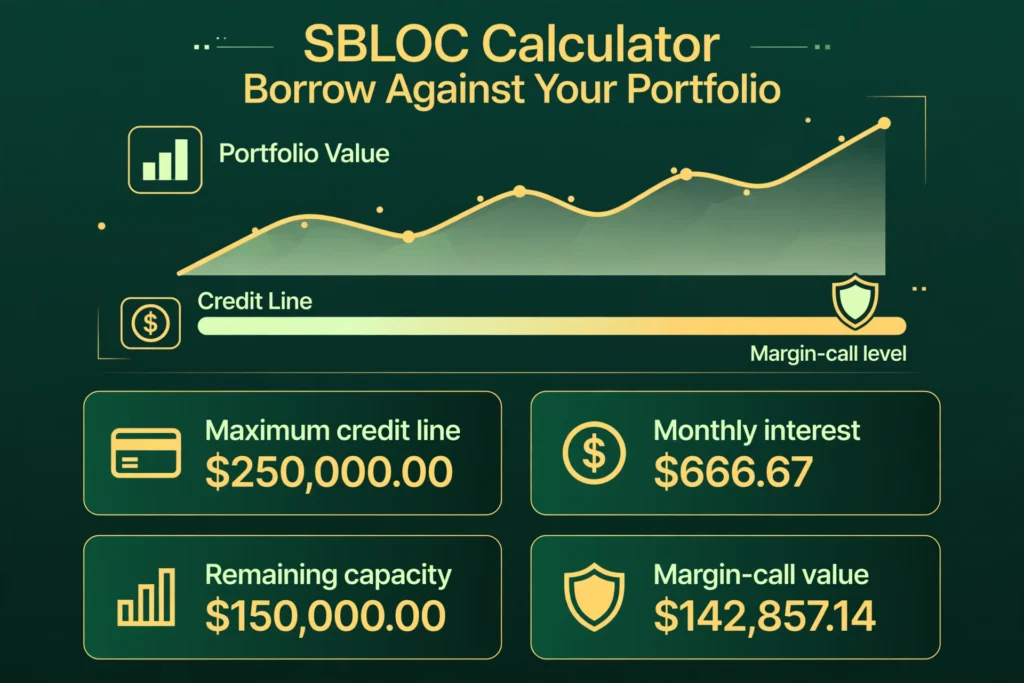
Worked example
Take a $500,000 portfolio with a 50% maximum loan-to-value, an 8% annual rate, a $100,000 draw and a 70% maintenance threshold. The maximum credit line is $250,000.00. The $100,000 draw costs $666.67 a month in interest only, or $8,000.00 a year. The remaining borrowing capacity is $150,000.00. The current loan-to-value is 20.00%.
The margin-call figure is the one to read twice. With $100,000 drawn and a 70% maintenance threshold, the portfolio would have to fall to $142,857.14 before a call. From $500,000, that is a 71.43% drop. The buffer is wide because the draw is small relative to the portfolio.
Change one input and the picture changes. Draw $800,000 from a $2,000,000 portfolio at 65% loan-to-value and 7.25%, with a 75% maintenance threshold, and the maximum line is $1,300,000.00, the monthly payment is $4,833.33, the annual interest is $58,000.00, and $500,000.00 of capacity remains. The margin-call value is $1,066,666.67, so the portfolio can fall 46.67% before a call — a narrower buffer, because the draw is 40.00% of the portfolio rather than 20.00%.
Draw the full line and the buffer nearly vanishes. A $100,000 portfolio at 50% loan-to-value with a $50,000 draw at 6.5% has a maximum line of $50,000.00, a monthly payment of $270.83, and $0.00 of remaining capacity. The margin-call value is $71,428.57, so the portfolio only has to fall 28.57% before a call. That is the cost of borrowing the maximum: there is no room left for the market to move against you.
This page gives general information about securities-based lines of credit and how the numbers work. It is not financial advice, tax advice or a recommendation to borrow against securities, and it does not take your full situation into account. A margin call can force the sale of your securities, sometimes without notice. Lending terms, advance rates, maintenance thresholds and interest rates vary by lender and change over time. Check the terms of any loan agreement with the lender and speak to a qualified financial adviser before borrowing against a portfolio.
How much can I borrow with an SBLOC?
It depends on your portfolio value and the loan-to-value your lender allows. For a diversified equity portfolio, advance rates of 50% to 70% are commonly cited, so a $500,000 portfolio supports a credit line of $250,000 to $350,000. U.S. Treasuries can support up to 95%, while concentrated or volatile holdings support less. Enter your own numbers in the calculator above for a figure based on your portfolio.
What is the monthly payment on an SBLOC?
Most SBLOCs are interest-only, so the monthly payment is the amount drawn multiplied by the annual rate, divided by 12. A $100,000 draw at 8% costs $666.67 a month, and $8,000.00 a year. The payment covers interest only, so the amount drawn stays owed until you repay it.
What is a margin call on an SBLOC?
A margin call is the lender’s demand to restore the collateral ratio when the pledged portfolio has fallen too far. You must deposit more cash, pledge more securities or repay part of the loan, usually within two to three days. If you cannot, the lender can sell your securities and keep the cash, sometimes without notice.
How far can my portfolio fall before a margin call?
Divide the amount drawn by the maintenance threshold to find the portfolio value where a call triggers. With $100,000 drawn and a 70% maintenance threshold, the call triggers at $142,857.14. From a $500,000 portfolio that is a 71.43% fall. Drawing less widens the buffer.
Can I use an SBLOC to buy stocks?
No. An SBLOC is a non-purpose loan, and the proceeds may not be used to purchase or trade securities. The money can be used for other purposes, such as buying real estate, funding a business, paying a tax bill or covering a large personal expense.
Is an SBLOC the same as debt consolidation?
No. An SBLOC is a revolving, interest-only line of credit secured by an investment portfolio, with margin-call risk and a variable rate. A debt-consolidation loan is a fixed-term instalment loan that rolls several debts into one payment. An SBLOC can be used to repay other debts, but it is not a debt-consolidation product.