Savings Calculator Online
Savings Calculator Online
Set a savings goal and a deadline — find the monthly deposit that gets you there.
A savings calculator online that solves for your goal tells you the exact monthly deposit needed to reach a chosen target by a chosen date. Enter your target amount, what you have already saved, the annual interest rate and the number of years, and it works out the monthly deposit, the total you will pay in, and the interest your money earns along the way.
What is a savings calculator online?
A savings calculator online is a planning tool that projects how a savings balance grows from a starting deposit, an interest rate, and regular contributions. Most versions of it work forwards: you type in a monthly deposit and the calculator tells you the balance you end up with. This page works the other way round. You start with the target — $10,000 for a holiday, $15,000 for an emergency fund, $60,000 for a house deposit — and the calculator works backwards to the monthly deposit that reaches it on time.
That direction matters, because it matches how people actually plan. A goal has a fixed number attached to it: the price of the car, the deposit the bank wants, the cushion that covers six months of bills. Nobody knows in advance what monthly deposit they can afford and then wonders what it grows into; they know the number they need and want to know what it costs per month. A goal solver answers that question directly, in one number, instead of making you guess a deposit and check the result over and over.
The calculator on this page uses monthly compounding, which is how most savings accounts add interest, and it assumes each deposit lands at the end of the month. It takes four inputs: the savings goal, the starting balance, the annual interest rate, and the time in years. From those it gives four results: the monthly deposit needed, the total deposits over the whole term, the interest earned, and a future-value check that proves the plan actually lands on the target.
How much do I need to save each month?
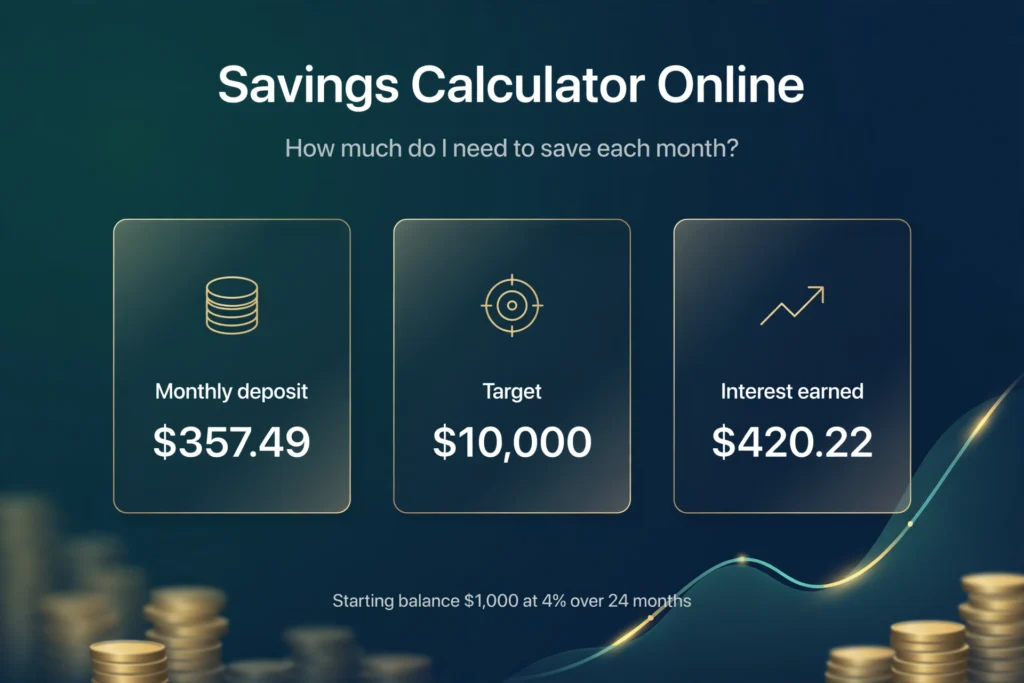
Take the worked example on this page: a $10,000 goal, $1,000 already saved, a 4% annual rate, and 2 years to get there. The answer is $357.49 a month. Over 24 months that is $8,579.76 of your own money, and interest adds $420.22, so the plan lands at $9,999.98 — two cents short of the target, because the monthly amount is rounded to the nearest cent. Add two cents to the final deposit and the goal is met exactly.
The same question at other amounts follows the same pattern. A $12,000 goal from nothing at 0% over 3 years needs $333.33 a month — a plain division, $12,000 divided by 36 months. A $15,000 emergency fund from a $2,000 start at 4% over 3 years needs $333.81 a month. A $50,000 goal from a $5,000 start at 5% over 10 years needs $268.96 a month, and interest does more than a quarter of the work there — $12,724.57 of the $50,000. A $60,000 house deposit from a $10,000 start at 4.5% over 5 years needs $707.15 a month.
Every one of those figures comes from the same formula, and the table below lists the monthly deposit for a $10,000 goal from nothing at 4%, for terms from one year to ten. Find your goal and your deadline in the table and you have the monthly number without typing anything.
How does the monthly deposit formula work?
The formula has three steps, and each one is easy to follow. First, turn the annual rate into a monthly rate by dividing by 12, and turn the years into months by multiplying by 12. At 4% a year over 2 years, the monthly rate is 0.04 ÷ 12, which is 0.003333, and the number of months is 24.
Second, work out what the starting balance grows to on its own. The $1,000 starting balance at 4% for 24 months grows to $1,000 × (1.003333)^24, which is $1,083.14. That leaves $10,000 − $1,083.14, or $8,916.86, for the deposits to cover.
Third, spread that remaining amount over the monthly deposits, allowing for the interest each deposit earns. A deposit made in the first month earns interest for 23 more months; a deposit made in the last month earns none. The formula that accounts for all of that is PMT = (T − S × (1 + i)^n) × i ÷ ((1 + i)^n − 1), where T is the target, S is the starting balance, i is the monthly rate and n is the number of months. For the worked example: PMT = (10,000 − 1,083.14) × 0.003333 ÷ ((1.003333)^24 − 1) = 8,916.86 × 0.003333 ÷ 0.08314 = $357.49 a month.
The future-value check runs the formula in reverse. It takes the starting balance grown to the end, adds the deposits grown to the end, and confirms the total equals the target: $1,083.14 + $357.49 × ((1.003333)^24 − 1) ÷ 0.003333 = $9,999.98. The two-cent gap is rounding, not an error — the monthly deposit is shown to the nearest cent, and 24 deposits of $357.49 total $8,579.76 instead of the unrounded $8,579.78.
What happens if the interest rate is zero?
With no interest, the whole calculation collapses to a division: the amount still to save, divided by the number of months. A $12,000 goal from nothing over 3 years is $12,000 ÷ 36, which is $333.33 a month. A $10,000 goal from nothing over 1 year is $10,000 ÷ 12, which is $833.33 a month. A $10,000 goal from nothing over 5 years is $10,000 ÷ 60, which is $166.67 a month.
The zero-rate case is worth knowing for two reasons. First, it is the honest baseline: it is what the goal costs when the money earns nothing, which is close to reality for money kept in a checking account or a drawer. Second, it shows exactly how much the interest rate is worth. At 4% over 5 years, the $10,000 goal needs $150.83 a month instead of $166.67 — interest covers $950.09 of the goal. At 6% over 5 years it needs $143.33 a month, and interest covers $1,400.32. The rate never changes the answer by a huge amount over a short term, but over a long term it does real work.
This calculator handles a zero rate as a separate case rather than dividing by zero. Enter 0% and it divides the remaining amount by the months, with no error and no strange result. Short goals under a year also work: a $1,000 goal from nothing at 3% over 6 months needs $165.63 a month, and interest adds only $6.23 — over six months, the rate barely matters, and the monthly number is close to the no-interest figure of $166.67.
What if I already have enough saved?
If the starting balance is already at or above the target, the monthly deposit is $0.00 and no deposits are needed at all. A $6,000 starting balance against a $5,000 goal at 4% over 5 years needs nothing more from you. Left alone, the $6,000 grows to $7,325.98 by the deadline, so the interest earned on the starting balance is $1,325.98 and the plan ends $2,325.98 above the target.
That case is not a trick question — it comes up in real plans. Someone saving for a $5,000 holiday who already has $6,000 in the account does not need a monthly deposit; they need to know the goal is already met and the money is still growing. The calculator says so plainly instead of returning a negative deposit, which would be meaningless. A negative monthly deposit would mean taking money out, and that is a different question entirely.
The same logic applies when the starting balance exactly equals the target. A $5,000 start against a $5,000 goal at 4% over 2 years needs a $0.00 monthly deposit, and the balance grows to $5,415.71 on its own. If the goal is already met, the useful question becomes what to do with the extra — move the deadline earlier, raise the target, or leave the money where it is.
How much do I need to save each month for common goals?
The table below gives the monthly deposit for a $10,000 goal starting from nothing, at 4% a year with monthly compounding. Every figure was computed from the same formula this calculator uses.
| Years | Monthly deposit | Total deposits | Interest earned |
| 1 | $818.17 | $9,817.99 | $182.01 |
| 2 | $400.92 | $9,621.98 | $378.02 |
| 3 | $261.91 | $9,428.63 | $571.37 |
| 5 | $150.83 | $9,049.91 | $950.09 |
| 10 | $67.91 | $8,149.42 | $1,850.58 |
Two patterns stand out. First, doubling the time more than halves the monthly amount. One year needs $818.17 a month; two years needs $400.92, which is less than half of $818.17. Five years needs $150.83; ten years needs $67.91, again less than half. The extra time does two things at once: it spreads the deposits over more months, and it gives interest more time to work.
Second, interest earns a bigger share as the term grows. Over one year, interest adds $182.01 — under 2% of the goal. Over ten years it adds $1,850.58 — more than 18% of the goal. The monthly deposit falls from $818.17 to $67.91, a drop of more than 90%, while the term only grows tenfold. That is why the same goal feels so different at different deadlines: time is doing most of the work.
To scale the table to another goal, multiply. A $5,000 goal needs half the monthly deposit of a $10,000 goal at the same rate and term; a $20,000 goal needs double. A $20,000 goal over 5 years at 4% needs $301.66 a month, and a $5,000 goal over 5 years at 4% needs $75.42 a month. The table is a starting point, and the calculator above gives the exact figure for any goal you type in.
How does the interest rate change the monthly amount?
The rate changes the monthly deposit, but less than most people expect over short terms. The table below shows a $10,000 goal from nothing over 5 years at four rates.
| Annual rate | Monthly deposit | Total deposits | Interest earned |
| 0% | $166.67 | $10,000.00 | $0.00 |
| 2% | $158.61 | $9,516.66 | $483.34 |
| 4% | $150.83 | $9,049.91 | $950.09 |
| 6% | $143.33 | $8,599.68 | $1,400.32 |
Moving from 0% to 6% cuts the monthly deposit from $166.67 to $143.33 — a saving of $23.34 a month, or about 14%. Each extra two points of rate saves roughly $8 a month on this goal and term. The rate matters, but it does not transform a goal you cannot afford into one you can. The deadline and the goal itself matter far more.
That is why the rate you enter should be one your account actually pays. The FDIC national average savings rate was 0.38% APY in October 2026, while top high-yield savings accounts paid roughly 3.90–4.27% APY around the same time. At 0.38%, a $10,000 goal over 5 years needs about $165 a month — barely different from the 0% figure. At 4%, it needs $150.83. The gap between an ordinary account and a high-yield account is real money, but it is tens of dollars a month on a goal this size, not hundreds. Use the rate your own bank quotes, and remember that savings rates change — the result is a plan under one fixed rate, not a promise.
What difference does a starting balance make?
Money already saved is the cheapest part of any goal, because it has the longest time to earn interest and it directly reduces what the deposits must cover. The table below shows a $10,000 goal at 4% with a $1,000 starting balance, for the same terms as the table above.
| Years | Monthly deposit |
| 1 | $733.02 |
| 2 | $357.49 |
| 3 | $232.38 |
| 5 | $132.42 |
| 10 | $57.79 |
Against the from-nothing table, the $1,000 start saves $85.15 a month over one year ($818.17 down to $733.02) and $10.12 a month over ten years ($67.91 down to $57.79). The saving is biggest over short terms, because over one year the $1,000 has little time to grow — it mostly just subtracts from the amount the deposits must cover. Over ten years it grows to $1,490.83 on its own, so it does more work, but the monthly deposit is already small by then.
The lesson is practical: any lump sum you can put in at the start — a tax refund, a bonus, money moved from another account — cuts the monthly number straight away. It does not have to be large. Even $1,000 against a $10,000 goal cuts the two-year monthly deposit from $400.92 to $357.49, a saving of $43.43 every month.
How does time change the monthly deposit?
Time is the strongest lever in the whole calculation, stronger than the rate and stronger than the starting balance. Stretching a $10,000 goal at 4% from 1 year to 2 years cuts the monthly deposit from $818.17 to $400.92. Stretching it from 5 years to 10 years cuts it from $150.83 to $67.91. Each doubling of the term more than halves the monthly amount, because the extra months both spread the deposits thinner and give interest longer to compound.
That cuts both ways. Shortening a deadline is expensive. Moving a $10,000 goal from 5 years to 3 years raises the monthly deposit from $150.83 to $261.91 — an extra $111.08 a month. Moving it from 3 years to 1 year raises it from $261.91 to $818.17 — an extra $556.26 a month. When a monthly number looks too high, the honest fix is usually to move the deadline rather than to abandon the goal. A goal that needs $818.17 a month over one year needs $150.83 a month over five years, and the goal itself has not changed at all.
There is a limit to this, and it is worth saying directly. Stretching a deadline only helps if the money stays saved. A ten-year plan that gets raided in year three for something else is not a ten-year plan. The monthly deposit the calculator gives assumes every deposit lands on schedule and nothing is withdrawn. If the deadline is far away, the plan needs to survive that long untouched.
What is the difference between a savings goal calculator and a compound interest calculator?
The two tools answer opposite questions. A compound interest calculator grows one lump sum that is left alone: it tells you what $10,000 becomes after 20 years at a fixed rate, with no new deposits during the term. The FV Annuity Calculator on this site works in the other forward direction: you enter a monthly payment and it tells you the future value, so $500 a month for 30 years at 7% grows to $609,985.50. Both start with what you put in and work out what you end up with.
This page starts with what you want to end up with and works out what to put in. The target is the input and the monthly deposit is the output. If you already know the deposit you can afford and want to see where it leads, the FV Annuity Calculator is the right tool. If you know the target and the deadline and want to know the deposit, this page is the right tool. The two are mirror images of the same maths, and the future-value check on this page is the same formula the FV Annuity Calculator uses, run in reverse to prove the plan lands on the target.
A compound interest calculator cannot answer a goal question at all, because it has no place to enter a monthly deposit. And a goal solver cannot tell you what a lump sum becomes, because it has no place to enter a deposit you already plan to make. Pick the tool that matches the question you are actually asking.
How do I pick a savings goal I can actually reach?
Start with the goal that protects you first. An emergency fund was the most commonly cited savings goal in NerdWallet’s April 2026 savings report, with 45% of Americans surveyed setting money aside for one. The usual guideline is enough to cover three to six months of essential spending — not three to six months of income, but of the bills that cannot wait. A $15,000 emergency fund from a $2,000 start at 4% over 3 years needs $333.81 a month, which is one of the worked examples above.
Next, check the monthly number against what actually lands in your account. The Take Home Pay Calculator works out your net pay after tax and deductions, so the monthly deposit is measured against real money rather than a salary figure. Then compare the deposit with the 50/30/20 budget guideline: 50% of after-tax income to needs, 30% to wants, and 20% to savings and extra debt payments. On a $50,000 salary, 20% is $833 a month — enough to cover a $10,000 goal in a year at 4% with room to spare. If 20% is out of reach today, start lower and raise it a point or two every few months, or every time pay rises. A plan that survives is worth more than a plan that looks good for a month and then stops.
For longer goals, the order matters. An employer retirement match comes before extra saving, because it is an instant return no savings account can match — the Matching 401K Calculator shows what an employer match adds to a retirement account. High-interest debt usually comes before a long-term savings goal too, because the interest on the debt is almost always higher than the interest on the savings. After the match and the expensive debt, the emergency fund comes next, and only then the longer goals: a house deposit, a car, a holiday.
Retirement goals work differently from savings goals, because the target is not a fixed price but a yearly income. The 4 Percent Rule Calculator turns a yearly spending figure into a retirement target, and that target is usually far larger than a savings goal — which is why retirement saving runs for decades, where the interest share of the final number is at its largest. For goals with a fixed price and a fixed date, this page is the right tool.
What mistakes do people make when planning savings?
The most common mistake is entering the annual rate as the monthly rate. A 4% annual rate with monthly deposits needs a monthly rate of 0.04 ÷ 12, which is 0.003333, and 24 periods for two years — not 4% and 2 periods. Using 4% as the monthly rate and 2 as the number of periods produces a monthly deposit tens of thousands of times too small, and it looks plausible until it is checked. This calculator does the conversion for you, but anyone checking the maths by hand should watch for it.
The second mistake is forgetting the starting balance. Money already saved reduces the monthly deposit directly, and leaving it out inflates the answer. The $10,000 goal over 2 years at 4% needs $400.92 a month from nothing and $357.49 a month with a $1,000 start. Forgetting $1,000 already saved costs $43.43 a month for no reason.
The third mistake is treating the rate as a guarantee. The calculator assumes one fixed rate for the whole term. Real savings rates change, and banks can raise or lower them at any time. A plan worked out at 4% that actually earns 0.38% — the FDIC national average in October 2026 — will land short. Run the numbers at the lowest rate you might realistically earn as well as the highest, and see how much the monthly deposit moves.
The fourth mistake is ignoring tax. Interest earned on a savings account is taxed as ordinary income, so the rate that actually compounds is the rate after tax, not the rate the bank quotes. At a 4% rate and a 22% tax rate, the effective rate is closer to 3.1%. The calculator does not subtract tax, and neither do most of the pages that rank for this keyword, so treat the interest figure as before tax.
The fifth mistake is setting a monthly deposit that leaves no room for life. A deposit that takes every spare dollar works until the first unexpected bill, and then the plan stops. A smaller deposit that survives for the whole term beats a larger one that lasts two months. If the monthly number the calculator gives is more than you can hold, move the deadline — the goal stays the same, and the monthly number falls.
How do I use this savings calculator online?
Enter your savings goal first — the total amount you want to have by the deadline. Then enter your starting balance, the money already set aside for this goal. Leave it at zero if you are starting from nothing. Enter the annual interest rate as a percentage: 4 means 4% a year, not 0.04. Enter the time in years; half years work too, so 0.5 means six months.
Press the button, or just keep typing — the calculator updates as you change any number. The four result boxes show the monthly deposit needed, the total deposits over the whole term, the interest earned, and a future-value check that proves the plan lands on the target. The note under the results explains what the numbers mean for your exact inputs, including the case where your starting balance already covers the goal. The defaults — a $10,000 goal, a $1,000 starting balance, 4%, 2 years — give $357.49 a month, so you can see a worked result before typing anything.
To compare two plans, run the first set of numbers, note the monthly deposit, then change one input and run it again. Changing only the rate, only the term or only the starting balance shows exactly what that one change is worth. If you want to see more tools in the same style, the calculators category page lists the full set of calculators on this site.
Worked example
Take the goal most people type in first: $10,000 in 2 years, starting from $1,000, at 4% a year. The monthly rate is 0.04 ÷ 12, which is 0.003333, and the number of months is 24. The $1,000 starting balance grows to $1,083.14 on its own. The deposits must cover the remaining $8,916.86, and the formula gives a monthly deposit of $357.49. Over 24 months that is $8,579.76 of your own money, interest adds $420.22, and the plan lands at $9,999.98 — two cents short because the monthly amount is rounded to the cent, so add two cents to the final deposit.
Now the same goal with no starting balance and no interest. $10,000 over 2 years at 0% is $10,000 ÷ 24, which is $416.67 a month. The $1,000 start and the 4% rate together save $59.18 a month against that baseline. Stretch the same goal to 5 years at 4% and the monthly deposit falls to $150.83, with interest covering $950.09 of the goal. Stretch it to 10 years and the deposit is $67.91 a month, with interest covering $1,850.58.
A bigger goal shows the same pattern at a larger scale. A $60,000 house deposit from a $10,000 start at 4.5% over 5 years needs $707.15 a month. The starting balance grows to $12,517.96 on its own, the deposits total $42,429.00, and interest adds $7,570.94. And an emergency fund of $15,000 from a $2,000 start at 4% over 3 years needs $333.81 a month, with $982.77 of interest. One formula, any goal, and the same check at the end: the plan lands on the target.
This page gives general information about saving towards a goal. It is not financial advice, and it does not take your income, debts, tax position or other circumstances into account. Savings rates change, and the figures here assume one fixed rate and deposits made on schedule.
How much do I need to save each month to reach $10,000?
It depends on your starting balance, the interest rate and the deadline. From nothing at 4% a year, $10,000 takes $818.17 a month over 1 year, $400.92 over 2 years, $261.91 over 3 years, $150.83 over 5 years and $67.91 over 10 years. With a $1,000 starting balance at 4%, the 2-year figure falls to $357.49 a month. Enter your own numbers in the calculator above for the exact figure.
How do you calculate the monthly deposit for a savings goal?
Divide the annual rate by 12 to get the monthly rate, multiply the years by 12 to get the months, then use PMT = (T − S × (1 + i)^n) × i ÷ ((1 + i)^n − 1), where T is the target, S is the starting balance, i is the monthly rate and n is the number of months. With a zero rate it is a plain division: (T − S) ÷ n. For a $10,000 goal from a $1,000 start at 4% over 2 years, that gives $357.49 a month.
What interest rate should I use in a savings calculator?
Use the rate your own bank actually pays. The FDIC national average savings rate was 0.38% APY in October 2026, while top high-yield savings accounts paid roughly 3.90–4.27% APY around the same time. Rates change, so a plan worked out at 4% that actually earns less will land short — run the numbers at the lowest rate you might realistically earn as well.
What happens if I already have more saved than my goal?
The monthly deposit is $0.00 — no deposits are needed. A $6,000 starting balance against a $5,000 goal at 4% over 5 years grows to $7,325.98 on its own, so the interest earned on the starting balance is $1,325.98 and the plan ends above the target. This calculator says so plainly instead of returning a negative deposit.
Does the monthly deposit change if I save for longer?
Yes, and by more than the extra time alone would suggest. A $10,000 goal at 4% needs $818.17 a month over 1 year, $400.92 over 2 years, $150.83 over 5 years and $67.91 over 10 years — each doubling of the term more than halves the monthly amount, because the extra months both spread the deposits thinner and give interest longer to work. When a monthly number looks too high, moving the deadline is usually the honest fix.
Is a savings goal calculator the same as a compound interest calculator?
No. A compound interest calculator grows one lump sum left alone and tells you what it becomes. A savings goal calculator starts with the target and works out the monthly deposit that reaches it. The FV Annuity Calculator on this site works in the forward direction — a monthly payment in, a future value out — while this page works in reverse: a target in, a monthly deposit out.