Rounding Calculator
Rounding Calculator
Enter a number, pick the place to round to, and see the rounded value, the digit that decided it, and the reason why.
This tool uses half-up rounding. A deciding digit of 5 or more rounds up; 4 or less rounds down.
Rounding means replacing a number with a nearby number that is shorter and easier to work with. The rounded number is not exact, and that is the point. It keeps enough of the original value to be useful, and it drops the rest so the number fits the job at hand: a price tag, a school answer, a measurement, or a quick estimate.
A rounded number is a promise about precision. When a shop price reads 12.69, the two digits after the point say the amount is exact to the cent. When a road sign says a town is 30 miles away, the zero says the distance is approximate, not measured to the mile. Rounding is how those two messages get written, and the rule behind them is the same in both cases.
How do you round to the nearest hundredth?
Look at the digit in the thousandths place, the third digit after the decimal point. If that digit is 5 or more, add 1 to the hundredths digit. If it is 4 or less, leave the hundredths digit alone. Then drop every digit after the hundredths place, keeping the trailing zero if the answer needs two decimal places.
Take 113.097, the number many readers arrive here to check. The hundredths digit is 9, the second digit after the point. The thousandths digit is 7, the digit right after it. Since 7 is 5 or more, the 9 rounds up. Nine plus one is ten, so the 9 becomes 0 and 1 carries into the tenths place, turning the 0 there into 1. The answer is 113.10, written with the trailing zero because rounding to the nearest hundredth always shows two digits after the point.
The same steps work on any decimal. To round 3.14159 to the nearest hundredth, find the hundredths digit, 4, and the thousandths digit, 1. One is less than 5, so the 4 stays and the rest drops away, giving 3.14. To round 12.685 to the nearest hundredth, the hundredths digit is 8 and the thousandths digit is 5, so the 8 rounds up to 9 and the answer is 12.69. To round 4.0962, the hundredths digit is 9 and the thousandths digit is 6, so the 9 rounds up with a carry and the answer is 4.10.
Rounding to the nearest hundredth is the same as rounding to two decimal places. The two phrases describe one job, and money is where most people meet it: prices, bills and bank balances are kept to two decimal places because a cent is one hundredth of a dollar, a pound or a euro.
What does rounding mean, exactly?
Rounding replaces a number with the closest number that fits a chosen level of detail. The chosen level is called the place you are rounding to. It can be a decimal place, such as the nearest tenth or hundredth, or a whole-number place, such as the nearest ten or hundred.
Every rounding job has three parts. First, the place you keep. Second, the deciding digit, which is the first digit you drop. Third, the rule that turns the deciding digit into a decision: 5 or more rounds the kept digit up, and 4 or less leaves it alone. Nothing else decides the answer. Digits further to the right do not get a vote, and the size of the number does not change the rule.
The result is always one of the two neighbours at the chosen place. Rounding 113.097 to the nearest hundredth picks between 113.09 and 113.10, and 113.097 sits closer to 113.10. Rounding 2,847 to the nearest hundred picks between 2,800 and 2,900, and 2,847 sits closer to 2,800. Thinking of it as a choice between two neighbours makes the carry cases less strange: 9.995 to the nearest hundredth picks between 9.99 and 10.00, and it lands on 10.00.
How does the half-up rule work?
Half-up rounding is the rule this calculator uses, and it is the rule most schools teach. When the deciding digit is 5 or more, round up. When it is 4 or less, round down. An exact half, such as 2.5 rounded to the nearest whole number, rounds up to 3.
The word “up” here means away from zero in size. A negative number follows the same rule on its size: -2.5 rounded to the nearest whole number is -3, and -47.86 rounded to the nearest tenth is -47.9, because the deciding digit 6 rounds the size up. The sign stays with the number, and the size moves the same way it would for a positive number.
Half-up is not the only rule in use. Banker’s rounding, also called half to even, handles exact halves differently: 2.5 rounds to 2, and 3.5 rounds to 4, because each half goes to the nearest even number. Some computer programs and some financial systems use banker’s rounding because it spreads exact halves evenly instead of always pushing them up. This tool does not use banker’s rounding, and its answers will differ from a banker’s rounding tool only on exact halves such as 2.5, 12.685 at a coarser place, or 0.5. On every other number the two rules agree.
The reason schools teach half-up is that it is easy to state, easy to check by hand, and easy to remember: five or more goes up. If a teacher, an exam board or a workplace standard asks for a different rule, follow that rule for that job, and say which rule was used. The rule matters most exactly where it changes the answer, which is on halves.
How do I round to the nearest tenth and thousandth?
The method never changes, only the place. For the nearest tenth, keep one digit after the point and look at the second. For the nearest thousandth, keep three digits after the point and look at the fourth.
Rounding 7.46 to the nearest tenth shows the method in its shortest form. The tenths digit is 4 and the hundredths digit is 6. Six is 5 or more, so the 4 rounds up to 5 and the answer is 7.5. Rounding 113.097 to the nearest tenth gives 113.1, because the hundredths digit is 9. Rounding the same number to the nearest thousandth gives 113.097 unchanged, because there is no fourth decimal digit to force a change, and the number already has exactly three digits after the point.
The thousandth place turns up in measurements more than in money. A length of 3.14159 inches rounded to the nearest thousandth is 3.142, and a dose or a laboratory reading kept to three decimal places is rounded the same way. The extra digit is kept only when the measurement behind it is real: rounding to the thousandth does not make a rough measurement precise, it only writes the rough measurement with more digits.
A useful check works for any decimal place. Cover the digits after the place you are keeping, and look at the first covered digit. That one digit decides everything. If it is 5 or more, the last digit you can see goes up by one. If it is 4 or less, nothing changes. The rest of the covered digits can be ignored, because they have already had their say through that first digit.
How do I round to the nearest ten, hundred and thousand?
Whole-number rounding uses the same rule, with zeros filling the places that are dropped. To round to the nearest ten, look at the ones digit. To round to the nearest hundred, look at the tens digit. To round to the nearest thousand, look at the hundreds digit.
Take 2,847. To the nearest ten, the ones digit is 7, so the tens digit rounds up and the answer is 2,850. To the nearest hundred, the tens digit is 4, so the hundreds digit stays and the answer is 2,800. To the nearest thousand, the hundreds digit is 8, so the thousands digit rounds up and the answer is 3,000. One number, three answers, each correct for the place that was asked for.
The zeros are part of the answer, not decoration. Writing 2,800 instead of 28 keeps the size of the number, and that is why a common slip is to drop the zeros and write 28. The rounded number must stay in the same range as the original: 2,847 rounded to the nearest hundred is near 2,800, not near 28.
Carries happen here too. Rounding 950 to the nearest hundred gives 1,000, because the tens digit is 5, the 9 rounds up to 10, and the 1 carries into the thousands place. Rounding 1,256 to the nearest ten gives 1,260, and to the nearest thousand gives 1,000, because the hundreds digit is 2. Rounding 500 to the nearest thousand gives 1,000, because 500 is exactly halfway between 0 and 1,000 and half-up rounds it up. Rounding 499 to the nearest thousand gives 0, because 499 is below the halfway mark.
Large places are used for estimates: crowds, budgets, distances and populations. A crowd of 2,847 people is “about 2,800” or “about 3,000” depending on how rough the estimate needs to be, and the rounding place is what sets how rough.
What are significant figures and how do I round to them?
Significant figures count meaningful digits, starting from the first digit that is not zero. Decimal places count digits after the point. The two ideas answer different questions, and mixing them up is one of the most common rounding mistakes.
Leading zeros are never significant, because they only place the decimal point. In 0.00000086372743, the first significant figure is 8, the second is 6, and the zeros before them do not count. Rounding that number to 2 significant figures keeps the 8 and the 6, looks at the next digit, 3, and leaves the 6 alone, giving 0.00000086. To 3 significant figures it keeps 8, 6 and 3, looks at the 7, rounds the 3 up to 4, and gives 0.000000864.
The same count works on large numbers. Rounding 4,567 to 2 significant figures keeps the 4 and the 5, looks at the 6, rounds the 5 up, and gives 4,600. Rounding 3,266.528 to 2 significant figures keeps the 3 and the 3, looks at the 6, rounds up, and gives 3,300. Rounding 12.345 to 2 significant figures keeps the 1 and the 2, looks at the 3, and gives 12.
Significant figures matter most in science, where the number of digits claims a precision the measurement must actually have. A reading of 0.004567 rounded to 2 decimal places would become 0.00, which destroys the measurement entirely. Rounded to 2 significant figures it becomes 0.0046, which keeps what the measurement actually said. That is the practical difference: decimal places fix the position after the point, while significant figures fix how many meaningful digits survive, wherever the point falls.
Zeros inside a number, and zeros after a decimal point that follow a non-zero digit, are significant. In 113.10 the trailing zero is significant: it says the measurement was recorded to the hundredth, not merely to the tenth. That is why the tool writes 113.10 and not 113.1. The extra zero carries information, and dropping it changes what the number claims.
How do I round money to the nearest cent?
Money is rounded to the nearest hundredth, because one cent is one hundredth of the main unit. A price of 19.995 rounds to 20.00, and a bill of 4.0962 rounds to 4.10. The trailing zeros stay, because 20.00 and 4.10 are amounts to the cent, while 20 and 4.1 are not written as money.
Two habits keep money rounding honest. First, round once, at the end. Adding up unrounded figures and rounding the total gives a fairer answer than rounding every line first and then adding the rounded lines, because each early rounding adds a small error and the errors pile up. Second, keep the full figures during a calculation and round only when the number is shown or paid. A Percentage Calculator result, for example, should be worked out in full and rounded to cents at the last step, not rounded halfway through.
Cash changes the picture in some countries. Where 1-cent coins no longer circulate, cash totals are rounded to the nearest 5 cents at the till, while card payments still use the exact cent figure. The rounding rule is the same; only the place changes, from the nearest cent to the nearest 5 cents.
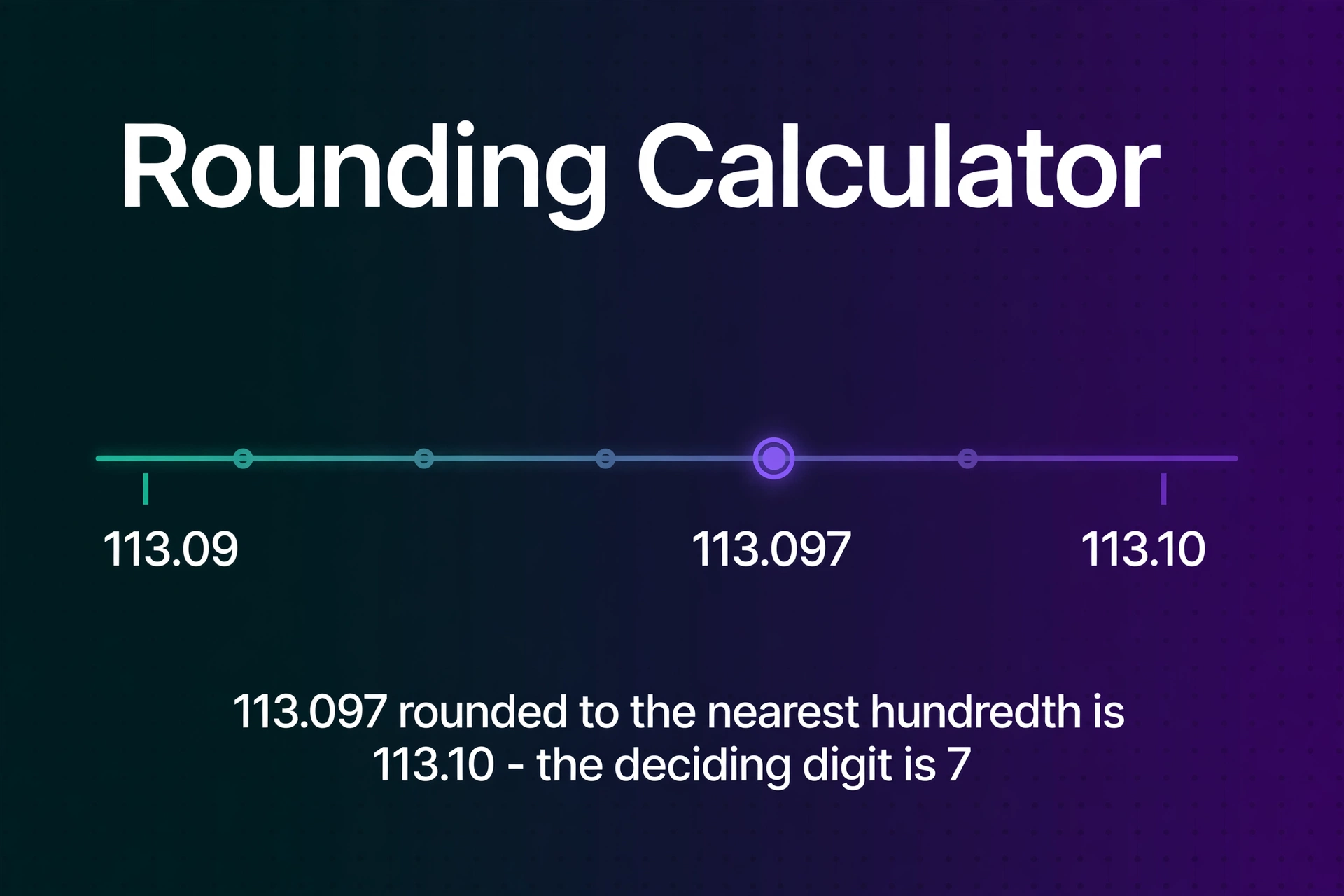
Why does 113.097 round to 113.10 and not 113.09?
Because only the thousandths digit decides, and it is 7. The hundredths digit is 9, and 7 is 5 or more, so the 9 must go up. Going up from 9 means carrying, and the carry is what turns 113.09 into 113.10.
A reader who answers 113.09 has usually looked at the wrong digit, often the 7 at the end of the number and treated it as though it belonged to the hundredths place, or has rounded the number twice: first 113.097 to 113.10 is one step, but rounding 113.097 to 113.1 and then to 113.09 would be a different, wrong path. The worked example is worth setting out in full because the carry is the part people miss.
Start with 113.097. Mark the hundredths digit: 9. Mark the deciding digit, the thousandths digit: 7. Since 7 is 5 or more, add 1 to the hundredths digit. Nine plus one is ten, so write 0 in the hundredths place and carry 1 to the tenths place. The tenths digit is 0, and 0 plus the carried 1 is 1. Drop the thousandths digit. The answer is 113.10.
The same carry pattern appears in 4.0962, which rounds to 4.10, and in 9.995, which rounds to 10.00. In each case the 9 rounds up, the carry moves left, and the answer gains a digit on the left or a zero on the right. None of these is a mistake in the tool. They are what half-up rounding does when the kept digit is 9.
How do I round negative numbers?
Round the size and keep the sign. The rule looks at the size of the number, not at its direction on the number line. Negative numbers round away from zero under the half-up rule, which is how most school teaching treats them.
So -113.097 to the nearest hundredth is -113.10, because 113.097 rounds to 113.10 and the minus sign stays. Negative 47.86 to the nearest tenth is -47.9, because the hundredths digit 6 rounds the tenths digit 8 up to 9. Negative 2.5 to the nearest whole number is -3, because 2.5 rounds up to 3 and the sign stays.
The confusion comes from the phrase “round up”, which some readers hear as “toward larger numbers on the number line”. Under that reading, -2.5 would round to -2. That is a real rounding rule, called rounding toward positive infinity, but it is not the half-up rule, and it is not what this tool does. If a job needs negative numbers to round toward zero or toward positive infinity, that needs to be stated, because the answer changes. For school work and for most everyday use, round the size and keep the sign.
What mistakes do people make when rounding?
The most common mistake is rounding twice. Rounding 113.097 to the nearest tenth gives 113.1, and rounding 113.1 to the nearest whole number gives 113, which happens to match the direct answer here. But rounding 12.345 to the nearest hundredth gives 12.35, and rounding 12.35 to the nearest tenth gives 12.4, while rounding 12.345 directly to the nearest tenth gives 12.3. The two-step path is wrong. Always round from the original number, never from an already rounded one.
The second mistake is rounding too early. A calculation carried out with rounded numbers collects a small error at every step, and the final answer can drift further from the truth than any single rounding would suggest. The fix is simple: keep every digit while working, and round only the final answer. This matters in school problems, in measurements, and in money, where a Mean Median Mode Calculator result or a SE Calculator result should be rounded at the end, not in the middle.
The third mistake is dropping trailing zeros. Writing 113.1 when the answer should be 113.10 loses the claim that the number was recorded to the hundredth. Writing 2,800 as 28 loses the size of the number altogether. Trailing zeros after the decimal point, and zeros that hold a whole-number place, are part of the answer.
The fourth mistake is using the wrong deciding digit. When rounding to the nearest hundredth, the deciding digit is the thousandths digit, not the last digit of the number and not the digit two places to the right. In 113.097 the deciding digit is 7 because it sits right after the hundredths digit. In 3.14159 the deciding digit for the nearest hundredth is 1, the third digit after the point, and the 5 and 9 further right do not matter.
The fifth mistake is treating decimal places and significant figures as the same thing. They are not, and 0.004567 shows why: 2 decimal places gives 0.00, while 2 significant figures gives 0.0046. Picking the wrong one can erase a measurement or claim a precision that was never there.
When should I round, and when should I keep every digit?
Round when the number is going to be read, quoted, paid or compared. Keep every digit while the number is still being worked on. That single sentence covers most cases.
A final answer in homework is rounded to the place the question asks for. A measurement is rounded to the precision of the instrument that made it. A price is rounded to the cent. An estimate is rounded to the nearest ten, hundred or thousand so the reader can grasp it at a glance. In each case the rounding place is chosen first, and the number follows.
Do not round in the middle of a chain of calculations. Do not round a number and then use the rounded value as though it were exact. And do not add digits that the measurement never had: writing 3.14159265 as an answer when the measurement was only made to two decimal places claims a precision that does not exist. Rounding is a way of being honest about precision, and its value is exactly that honesty.
Averages show the same point. If a set of measurements averages to 12.345 and the instrument reads to two decimal places, the honest answer is 12.35, not 12.345 and not 12. The place you round to should match the precision you actually have, and a Ratio Multipliers result or any other worked figure follows the same rule: round the answer to the precision the inputs support.
Does rounding work the same in school and in real life?
The rule is the same, and the stakes are different. In school, rounding is usually a question with one right answer, a stated place, and the half-up rule. The working is shown, the deciding digit is named, and the answer is marked right or wrong.
In real life the place is rarely stated, and choosing it is part of the job. A shopkeeper rounding to the cent, an engineer rounding a measurement to the precision of the instrument, and a writer rounding a crowd to the nearest thousand are all using the same rule at different places. The skill is not only applying the rule but picking the place that fits the reader and the purpose.
One difference is worth knowing. Some computer programs round halves to the nearest even number, which is banker’s rounding, and spreadsheet functions do not all agree on halves. A result of 2.5 in one program can become 2 and in another become 3. That is why this page states its rule in plain words at the top: half-up, with halves going away from zero. When two tools disagree on a half, the rule is usually the reason, and checking the rule settles the argument faster than retyping the number.
For more calculators in this set, see the Calculators category.
Quick-reference table
The tables below are computed from the tool and the half-up rule. The first table rounds 113.097 to every place. The second rounds 2,847 to every whole-number place. The third rounds small and large numbers to 2 significant figures.
| 113.097 rounded to | Result | Deciding digit |
|---|---|---|
| Nearest whole number | 113 | 0 (tenths) |
| Nearest tenth | 113.1 | 9 (hundredths) |
| Nearest hundredth | 113.10 | 7 (thousandths) |
| Nearest thousandth | 113.097 | 0 |
| 2,847 rounded to | Result | Deciding digit |
|---|---|---|
| Nearest ten | 2,850 | 7 (ones) |
| Nearest hundred | 2,800 | 4 (tens) |
| Nearest thousand | 3,000 | 8 (hundreds) |
| Number | 2 significant figures | Deciding digit |
|---|---|---|
| 0.00000086372743 | 0.00000086 | 3 |
| 0.004567 | 0.0046 | 6 |
| 12.345 | 12 | 3 |
| 3,266.528 | 3,300 | 6 |
| 4,567 | 4,600 | 6 |
| 999 | 1,000 | 9 |
How do you round to the nearest hundredth?
Keep two digits after the decimal point and look at the third digit, the thousandths digit. If it is 5 or more, add 1 to the hundredths digit. If it is 4 or less, leave the hundredths digit alone and drop the rest. For example, 113.097 rounds to 113.10 because the thousandths digit is 7, and 3.14159 rounds to 3.14 because the thousandths digit is 1.
What is 113.097 rounded to the nearest hundredth?
113.10. The hundredths digit is 9 and the thousandths digit is 7. Since 7 is 5 or more, the 9 rounds up, carrying 1 into the tenths place, so the answer is 113.10 with the trailing zero kept.
How do I round to 2 significant figures?
Count two meaningful digits starting from the first digit that is not zero, then look at the next digit. If it is 5 or more, round the second digit up. If it is 4 or less, leave it alone. For example, 0.00000086372743 to 2 significant figures is 0.00000086, because the third significant digit is 3.
What is the difference between decimal places and significant figures?
Decimal places count digits after the decimal point, while significant figures count meaningful digits starting from the first non-zero digit. For example, 0.004567 to 2 decimal places is 0.00, but to 2 significant figures it is 0.0046. The two answers are different because they measure different things.
How do I round to the nearest ten, hundred or thousand?
Look at the digit immediately to the right of the place you are keeping: the ones digit for the nearest ten, the tens digit for the nearest hundred, and the hundreds digit for the nearest thousand. If that digit is 5 or more, round up. If it is 4 or less, round down, and fill the dropped places with zeros. For example, 2,847 rounds to 2,850 to the nearest ten, 2,800 to the nearest hundred, and 3,000 to the nearest thousand.
What is half-up rounding, and how is it different from banker’s rounding?
Half-up rounding sends an exact half up: 2.5 rounds to 3 and -2.5 rounds to -3. Banker’s rounding, also called half to even, sends an exact half to the nearest even number: 2.5 rounds to 2 and 3.5 rounds to 4. This tool uses half-up rounding. The two rules agree on every number except exact halves.