Treadmill Steps Calculator
Turn your treadmill distance or time into steps. Enter the distance from your treadmill display or the time and speed, plus your step length or your height, and see the step count, the distance and your cadence.
A treadmill steps calculator turns a treadmill workout into a step count. It divides the distance you covered by the length of one step, and that division gives the number of steps you took. The calculator at the top works from the distance on your treadmill display, or from the time and speed if you would rather enter those, and it works out the distance in kilometres and miles and your cadence, which is your steps per minute.
How do I use the Treadmill Steps Calculator?
Choose whether to enter the distance from the treadmill display or the time and speed. If you choose distance, type the distance and pick kilometres or miles. If you choose time, type the time in minutes and the speed, and pick kilometres per hour or miles per hour. The tool works out the distance from the time and speed first, then the steps.
Then enter your step length, or tick the box to estimate it from your height instead. Type the step length in centimetres, inches or feet, or type your height in centimetres. The estimate uses your height times 0.413, which is the average ratio of step length to height. Press 'Calculate steps' to see the steps, the distance in kilometres and miles, and the cadence when you entered a time.
Five boxes appear: steps, distance in kilometres, distance in miles, time and cadence. The time and cadence show a dash when you entered a distance, because no time was given. A note under the boxes shows the working, so you can check it against your own arithmetic. It stores nothing you type.
What does a worked example look like?
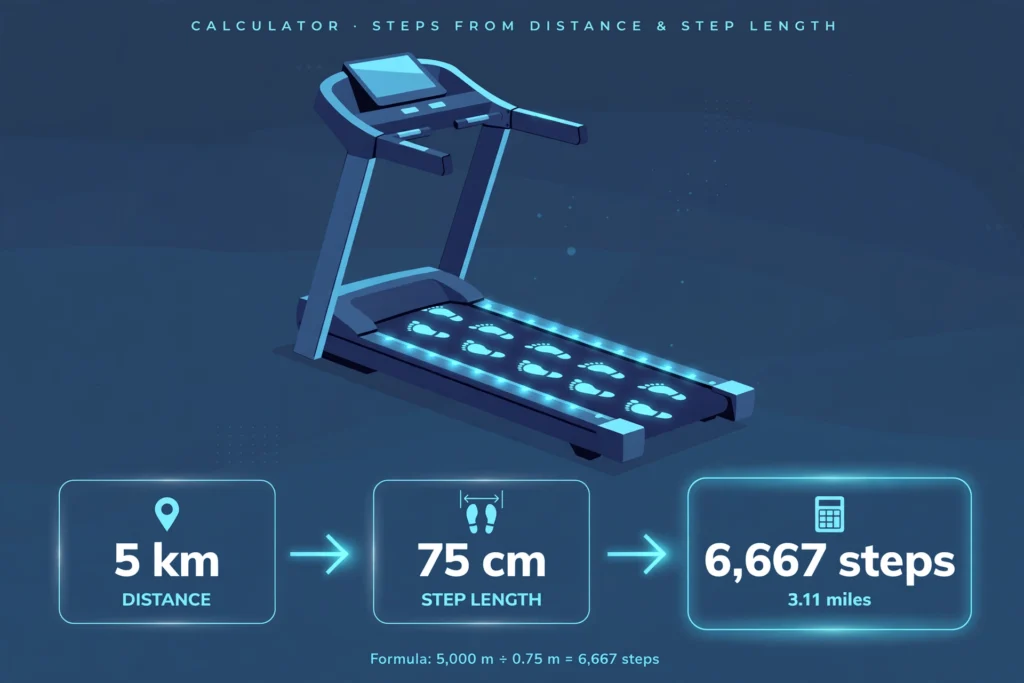
Start with the simplest case: 5 kilometres at a step length of 75 centimetres. The distance is 5,000 metres and the step length is 0.75 metres. The step count is 5,000 ÷ 0.75 = 6,666.67, which rounds to 6,667 steps. The distance is 5.00 kilometres, which is 3.11 miles. No time was entered, so the time and cadence show dashes.
Change the units and the numbers change with them. 3 miles at a step length of 2.5 feet gives 6,336 steps exactly. The distance is 3 miles, which is 4.83 kilometres, and the step length of 2.5 feet is 0.762 metres. The step count is 4,828.03 ÷ 0.762 = 6,336.26, which rounds to 6,336 steps. The note under the boxes shows the working: 4,828 m ÷ 0.762 m per step = 6,336 steps.
Try the time and speed next. 30 minutes at 6 kilometres per hour is a distance of 3 kilometres. At a step length of 75 centimetres, that is 3,000 ÷ 0.75 = 4,000 steps. The cadence is 4,000 steps over 30 minutes, which is 133 steps per minute. The distance is 3.00 kilometres, which is 1.86 miles.
A height estimate works the same way. A height of 180 centimetres gives an estimated step length of 180 × 0.413 = 74.34 centimetres, which is 0.743 metres. Walking 10 kilometres at that step length gives 10,000 ÷ 0.743 = 13,452 steps. The distance is 10.00 kilometres, which is 6.21 miles. The note under the boxes shows the estimate first: 'Estimated step length: 74.34 cm.'
A short distance works the same way. 1 mile at a step length of 80 centimetres gives 2,012 steps. The distance is 1 mile, which is 1.61 kilometres, and the step length of 80 centimetres is 0.800 metres. The step count is 1,609 ÷ 0.800 = 2,012 steps. The note shows the working: 1,609 m ÷ 0.800 m per step = 2,012 steps.
How does treadmill distance become a step count?
The calculation is a division: steps = distance ÷ step length. The distance must be in the same units as the step length, so the tool converts both to metres first. A distance in kilometres is multiplied by 1,000, a distance in miles by 1,609.344, a step length in centimetres is divided by 100, a step length in inches is multiplied by 0.0254, and a step length in feet is multiplied by 0.3048. The result is rounded to the nearest whole step, because a step is a whole thing and a fraction of a step has no meaning.
The step count is only as good as the step length. A step length that is 1 centimetre too long on a 5-kilometre walk changes the count by about 90 steps, because 5,000 ÷ 0.75 is 6,667 and 5,000 ÷ 0.76 is 6,579. Measure your step length if you want the count to be right, or use the height estimate as a starting point and adjust it until the count matches a walk you know.
What is the difference between step length and stride length?
Step length is the distance from the heel of one foot to the heel of the other foot. Stride length is the distance from the heel of one foot to the heel of the same foot again, which is two steps. A stride is about twice a step: a step length of 75 centimetres is a stride length of about 150 centimetres. This calculator uses step length, not stride length, because that is what the step count divides by.
The two are mixed up often, and the mistake doubles or halves the answer. If you enter a stride length of 150 centimetres where the tool expects a step length, the step count comes out at half the true number: 5,000 ÷ 1.50 = 3,333 steps instead of 6,667. If you enter a step length where a stride length is expected, the count doubles. Check which one your number is before you enter it.
How do I estimate my step length from my height?
Multiply your height by 0.413. That ratio is the average step length as a fraction of height, and it is the ratio the tool uses when you tick the box to estimate from height. A height of 180 centimetres gives 180 × 0.413 = 74.34 centimetres. A height of 170 centimetres gives 70.21 centimetres, and a height of 160 centimetres gives 66.08 centimetres. The estimate is an average, and your own step length may be a few centimetres either side of it.
To measure your own step length, walk 10 steps on flat ground, measure the distance from the heel of your first step to the heel of your last step, and divide by 10. Ten steps of 7.5 metres give a step length of 75 centimetres. Measure on a treadmill if you want the step length for treadmill walking, because the belt changes the stride slightly. Use that measured length in the tool for the most accurate count.
How many steps are in a mile on a treadmill?
It depends on your step length, because the step count is the distance divided by the step length. A mile is 1,609.344 metres. At a step length of 75 centimetres, a mile is 1,609.344 ÷ 0.75 = 2,146 steps. At 80 centimetres, it is 1,609.344 ÷ 0.80 = 2,012 steps. At 65 centimetres, it is 1,609.344 ÷ 0.65 = 2,476 steps. The longer your step, the fewer steps a mile takes.
The often-quoted figure of about 2,000 steps per mile is a rough average for an adult walking at a normal pace, and it assumes a step length near 80 centimetres. A shorter person with a 65-centimetre step takes about 2,476 steps per mile, and a taller person with an 85-centimetre step takes about 1,893 steps per mile. Use your own step length in the tool for a count that fits you.
What is cadence, and what is a normal cadence on a treadmill?
Cadence is the number of steps per minute, and it is the step count divided by the time in minutes. A cadence of 133 steps per minute over 30 minutes is 4,000 steps. Cadence rises with speed: a slow walk is about 100 steps per minute, a brisk walk is 120 to 130, and a run is 160 to 180. The tool shows the cadence only when you enter a time, because it needs a time to divide by.
A cadence of 100 steps per minute is a useful target for moderate exercise, and it is the pace the health guidance counts as brisk walking. A cadence of 120 steps per minute is a brisk walk, and 130 is a fast walk. Running cadence is higher, and a common target for runners is 180 steps per minute, though the right number depends on your height and speed. The cadence the tool shows is a check on your pace, not a target to chase.
Do treadmill steps match outdoor steps?
They match if the step length is the same, because the calculation is the same division. The treadmill does not change the arithmetic; it changes the step length slightly, because the belt moves under you and the stride shortens by a few centimetres. A step length measured outdoors is usually a little longer than the same person's step length on a treadmill at the same speed, so a count worked out from an outdoor step length is a little lower than the count on the belt.
The distance matters too. A treadmill measures distance from the belt speed and the time, and it assumes a constant speed. If you hold the handrail or change speed often, the distance on the display is a little off, and the step count follows it. The steps to calories calculator on this site turns a step count into the calories it burns, which is the next step after counting the steps.
Why does my treadmill step count differ from my tracker?
A wrist tracker counts steps from the swing of your arm, not from the distance you covered, and the two methods disagree when the arm does not swing. Holding the handrail, pushing a pram, or carrying a phone in the same hand all stop the arm swinging, and the tracker misses steps. The treadmill divides the distance by the step length, and that method counts every step the belt carried you through, whether or not your arm swung.
The step length is the other reason. A tracker uses its own estimate of your step length, worked out from your height and its own model, while this tool uses the step length you enter. If the tracker's estimate is 70 centimetres and your true step length is 75 centimetres, the tracker counts about 7% more steps than the tool for the same distance. Enter your measured step length here for a count that fits you, and compare the tracker's count against it.
What mistakes do people commonly make?
- Mixing up step length and stride length. A stride is two steps, so entering a stride length where a step length is expected halves the count. Check which one your number is before you enter it.
- Mixing up kilometres and miles. A mile is 1.609 kilometres, so 5 miles is 8.05 kilometres, not 5 kilometres. Entering a distance in miles where the tool expects kilometres makes the count about 61% too high. Check the unit before you press Calculate steps.
- Using a step length in the wrong unit. A step length of 75 inches is not 75 centimetres; it is 190.5 centimetres, which is longer than a person's leg. The tool stops a step length above 150 centimetres, 60 inches or 5 feet, because no real step is that long. Check the unit on the step length as well as on the distance.
- Forgetting that the treadmill display is in the unit the treadmill is set to. A treadmill set to miles shows 3 where a treadmill set to kilometres shows 4.83, and entering 3 as kilometres when it is really 3 miles gives 4,000 steps instead of 6,336. Check the unit on the display before you enter the distance.
- Comparing the count against a tracker and assuming one of them is wrong. A tracker counts arm swings and this tool divides distance by step length, so the two disagree when the arm does not swing or when the step length is estimated. They are different methods, and the difference is expected. Use the same step length in both to compare them fairly.
- Using the height estimate as if it were a measurement. The estimate of height times 0.413 is an average, and your own step length may be a few centimetres either side of it. A step length that is 5 centimetres out changes a 5-kilometre count by about 450 steps. Measure your own step length for a count you can trust. The steps to calories calculator turns the step count into calories, and the same care with the step length applies there too.
What are the limits of this calculator?
This calculator divides a distance by a step length, and that is all it does. It does not measure the distance for you, and it does not know your step length unless you enter it or estimate it from your height. It assumes the step length stays the same for the whole walk, and it assumes the treadmill's distance is right. It does not count steps from a sensor, and it does not work out calories, which need your weight and the time as well.
It also works only with the figures you enter. A step length that is wrong by 5 centimetres changes a 5-kilometre count by about 450 steps, and a distance that is wrong by 100 metres changes the count by about 133 steps. If the treadmill display is wrong, the count is wrong with it. The running pace calculator on this site works out the pace from a distance and a time, which is the same pair of numbers this tool uses in its time-and-speed mode.
How can I check the tool against a known result?
The simplest check is the worked example: 5 kilometres at a step length of 75 centimetres should give 6,667 steps, a distance of 5.00 kilometres and 3.11 miles, with dashes for the time and cadence. Every box should match. If a box does not match, check the inputs first: the mode must be distance, the distance must be 5, the unit must be kilometres, the step length must be 75 and its unit must be centimetres.
A second check uses the quick-reference table below. Pick a row and check the tool's figures against it: 3 kilometres at 70 centimetres gives 4,286 steps, and 10 kilometres at 80 centimetres gives 12,500 steps. A third check uses the time and speed: 30 minutes at 6 kilometres per hour should give a distance of 3.00 kilometres and 4,000 steps at a step length of 75 centimetres. A fourth check uses a round number: 1 mile at 80 centimetres gives 2,012 steps. If the tool passes those checks, it is working.
More tools in the same collection are in the calculators category, including the time distance speed calculator for working out a speed from a distance and a time.
How many steps are 1, 3, 5 and 10 kilometres at common step lengths?
This table shows the step count for common distances and step lengths. Use it as a quick reference, and use the calculator above for any distance or step length not listed.
| Distance | 65 cm | 70 cm | 75 cm | 80 cm |
|---|---|---|---|---|
| 1 km | 1,538 | 1,429 | 1,333 | 1,250 |
| 3 km | 4,615 | 4,286 | 4,000 | 3,750 |
| 5 km | 7,692 | 7,143 | 6,667 | 6,250 |
| 10 km | 15,385 | 14,286 | 13,333 | 12,500 |
Frequently asked questions
How many steps are in 5 km on a treadmill?
It depends on your step length. At 75 centimetres, 5 kilometres is 6,667 steps. At 70 centimetres it is 7,143 steps, and at 80 centimetres it is 6,250 steps. The step count is the distance divided by the step length, so a longer step gives fewer steps for the same distance.
How many steps are in 3 miles on a treadmill?
It depends on your step length. At 2.5 feet, 3 miles is 6,336 steps. At 2.6 feet it is 6,093 steps, and at 2.4 feet it is 6,600 steps. The distance is 4.83 kilometres, and the step count is the distance divided by the step length.
How do I convert treadmill distance to steps?
Divide the distance by your step length, using the same units for both. A distance of 5 kilometres is 5,000 metres, and a step length of 75 centimetres is 0.75 metres, so the count is 5,000 ÷ 0.75 = 6,667 steps. This calculator does that division for you, and it converts the units as well.
Does the treadmill count steps accurately?
A treadmill does not count steps at all; it measures the distance from the belt speed and the time, and the step count is worked out from that distance and your step length. The count is accurate when the distance and the step length are right, and it is wrong when either of them is wrong. A wrist tracker counts arm swings instead, so the two often disagree.
How many steps should I walk on a treadmill a day?
A common target is 10,000 steps a day, which is about 8 kilometres at a step length of 80 centimetres, or about 7.5 kilometres at 75 centimetres. The right number depends on your health and your fitness, and a target of 7,000 to 8,000 steps a day is a reasonable start for most people. This is general information, not medical advice.
What is a good cadence on a treadmill?
A cadence of 100 steps per minute is a brisk walk, and 120 to 130 steps per minute is a fast walk. Running cadence is higher, and a common target for runners is 180 steps per minute, though the right number depends on your height and speed. The tool shows your cadence when you enter a time, so you can compare it against these figures.