Ratio Multipliers
Enter a ratio and choose what you want to work out: scale it by a multiplier, find a missing part from a part you already know, or split a total between the two parts.
Multiplying both parts of a ratio by the same number gives an equivalent ratio: the size changes and the proportion stays the same. The multiplier must be above 0, and at least one part of the ratio must be above 0. Your entries stay in your browser.
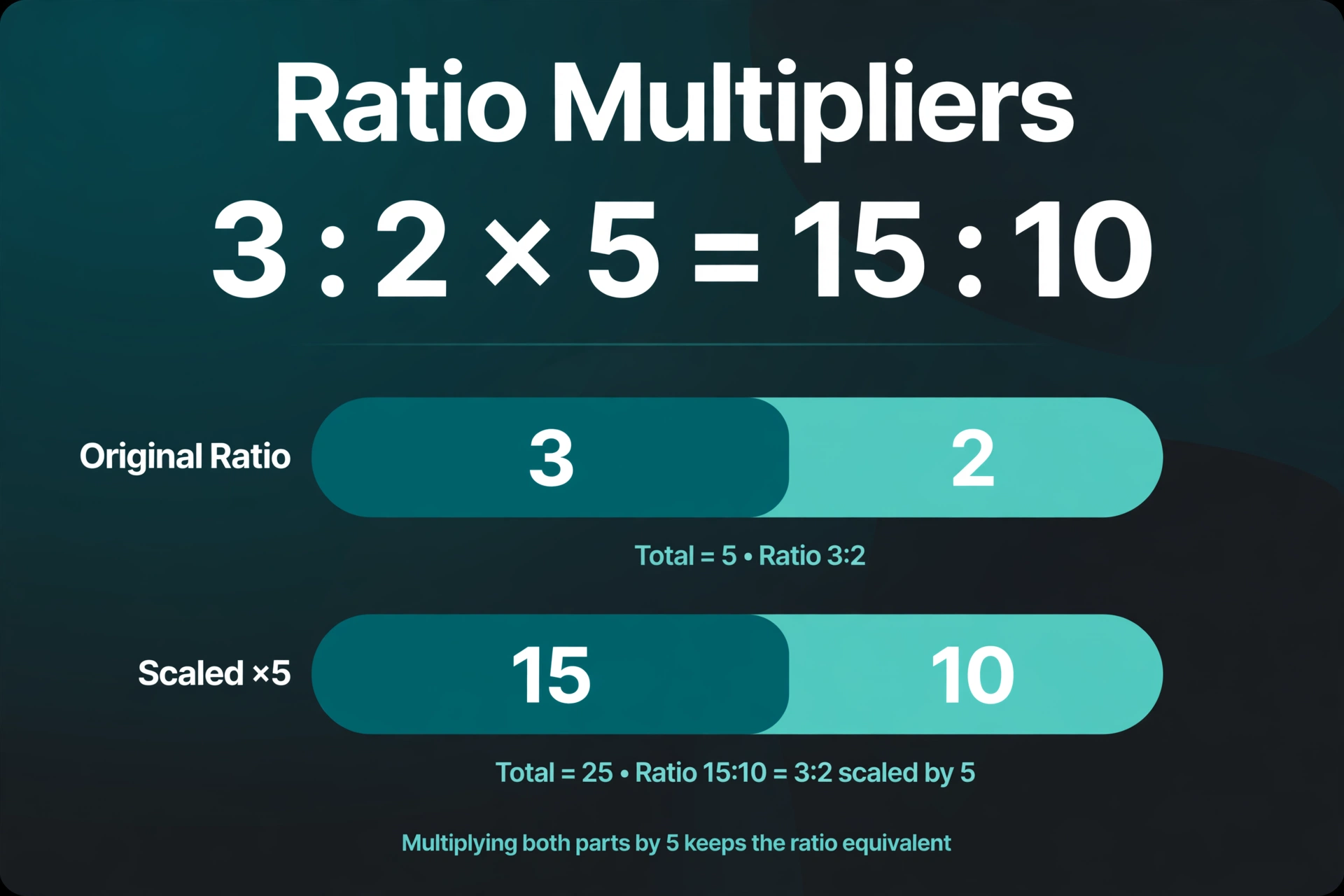
A ratio multiplier is a single number that scales every part of a ratio by the same amount. Multiplying both parts of 3:2 by 5 gives 15:10, which is the same ratio at a larger size: the proportion is unchanged, only the quantities grow.
How do I use the Ratio Multipliers tool?
Choose what you want to work out first. The tool has three modes, and the boxes it asks for change with the mode you pick.
In “Scale the ratio by a multiplier” mode, enter the two parts of the ratio and the multiplier. The tool multiplies both parts by that number and shows the scaled ratio, the simplified ratio, the multiplier used, the value of A divided by B, each part’s share of the total as a percentage, and two bars that draw the ratio as lengths in proportion.
In “Find a missing part from a known part” mode, enter the two parts of the ratio, say which part you already know, and enter its value. The tool works out the multiplier from the known part — the known value divided by the parts it stands for — and uses it to find the other part.
In “Split a total between the two parts” mode, enter the two parts of the ratio and the total to split. The tool adds the parts together to count how many parts the total holds, divides the total by that count to price one part, and multiplies by each part to give the two shares.
If an input is wrong, the tool shows a plain-language error and no results. A ratio of 0:0 has no meaning, so it is rejected. A negative part is rejected. A multiplier of 0 is rejected, because multiplying by 0 would make both parts 0, and a negative multiplier is rejected for the same reason: a scaled quantity cannot be negative. A blank box is rejected with a message naming the box. A known part of 0 is rejected too, because a part that is 0 cannot tell you the size of one part.
What does a worked example look like?
Start with the simplest case. A ratio of 3:2 scaled by 5 gives 15:10. The working is 3 × 5 = 15 and 2 × 5 = 10. The simplified ratio is 3:2, because 15 and 10 share the divisor 5 and dividing both by 5 returns 3:2. The value of A divided by B is 1.5, and it is 1.5 for both 3:2 and 15:10, which is how you know the two ratios are the same proportion. Part A is 60% of the total and part B is 40% of the total, because 3 out of 5 parts is 60% and 2 out of 5 parts is 40%.
A second example uses the same ratio scaled down. A ratio of 3:2 scaled by 0.5 gives 1.5:1. The working is 3 × 0.5 = 1.5 and 2 × 0.5 = 1. A multiplier below 1 shrinks the ratio, and a multiplier of 1 leaves it exactly as it is: 3:2 scaled by 1 is 3:2. The simplified ratio is still 3:2, the value of A divided by B is still 1.5, and the shares are still 60% and 40%. Scaling changes the size and never changes the proportion.
A third example splits a total. A ratio of 3:2 split across a total of 100 gives 60 and 40. The ratio has 5 parts in total (3 + 2), so one part is 100 ÷ 5 = 20. Part A is 3 × 20 = 60 and part B is 2 × 20 = 40. The two shares add back to the total: 60 + 40 = 100. Part A is 60% of the total and part B is 40%.
A fourth example finds a missing part. A ratio of 7:5 with a known part B of 84 gives a missing part A of 117.6. One part is worth 84 ÷ 5 = 16.8, so part A is 7 × 16.8 = 117.6. The multiplier used is 16.8×. The value of A divided by B is 1.4, and the shares are 58.33% and 41.67%: 7 out of 12 parts is 58.33% and 5 out of 12 parts is 41.67%.
A fifth example is the box case, worked in all three modes so the modes can be checked against each other. A box measures 150 by 85. Its ratio is 150:85, which simplifies to 30:17, because 150 and 85 share the divisor 5. In scale mode, 150:85 scaled by 2 gives 300:170. In known-part mode, a ratio of 150:85 with a known part A of 300 gives a missing part B of 170, and with a known part B of 170 gives a missing part A of 300: the multiplier is 2× in both directions. In total mode, a ratio of 150:85 split across a total of 470 gives 300 and 170, because the ratio has 235 parts in total (150 + 85) and one part is 470 ÷ 235 = 2, so part A is 150 × 2 = 300 and part B is 85 × 2 = 170. All three modes agree, and the value of A divided by B is 1.76 in every case.
What is a ratio multiplier?
A ratio compares two quantities by division: the ratio 3:2 says that for every 3 units of the first quantity there are 2 units of the second. A ratio multiplier is the number you multiply both parts by to make an equivalent ratio — a ratio that says the same thing at a different size. The rule is that an equivalent ratio multiplies every term by the same non-zero number, written as A:B:C = kA:kB:kC for k ≠ 0. The multiplier k is the scale factor, and it is the same for every part.
The multiplier is what makes a ratio useful instead of just descriptive. A ratio of 3:2 on its own tells you the shape of a mixture, a split or a drawing. The multiplier tells you the size: the same 3:2 shape can be 3 litres and 2 litres, or 15 litres and 10 litres, or 300 grams and 200 grams. The multiplier is the bridge between the shape and the size, and finding it is the whole job of this tool: in scale mode you give it directly, in known-part mode the tool finds it from a known part, and in total mode the tool finds it as the value of one part.
A ratio multiplier is not the same as a percentage, though the two are related. A percentage states one part as a share of a total of 100. A ratio states the parts against each other. The ratio 3:2 is 60% and 40% of its total, and the ratio 5:3 is 62.5% and 37.5% of its total, because 5 out of 8 parts is 62.5% and 3 out of 8 parts is 37.5%. To work a share out as a percentage of a different total, the percentage calculator gives the figure.
How do I scale a ratio by a multiplier?
Multiply both parts by the same number. That is the whole method, and the only way it goes wrong is multiplying one part and not the other, or multiplying by two different numbers.
Take the ratio 3:2 and the multiplier 5. Multiply the first part: 3 × 5 = 15. Multiply the second part: 2 × 5 = 10. The scaled ratio is 15:10. Check it by dividing both parts by their greatest common divisor, 5: 15 ÷ 5 = 3 and 10 ÷ 5 = 2, which returns the original 3:2. The check confirms the scaling is correct: an equivalent ratio always simplifies back to the original.
The multiplier can be a whole number, a decimal or a fraction. A multiplier of 2 doubles the ratio: 3:2 becomes 6:4. A multiplier of 3 triples it: 3:2 becomes 9:6. A multiplier of 4 gives 12:8, and a multiplier of 10 gives 30:20. A multiplier of 0.5 halves it: 3:2 becomes 1.5:1. A multiplier of 1 changes nothing. The table near the end of this page lists every multiplier from 0.5 to 10 for the ratio 3:2, so the pattern is easy to read at a glance.
Decimal parts in a ratio are handled the same way, and the tool simplifies them first. A ratio of 1.5:2.5 simplifies to 3:5, because multiplying both parts by 10 gives 15:25 and dividing both by their greatest common divisor, 5, gives 3:5. Scaling 1.5:2.5 by 2 gives 3:5 directly: 1.5 × 2 = 3 and 2.5 × 2 = 5. A ratio of 4:6 simplifies to 2:3, because both parts share the divisor 2, and scaling 4:6 by 3 gives 12:18, which also simplifies to 2:3. Simplifying first keeps the numbers small and makes the pattern visible; the rational calculator works through the same kind of fraction simplification with step-by-step working. Where a ratio part is itself a fraction or a mixed number, the mixed fraction calculator works with those forms.
How do I find a missing part from a known part?
Count the parts, price one part, then multiply. This is the multiplier method: add the parts of the ratio to get a total number of parts, divide a known quantity by the number of parts it stands for, and that gives the value of one part. Multiplying that value by any number of parts answers the question.
Take the ratio 3:2 with a known part A of 15. Part A stands for 3 parts, so one part is 15 ÷ 3 = 5. Part B stands for 2 parts, so part B is 2 × 5 = 10. The multiplier used is 5×, and the full scaled ratio is 15:10. The same method works from the other side: with a known part B of 10, one part is 10 ÷ 2 = 5, and part A is 3 × 5 = 15.
The method works with awkward numbers too, and that is where it earns its keep. A ratio of 7:5 with a known part B of 84 gives a missing part A of 117.6. One part is 84 ÷ 5 = 16.8, and part A is 7 × 16.8 = 117.6. No proportion needs to be set up and nothing needs to be cross-multiplied: one division and one multiplication answer the question, and the multiplier, 16.8×, is visible in the results so the working can be checked.
The known part does not have to be a whole number, and it does not have to be the larger part. A known part B of 170 in the ratio 150:85 gives a missing part A of 300, because one part is 170 ÷ 85 = 2 and part A is 150 × 2 = 300. A known part smaller than the part it stands for gives a multiplier below 1 and a smaller missing part: a known part A of 1.5 in the ratio 3:2 gives one part of 1.5 ÷ 3 = 0.5 and a missing part B of 2 × 0.5 = 1, so the scaled ratio is 1.5:1.
How do I scale a ratio to a target total?
Add the parts, divide the total by the part count, then multiply. A ratio of 3:2 has 5 parts in total. A total of 100 divided by 5 gives one part of 20. Part A is 3 × 20 = 60 and part B is 2 × 20 = 40. The two shares add to 100, which is the check: if they do not add to the total, the arithmetic is wrong somewhere.
The same method splits any total in the same proportion. A ratio of 5:3 has 8 parts in total. A total of 80 gives one part of 80 ÷ 8 = 10, so the shares are 50 and 30. A total of 160 gives one part of 20, so the shares are 100 and 60. A total of 400 gives one part of 50, so the shares are 250 and 150. The shares are always 62.5% and 37.5% of the total, whatever the total is, because the proportion never changes: only the size changes. Each pair adds back to its total — 50 + 30 = 80, 100 + 60 = 160, 250 + 150 = 400 — and that addition is the check to run every time.
Splitting a total is the mode to use for mixtures, money and time. A paint mix of 3 parts base to 2 parts thinner across 100 litres is 60 litres of base and 40 litres of thinner. A sum of money split 5:3 across 400 is 250 and 150. A working day split in the ratio 5:3 across 8 hours is 5 hours and 3 hours, because one part is 8 ÷ 8 = 1 hour. The method is the same in every case: count the parts, price one part, multiply.
How do I scale a box or image, such as 150 by 85?
A box or an image has a ratio too: its width to its height. A box that measures 150 by 85 has the ratio 150:85, which simplifies to 30:17. The value of the width divided by the height is 1.76, so the box is 1.76 times as wide as it is tall. That number, 1.76, is the aspect ratio written as a single decimal, and it is the same for every box with the same shape: 300 by 170, 150 by 85 and 30 by 17 all divide to 1.76.
To scale the box to a new width, use the known-part mode. A width of 300 with the ratio 150:85 gives a height of 170, because one part is 300 ÷ 150 = 2 and the height is 85 × 2 = 170. To scale it to a new height, do the same from the other side: a height of 170 gives a width of 300, because one part is 170 ÷ 85 = 2 and the width is 150 × 2 = 300. To scale it to a new total of width plus height, use the total mode: a total of 470 gives 300 and 170, and a total of 235 gives 150 and 85, because the ratio has 235 parts in total and one part is 235 ÷ 235 = 1.
The rule that matters here is that both sides must be multiplied by the same number. Scaling only the width stretches the box and changes its shape; scaling both sides by the same multiplier keeps the shape and changes only the size. That is what “keeping the aspect ratio” means, and it is the same rule as scaling any ratio: multiply every part by the same number.
One more rule belongs in this section, because it catches people out when they scale a box. When every length is scaled by a factor, areas scale by that factor squared and volumes by it cubed. Doubling every length of a box multiplies its surface area by 4 and its volume by 8. A box scaled by 2 in each side is twice as wide, twice as tall and twice as deep, but it holds eight times as much. The ratio tool scales the sides; the area and volume follow the square and the cube. For scale drawings and flat shapes, the geometry calculator works out the area of the shape at its new size.
What is the difference between a ratio, a proportion and a rate?
A ratio compares two quantities: 3:2 says how the two parts stand against each other. A proportion states that two ratios are equal: 3:2 = 15:10 is a proportion, because both ratios describe the same relationship. A rate is a ratio with different units, usually with time in the second part: 60 miles per hour compares miles with hours, and a unit rate states the second quantity as 1, such as 60 miles per 1 hour.
The three words get mixed up because they share the same arithmetic. Scaling a ratio, solving a proportion and finding a unit rate all come down to multiplying or dividing both sides by the same number. The difference is what the numbers mean. A ratio of 3:2 has no units of its own; it is a shape. A proportion is a claim that two ratios match. A rate has units, and the units decide whether the answer makes sense: miles per hour cannot be swapped with hours per mile without changing the meaning.
The proportion form is the one to use when the question is written as an equation. A proportion A:B = C:D can be solved for any one missing term from the other three: D = B × C ÷ A, C = A × D ÷ B, B = A × D ÷ C, and A = B × C ÷ D. The ratio 3:2 = 15:10 fits that form with A = 3, B = 2, C = 15 and D = 10, and the check is 3 × 10 = 30 and 2 × 15 = 30: the two cross-products are equal, which is what makes the proportion true. The tool’s known-part mode is this same arithmetic, done by the multiplier method instead of cross-multiplication.
What mistakes do people commonly make with ratios?
The first mistake is scaling only one side. Multiplying the first part by 5 and leaving the second part alone turns 3:2 into 15:2, which is a different ratio altogether. Both parts must be multiplied by the same number, every time, without exception. The simplified-ratio box in the results is the check: if the scaled ratio does not simplify back to the original, one side was missed.
The second mistake is adding instead of multiplying. Adding 5 to both parts of 3:2 gives 8:7, which is not an equivalent ratio. Adding the same number to both parts changes the proportion, because the parts grow by different fractions of themselves. Only multiplication by a shared factor keeps the proportion.
The third mistake is reading the ratio backwards. A ratio of 3:2 is not the same as a ratio of 2:3: the first says part A is larger, the second says part B is larger. The value of A divided by B tells the two apart at a glance: 3:2 divides to 1.5, and 2:3 divides to 0.67. When the parts carry labels — flour and sugar, base and thinner, width and height — write the labels next to the numbers before calculating.
The fourth mistake is forgetting that a ratio has no units. A ratio of 3:2 between litres and litres is a shape; a ratio of 3 litres to 2 kilograms is not a ratio at all until the units are made the same. Convert first, then form the ratio. The tool takes plain numbers, so the conversion is the reader’s job: 3 metres and 200 centimetres are the same length, and their ratio is 1:1, not 3:200.
The fifth mistake is treating a discount as a subtraction from the ratio instead of a proportion of the price. A discount of ₹120 on a marked price of ₹600 is the ratio 120:600, which simplifies to 1:5, and 1 ÷ 5 = 20%, so the discount is 20%. The selling price is ₹600 − ₹120 = ₹480. The ratio states the discount against the marked price; the subtraction gives the price paid. Both are needed, and they answer different questions. To work out a percentage reduction on any price, the discount calculator gives the figure.
The sixth mistake is scaling an area or a volume by the length factor. Doubling the sides of a box does not double its area or its volume: the area becomes 4 times as large and the volume 8 times as large. Anyone scaling a floor plan, a photograph or a container needs the square and the cube, not the factor itself.
What are the limits of this tool?
This tool works with two-part ratios only. A three-part ratio such as 2:3:5 needs each of its three terms multiplied by the same factor, and this tool does not take a third part. The method is identical — multiply all three by the multiplier — but the tool has two boxes, not three.
The tool rounds its display to two decimal places. A value such as 150 ÷ 85 is 1.7647…, and the tool shows 1.76. The rounding is for display only; the shares in the total mode are computed from the unrounded parts, so 300 and 170 add to exactly 470. Where an exact fraction matters, keep the original inputs: 30:17 is exact, and 1.76 is the rounded decimal form of it.
The tool takes plain numbers and assigns them no units. A ratio of 150:85 in millimetres and the same ratio in centimetres give the same scaled result, because the units cancel. The reader must make sure both parts are in the same unit before entering them, and must put the units back on the answer afterwards.
The tool does not give advice. A ratio can say how a mixture, a split or a price is divided, but it cannot say whether that division is fair, safe or sensible. A paint mix, a recipe and a financial split all use the same arithmetic, and the judgement about each one belongs to the person using the numbers, not to the calculator.
How can I check the tool against a known result?
The simplest check uses the first worked example. Choose “Scale the ratio by a multiplier”, enter 3 and 2, and enter a multiplier of 5. The tool should show a simplified ratio of 3:2, a scaled ratio of 15:10, a multiplier used of 5×, a value of A divided by B of 1.5, a part A share of 60% and a part B share of 40%. The note should say 3 × 5 = 15 and 2 × 5 = 10, so 3:2 scaled by 5 is 15:10.
A second check uses the known-part mode. Choose “Find a missing part from a known part”, enter 7 and 5, choose part B, and enter 84. The tool should show a missing part A of 117.6 and a multiplier used of 16.8×. Change the known part to part A with a value of 15 in the ratio 3:2 and the tool should show a missing part B of 10 and a multiplier used of 5×.
A third check uses the total mode. Choose “Split a total between the two parts”, enter 5 and 3, and enter a total of 400. The tool should show a split of 250 and 150, a value of one part of 50, shares of 62.5% and 37.5%, and a note saying the ratio has 8 parts in total, so one part is 400 ÷ 8 = 50.
A fourth check tests the box case in all three modes. In scale mode, 150:85 with a multiplier of 2 should give 300:170. In known-part mode, 150:85 with a known part A of 300 should give a missing part B of 170. In total mode, 150:85 with a total of 470 should give a split of 300 and 170. All three modes should show a simplified ratio of 30:17 and a value of A divided by B of 1.76.
A fifth check tests the errors. Enter a ratio of 0:0 and the tool should show the error “A ratio of 0:0 has no meaning. Enter at least one part above 0.” with no results. Enter a multiplier of 0 and the tool should show the error “The multiplier must be above 0.” with no results. Enter a negative first part and the tool should show the error “The first part of the ratio cannot be below 0.” with no results. The bars under the results should show part A at 60% of the track width and part B at 40% for the ratio 3:2.
The equivalent-ratio rule behind the tool is stated on the equivalent ratio calculator page from Mathulate, which gives the rule that an equivalent ratio multiplies every term by the same non-zero number. More tools in the same collection are in the calculators category.
What does scaling 3:2 look like at every multiplier?
Every figure in this table was computed with the same arithmetic the tool uses. The simplified ratio is 3:2 in every row, the value of A divided by B is 1.5 in every row, and the shares are 60% and 40% in every row. Only the size changes.
| Multiplier | Scaled ratio | Simplified ratio | A ÷ B | Part A share | Part B share |
|---|---|---|---|---|---|
| 0.5× | 1.5 : 1 | 3 : 2 | 1.5 | 60% | 40% |
| 1× | 3 : 2 | 3 : 2 | 1.5 | 60% | 40% |
| 2× | 6 : 4 | 3 : 2 | 1.5 | 60% | 40% |
| 3× | 9 : 6 | 3 : 2 | 1.5 | 60% | 40% |
| 4× | 12 : 8 | 3 : 2 | 1.5 | 60% | 40% |
| 5× | 15 : 10 | 3 : 2 | 1.5 | 60% | 40% |
| 10× | 30 : 20 | 3 : 2 | 1.5 | 60% | 40% |
Two patterns in the table are worth reading. First, the scaled ratio at a multiplier of 10 is 30:20, which is ten times the original 3:2 in both parts, and it still simplifies to 3:2: scaling never changes the simplified form. Second, the shares never move: 60% and 40% at every multiplier, from 0.5× to 10×. A multiplier changes quantities, and quantities alone. That is the whole point of a ratio multiplier, and it is why the same ratio can describe a teaspoon of mixture and a tanker of it.
Frequently asked questions
What is a ratio multiplier?
A ratio multiplier is a single number that scales every part of a ratio by the same amount. Multiplying both parts of 3:2 by 5 gives 15:10, which is the same ratio at a larger size. The multiplier is also called a scale factor. It changes the quantities and never changes the proportion.
How do I scale a ratio by a multiplier?
Multiply both parts by the same number. For the ratio 3:2 and a multiplier of 5, the working is 3 × 5 = 15 and 2 × 5 = 10, so the scaled ratio is 15:10. Check the answer by simplifying: 15 and 10 share the divisor 5, and dividing both by 5 returns 3:2. A multiplier below 1 shrinks the ratio: 3:2 scaled by 0.5 is 1.5:1.
How do I find a missing part in a ratio?
Count the parts, price one part, then multiply. For a ratio of 7:5 with a known part B of 84, one part is 84 ÷ 5 = 16.8, so the missing part A is 7 × 16.8 = 117.6. For a ratio of 3:2 with a known part A of 15, one part is 15 ÷ 3 = 5, so the missing part B is 2 × 5 = 10.
How do I scale a ratio to a total?
Add the parts together, divide the total by that count to price one part, then multiply by each part. For a ratio of 3:2 and a total of 100, the ratio has 5 parts, so one part is 100 ÷ 5 = 20, and the shares are 3 × 20 = 60 and 2 × 20 = 40. The shares add back to the total: 60 + 40 = 100.
How do I scale a box or image, such as 150 by 85?
A box of 150 by 85 has the ratio 150:85, which simplifies to 30:17, and the width divided by the height is 1.76. To scale it to a width of 300, multiply both sides by 2: the height becomes 170, so the scaled box is 300 by 170. Both sides must be multiplied by the same number, or the shape changes. Doubling every length multiplies the area by 4 and the volume by 8.
What is the difference between a ratio and a proportion?
A ratio compares two quantities, such as 3:2. A proportion states that two ratios are equal, such as 3:2 = 15:10. A rate is a ratio with different units, usually with time in the second part, such as 60 miles per hour. Scaling a ratio, solving a proportion and finding a unit rate all use the same arithmetic: multiplying or dividing both sides by the same number.