GCF Variable Calculator
GCF Variable Calculator
Find the greatest common factor of two, three or four whole numbers — with prime factorisation, Euclidean steps and the LCM.
Numbers 3 and 4 are optional — leave them blank for a two-number GCF. Whole numbers only; negative numbers are read by their absolute value.
A GCF variable calculator finds the greatest common factor of the numbers you type in — the largest whole number that divides each of them with nothing left over. Enter two, three or four whole numbers and it gives you the GCF, the prime factorisation of each number, the Euclidean algorithm steps, and the LCM as well.
What does “variable” mean in a GCF variable calculator?
The word “variable” in the name trips people up, because it means two different things in maths. In school algebra, a variable is a letter like x that stands for a number you do not know yet, and some GCF tools do handle expressions like 12x² and 18x. The rule there is to take the lowest exponent of each letter the terms share: the GCF of 12x²y and 18xy³ is 6xy, because the coefficients 12 and 18 share a GCF of 6, the lowest power of x is x¹, and the lowest power of y is y¹. That is a real kind of GCF problem, and it is worth knowing the rule.
But this calculator works with plain numbers. Here “variable” means the inputs vary: you type in any two, three or four whole numbers and the calculator works out their GCF. The searches behind this page are plain pairs — the GCF of 50 and 35, the GCF of 12000 and 3000, the GCF of 4000 and 140 — so the tool is built for numbers, and the page says so plainly rather than pretending to do algebra it does not do. If your problem has letters in it, use the lowest-exponent rule above; if it has numbers only, use the calculator at the top of this page.
What is the greatest common factor?
The greatest common factor of two or more whole numbers is the largest whole number that divides every one of them with nothing left over. It is also called the greatest common divisor (GCD) and the highest common factor (HCF) — three names for the same idea, so a textbook that says GCD and a teacher who says HCF are talking about exactly the same number.
Take 12 and 18. The factors of 12 are 1, 2, 3, 4, 6 and 12. The factors of 18 are 1, 2, 3, 6, 9 and 18. The numbers on both lists — the common factors — are 1, 2, 3 and 6. The largest of them is 6, so GCF(12, 18) = 6. That is the whole idea: list what each number divides by, find what they share, and take the biggest.
Three facts follow from the definition and are worth keeping in mind. First, the GCF can never be bigger than the smallest number in the set, because nothing larger than that number can divide it. Second, when the smaller number divides the larger one exactly, the smaller number is itself the GCF — 3000 divides 12000 exactly, so GCF(12000, 3000) = 3000. Third, the GCF of a number with itself is the number: GCF(36, 36) = 36. And every pair of whole numbers shares at least the factor 1, so the GCF is never zero — the smallest it can be is 1.
How do you find the GCF with prime factorisation?
Prime factorisation is the clearest method to learn, because it shows why the answer is what it is. Every whole number above 1 can be written as a product of prime numbers in exactly one way, and a factor tree finds that product: keep splitting a number into a factor pair until every branch ends in a prime.
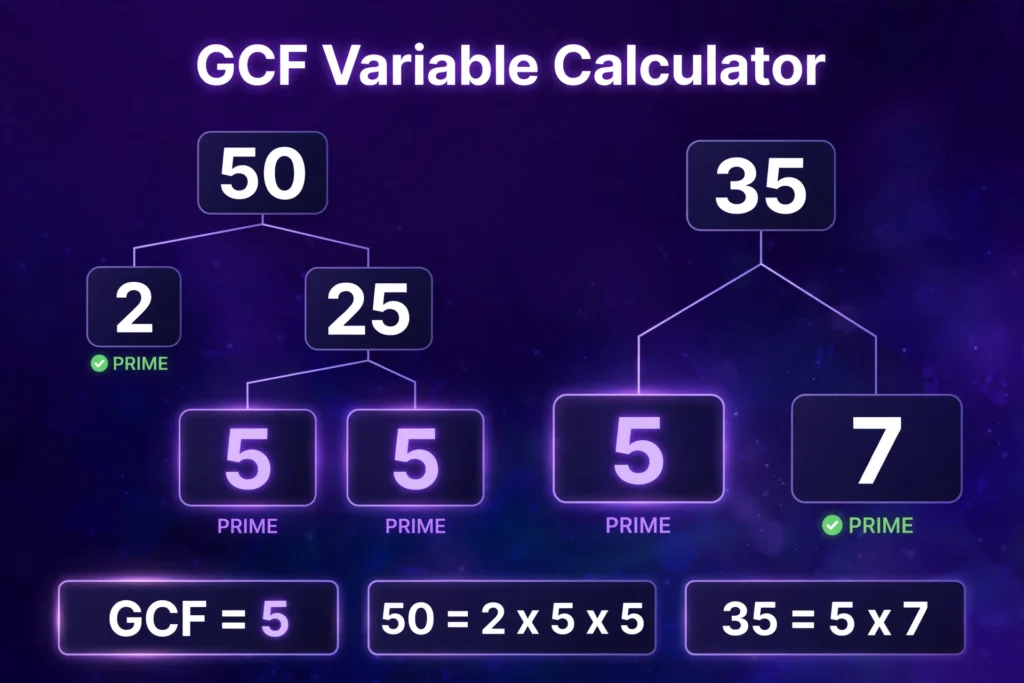
For the main example on this page, 50 and 35, the trees look like this. Split 50 into 2 and 25; 2 is prime and stops there, while 25 splits into 5 and 5. So 50 = 2 × 5². Split 35 into 5 and 7; both are prime and stop there. So 35 = 5 × 7. Now compare the two products. The only prime that appears in both is 5, and its lowest power in either number is 5¹. Multiply the shared primes together and the GCF is 5.
The rule is the lowest power, not the highest — that is the step people get wrong. For 12 and 18: 12 = 2² × 3 and 18 = 2 × 3². The shared primes are 2 and 3. The lowest power of 2 is 2¹ and the lowest power of 3 is 3¹, so the GCF is 2 × 3 = 6. Taking the highest powers instead would give 2² × 3² = 36, which does not even divide 12. The lowest power is what both numbers can actually manage.
Prime factorisation is the best method for small and medium numbers, and it is the method this calculator shows beside every result. It gets slow for very large numbers, because finding the prime factors of a huge number takes real work — which is where the next method comes in.
How does the Euclidean algorithm find the GCF?
The Euclidean algorithm finds the GCF without factoring anything at all. It comes from Euclid’s Elements, Book VII, written around 300 BCE, and it is still the fastest practical way to find the GCF of large numbers. The rule is simple: divide the larger number by the smaller one and keep the remainder. Then replace the larger number with the smaller one, and the smaller one with the remainder. Repeat until the remainder is 0. The last non-zero remainder is the GCF.
For 50 and 35 it runs like this. First, 50 = 1 × 35 + 15, so the remainder is 15. Next, 35 = 2 × 15 + 5, so the remainder is 5. Then 15 = 3 × 5 + 0, so the remainder is 0 and the chain stops. The last non-zero remainder is 5, so GCF(50, 35) = 5 — the same answer the factorisation gave, by a different road.
Why does it work? Any number that divides both the larger and the smaller number must also divide the remainder when one is divided by the other, so the set of common divisors never changes as the numbers shrink. Each step makes the numbers smaller, so the chain has to end, and when it ends the last divisor left standing is the greatest common one. The calculator above uses this algorithm for the answer itself and shows the factorisation alongside it, so you get the speed of Euclid and the explanation of the factor tree in one place.
The Euclidean algorithm earns its keep on big numbers. For 4000 and 140, factoring both numbers by hand takes a while; Euclid takes four short steps: 4000 = 28 × 140 + 80, then 140 = 1 × 80 + 60, then 80 = 1 × 60 + 20, then 60 = 3 × 20 + 0. The last non-zero remainder is 20, so GCF(4000, 140) = 20. And for 12000 and 3000 it takes a single step: 12000 = 4 × 3000 + 0, so the GCF is 3000 at once.
How do you find the GCF of three or more numbers?
The GCF of three or more numbers is found by folding: find the GCF of the first two numbers, then find the GCF of that result and the third number, and carry on until every number has been used. In symbols, GCF(a, b, c) = GCF(GCF(a, b), c). The order does not matter — any pairing gives the same answer, because the GCF of a set is a property of the whole set, not of the order you looked at it in.
For 24, 36 and 60, the fold runs like this. First, GCF(24, 36): 36 = 1 × 24 + 12, then 24 = 2 × 12 + 0, so the GCF of the first pair is 12. Then GCF(12, 60): 60 = 5 × 12 + 0, so the GCF of the whole set is 12. The factorisation agrees: 24 = 2³ × 3, 36 = 2² × 3² and 60 = 2² × 3 × 5, and the primes in all three, at their lowest powers, are 2² × 3 = 12.
The same folding works for the LCM: LCM(24, 36) = 72, then LCM(72, 60) = 360. This calculator accepts up to four numbers and folds both the GCF and the LCM for you, showing the Euclidean steps for each pair so you can follow the fold yourself.
What is the link between the GCF and the LCM?
The GCF and the LCM are a matched pair. The GCF is the largest number that divides into both numbers; the LCM, the least common multiple, is the smallest number both numbers divide into. For any two positive whole numbers they are tied together by one neat identity: GCF(a, b) × LCM(a, b) = a × b. The product of the two answers always equals the product of the two inputs.
Check it against the examples on this page. For 50 and 35: 5 × 350 = 1750, and 50 × 35 = 1750. For 12000 and 3000: 3000 × 12000 = 36,000,000, and 12000 × 3000 = 36,000,000. For 4000 and 140: 20 × 28000 = 560,000, and 4000 × 140 = 560,000. The identity holds every time, which makes it a handy check: if your GCF and LCM do not multiply to the product of your inputs, one of them is wrong.
The table below lists the GCF and the LCM for the pairs people look up most often. Every row was computed by the same method this calculator uses, so the numbers match what the tool shows.
| Numbers | GCF | LCM |
| 12, 18 | 6 | 36 |
| 24, 36 | 12 | 72 |
| 48, 60 | 12 | 240 |
| 8, 15 | 1 | 120 |
| 100, 80 | 20 | 400 |
| 17, 23 | 1 | 391 |
| 56, 98 | 14 | 392 |
| 27, 36 | 9 | 108 |
| 21, 28 | 7 | 84 |
| 90, 120 | 30 | 360 |
| 50, 35 | 5 | 350 |
| 12000, 3000 | 3000 | 12000 |
| 4000, 140 | 20 | 28000 |
Notice the two rows where the GCF is 3000 and 20 and the LCM is the larger input — that happens whenever the smaller number divides the larger one exactly. And notice the rows where the GCF is 1 and the LCM is the product of the two numbers: when two numbers share nothing, their LCM is just the two of them multiplied together. That is the subject of the next section.
What does it mean when the GCF is 1?
When the GCF of two numbers is 1, the numbers share no prime factor at all. They are called coprime, or relatively prime. For 8 and 15: 8 = 2³ and 15 = 3 × 5, and no prime appears in both lists, so GCF(8, 15) = 1 and the LCM is their product, 120. The same goes for 17 and 23, which are both prime themselves — nothing divides both except 1.
A GCF of 1 is not an error and it is not a failure of the method. It is a real answer, and it tells you something useful: the two numbers cannot be split into equal groups bigger than one, and a fraction made from them cannot be reduced. The fraction 8/15 is already in its lowest terms, because there is nothing to divide the top and bottom by except 1. Any two consecutive whole numbers are coprime for the same reason — 14 and 15, 99 and 100 — since any number dividing both would have to divide their difference, which is 1.
People sometimes expect the GCF to be a “real” number bigger than 1 and re-check their work when they get 1. There is nothing to re-check: 1 is the smallest possible GCF, and it shows up whenever the numbers have no factor in common. If the calculator shows a GCF of 1, it says so plainly in the notes under the result.
Where is the GCF actually used?
The most common use is simplifying fractions. To reduce a fraction to lowest terms, divide the top and the bottom by their GCF. The fraction 50/35 has GCF(50, 35) = 5, so dividing top and bottom by 5 gives 10/7. The fraction 4000/140 has GCF(4000, 140) = 20, so dividing by 20 gives 200/7. The same idea works with letters as well as numbers: the Rational Calculator simplifies fractions and rational expressions, and the first step in that work is finding the GCF of the coefficients. Once a fraction is reduced, the Mixed Fraction Calculator turns an improper fraction into a mixed number, so 10/7 becomes 1 3/7.
The second use is splitting things into equal groups with nothing left over. A teacher with 48 pencils and 60 pens who wants identical packs finds GCF(48, 60) = 12: 12 packs, each with 4 pencils and 5 pens, and nothing spare. A baker with 50 cupcakes and 35 muffins makes 5 identical boxes, each with 10 cupcakes and 7 muffins. The GCF is the largest number of equal groups the items can be split into, and the quotients say what goes in each group.
The third use is measurement and tiling. A floor 12000 mm long and 3000 mm wide can be tiled with square tiles 3000 mm on a side — the GCF — with no cutting at all. A garden bed 4000 mm by 140 mm takes square pavers 20 mm on a side, again the GCF. Whenever the question is “what is the biggest equal piece that fits both lengths exactly”, the answer is the GCF.
The fourth use is in algebra, where the GCF is the first step in factoring. To factor 12x² + 18x, take the GCF of the terms — 6x — and pull it out: 6x(2x + 3). Every term in a polynomial is divided by the GCF of its coefficients and its shared letters, which is the same lowest-exponent rule from the first section of this page. Factoring, simplifying fractions and splitting groups are all the same idea wearing different clothes: find what the numbers share, and take the biggest of it.
What mistakes do people make with the GCF?
The most common mistake is mixing up the GCF with the LCM. The GCF divides into the numbers; the LCM is divided into by the numbers. For 12 and 18 the GCF is 6 and the LCM is 36, and swapping them gives an answer that is wrong in both directions. If the question asks for the largest shared divisor, it wants the GCF; if it asks for the smallest shared multiple, it wants the LCM. The identity GCF × LCM = a × b is the check that catches the swap: 6 × 36 = 216 = 12 × 18.
The second mistake is taking the highest exponent in the factorisation instead of the lowest. For 12 = 2² × 3 and 18 = 2 × 3², the shared primes are 2 and 3, and the GCF uses 2¹ × 3¹ = 6. Taking the highest powers gives 2² × 3² = 36, which is bigger than 12 and cannot possibly divide it. The lowest power is the rule, every time.
The third mistake is assuming the GCF has to be a prime number. It does not. The GCF of 12 and 18 is 6, which is not prime, and the GCF of 48 and 60 is 12, which is not prime either. The GCF is the biggest shared divisor, prime or not.
The fourth mistake is missing a factor when listing them. The safe way to list factors is in pairs: for 18, 1 × 18, 2 × 9, 3 × 6 — and when the pairs start repeating, the list is done. Listing one factor at a time from memory is how a factor gets skipped and a wrong GCF follows.
The fifth mistake is feeding the calculator a decimal. The GCF is defined for whole numbers, so 12.5 has no GCF in the usual sense. This calculator asks for whole numbers only and says so when it gets a decimal. Convert first — a measurement of 12.5 cm is 125 mm — and then find the GCF of the whole numbers.
How do you use this GCF variable calculator?
Enter two, three or four whole numbers in the fields at the top of the page. Numbers 3 and 4 are optional — leave them blank for a two-number GCF. The defaults, 50 and 35, give a GCF of 5 and an LCM of 350, so you can see a full result before typing anything. Press “Find the GCF” or just type: the result updates as you type.
The result shows the GCF in the large box and the LCM beside it. Underneath, the prime factorisation of each number is listed, then the Euclidean algorithm steps for each pair, so you can see both methods arriving at the same answer. A note under the result explains anything unusual about your inputs: a zero that was left out, a negative number read by its absolute value, or a GCF of 1 meaning the numbers are coprime.
Awkward inputs are handled in the open. A single number on its own gets the message “Enter at least two whole numbers.” All zeros gets “The GCF is not defined when every number is 0.” A decimal gets told it is not a whole number. A zero beside a real number is simply left out — every whole number divides 0, so a zero cannot change the GCF — and a negative number is read by its absolute value, because divisibility ignores sign. For other number work, the Percentage Calculator turns a share into a percentage, the SE Calculator works out the standard error from a list of numbers, and you can browse the full set of calculators in the calculators category.
How do you work through a GCF problem from start to finish?
Five worked examples, each using the numbers from the tool’s own runs.
First, 50 and 35. Factor them: 50 = 2 × 5² and 35 = 5 × 7. The only shared prime is 5, so the GCF is 5. Euclid agrees: 50 = 1 × 35 + 15, 35 = 2 × 15 + 5, 15 = 3 × 5 + 0. The LCM is 350, and the check holds: 5 × 350 = 1750 = 50 × 35. As a fraction, 50/35 reduces to 10/7.
Second, 12000 and 3000. Factor them: 12000 = 2⁵ × 3 × 5³ and 3000 = 2³ × 3 × 5³. The shared primes at their lowest powers are 2³ × 3 × 5³ = 3000, so the GCF is 3000. Euclid takes one step: 12000 = 4 × 3000 + 0. The LCM is 12000, the larger number itself — which is always the case when the smaller number divides the larger one exactly.
Third, 4000 and 140. Factor them: 4000 = 2⁵ × 5³ and 140 = 2² × 5 × 7. The shared primes at their lowest powers are 2² × 5 = 20, so the GCF is 20. Euclid takes four steps: 4000 = 28 × 140 + 80, 140 = 1 × 80 + 60, 80 = 1 × 60 + 20, 60 = 3 × 20 + 0. The LCM is 28000, and the check holds: 20 × 28000 = 560,000 = 4000 × 140.
Fourth, three numbers: 24, 36 and 60. Factor them: 24 = 2³ × 3, 36 = 2² × 3² and 60 = 2² × 3 × 5. The primes in all three, at their lowest powers, are 2² × 3 = 12. By folding: GCF(24, 36) = 12, then GCF(12, 60) = 12. The LCM folds the same way to 360.
Fifth, the coprime pair 8 and 15. Factor them: 8 = 2³ and 15 = 3 × 5. No prime is shared, so the GCF is 1. Euclid agrees: 15 = 1 × 8 + 7, 8 = 1 × 7 + 1, 7 = 7 × 1 + 0. The LCM is their product, 120, and the check holds: 1 × 120 = 120 = 8 × 15. The fraction 8/15 is already in its lowest terms.
This page gives general information about the greatest common factor and how the numbers work.
What is a GCF variable calculator?
A GCF variable calculator finds the greatest common factor of the numbers you type in — the largest whole number that divides each of them with nothing left over. Enter two, three or four whole numbers and it gives you the GCF, the prime factorisation of each number, the Euclidean algorithm steps, and the LCM as well. For 50 and 35, the GCF is 5.
What does “variable” mean in a GCF variable calculator?
On this page, “variable” means the inputs vary: you type in any whole numbers and the calculator works out their GCF. It does not mean algebraic variables like x and y. If your problem does have letters, the rule is to take the GCF of the coefficients and the lowest exponent of each shared letter — the GCF of 12x²y and 18xy³ is 6xy.
What is the GCF of 50 and 35?
The GCF of 50 and 35 is 5. Factor them: 50 = 2 × 5² and 35 = 5 × 7, and the only prime they share is 5. The Euclidean algorithm agrees: 50 = 1 × 35 + 15, 35 = 2 × 15 + 5, 15 = 3 × 5 + 0. Their LCM is 350.
What is the GCF of 12000 and 3000?
The GCF of 12000 and 3000 is 3000. Because 3000 divides 12000 exactly (12000 = 4 × 3000), the smaller number is itself the GCF, and the LCM is the larger number, 12000. The factorisations agree: 12000 = 2⁵ × 3 × 5³ and 3000 = 2³ × 3 × 5³, and the shared primes at their lowest powers give 2³ × 3 × 5³ = 3000.
What does it mean if the GCF is 1?
A GCF of 1 means the numbers share no prime factor — they are coprime. For 8 and 15, 8 = 2³ and 15 = 3 × 5, so nothing is shared and the GCF is 1; the LCM is their product, 120. A GCF of 1 is a real answer, not an error: it means a fraction made from the numbers cannot be reduced, and the numbers cannot be split into equal groups bigger than one.
What happens if I enter zero, a negative number, or a decimal?
A zero is left out, because every whole number divides 0 — so GCF(0, 5) = 5. A negative number is read by its absolute value, so GCF(−12, 18) = 6. A decimal is refused with the message that it is not a whole number, because the GCF is defined for whole numbers. Entering only one number, or all zeros, gives a plain message explaining what is missing.