Estimate RMD Calculator
Enter your account balance as of December 31 of last year and your age on your birthday in the distribution year. The tool divides the balance by the IRS divisor for your age and shows the required minimum distribution.
The RMD is your prior December 31 balance divided by the distribution period for your age in the IRS Uniform Lifetime Table (Table III in IRS Publication 590-B). The table has applied since 2022, so the same divisor is used for 2025 and 2026. Your first RMD can wait until April 1 of the year after you reach your starting age; every later RMD is due by December 31. Your entries stay in your browser.
A required minimum distribution (RMD) is the smallest amount the IRS requires you to withdraw each year from a tax-deferred retirement account once you reach the starting age. This calculator divides your account balance on December 31 of last year by the divisor for your age in the IRS Uniform Lifetime Table, and shows the RMD, the monthly figure and the balance left after the withdrawal.
How do I use the Estimate RMD Calculator?
Enter your account balance as of December 31 of last year in the first box. Use the balance on that exact date, not the balance today and not the balance on the day you plan to withdraw. Your account statement for December 31 shows the figure, and your custodian reports it to you each January.
Enter your age on your birthday in the distribution year in the second box. That is the age you reach during the year the RMD applies to, not your age today if your birthday falls later in the year. A person who turns 73 in 2026 enters 73 for a 2026 RMD, even if they are still 72 when they run the calculation.
Enter your birth year in the third box if you want the tool to check your starting age. The box is optional, but it matters for people born in 1960 or later, whose RMDs start at 75 rather than 73. Without a birth year the tool uses 73 as the starting age, which is right for most people taking RMDs today. With a birth year of 1960 or later and an age below 75, the tool shows a message saying no RMD is due yet, and it does not show a number.
Enter the distribution year in the fourth box if you want a year other than 2026. The box accepts any year from 2022, when the current IRS table took effect. Leave it blank for 2026. The same table applies to 2025 and 2026, so a 2025 RMD uses the same divisor as a 2026 RMD at the same age.
Press the calculate button and six labelled boxes appear. The first box is the distribution year. The second is the IRS divisor for your age. The third is the estimated RMD: the balance divided by the divisor. The fourth is the monthly figure: the RMD divided by 12. The fifth is the balance left after the withdrawal: the balance minus the RMD. The sixth is the RMD as a share of the balance, which is 100 divided by the divisor. Under the boxes, a note repeats the division in plain words.
If an input is wrong, the tool shows a plain-language error and no results. A balance of $0 or below is rejected, because there is nothing to divide. A blank balance is rejected with a message naming the box. A blank age is rejected the same way. An age above 120 is rejected, because the IRS table ends at 120 and over with a divisor of 2.0. A distribution year before 2022 is rejected, because the current table did not apply then. A balance above $100,000,000 is rejected as outside the range the tool covers.
What does a worked example look like?
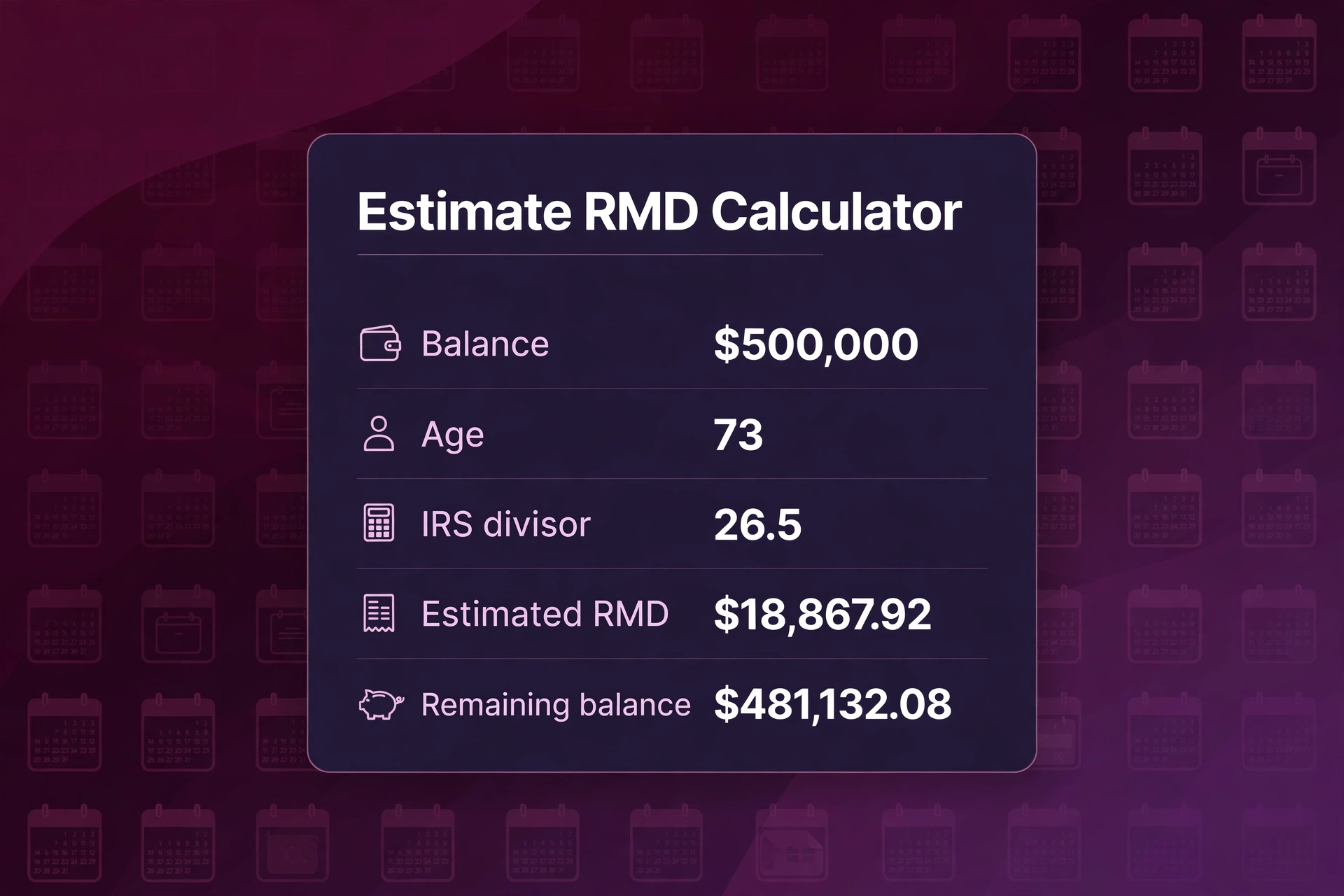
Start with the first example. A balance of $500,000 at age 73 gives an RMD of $18,867.92. The divisor for age 73 is 26.5, so the working is $500,000 ÷ 26.5 = $18,867.92. The monthly figure is $18,867.92 ÷ 12 = $1,572.33. The balance left after the withdrawal is $500,000 − $18,867.92 = $481,132.08. The RMD is 3.77% of the balance, because 100 ÷ 26.5 = 3.77.
A second example uses a larger balance at a later age. A balance of $1,000,000 at age 75 gives an RMD of $40,650.41. The divisor for age 75 is 24.6, so the working is $1,000,000 ÷ 24.6 = $40,650.41. The monthly figure is $40,650.41 ÷ 12 = $3,387.53. The balance left after the withdrawal is $1,000,000 − $40,650.41 = $959,349.59. The RMD is 4.07% of the balance.
A third example uses a smaller balance at age 80. A balance of $250,000 at age 80 gives an RMD of $12,376.24. The divisor for age 80 is 20.2, so the working is $250,000 ÷ 20.2 = $12,376.24. The monthly figure is $12,376.24 ÷ 12 = $1,031.35. The balance left after the withdrawal is $250,000 − $12,376.24 = $237,623.76. The RMD is 4.95% of the balance.
A fourth example shows the same balance at a different age, so the effect of the shrinking divisor is visible. A balance of $500,000 at age 75 gives an RMD of $20,325.20, because $500,000 ÷ 24.6 = $20,325.20. The same $500,000 at age 73 gave $18,867.92. The balance did not change; the divisor fell from 26.5 to 24.6, and the RMD rose by $1,457.28. The monthly figure at 75 is $1,693.77 and the balance left is $479,674.80.
A fifth example uses the age-74 divisor. A balance of $750,000 at age 74 gives an RMD of $29,411.76. The divisor for age 74 is 25.5, so the working is $750,000 ÷ 25.5 = $29,411.76. The monthly figure is $2,450.98 and the balance left is $720,588.24. The RMD is 3.92% of the balance.
A sixth example is the one IRS Publication 590-B uses. A balance of $100,000 at age 75 gives an RMD of $4,065.04, because $100,000 ÷ 24.6 = $4,065.04. The publication rounds its own example to about $4,065. The monthly figure is $338.75 and the balance left is $95,934.96.
A seventh example shows what happens below the starting age. A balance of $500,000 at age 65 gives no number at all. The tool shows a message saying no RMD is due yet, that RMDs begin at age 73 for most account owners, and that the owner will reach that age in 8 years. The same message appears for a person born in 1962 who enters age 73: the tool says RMDs begin at age 75 for people born in 1960 or later, and that the owner will reach that age in 2 years. At age 75 the same person with the same $500,000 balance gets an RMD of $20,325.20.
What is a required minimum distribution?
A required minimum distribution is the minimum amount the IRS requires you to withdraw each year from most tax-deferred retirement accounts once you reach a set age. The money in those accounts was never taxed when it went in, and the RMD is the mechanism that makes sure it gets taxed eventually. Without it, the money could sit untaxed for a lifetime.
The RMD is a floor, not a ceiling. You can always withdraw more than the minimum. The IRS only sets the smallest amount you must take. Taking more is allowed, and the extra does not count toward a later year's RMD: the IRS FAQs state plainly that a distribution above the RMD for one year cannot be applied to the RMD for a future year. Each year is worked out on its own, from that year's balance and that year's divisor.
The RMD is also not a suggestion about how much to spend. It is a tax rule. The amount you need to live on may be larger or smaller than the RMD, and the RMD says nothing about that. The 4 percent rule calculator works out a withdrawal rate for spending plans, which is a different question from the minimum the IRS requires.
RMDs are taxed as ordinary income in the year they are withdrawn, except for any part that is a return of after-tax money. That is the IRS rule stated in its RMD FAQs. The tax itself is not part of this calculation: this tool gives the amount to withdraw, not the tax on it.
At what age do RMDs start?
The starting age depends on the year you were born, because Congress has moved it twice. The SECURE Act of 2019 moved it from 70½ to 72, and the SECURE 2.0 Act of 2022 moved it to 73 and scheduled a further move to 75. The table below gives the starting age by birth year.
| Born | RMDs begin at age |
|---|---|
| Before July 1, 1949 | 70½ |
| July 1, 1949 – 1950 | 72 |
| 1951 – 1959 | 73 |
| 1960 or later | 75 |
For people taking RMDs today, the age that matters is 73 or 75. People born from 1951 through 1959 start at 73. People born in 1960 or later start at 75, so their first RMD year is 2035 at the earliest. The wording of the law overlaps for people born in 1959, and IRS proposed regulations published in July 2024 would set their starting age at 73. This page follows that reading, and the tool does the same: a birth year of 1959 gives a starting age of 73.
The starting age is the age at which RMDs begin, not the age at which the first withdrawal must be made. The first RMD is due for the year you reach the starting age, but you can delay taking it until April 1 of the following year. The deadline is covered in full in the section on due dates below.
Which accounts have to take RMDs?
RMDs apply to traditional IRAs and to most employer plans: 401(k) plans, 403(b) plans, 457(b) plans, profit-sharing plans, SEP IRAs and SIMPLE IRAs. The IRS RMD FAQs list all of these as accounts the rules apply to. If you hold several of them, each one has its own RMD, worked out from its own December 31 balance — though the withdrawal rules for taking the total differ by account type, as the section on the December 31 balance explains.
Roth IRAs have no RMDs while the original owner is alive. That is the rule in IRS Publication 590-B and in the IRS RMD FAQs. Designated Roth accounts in employer plans — Roth 401(k)s and Roth 403(b)s — also have no lifetime RMDs, starting with the 2024 distribution year, under SECURE 2.0. Beneficiaries of Roth accounts are a different matter: RMD rules do apply to them after the owner's death.
A 401(k) has one more rule worth knowing. Participants in a workplace retirement plan can delay taking RMDs from that plan until the year they retire, unless they are a 5% owner of the business sponsoring the plan. That delay applies to the workplace plan only. Owners of traditional IRAs, SEP IRAs and SIMPLE IRAs must begin taking RMDs once they reach the starting age, even if they are still working. The matching 401k calculator works out the employer match on a 401(k) for people still contributing to one.
Why does the December 31 balance matter?
The RMD is worked out from the account balance on December 31 of the year before the distribution year. That date is fixed, and it is the only balance that counts. The balance on the day you withdraw, the balance at the start of the year, and the balance at any other date do not enter the calculation. If the account was worth $500,000 on December 31, 2025 and $520,000 on the day you withdraw in 2026, the 2026 RMD is still worked out from $500,000.
The reason the date is fixed is that the RMD has to be knowable at the start of the year. The IRS sets the divisor by age and the balance by date, and the two together give a single figure for the year. The figure is then recalculated every year from scratch: next year's balance and next year's divisor give next year's RMD. A balance that grows raises the next RMD, and a balance that falls lowers it, but the divisor falls every year, so the share of the balance you must take rises with age whatever the balance does.
Each account has its own RMD, but the withdrawal does not always have to come from the account it was worked out on. An IRA owner must calculate the RMD separately for each IRA they own, but can withdraw the total amount from one or more of the IRAs. A 403(b) contract owner can do the same across 403(b) contracts. RMDs required from other types of retirement plans, such as 401(k) and 457(b) plans, must be taken separately from each of those plan accounts. Those are the rules in the IRS RMD FAQs, and they matter when someone holds several accounts: the arithmetic is per account, and the withdrawal can be combined only for IRAs and 403(b)s.
How does the Uniform Lifetime Table work?
The Uniform Lifetime Table is Table III in IRS Publication 590-B, Appendix B. It gives one number for each age: the distribution period, also called the divisor. You divide your prior December 31 balance by the divisor for your age, and the result is your RMD. The table was revised effective 2022, and the same divisors apply to 2025 and 2026.
The divisor falls as age rises, so the share of the balance you must take rises with age. At 73 the divisor is 26.5, which is 3.77% of the balance. At 75 it is 24.6, which is 4.07%. At 80 it is 20.2, which is 4.95%. At 85 it is 16.0, which is 6.25%. At 90 it is 12.2, which is 8.20%. The table below gives the divisor, the share of the balance, and the RMD on a $100,000 balance for every age from 73 to 90. The IRS table continues past 90, down to a divisor of 2.0 at age 120 and over, which is 50% of the balance.
| Age | Divisor | RMD as a share of the balance | RMD on $100,000 |
|---|---|---|---|
| 73 | 26.5 | 3.77% | $3,773.58 |
| 74 | 25.5 | 3.92% | $3,921.57 |
| 75 | 24.6 | 4.07% | $4,065.04 |
| 76 | 23.7 | 4.22% | $4,219.41 |
| 77 | 22.9 | 4.37% | $4,366.81 |
| 78 | 22.0 | 4.55% | $4,545.45 |
| 79 | 21.1 | 4.74% | $4,739.34 |
| 80 | 20.2 | 4.95% | $4,950.50 |
| 81 | 19.4 | 5.15% | $5,154.64 |
| 82 | 18.5 | 5.41% | $5,405.41 |
| 83 | 17.7 | 5.65% | $5,649.72 |
| 84 | 16.8 | 5.95% | $5,952.38 |
| 85 | 16.0 | 6.25% | $6,250.00 |
| 86 | 15.2 | 6.58% | $6,578.95 |
| 87 | 14.4 | 6.94% | $6,944.44 |
| 88 | 13.7 | 7.30% | $7,299.27 |
| 89 | 12.9 | 7.75% | $7,751.94 |
| 90 | 12.2 | 8.20% | $8,196.72 |
The table assumes a hypothetical beneficiary exactly 10 years younger than the owner, which is why it works for most account owners whatever their actual beneficiary is. The one exception is an owner whose sole beneficiary for the whole year is a spouse more than 10 years younger. That owner uses Table II, the Joint and Last Survivor Table, instead. Its divisors are larger at every age, so the RMD it gives is smaller. This tool uses the Uniform Lifetime Table only, and says so in its limits below. To work a share of a balance out as a percentage on any figure, the percentage calculator gives the result.
When is my RMD due?
The RMD for a year is due by December 31 of that year. The first RMD is the exception: it can wait until April 1 of the year after you reach your starting age. If you reach age 73 in 2026, your first RMD is due by April 1, 2027, and your second RMD is due by December 31, 2027.
Delaying the first RMD means taking two RMDs in one tax year. Both count as income in the year they are received, so the delay can push you into a higher tax bracket for that year. Some people take the first RMD in the year they reach the starting age to spread the income across two years instead. The choice is a tax question, and this page does not recommend one path or the other.
The deadline is the date the money must leave the account, not the date the calculation is done. A withdrawal taken on December 30 counts for that year. A withdrawal taken on January 2 counts for the next year, and the RMD for the year just ended is missed. The custodian must report the RMD amount to you, or offer to calculate it for you, by January 31 of the year it is due, but the owner is ultimately responsible for taking the correct amount on time. That responsibility is stated in the IRS RMD FAQs.
What happens if I miss an RMD?
If you do not take the full RMD by the deadline, the shortfall may be subject to an excise tax of 25%. If you correct the shortfall within two years, the rate drops to 10%. The tax is reported on Form 5329 with the federal tax return for the year the RMD was required. The IRS may waive the penalty if you show the shortfall was due to reasonable error and that you are taking reasonable steps to fix it; that request is also made on Form 5329 with a letter of explanation. Those are the rules in the IRS RMD FAQs.
A short example shows the scale. An RMD of $18,867.92 missed in full carries an excise tax of 25%, which is $4,716.98. Corrected within two years, the tax at 10% is $1,886.79. The tax is on top of the ordinary income tax still owed on the amount when it is eventually withdrawn. The missed amount does not disappear: it still has to come out, and it is still taxed as income when it does.
The penalty is the reason the deadline and the arithmetic both matter. The calculation is one division, and the deadline is one date, but getting either wrong carries a cost measured as a share of the amount not taken. The tool gives the amount; the calendar gives the date.
Do spouses and beneficiaries use the same rules?
A spouse who is the sole beneficiary and more than 10 years younger changes the table, not the starting age. That owner uses Table II, the Joint and Last Survivor Table, which gives a larger divisor and a smaller RMD at every age. Everyone else — unmarried owners, owners whose spouse is not the sole beneficiary, and owners whose spouse is the sole beneficiary but not more than 10 years younger — uses the Uniform Lifetime Table, which is the table this tool carries.
A surviving spouse has choices other beneficiaries do not. If you inherit a traditional IRA from your spouse, Publication 590-B gives you two choices: treat it as your own IRA by designating yourself as the account owner, or treat it as your own by rolling it over into your IRA. Treating it as your own means the RMD rules then apply to you as the owner, at your own starting age.
Other beneficiaries use different rules entirely. A beneficiary of an inherited IRA uses Table I, the Single Life Expectancy Table, not the Uniform Lifetime Table. For owners who died after December 31, 2019, most non-spouse beneficiaries must empty the account within 10 years of the owner's death. The exceptions are a surviving spouse, a child who has not reached the age of majority, a disabled or chronically ill person, and a person not more than 10 years younger than the owner. Those are the rules in the IRS RMD FAQs. This tool does not calculate inherited IRA RMDs, and its limits below say so.
Can I take more than the minimum?
Yes. The IRS RMD FAQs answer that question with one word. You can withdraw more than the RMD in any year, for any reason: spending, a gift, a transfer to another account, or simply because you want the money out. The RMD is a minimum, and anything above it is your choice.
Three limits apply to the extra amount. First, the extra does not count toward a future year's RMD, as the section above explains. Second, an RMD amount cannot be rolled over into another tax-deferred account. The IRS FAQs state that directly: RMD amounts are not eligible for rollover. You can roll over other money from the same account, but not the RMD itself. Third, the withdrawal is taxed as ordinary income in the year it is received, except for any part that is a return of after-tax money or a qualified distribution from a Roth account.
Taking more than the minimum changes the balance the next RMD is worked out from. A larger withdrawal this year means a smaller December 31 balance, and a smaller balance means a smaller RMD next year, at the same divisor. That is the only way one year's withdrawal affects the next year's RMD. For a pension that pays a fixed monthly amount instead of a balance, the UPS retirement calculator values the whole payment stream as a lump sum.
What are the limits of this tool?
This tool uses the Uniform Lifetime Table only. It does not use Table II, the Joint and Last Survivor Table, so an owner whose sole beneficiary is a spouse more than 10 years younger will get a larger RMD here than the IRS requires. That owner should use the Joint Life Table in Publication 590-B, or ask the custodian for the figure.
This tool does not calculate RMDs for inherited IRAs, which use Table I and the 10-year rule. It does not calculate RMDs for 403(b) plans with pre-1987 amounts, which have their own deadline rules in the IRS FAQs. It does not estimate tax: the RMD is taxed as ordinary income, but the rate depends on total income, filing status and state, and this tool does not ask for any of those.
This tool does not project future balances or future RMDs. It gives one year's figure from one balance and one age. A balance left after the RMD will grow or fall with the investments inside the account, and next year's RMD will be worked out from that new balance. The compound interest calculator works out what a balance becomes over a chosen number of years at a rate you enter.
The tool rounds money to the nearest cent for display. The underlying division is exact, and the rounded figures in the article match the tool's display. The divisor is taken from the IRS table as printed, to one decimal place, and the RMD is the balance divided by that divisor.
This page gives general information about IRS rules. It is not tax advice and not financial advice, and it does not replace the account custodian, the plan administrator, or a qualified tax professional. Tax law changes, and the figures here follow the rules as published in IRS Publication 590-B (2025) and the IRS RMD FAQs. Confirm the amount with your custodian before acting on it, especially if your situation involves a spouse more than 10 years younger, an inherited account, or a workplace plan.
How can I check the tool against a known result?
The simplest check uses the first example. Enter a balance of $500,000, an age of 73, and a distribution year of 2026. The tool should show a divisor of 26.5, an RMD of $18,867.92, a monthly figure of $1,572.33, a balance left of $481,132.08, and a share of 3.77%. The note should say $500,000.00 divided by 26.5 = $18,867.92.
A second check uses the larger balance at age 75. Enter $1,000,000 and age 75. The tool should show a divisor of 24.6, an RMD of $40,650.41, a monthly figure of $3,387.53, a balance left of $959,349.59, and a share of 4.07%.
A third check uses the smaller balance at age 80. Enter $250,000 and age 80. The tool should show a divisor of 20.2, an RMD of $12,376.24, a monthly figure of $1,031.35, a balance left of $237,623.76, and a share of 4.95%.
A fourth check uses the Publication 590-B example. Enter $100,000 and age 75. The tool should show an RMD of $4,065.04, which is the publication's example of about $4,065, with a monthly figure of $338.75 and a balance left of $95,934.96.
A fifth check tests the under-age message. Enter $500,000 and age 65. The tool should show no number and no result boxes, only the message saying no RMD is due yet, that RMDs begin at age 73 for most account owners, and that the owner will reach that age in 8 years. Enter the same balance with age 73 and a birth year of 1962, and the tool should show the message for a starting age of 75 instead, with 2 years to go.
A sixth check tests the errors. Enter a balance of 0 and the tool should show the error "The balance must be above $0." with no results. Enter a blank balance and the tool should show the error "Enter your account balance as of December 31 of last year." Enter an age of 121 and the tool should show the error about the table ending at 120. Enter a distribution year of 2021 and the tool should show the error saying the table has applied since 2022.
The divisors behind the tool come from the IRS Uniform Lifetime Table in Publication 590-B, and the deadlines, penalties and account rules come from the IRS RMD FAQs. More tools in the same collection are in the calculators category.
What is my RMD at different balances and ages?
Every figure in these two tables was computed with the same arithmetic the tool uses: the balance divided by the divisor for the age. The first table holds the age at 73, where the divisor is 26.5, and changes the balance. The second holds the balance at $500,000 and changes the age.
| Balance on December 31 | RMD at age 73 | Monthly | Balance left | Share of balance |
|---|---|---|---|---|
| $100,000 | $3,773.58 | $314.47 | $96,226.42 | 3.77% |
| $250,000 | $9,433.96 | $786.16 | $240,566.04 | 3.77% |
| $500,000 | $18,867.92 | $1,572.33 | $481,132.08 | 3.77% |
| $750,000 | $28,301.89 | $2,358.49 | $721,698.11 | 3.77% |
| $1,000,000 | $37,735.85 | $3,144.65 | $962,264.15 | 3.77% |
| Age | Divisor | RMD on $500,000 | Monthly | Balance left | Share of balance |
|---|---|---|---|---|---|
| 73 | 26.5 | $18,867.92 | $1,572.33 | $481,132.08 | 3.77% |
| 75 | 24.6 | $20,325.20 | $1,693.77 | $479,674.80 | 4.07% |
| 80 | 20.2 | $24,752.48 | $2,062.71 | $475,247.52 | 4.95% |
| 85 | 16.0 | $31,250.00 | $2,604.17 | $468,750.00 | 6.25% |
| 90 | 12.2 | $40,983.61 | $3,415.30 | $459,016.39 | 8.20% |
Two patterns in the tables are worth reading. First, the RMD at age 73 is a fixed share of the balance: 3.77% of $100,000 and 3.77% of $1,000,000 alike, because the divisor is the same and the RMD is the balance divided by that divisor. Second, the RMD on the same $500,000 more than doubles between 73 and 90, from $18,867.92 to $40,983.61, because the divisor falls from 26.5 to 12.2. The balance did not change in that table; only the age did. That is the shape of the rule: a slowly rising share of a balance that is itself being drawn down, year after year.
Frequently asked questions
How do I calculate my RMD?
Divide your account balance on December 31 of last year by the distribution period for the age you reach this year, from the IRS Uniform Lifetime Table. A $500,000 balance at age 73 uses the divisor 26.5, so the RMD is $500,000 ÷ 26.5 = $18,867.92. A $1,000,000 balance at age 75 uses the divisor 24.6, so the RMD is $1,000,000 ÷ 24.6 = $40,650.41. The table has applied since 2022, so the same divisors are used for 2025 and 2026.
At what age do RMDs start?
RMDs start at age 73 for people born from 1951 through 1959, and at age 75 for people born in 1960 or later, under the SECURE 2.0 Act. People born in 1950 or earlier started at 72, and people born before July 1, 1949 started at 70½. Participants in a workplace retirement plan can delay RMDs from that plan until the year they retire, unless they are a 5% owner of the business sponsoring the plan. IRA owners must begin at the starting age even if they are still working.
When is my RMD due?
Your RMD for a year is due by December 31 of that year. Your first RMD can wait until April 1 of the year after you reach your starting age. If you reach age 73 in 2026, your first RMD is due by April 1, 2027, and your second RMD is due by December 31, 2027. Delaying the first RMD means taking two RMDs in one tax year, and both count as income in the year they are received.
What happens if I miss my RMD?
The shortfall may be subject to an excise tax of 25%, reduced to 10% if you correct it within two years. The tax is reported on Form 5329 with your federal tax return for the year the RMD was required. The IRS may waive the penalty if you show the shortfall was due to reasonable error and you are taking reasonable steps to fix it. On an RMD of $18,867.92 missed in full, the tax at 25% is $4,716.98, and at 10% it is $1,886.79, on top of the ordinary income tax still owed when the money is withdrawn.
Do Roth IRAs have RMDs?
No, not while the original owner is alive. Roth IRAs have no lifetime RMDs, and designated Roth accounts in employer plans — Roth 401(k)s and Roth 403(b)s — have had no lifetime RMDs since the 2024 distribution year. RMD rules do apply to the beneficiaries of Roth accounts after the owner's death. Traditional IRAs, SEP IRAs, SIMPLE IRAs, 401(k)s, 403(b)s and 457(b)s all have RMDs during the owner's life.
Can I take more than the minimum, and can I roll an RMD over?
Yes, you can withdraw more than the RMD in any year. The extra does not count toward a future year's RMD: each year's RMD is worked out on its own. No, an RMD amount cannot be rolled over into another tax-deferred account. The IRS FAQs state that RMD amounts are not eligible for rollover. You can roll over other money from the same account, but not the RMD itself.