Mol Calculator
Pick a calculation, enter the two values it asks for, and the tool works out the answer — with millimole and particle-count conversions on every result.
Need a molar mass first? Work it out from the chemical formula with the Molecular Mass Finder, then enter it here in g/mol.
1 mol = 1,000 mmol. 1 mol/L = 1,000 mmol/L. Particle counts use the Avogadro constant, 6.02214076 x 10^23 per mol. Your entries stay in your browser.
A mol calculator turns a mass in grams into moles, turns moles back into a mass, and works out the molarity of a solution from moles and volume. One mole of any substance contains exactly 6.02214076 x 10^23 particles, so the mole is the bridge between the grams on a balance and the number of atoms or molecules in a sample.
How do I use the Mol Calculator?
Pick the calculation first. “Moles from mass” is the most common: enter the mass in grams and the molar mass in g/mol, and the tool divides the first by the second. “Mass from moles” does the reverse: enter the moles and the molar mass, and the tool multiplies them. “Molarity” has two directions of its own: pick “Molarity” to divide moles by litres, or pick “Moles” to multiply a molarity by a volume. Every mode shows four results: the answer itself, the millimole version of it, the particle count, and the mass in milligrams where a mass is involved. The note under the results shows the working with your own numbers, so you can check the arithmetic.
The molar mass is entered by hand, in g/mol. The tool does not look up chemical formulas: that is the job of the Molecular Mass Finder on this site, which works out a molar mass from a formula such as H2O or C6H12O6. If you do not know the molar mass yet, find it there first and enter the figure here. The molar masses used in the examples on this page — water 18.015 g/mol, sodium chloride 58.44 g/mol, glucose 180.156 g/mol — are the abridged IUPAC 2021 values the Molecular Mass Finder uses, built from the standard atomic weights of hydrogen 1.008, carbon 12.011, oxygen 15.999, sodium 22.990 and chlorine 35.45.
Volumes can be entered in litres or millilitres. Molar masses up to 1,000,000 g/mol are accepted, so protein and DNA molar masses work too. Pick millilitres and the tool divides by 1,000 before it calculates, so 250 mL becomes 0.25 L. The volume must be the volume of the finished solution, not the volume of water poured in at the start: a solution made up to 250 mL in a volumetric flask has a volume of 0.25 L even if the water added was less than that, because the solid takes up room.
If an input is wrong, the tool shows a plain-language error and no results. A blank mass is rejected with “Enter the mass in grams.” A mass of 0 or below is rejected, because a sample with no mass contains no moles. A mass above 1,000,000 g is rejected. A blank molar mass is rejected with “Enter the molar mass in g/mol.” A molar mass of 0 or below is rejected, because every real substance has a positive molar mass, and a value above 1,000,000 g/mol is rejected. The high cap covers proteins and DNA fragments, whose molar masses run into the hundreds of thousands. A blank number of moles is rejected with “Enter the number of moles.” Moles of 0 or below are rejected, and a figure above 1,000,000 mol is rejected. A blank volume is rejected with “Enter the volume of the solution.” A volume of 0 or below is rejected, because dividing by zero has no meaning, and a volume above 10,000 L (or 10,000,000 mL) is rejected. A blank molarity is rejected with “Enter the molarity in mol/L.” A molarity of 0 or below is rejected, and a figure above 100 mol/L is rejected.
What does a worked example look like?
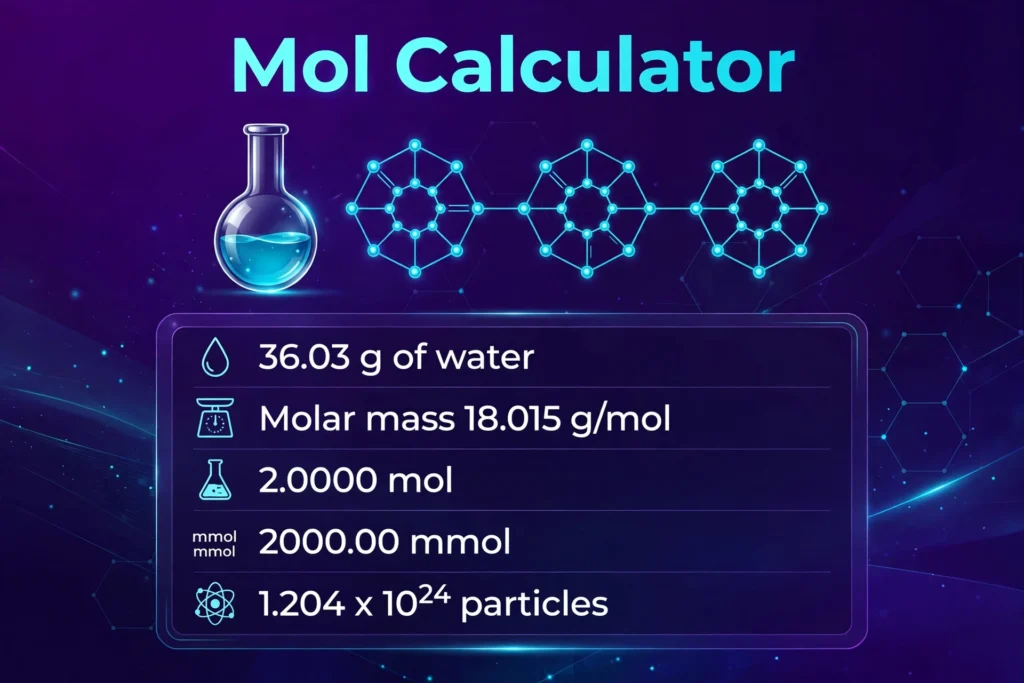
Take 36.03 g of water. The molar mass of water is 18.015 g/mol. The formula for moles is n = m / M, so the calculation is 36.03 / 18.015. That is 36.03 divided by 18.015, which is 2.0000 mol. The millimole figure is 2.0000 x 1,000 = 2000.00 mmol. The particle count is 2.0000 x 6.02214076 x 10^23 = 1.204 x 10^24 water molecules. The mass in milligrams is 36.03 x 1,000 = 36030.00 mg.
A second example uses table salt. Take 58.44 g of sodium chloride, NaCl, with a molar mass of 58.44 g/mol. The calculation is 58.44 / 58.44 = 1.0000 mol. That is 1000.00 mmol, and the particle count is 1.0000 x 6.02214076 x 10^23 = 6.022 x 10^23 formula units. One mole of salt is 58.44 g because the molar mass says so: the number is the same as the molar mass whenever the mass equals one mole’s worth, and this is the cleanest check that the tool is dividing the right way round.
A third example uses glucose, the sugar in blood. Take 180.156 g of glucose, C6H12O6, with a molar mass of 180.156 g/mol. The calculation is 180.156 / 180.156 = 1.0000 mol, which is 1000.00 mmol and 6.022 x 10^23 molecules. A smaller sample shows the same pattern: 10 g of sodium chloride is 10 / 58.44 = 0.1711 mol, which is 171.12 mmol and 1.030 x 10^23 formula units. The moles figure has four decimal places and the millimoles two, so the two figures can differ in the last digit when the unrounded value sits between them — 0.1711 mol is the rounded display, while 171.12 mmol comes from the unrounded 0.171122 mol.
A fourth example runs the other way, from moles to mass. Take 2.5 mol of sodium chloride with a molar mass of 58.44 g/mol. The formula is m = n x M, so the calculation is 2.5 x 58.44 = 146.1000 g. That is 146100.00 mg, 2500.00 mmol, and 1.506 x 10^24 formula units. A smaller example: 0.5 mol of glucose with a molar mass of 180.156 g/mol is 0.5 x 180.156 = 90.0780 g, which is 90078.00 mg, 500.00 mmol, and 3.011 x 10^23 molecules.
A fifth example works out a molarity. Take 0.25 mol of solute in 0.5 L of solution. The formula is M = n / V, so the calculation is 0.25 / 0.5 = 0.5000 mol/L. That is 500.00 mmol/L, and the solute is 250.00 mmol. The reverse direction works the same way: a 1.0000 mol/L solution with a volume of 0.25 L contains 1.0000 x 0.25 = 0.2500 mol of solute, which is 250.00 mmol and 1000.00 mmol/L. Volumes in millilitres need the extra step: 0.1 mol in 250 mL is 0.1 / 0.25 = 0.4000 mol/L, because 250 mL is 0.25 L, and the answer is 400.00 mmol/L.
A sixth example chains the two steps together, the way a bench preparation does. To make 250 mL of a 0.2000 M sodium chloride solution, first work out the moles: 0.2000 mol/L x 0.25 L = 0.0500 mol. Then work out the mass: 0.0500 mol x 58.44 g/mol = 2.922 g. So 2.922 g of NaCl, made up to 250 mL, gives 0.0500 mol in 0.25 L, which is 0.0500 / 0.25 = 0.2000 mol/L, or 200.00 mmol/L. The particle count in that solution is 0.0500 x 6.02214076 x 10^23 = 3.011 x 10^22 formula units.
What is a mole?
A mole is the SI unit for amount of substance, and one mole of anything contains exactly 6.02214076 x 10^23 elementary entities — atoms, molecules, ions or formula units, depending on the substance. That number is the Avogadro constant, and it has been exact by definition since the 2019 revision of the SI, when the mole was redefined in terms of the constant itself rather than in terms of 12 grams of carbon-12. The International Union of Pure and Applied Chemistry (IUPAC) sets the definition, and the National Institute of Standards and Technology (NIST) publishes the constant as part of the SI.
The mole exists because atoms are too small to count one by one. A single water molecule weighs about 3 x 10^-23 grams, a figure no balance can measure and no person can use. Chemists therefore count in moles: a mole is a chemist’s dozen, a fixed number of particles large enough to weigh. One mole of water weighs 18.015 g, one mole of sodium chloride weighs 58.44 g, and one mole of glucose weighs 180.156 g — and each of those samples contains the same number of particles, 6.02214076 x 10^23, even though the masses are very different.
The mole also makes chemical equations work. The equation 2 H2 + O2 → 2 H2O says that two molecules of hydrogen react with one molecule of oxygen to make two molecules of water. Read in moles, it says the same thing at a weighable scale: two moles of hydrogen react with one mole of oxygen to make two moles of water. That is 4.032 g of hydrogen plus 31.998 g of oxygen giving 36.03 g of water. Without the mole, the equation would be a statement about single molecules; with it, the equation becomes a recipe for the bench.
Amount of substance is not the same as mass, volume or number of particles, and the three must not be mixed up. Mass is measured in grams, volume in litres, particle count in single particles, and amount in moles. The mole is the only one of the four that counts particles in a fixed-size group, and it is the quantity that appears in the formulas for molarity, gas laws and reaction stoichiometry. A litre of water and a litre of salt solution can hold very different numbers of moles, and a gram of water and a gram of salt hold very different numbers of moles too — 1 g of water is 0.0555 mol, while 1 g of sodium chloride is 0.0171 mol.
How do I calculate moles from mass?
Divide the mass in grams by the molar mass in g/mol: n = m / M. The units cancel to leave moles, because grams divided by grams per mole is moles. The formula works for any substance, as long as the molar mass is right. The hard part of the calculation is never the division; it is getting the molar mass.
The molar mass comes from the chemical formula. Add up the atomic masses of every atom in the formula: water, H2O, is 2 x 1.008 + 15.999 = 18.015 g/mol. Sodium chloride, NaCl, is 22.990 + 35.45 = 58.44 g/mol. Glucose, C6H12O6, is 6 x 12.011 + 12 x 1.008 + 6 x 15.999 = 180.156 g/mol. The atomic masses come from the IUPAC standard atomic weights, and the values used on this page are the abridged 2021 figures the Molecular Mass Finder uses. For precise laboratory work, use the exact standard atomic weights for the isotopic composition of the material in hand, and the exact molar mass printed on the reagent bottle where one is given, because hydrates and salts with waters of crystallisation have larger molar masses than their anhydrous formulas suggest: copper(II) sulfate pentahydrate, CuSO4·5H2O, is 249.68 g/mol against 159.60 g/mol for anhydrous copper(II) sulfate.
Two checks catch the commonest error, which is dividing the wrong way round. First, the answer in moles should usually be smaller than the mass in grams when the molar mass is above 1 g/mol — and every real molar mass is above 1 g/mol, since hydrogen itself is 1.008. If the moles figure is larger than the mass, the division is upside down. Second, one mole’s worth of the substance weighs exactly its molar mass in grams: 18.015 g of water is 1.0000 mol, 58.44 g of salt is 1.0000 mol, 180.156 g of glucose is 1.0000 mol. Any mass below that gives fewer than one mole, and any mass above it gives more.
How do I calculate mass from moles?
Multiply the moles by the molar mass: m = n x M. The units give grams, because moles times grams per mole is grams. This is the reverse of the first calculation, and it is the step used whenever a recipe or a protocol gives an amount in moles and the balance needs grams. A protocol that calls for 2.5 mol of sodium chloride needs 2.5 x 58.44 = 146.1000 g. A protocol that calls for 0.5 mol of glucose needs 0.5 x 180.156 = 90.0780 g. A protocol that calls for 0.05 mol of sodium chloride needs 0.05 x 58.44 = 2.922 g, the figure from the bench example above.
The same check works in reverse: the mass in grams should be the moles multiplied by a number above 1, so the mass is larger than the number of moles for every real substance. If a calculation gives a mass smaller than the moles, something has been divided instead of multiplied, or the molar mass has been entered in the wrong units. Millimoles need care here too: 2,500 mmol of sodium chloride is 2.5 mol, so the mass is 2.5 x 58.44 = 146.1000 g, not 2,500 x 58.44. Convert millimoles to moles first by dividing by 1,000, then multiply.
What is molarity, and how do I calculate it?
Molarity is the concentration of a solution, defined as the moles of solute in one litre of solution: M = n / V, with the answer in mol/L, written as M and read as “molar”. A 1.0000 M solution contains one mole of solute in every litre. A 0.5000 M solution contains half a mole in every litre. Molarity is the most common way chemists express concentration, because it ties directly to reaction stoichiometry: equal volumes of solutions at the same molarity contain equal numbers of moles, so a titration can be read straight off the volumes.
The calculation is one division. Take 0.25 mol of solute in 0.5 L of solution: 0.25 / 0.5 = 0.5000 mol/L. The reverse is one multiplication: a 1.0000 M solution with a volume of 0.25 L contains 1.0000 x 0.25 = 0.2500 mol. The combined form, used when the starting point is a weighed mass, is M = m / (M_molar x V): 2.922 g of sodium chloride in 0.25 L is 2.922 / (58.44 x 0.25) = 0.2000 mol/L, the same answer the two-step version gives.
Three points about volume decide whether the answer is right. First, convert millilitres to litres by dividing by 1,000: 250 mL is 0.25 L, and using 250 in the formula instead gives an answer 1,000 times too small. Second, use the final volume of the solution, not the volume of solvent added: a solution made up to 250 mL in a volumetric flask has a volume of 0.25 L even if less than 250 mL of water went in. Third, molarity changes a little with temperature, because liquids expand and contract: a solution made up to the mark on a cold bench is slightly more concentrated when it warms up, which is why precise work uses volumetric glassware calibrated at 20 °C and notes the temperature.
Molarity is not the only way to express concentration, and the others exist because molarity has limits. Molality is moles of solute per kilogram of solvent, and it does not change with temperature, so it is used where temperature varies. Mass concentration is grams per litre, and it needs no molar mass at all: 58.44 g/L of sodium chloride is 1.0000 mol/L, because 58.44 / 58.44 = 1.0000. Percent by mass and parts per million are used where the amounts are very small or where the solute is a trace impurity. This tool works in molarity because it is the unit that reaction calculations use, and the millimole-per-litre figure on every result is the same concentration in the smaller unit that laboratory protocols usually print.
Solute potential, the osmotic part of water potential in plant and cell biology, is one place molarity shows up outside the chemistry bench. It is calculated with the van ’t Hoff equation, Ψs = −iCRT, where C is the molar concentration of the solute, R is the gas constant, T is the absolute temperature, and i is the number of particles the solute splits into. The minus sign means solute potential is always zero or negative: pure water has a solute potential of zero, and adding solute lowers it. A molarity from this tool is the C that goes into that equation, with the volume in litres and the temperature in kelvin.
How do I convert between moles and millimoles?
Multiply moles by 1,000 to get millimoles, and divide millimoles by 1,000 to get moles. The prefix milli- means one thousandth, so 1 mol = 1,000 mmol, 1 mmol = 0.001 mol, and 0.1711 mol = 171.12 mmol. The same factor applies to concentration: 1 mol/L = 1,000 mmol/L, so 0.5000 mol/L = 500.00 mmol/L, 0.2000 mol/L = 200.00 mmol/L, and 0.0500 mol/L = 50.00 mmol/L. Converting the other way, 25 mM is 25 / 1,000 = 0.0250 mol/L, and 250 mM is 0.2500 mol/L.
Millimoles are the working unit in biology and medicine, where the amounts are small. A blood glucose reading of 5.5 mmol/L is 0.0055 mol/L. A 50 mM buffer is 0.0500 mol/L. A protocol that asks for 250 mmol of a reagent is asking for 0.25 mol, which for sodium chloride is 0.25 x 58.44 = 14.6100 g. The tool shows both units on every result so that no conversion has to be done by hand, and the millimole figure is computed from the unrounded value, so it can differ in the last digit from a figure worked out from the rounded moles display.
Proteins are where the millimole scale meets a second conversion, from kilodaltons to moles. A dalton is one atomic mass unit, and a kilodalton (kDa) is 1,000 daltons, so a protein with a mass of 50 kDa has a molar mass of 50,000 g/mol. That figure goes into the same formula as any other molar mass: 0.1 g of a 50 kDa protein is 0.1 / 50,000 = 2.000 x 10^-6 mol, which is 0.0020 mmol and 1.204 x 10^18 molecules. The tool shows the moles in scientific notation here, because four decimal places would print 0.0000 and hide the answer. The same arithmetic works for DNA: a double-stranded DNA fragment of 1,000 base pairs has a molar mass of about 660,000 g/mol, so 0.1 g of it is 0.1 / 660,000 = 1.515 x 10^-7 mol. For protein and DNA work, use the exact molar mass from the supplier or the sequence, because a His-tag or a fusion partner changes the mass and the moles with it.
What is Avogadro’s number?
Avogadro’s number is 6.02214076 x 10^23, the number of particles in one mole. It is named after Amedeo Avogadro, who proposed in 1811 that equal volumes of gases at the same temperature and pressure contain equal numbers of molecules. The number itself was measured over the following two centuries, and since the 2019 revision of the SI it is exact by definition: the mole is now defined as the amount of substance that contains exactly 6.02214076 x 10^23 elementary entities. The value is published by NIST as part of the SI constants, and the definition of the mole is set out in the IUPAC Gold Book.
The particle count follows from the moles by one multiplication: particles = moles x 6.02214076 x 10^23. Half a mole of water contains 0.5 x 6.02214076 x 10^23 = 3.011 x 10^23 molecules. A quarter of a mole contains 0.25 x 6.02214076 x 10^23 = 1.506 x 10^23 particles. Two moles contain 2 x 6.02214076 x 10^23 = 1.204 x 10^24 particles. The count is exact in the same sense as the constant: it is a definition, not a measurement, so the only uncertainty in it comes from the moles figure itself.
The size of the number is hard to picture. A mole of water is 18.015 g, about a tablespoon, yet it contains 6.02214076 x 10^23 molecules.
How many moles are in common masses?
Every figure in this table was computed with the same formulas the tool uses. The three substances are water (18.015 g/mol), sodium chloride (58.44 g/mol) and glucose (180.156 g/mol). The pattern to read is that the moles column is the mass divided by the molar mass, so doubling the mass doubles the moles, and the particle count follows the moles.
| Substance | Mass | Moles | Millimoles | Particles |
|---|---|---|---|---|
| Water | 9.0075 g | 0.5000 mol | 500.00 mmol | 3.011 x 10^23 |
| Water | 18.015 g | 1.0000 mol | 1000.00 mmol | 6.022 x 10^23 |
| Water | 36.03 g | 2.0000 mol | 2000.00 mmol | 1.204 x 10^24 |
| Water | 90.075 g | 5.0000 mol | 5000.00 mmol | 3.011 x 10^24 |
| Water | 180.15 g | 10.0000 mol | 10000.00 mmol | 6.022 x 10^24 |
| Sodium chloride | 5.844 g | 0.1000 mol | 100.00 mmol | 6.022 x 10^22 |
| Sodium chloride | 29.22 g | 0.5000 mol | 500.00 mmol | 3.011 x 10^23 |
| Sodium chloride | 58.44 g | 1.0000 mol | 1000.00 mmol | 6.022 x 10^23 |
| Sodium chloride | 116.88 g | 2.0000 mol | 2000.00 mmol | 1.204 x 10^24 |
| Sodium chloride | 292.2 g | 5.0000 mol | 5000.00 mmol | 3.011 x 10^24 |
| Glucose | 18.0156 g | 0.1000 mol | 100.00 mmol | 6.022 x 10^22 |
| Glucose | 90.078 g | 0.5000 mol | 500.00 mmol | 3.011 x 10^23 |
| Glucose | 180.156 g | 1.0000 mol | 1000.00 mmol | 6.022 x 10^23 |
| Glucose | 360.312 g | 2.0000 mol | 2000.00 mmol | 1.204 x 10^24 |
| Glucose | 900.78 g | 5.0000 mol | 5000.00 mmol | 3.011 x 10^24 |
The table also shows why molar mass matters more than mass alone. Five grams of water is not in the table, but the pattern gives it: 5 g of water is 5 / 18.015 = 0.2775 mol, while 5 g of glucose is 5 / 180.156 = 0.0278 mol — ten times fewer moles for the same mass, because a glucose molecule is ten times heavier than a water molecule. The same mass of two substances holds different numbers of moles whenever their molar masses differ, and the ratio is the inverse ratio of the molar masses. A second pattern is the particle column: 0.1000 mol of anything is 6.022 x 10^22 particles, whether it is salt or sugar, because the particle count depends only on the moles.
A smaller table covers molarity from a weighed mass in one litre, the most common bench preparation. Dissolving 5.844 g of sodium chloride and making the solution up to 1 L gives 5.844 / 58.44 / 1 = 0.1000 mol/L. Dissolving 58.44 g and making it up to 1 L gives 58.44 / 58.44 / 1 = 1.0000 mol/L. Dissolving 18.0156 g of glucose and making it up to 1 L gives 18.0156 / 180.156 / 1 = 0.1000 mol/L. Dissolving 90.078 g of glucose and making it up to 0.5 L gives 90.078 / 180.156 / 0.5 = 1.0000 mol/L — the same concentration as the salt example, because the moles and the volume scale together.
What mistakes do people make with mol calculations?
The commonest mistake is the millilitre step: using 250 instead of 0.25 in the molarity formula gives an answer 1,000 times too small, and using 0.25 where litres were already the unit gives an answer 1,000 times too large. Enter the volume with its unit, and let the tool do the division. The second mistake is using the volume of solvent instead of the volume of the finished solution: a solution made up to 250 mL has a volume of 0.25 L, whatever volume of water was poured in first.
The third mistake is the molar mass. Using the molar mass of the anhydrous salt for a hydrate, or the other way round, throws the answer off by the mass of the waters of crystallisation. Using atomic masses rounded to whole numbers — 16 for oxygen instead of 15.999, 35 for chlorine instead of 35.45 — gives a molar mass that is close but not exact, and the error carries into every figure that follows. Using the molar mass of the wrong substance, such as the molar mass of sodium instead of sodium chloride, is a larger error of the same kind. The Molecular Mass Finder on this site works the molar mass out from the formula, which removes the arithmetic but not the need to type the right formula, including any waters of crystallisation.
The fourth mistake is mixing up moles and millimoles. A protocol that asks for 250 mmol is asking for 0.25 mol, not 250 mol, and a solution labelled 50 mM is 0.0500 mol/L, not 50 mol/L. The factor of 1,000 is the whole difference, and it is the difference between a working solution and a spill. The fifth mistake is rounding too early: working from a moles figure rounded to two decimal places and then multiplying by a molar mass carries the rounding error into the mass. Work from the unrounded value, and round only the figure that is printed — which is what this tool does, and why its millimole figure can differ in the last digit from a figure worked out from the rounded moles display.
How can I check the tool against a known result?
The simplest check uses the headline example. Pick “Moles from mass”, enter a mass of 36.03 g and a molar mass of 18.015 g/mol, and press Calculate. The tool should show 2.0000 mol, 2000.00 mmol, 1.204 x 10^24 particles, and 36030.00 mg, with the note “n = m / M = 36.03 g / 18.015 g/mol = 2.0000 mol.”
A second check uses table salt. Pick “Moles from mass”, enter a mass of 58.44 g and a molar mass of 58.44 g/mol. The tool should show 1.0000 mol, 1000.00 mmol, 6.022 x 10^23 particles, and 58440.00 mg.
A third check runs the reverse direction. Pick “Mass from moles”, enter 2.5 mol and a molar mass of 58.44 g/mol. The tool should show 146.1000 g, 146100.00 mg, 1.506 x 10^24 particles, and 2500.00 mmol.
A fourth check tests molarity. Pick “Molarity”, then “Molarity”, enter 0.25 mol and a volume of 0.5 L. The tool should show 0.5000 mol/L, 500.00 mmol/L, 0.2500 mol, and 250.00 mmol. Then switch the second selector to “Moles”, enter a molarity of 1.0 mol/L and a volume of 0.25 L. The tool should show 0.2500 mol, 250.00 mmol, 1.0000 mol/L, and 1000.00 mmol/L.
A fifth check tests the millilitre conversion. Pick “Molarity”, then “Molarity”, enter 0.1 mol and a volume of 250 mL. The tool should show 0.4000 mol/L and 400.00 mmol/L — the same answer as 0.1 mol in 0.25 L, because the tool divides the millilitres by 1,000 first.
A sixth check tests the small-number display. Pick “Moles from mass”, enter a mass of 0.1 g and a molar mass of 50000 g/mol. The tool should show 2.000 x 10^-6 mol, 0.0020 mmol, and 1.204 x 10^18 particles — not 0.0000 mol.
A seventh check tests the errors. Leave the mass blank and the tool should show the error “Enter the mass in grams.” with no results. Enter a mass of 0 and the tool should show the error “The mass must be above 0 g.” with no results. Enter a mass of −5 and the tool should show the same error. Enter a molar mass of 0 and the tool should show the error “The molar mass must be above 0 g/mol.” with no results. Enter a volume of 0 in molarity mode and the tool should show the error “The volume must be above 0.” with no results. Enter a molarity of 0 and the tool should show the error “The molarity must be above 0 mol/L.” with no results.
The Avogadro constant used on this page, 6.02214076 x 10^23 per mol, is the exact SI value published by NIST, and the mole is defined by IUPAC in the Gold Book. The molar masses used in the examples are the abridged IUPAC 2021 values the Molecular Mass Finder uses. More tools in the same collection are in the calculators category.
Frequently asked questions
How do I calculate moles from mass?
Divide the mass in grams by the molar mass in g/mol: n = m / M. For example, 36.03 g of water with a molar mass of 18.015 g/mol is 36.03 / 18.015 = 2.0000 mol. Find the molar mass from the chemical formula first — the Molecular Mass Finder on this site works it out from a formula such as H2O — then enter it here.
How do I calculate mass from moles?
Multiply the moles by the molar mass: m = n x M. For example, 2.5 mol of sodium chloride with a molar mass of 58.44 g/mol is 2.5 x 58.44 = 146.1000 g. Convert millimoles to moles first by dividing by 1,000, because 2,500 mmol is 2.5 mol.
How do I calculate molarity?
Divide the moles of solute by the litres of solution: M = n / V. For example, 0.25 mol in 0.5 L is 0.25 / 0.5 = 0.5000 mol/L, which is 500.00 mmol/L. Convert millilitres to litres first by dividing by 1,000, and use the final volume of the solution, not the volume of water added.
How do I convert molar to millimolar?
Multiply by 1,000: 1 mol/L = 1,000 mmol/L, so 0.5000 mol/L is 500.00 mmol/L and 0.2000 mol/L is 200.00 mmol/L. To go the other way, divide by 1,000: 25 mM is 0.0250 mol/L. The same factor converts moles to millimoles: 1 mol = 1,000 mmol.
How do I convert kDa to moles?
A kilodalton is 1,000 daltons, so a protein of 50 kDa has a molar mass of 50,000 g/mol. Divide the mass in grams by that molar mass: 0.1 g of a 50 kDa protein is 0.1 / 50,000 = 2.000 x 10^-6 mol, which is 0.0020 mmol and 1.204 x 10^18 molecules. Use the exact molar mass from the supplier or the sequence, because tags and fusion partners change it.
What is Avogadro’s number?
Avogadro’s number is 6.02214076 x 10^23, the number of particles in one mole. It has been exact by definition since the 2019 revision of the SI. To find the particle count, multiply the moles by it: 0.5 mol contains 0.5 x 6.02214076 x 10^23 = 3.011 x 10^23 particles.