Concrete Calculator Triangle
Concrete Calculator Triangle
Enter the triangle’s base and height, the slab thickness and a waste allowance to get the concrete volume and bag counts.
A concrete calculator triangle gives the volume of concrete needed for a triangular slab. Enter the triangle's base and height in feet, the slab thickness in inches and a waste allowance, and it returns the triangle area, the volume in cubic feet and cubic yards, and how many 80 lb, 60 lb and 40 lb bags the pour needs.
How does a concrete calculator triangle work?
A triangular slab is a triangular prism: a flat triangle extruded to the thickness of the pour. The tool works in three steps, and each step is simple enough to check by hand.
First it finds the area of the triangle. The area is one half of the base times the height, where the height is the perpendicular distance from the base to the opposite corner — not the length of a sloping side. A triangle with a base of 10 feet and a height of 8 feet covers 40 square feet, because 0.5 × 10 × 8 = 40.
Next it turns that area into a volume. Thickness is entered in inches and divided by 12 to get feet, then multiplied by the area. The same 40-square-foot triangle poured 4 inches thick needs 40 × (4 ÷ 12) = 13.33 cubic feet of concrete before any waste allowance.
Last it adds the waste allowance and converts the result into the units people actually order in. The volume with waste is divided by 27 to get cubic yards, since one cubic yard holds 27 cubic feet, and divided by each bag yield to get bag counts, rounded up to whole bags. With a 10% waste allowance, the example above becomes 14.67 cubic feet, or 0.54 cubic yards, which is 25 bags of 80 lb mix, 33 bags of 60 lb mix, or 49 bags of 40 lb mix.
How do I measure the base and height of a triangular slab?
Start by picking the longest straight edge of the triangle as the base, because the longest edge is usually the easiest to measure and to mark out with string lines. Measure it along the ground or along the formwork, in feet, and write the number down before moving on.
The height is the part people get wrong. It is the perpendicular distance from the base to the opposite corner — the shortest straight line from that corner down to the base line, meeting it at a right angle. It is not the length of either sloping side. On a corner pad where two edges meet at a right angle, the two short sides are the base and the height, and the sloping side is the hypotenuse. On any other triangle, run a string from the opposite corner square to the base line and measure along that string.
A practical way to check the height on site is the 3-4-5 method. Mark 3 feet along the base from the corner where the height meets it, mark 4 feet along the height line, and the distance between those two marks should be 5 feet if the angle is square. If it is not, shift the string until it is. A height measured along a sloping edge instead of square to the base will always be too long, and the volume will come out too high.
Measure twice, in different units if it helps: feet for the long runs, and a tape in inches for the thickness. Small measuring errors grow fast, because the error is multiplied by the thickness and then by the waste factor. A one-foot error on a 10-foot base changes the area by 5% on a triangle of this size, and the same error on the height doubles the effect.
What thickness should a triangular concrete slab be?
Thickness depends on what the slab will carry, and the common figures are the same as for a rectangular slab of the same use. A light footpath, a garden pad or a small shed base is usually poured 4 inches thick. A patio, a walkway that takes a wheelbarrow, or a general-purpose pad is also commonly 4 inches, with 5 to 6 inches used where the ground is soft or the load is heavier. A driveway corner, a parking pad or anything that will carry a vehicle is usually 6 inches, and heavier use calls for a thicker pour with reinforcement.
The thickness entered in the tool is the finished thickness of the concrete, not the depth of the hole. The hole has to be deeper, because the concrete sits on a compacted sub-base of gravel or crushed stone, commonly 4 inches deep under a slab. Digging to the concrete thickness alone leaves no room for the sub-base, and the finished slab ends up thinner than planned.
Thickness also has to be uniform for this tool's maths to hold. The calculator assumes one thickness across the whole triangle. If the ground falls away and the pour is thicker at one end, the tool will understate the volume. Measure the thickness at several points across the forms — at each corner and in the middle — and use the largest figure if the depth varies, or split the pour into sections and calculate each one on its own.
What is a waste allowance, and how much should I add?
A waste allowance is extra concrete ordered above the exact calculated volume, to cover the concrete that never becomes part of the finished slab. Some is lost to spillage during mixing and placing. Some fills low spots in the sub-base that were not visible before the pour. Some stays in the wheelbarrow, the mixer drum and the chute. And a form that bows outward under the weight of wet concrete takes more than the neat arithmetic says.
Ten percent is the usual allowance for a small triangular pour, and it is the default in the tool above. It is a sensible figure for a DIY job with bagged mix and a hand-mixed pour, where spillage is hard to avoid. Five percent can be enough on a small, well-formed pad with a flat, well-compacted sub-base and an experienced crew. Fifteen percent is worth considering where the ground is uneven, the forms are makeshift, or the triangle has awkward corners that are hard to fill cleanly.
The allowance matters more than it looks. On the worked example below, a 10% allowance turns 13.33 cubic feet into 14.67 cubic feet — the difference between 23 and 25 bags of 80 lb mix. Running short is the expensive mistake: a second trip for one more bag, or a second ready-mix delivery, costs far more than the spare bag would have. Ordering a little extra and having one bag left over is the cheaper outcome.
How many bags of concrete do I need for a triangle?
Bag counts come from the volume with waste, divided by what one bag yields once mixed. The yields used here are the figures printed on the QUIKRETE Concrete Mix data sheet, which is the reference most concrete calculators use: an 80 lb bag yields 0.60 cubic feet, a 60 lb bag yields 0.45 cubic feet, and a 40 lb bag yields 0.30 cubic feet. Other brands print their own yield on the bag, and it is worth checking, because a different yield changes the count.
The tool rounds every bag count up to the next whole bag. A result of 24.44 bags becomes 25, because a partial bag cannot be bought. The three sizes are not interchangeable in price: the 40 lb bag is easier to lift and mix, but you need more of them, and the cost per cubic foot is usually higher. The 80 lb bag is the cheapest per cubic foot in most stores, but at 80 pounds it is heavy work on a large pour, and a two-person job becomes sensible once the count passes about 20 bags.
For the worked example — base 10 feet, height 8 feet, thickness 4 inches, waste 10% — the tool gives 25 bags of 80 lb mix, 33 bags of 60 lb mix, or 49 bags of 40 lb mix. All three figures describe the same 14.67 cubic feet; pick one size and buy that count, rather than mixing sizes and trying to add the counts together.
When should I order ready-mix instead of bags?
Bags suit small pours. As a rule of thumb, anything under about 1 cubic yard is practical with bagged mix, and anything over that is worth pricing as ready-mix delivered by truck. The example triangle at 0.54 cubic yards is a comfortable bag job at 25 bags of 80 lb mix. A larger triangle — base 20 feet, height 12 feet, 4 inches thick — needs 1.48 cubic yards before waste, or 67 bags of 80 lb mix, which is more than 5,000 pounds of dry mix to haul, mix and place before it starts to set.
Ready-mix is sold by the cubic yard, usually with a minimum order of 1 cubic yard and a short-load fee below that. The tool's cubic-yard figure is the number to give the supplier, including the waste allowance. Suppliers commonly round up to the next quarter yard, so 0.54 cubic yards becomes an order of 0.75 cubic yards, and 0.97 cubic yards becomes 1 cubic yard. Ask the supplier how they round, and whether the price includes delivery and a minimum-load charge, before comparing the figure with the cost of bags.
Time is the other factor. Bagged concrete has to be mixed in batches, and a large pour can take hours, during which the first batches begin to set. Ready-mix arrives in one load and is placed in one continuous pour, which gives a more even finish and avoids cold joints between batches. If the triangle is part of a bigger job, price both options: the bags, the mixer hire, the water and the labour on one side, and the ready-mix ticket on the other.
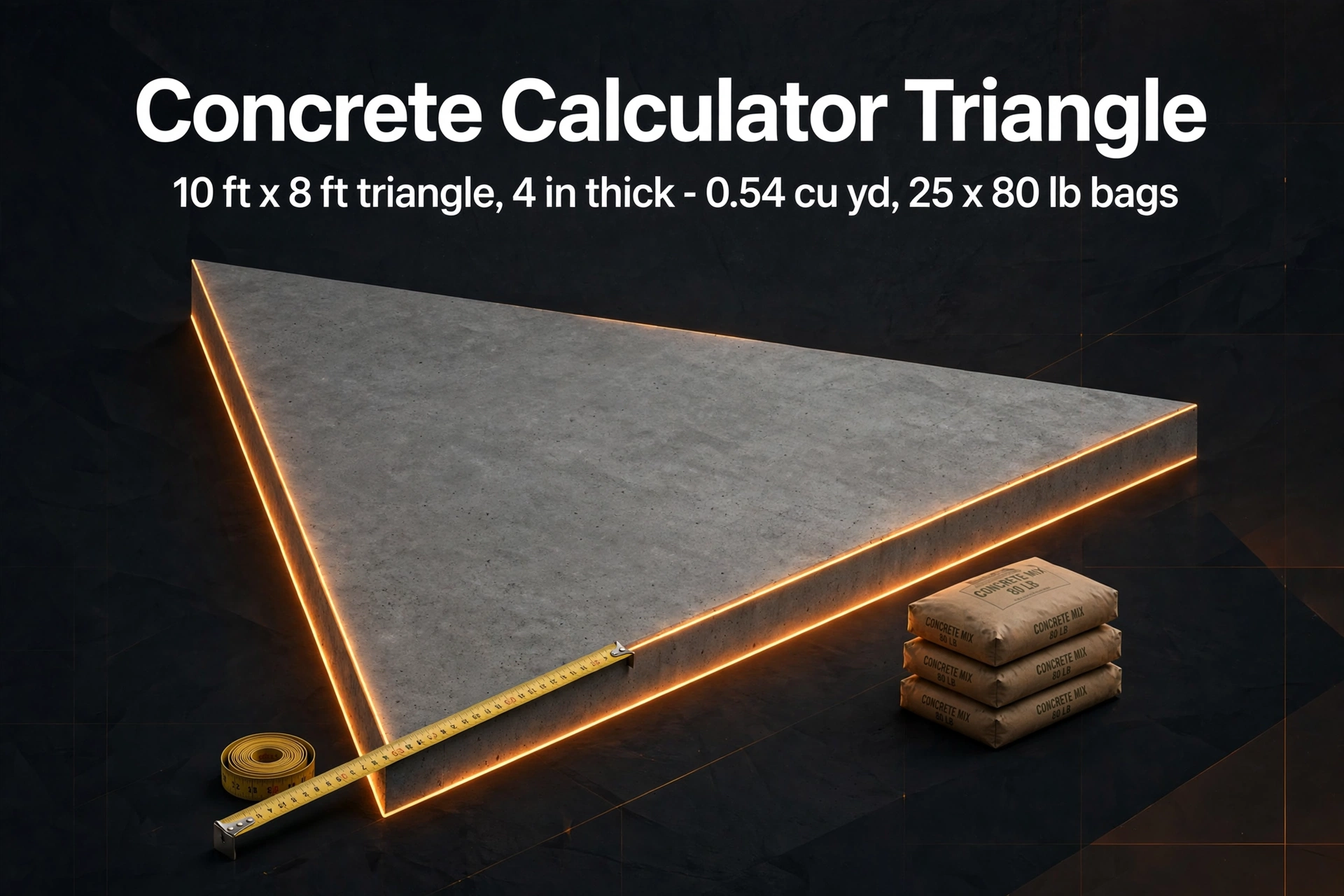
Worked example: a triangular patio corner
Take a corner of a patio that forms a right triangle. The long edge along the fence measures 10 feet, the short edge along the house measures 8 feet, and the two meet at a right angle, so the base is 10 feet and the height is 8 feet. The slab will be 4 inches thick, and a 10% waste allowance is added for spillage and an uneven sub-base.
Step one, the area: 0.5 × 10 × 8 = 40.00 square feet. Step two, the volume: 40 × (4 ÷ 12) = 13.33 cubic feet. Step three, waste: 13.33 × 1.10 = 14.67 cubic feet. Step four, cubic yards: 14.67 ÷ 27 = 0.54 cubic yards. Step five, bags: 14.67 ÷ 0.60 = 24.44, rounded up to 25 bags of 80 lb mix; 14.67 ÷ 0.45 = 32.59, rounded up to 33 bags of 60 lb mix; 14.67 ÷ 0.30 = 48.89, rounded up to 49 bags of 40 lb mix.
A second case shows how thickness changes the answer more than the footprint does. A triangle with a base of 12 feet and a height of 6 feet, poured 6 inches thick with no waste allowance, covers 36.00 square feet and needs 18.00 cubic feet, or 0.67 cubic yards — 30 bags of 80 lb mix, 40 of 60 lb, or 60 of 40 lb. The footprint is smaller than the first example, but the thicker pour needs more concrete. A third case, base 15 feet, height 10 feet, 4 inches thick, 5% waste, covers 75.00 square feet and needs 26.25 cubic feet, or 0.97 cubic yards — 44 bags of 80 lb mix, 59 of 60 lb, or 88 of 40 lb. That last figure is close to a full cubic yard, which is the point where ready-mix becomes worth pricing.
Quick-reference table: triangular slabs at 4 inches thick, before waste
The table below is computed from the same formula the tool uses — area = 0.5 × base × height, volume = area × (4 ÷ 12) — with no waste allowance, so add 10% to the volume before ordering. Bag counts are rounded up to whole bags.
| Base (ft) | Height (ft) | Triangle area (sq ft) | Volume (cu ft) | Volume (cu yd) | 80 lb bags | 60 lb bags | 40 lb bags |
|---|---|---|---|---|---|---|---|
| 6 | 4 | 12.00 | 4.00 | 0.15 | 7 | 9 | 14 |
| 8 | 6 | 24.00 | 8.00 | 0.30 | 14 | 18 | 27 |
| 10 | 8 | 40.00 | 13.33 | 0.49 | 23 | 30 | 45 |
| 12 | 6 | 36.00 | 12.00 | 0.44 | 20 | 27 | 40 |
| 12 | 10 | 60.00 | 20.00 | 0.74 | 34 | 45 | 67 |
| 15 | 10 | 75.00 | 25.00 | 0.93 | 42 | 56 | 84 |
| 20 | 12 | 120.00 | 40.00 | 1.48 | 67 | 89 | 134 |
At 6 inches thick, the same triangles need half as much again: the 10 × 8 ft triangle needs 20.00 cubic feet (0.74 cu yd, 34 bags of 80 lb mix), the 12 × 10 ft triangle needs 30.00 cubic feet (1.11 cu yd, 50 bags of 80 lb mix), and the 15 × 10 ft triangle needs 37.50 cubic feet (1.39 cu yd, 63 bags of 80 lb mix). Thickness is the fastest way to change the order, so measure it carefully.
What are the common mistakes with triangular concrete?
The most common mistake is using a sloping side as the height. The height must be measured square to the base. Using the sloping side overstates the area, and the error grows with the triangle: on a long, narrow triangle the sloping side can be far longer than the true height, and the order can come out 20% or 30% high. If the triangle is not a right triangle and the height is hard to measure on site, the three side lengths can be used with Heron's formula instead — but that is a different calculation, and this tool assumes a base and a perpendicular height.
The second mistake is forgetting to convert inches to feet. Thickness is usually spoken in inches — 4 inches, 6 inches — but the area is in square feet, so the thickness has to be divided by 12 before multiplying. Using 4 instead of 4 ÷ 12 makes the volume twelve times too large. The tool does this conversion for you, but it is the first thing to check when doing the maths by hand.
The third mistake is measuring the finished slab instead of the form. Forms take up space, and the concrete fills the inside of the form, so measure inside the formwork. A form board that is 2 inches thick on each side takes 4 inches off the length, and on a small triangle that is a real difference. Measure after the forms are set and braced, not before.
The fourth mistake is skipping the waste allowance. A slab calculated to the exact cubic foot will run short, because no sub-base is perfectly flat and no pour has zero spillage. A short pour leaves a cold joint where the second batch meets the first, and the finish suffers. Ten percent is a small price for a single continuous pour.
The fifth mistake is ordering by area instead of volume. Square feet tell you how much surface there is; they say nothing about how much concrete is needed until thickness is included. Two triangles with the same area but different thicknesses need different amounts of concrete, as the worked examples above show.
Can I use this for a triangle that is not a right triangle?
Yes, as long as you can measure a base and its perpendicular height. Every triangle has three possible base-and-height pairs — one for each side — and each pair gives the same area, because the area formula works for any triangle, not only right triangles. Pick the side that is easiest to measure as the base, then measure the perpendicular distance from the opposite corner to that side.
Where this tool does not apply is a triangle whose thickness varies across the pour, such as a ramp that tapers from thick at one end to thin at the other. The tool assumes uniform thickness. A tapered pour has to be split into sections of roughly even thickness, or calculated as a triangular prism with an average thickness, and the result will be an estimate rather than an exact figure. The same applies to a curved or irregular edge: split the shape into triangles and rectangles, calculate each one, and add the volumes together. The site's Figure Concrete for Slab Calculator covers the rectangular sections, and this tool covers the triangular ones.
How do I prepare the ground for a triangular slab?
Preparation decides whether the slab lasts, and it follows the same steps as a rectangular pour. Mark the triangle on the ground with string lines and pegs, then dig out the area to the depth of the concrete plus the sub-base — for a 4-inch slab on a 4-inch sub-base, that is 8 inches below the finished level. Remove soft spots, roots and loose soil, and compact the ground underneath.
Lay the sub-base of gravel or crushed stone, compact it in layers, and check the level across the triangle, not just along the edges. A sub-base that dips in the middle will take extra concrete to fill, and the finished slab will be thicker than planned in that spot. Set the formwork along all three sides, brace the corners well — the pointed corner of a triangle is the weakest point of the form and the first to bow outward under the weight of wet concrete — and check the thickness at each corner and in the middle before ordering.
Reinforcement is a separate decision from volume. A small garden pad may need none, while a driveway corner or a slab on soft ground usually gets wire mesh or rebar. The mesh sits in the middle of the slab's thickness, held up on chairs, and it does not change the concrete volume in any way that matters for ordering. Control joints, cut or formed into the surface after the pour, give the slab somewhere to crack neatly as it cures; on a triangle, a joint from the pointed corner toward the opposite side is common. None of this changes the number the tool gives — it changes how long the slab lasts.
How much does the concrete for a triangular slab weigh?
Wet concrete weighs about 150 pounds per cubic foot, or about 4,050 pounds per cubic yard. The worked example at 14.67 cubic feet weighs about 2,200 pounds once mixed, which is why the dry mix alone — 25 bags at 80 pounds each, or 2,000 pounds — is only part of the weight to move. A full cubic yard of wet concrete weighs just over two tons, and that weight has to be carried, barrowed or pumped into place before it stiffens.
Weight matters for two practical reasons. First, moving it: a standard wheelbarrow holds about 2 to 3 cubic feet per load, so the example pour is five or six barrow loads, while a 1.48-cubic-yard pour is around fifteen. Second, the ground underneath: wet concrete is heavy enough to push soft or uncompacted soil aside, which is why the sub-base and compaction steps matter. If the delivery truck has to cross a lawn or a driveway to reach the pour, check that the surface can take its weight — a loaded ready-mix truck weighs far more than the concrete it carries.
What should I do if my triangle is part of a bigger shape?
Most real pours are not a single neat triangle. A patio with a clipped corner, an L-shaped path, or a driveway that widens at the gate all break down into rectangles and triangles. Calculate each piece on its own — the rectangles with the Figure Concrete for Slab Calculator, the triangles with this tool — and add the volumes together, then apply one waste allowance to the total rather than to each piece, so the allowance is not counted twice.
Draw the plan on paper first and label each piece with its dimensions. The drawing also catches the most common splitting error, which is counting an area twice where two pieces overlap, or leaving a gap between them. Where two pieces share an edge, that edge belongs to one piece only. Add the pieces up, compare the total area with the overall footprint measured roughly, and if the two disagree by more than a few percent, re-check the split before ordering.
For the ground the slab sits on, the volume of fill or hardcore underneath can be worked out the same way — area times depth — and the site's Dirt Calculator handles that part of the job. If the triangle is a roof or floor area rather than a slab, the Tile Sq Ft Calculator and the Shingle Calculator cover the same base-and-height area maths for other materials. The full set of calculators sits on the Calculators category page.
How do I calculate concrete for a triangle-shaped slab?
Find the triangle area first: area = 0.5 × base × height, using the perpendicular height, not a sloping side. Multiply the area by the thickness in feet (thickness in inches ÷ 12) to get cubic feet, then divide by 27 for cubic yards. A triangle with a base of 10 ft, a height of 8 ft and a thickness of 4 in covers 40 sq ft and needs 13.33 cu ft before waste.
How many bags of concrete do I need for a triangular slab?
Divide the volume including waste by the yield of one bag: an 80 lb bag yields 0.60 cu ft, a 60 lb bag yields 0.45 cu ft, and a 40 lb bag yields 0.30 cu ft, then round up to whole bags. A triangle needing 14.67 cu ft with waste takes 25 bags of 80 lb mix, 33 bags of 60 lb mix, or 49 bags of 40 lb mix.
How many cubic yards of concrete is a triangle slab?
Divide the volume in cubic feet, including your waste allowance, by 27. A triangle with a base of 10 ft, a height of 8 ft and a thickness of 4 in, with 10% waste, needs 14.67 cu ft, which is 0.54 cu yd. A larger triangle — base 15 ft, height 10 ft, 4 in thick, 5% waste — needs 26.25 cu ft, or 0.97 cu yd.
What is the height of a triangle for a concrete calculation?
The height is the perpendicular distance from the base to the opposite corner — the shortest line from that corner to the base, meeting it at a right angle. It is not the length of a sloping side. On a right triangle, the two sides that meet at the right angle are the base and the height.
How much waste should I add when ordering concrete for a triangle?
Ten percent is the usual allowance for a small triangular pour, and it is the default in the calculator above. Use 5% on a small, well-formed pad with a flat, compacted sub-base, and 15% where the ground is uneven or the forms are makeshift. Running short costs more than the spare bag, because a second delivery or a second trip costs more than the extra concrete.
Should I use bags or ready-mix for a triangular slab?
Bags suit pours under about 1 cubic yard — the worked example at 0.54 cu yd is a comfortable bag job at 25 bags of 80 lb mix. Above 1 cubic yard, price ready-mix delivered by truck: a 20 ft × 12 ft triangle at 4 in thick needs 1.48 cu yd before waste, or 67 bags of 80 lb mix, which is more than 5,000 lb of dry mix to haul and mix by hand. Give the supplier the cubic-yard figure including waste.