Annuity Calculator Payment
Enter your lump sum, the annual interest rate, the payout term and how often payments arrive, and the tool works out the payment for each period.
This tool assumes an ordinary annuity: each payment arrives at the end of its period. The rate stays the same for the whole term, and the balance reaches exactly zero with the last payment. Your entries stay in your browser.
An annuity payment is the regular amount paid out from a lump sum over a set number of years. Enter the lump sum, the annual interest rate, the payout term and how often payments arrive, and this tool works out the payment for each period, the total paid and the total interest earned.
How do I use the Annuity Calculator Payment tool?
Enter four things. First, the lump sum: the amount of money the payments come from, also called the present value. Second, the annual interest rate as a percentage, such as 5. Third, the payout term in years, such as 20. Fourth, how often payments arrive: monthly, quarterly, every 6 months or yearly. Then press Calculate.
The tool shows six results. The payment per period is the amount of each payment. The number of payments is the term in years multiplied by the payments per year: 20 years of monthly payments is 240 payments. The total paid is the payment multiplied by the number of payments. The total interest earned is the total paid minus the lump sum. The annual income is the payment multiplied by the payments per year. The share of the total that is interest is the total interest divided by the total paid, as a percentage.
The tool assumes an ordinary annuity, which means each payment arrives at the end of its period. A monthly payment arrives at the end of each month, not at the start. The rate stays the same for the whole term, and the balance reaches exactly zero with the last payment: the last payment spends the last of the lump sum plus the last of the interest.
If an input is wrong, the tool shows a plain-language error and no results. A blank lump sum is rejected with “Enter the lump sum.” A lump sum of 0 or below is rejected, because there is nothing to pay out from. A negative rate is rejected, and a rate above 100% is rejected. A term of 0 years or below is rejected, and a term above 100 years is rejected. A rate of 0% is not an error: with no interest, the tool splits the lump sum evenly over the number of payments, so $500,000 over 20 years paid monthly is $2,083.33 a month and the total paid is exactly $500,000.
What does a worked example look like?
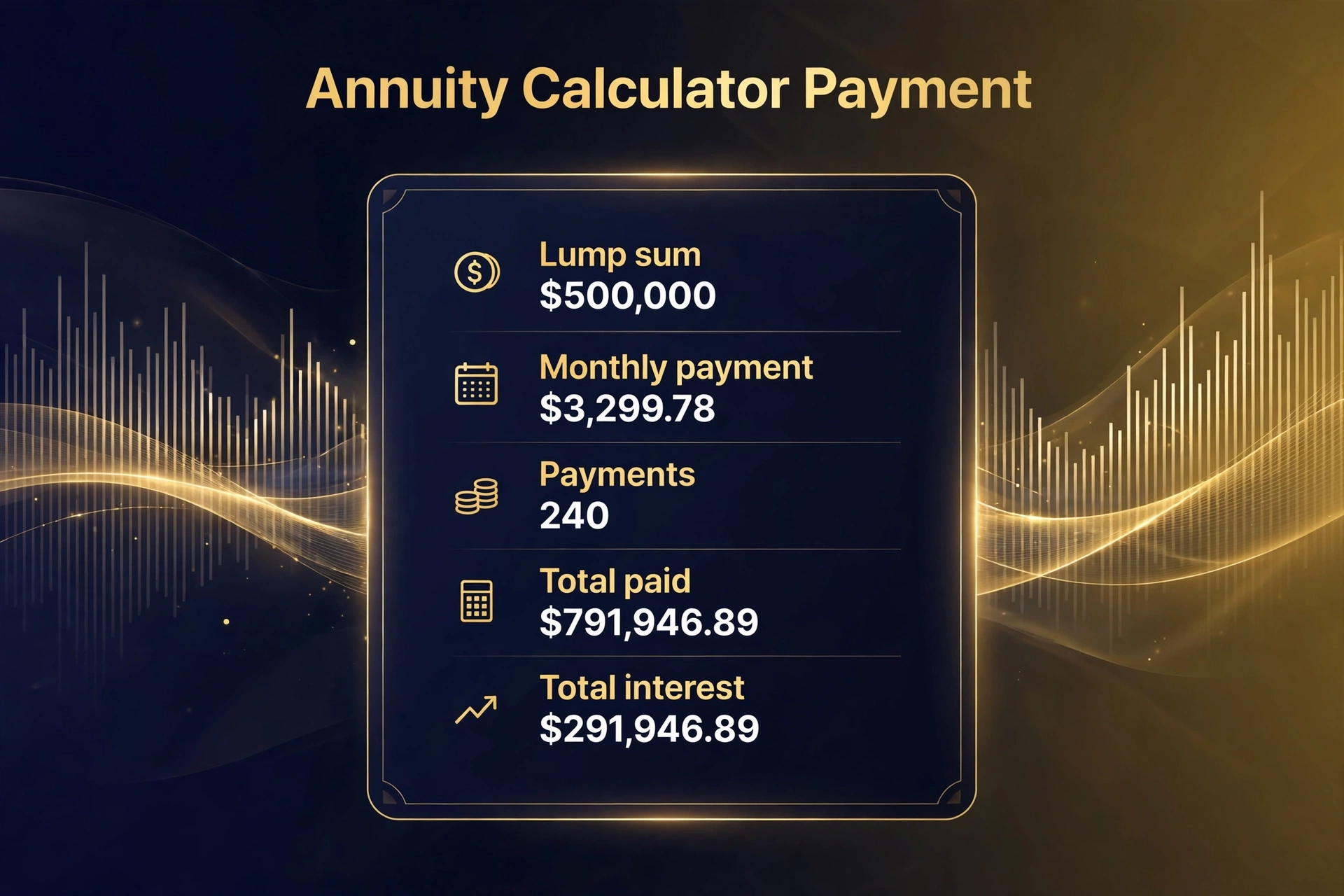
Take a lump sum of $500,000, an annual interest rate of 5%, a payout term of 20 years, and monthly payments. The per-period rate is 5% divided by 12, which is 0.4167% a month, or 0.0041667 as a decimal. The number of payments is 20 × 12 = 240. The formula is PMT = PV × r / (1 − (1+r)^−n), so the payment is $500,000 × 0.0041667 / (1 − (1.0041667)^−240). The factor (1 − (1.0041667)^−240) is 0.6314, so the payment is $2,083.33 / 0.6314 = $3,299.78 a month.
The rest follows from that one number. The total paid is $3,299.78 × 240 = $791,946.89. The total interest earned is $791,946.89 − $500,000 = $291,946.89. The annual income is $3,299.78 × 12 = $39,597.34 a year. The share of the total that is interest is $291,946.89 / $791,946.89 = 36.86%. So a $500,000 lump sum at 5% over 20 years pays $3,299.78 a month, and a little over a third of everything received is interest. To work a share like that out as a percentage on any figures, the percentage calculator gives the result.
A second example changes the numbers. A lump sum of $250,000 at 4% over 15 years, paid monthly, gives $1,849.22 a month. There are 180 payments, the total paid is $332,859.57, and the total interest earned is $82,859.57. The annual income is $22,190.64, and interest is 24.89% of the total paid. The shorter term and the lower rate both pull the interest share down: less time for interest to build, and a lower rate on the balance.
A third example uses a smaller sum at a higher rate. A lump sum of $100,000 at 6% over 10 years, paid monthly, gives $1,110.21 a month. There are 120 payments, the total paid is $133,224.60, and the total interest earned is $33,224.60. The annual income is $13,322.46, and interest is 24.94% of the total paid. The payment is higher than a tenth of the lump sum each year would suggest, because the balance earns 6% while it is being paid out.
A fourth example stretches the term. A lump sum of $1,000,000 at 5% over 30 years, paid monthly, gives $5,368.22 a month. There are 360 payments, the total paid is $1,932,557.84, and the total interest earned is $932,557.84. The annual income is $64,418.59, and interest is 48.26% of the total paid — nearly half of everything received. The long term is what does it: 30 years of interest on a large balance adds up to almost as much as the lump sum itself.
A fifth example changes only the frequency, keeping the same lump sum, rate and term: $500,000 at 5% over 20 years. Paid monthly, the payment is $3,299.78 and the total paid is $791,946.89. Paid quarterly, each payment is $9,923.26, there are 80 payments, and the total paid is $793,860.96. Paid every 6 months, each payment is $19,918.12, there are 40 payments, and the total paid is $796,724.66. Paid yearly, each payment is $40,121.29, there are 20 payments, and the total paid is $802,425.87. Less frequent payments mean a slightly higher total, because each payment waits longer and the balance earns interest for longer before it is drawn down.
What is an annuity payment?
An annuity payment is a regular payment made from a lump sum over a fixed period. The lump sum is handed over once, and the payments come back in instalments. Each payment is part interest and part return of the lump sum itself. Early payments are mostly interest, because the balance is still large; later payments are mostly return of the lump sum, because the balance has shrunk. By the last payment, the balance is exactly zero.
The word “annuity” covers two different things, and the difference matters. An annuity can be a product bought from an insurance company, where the insurer promises the payments and takes the risk that the money runs out. Or it can be a calculation: a lump sum paid out over a term at a rate, which is what this tool does. This tool does the calculation. It does not sell an annuity, quote an insurer’s price, or promise that any insurer will pay the figure it shows. An insurer’s quote also builds in its own costs, its profit margin and its view of how long people live, so a real quote will differ from this calculation.
The payment formula is the present value of an annuity, solved for the payment. PV is the present value, the lump sum. r is the rate per payment period: the annual rate divided by the number of payments per year. n is the total number of payments: the years multiplied by the payments per year. The formula PMT = PV × r / (1 − (1+r)^−n) finds the level payment that spends the balance down to exactly zero over n payments. It is the same formula a loan uses, run in the other direction: a loan calculator works out the repayment on money borrowed, while this tool works out the income from money handed over. The EMI calculator works through the same monthly-instalment arithmetic for loans.
How much does a $500,000 annuity pay per month?
It depends on the rate and the term, and the tool’s own arithmetic gives the fixed-term answer. At 5% over 20 years, paid monthly, a $500,000 lump sum pays $3,299.78 a month, with $791,946.89 paid in total and $291,946.89 of that as interest. Change the term and the payment moves a lot: at the same 5%, $500,000 over 10 years pays $5,303.28 a month, over 15 years it pays $3,953.97 a month, over 25 years it pays $2,922.95 a month, and over 30 years it pays $2,684.11 a month. A shorter term means a bigger monthly payment and less interest in total; a longer term means a smaller monthly payment and more interest in total.
That fixed-term answer is not the same as a lifetime annuity quote. A lifetime annuity pays until death, so it has no fixed number of payments, and its monthly amount depends on the age payments start, on gender and health, and on the insurer’s own assumptions about how long people live. No formula with a lump sum, a rate and a term can produce a lifetime quote, because a lifetime has no term to put into the formula. Anyone comparing this tool’s figure with a lifetime quote should expect the two to differ, and the quote is the one that counts for a real purchase.
The same scaling works for any lump sum, because the payment grows in direct proportion to the lump sum when the rate and term stay the same. A $100,000 lump sum at 5% over 20 years, paid monthly, gives $659.96 a month. A $200,000 lump sum on the same terms pays $1,319.91 a month, and $500,000 pays $3,299.78 a month — each figure is the same payment scaled by the lump sum, rounded to the cent. The quick-reference table near the end of this page lists the monthly payment per $100,000 at four rates and five terms, so any lump sum can be scaled from it.
How does the interest rate change the payment?
A higher rate means a higher payment, because the balance earns more while it is being paid out. Take $100,000 over 10 years, paid monthly. At 3% the payment is $965.61 a month. At 4% it is $1,012.45. At 5% it is $1,060.66. At 6% it is $1,110.21. Each extra point of rate adds roughly $48 to $50 a month on this lump sum and term. The total paid rises with the rate too: $115,873.20 at 3% against $133,224.60 at 6%, though the total paid at 3% is not in the table and comes from the same formula — $965.61 × 120 = $115,873.20, with $15,873.20 of interest.
The rate matters more over longer terms, because interest has more years to work. Take $100,000 over 30 years, paid monthly. At 3% the payment is $421.60 a month. At 6% it is $599.55 a month — a gap of $177.95 a month, against a gap of $144.60 a month over 10 years. The longer the money sits, the more the rate decides the outcome.
A rate of 0% is the floor. With no interest at all, the payment is simply the lump sum divided by the number of payments: $500,000 over 20 years paid monthly is $2,083.33 a month, and the total paid is exactly $500,000 with no interest. Every point of rate above zero lifts the payment above that floor. At 5% over 20 years the payment is $3,299.78, which is $1,216.45 a month above the 0% floor — that extra $1,216.45 a month is the interest doing its work.
How does the payout term change the payment?
A longer term means a smaller payment, because the same lump sum is spread over more payments. Take $500,000 at 5%, paid monthly. Over 10 years the payment is $5,303.28 a month. Over 15 years it is $3,953.97. Over 20 years it is $3,299.78. Over 25 years it is $2,922.95. Over 30 years it is $2,684.11. Stretching the term from 10 years to 30 years cuts the monthly payment nearly in half, from $5,303.28 to $2,684.11.
But the total paid moves the other way. Over 10 years the total paid is $636,393.09, with $136,393.09 of interest. Over 30 years the total paid is $966,278.92, with $466,278.92 of interest. The longer term pays out $329,885.83 more in total, and almost all of that extra is interest: the balance earns for 20 more years. The trade-off is plain: a shorter term gives more each month and less in total; a longer term gives less each month and more in total.
The payment does not fall in proportion to the term. Doubling the term from 10 years to 20 years does not halve the payment: $5,303.28 becomes $3,299.78, which is 62% of the shorter-term payment, not 50%. The reason is interest. Over the longer term the balance earns more, and that extra interest supports a payment higher than a straight split would give. A straight split of $500,000 over 10 years would be $4,166.67 a month, and over 20 years it would be $2,083.33; the real payments, $5,303.28 and $3,299.78, sit above those floors by the interest each term earns.
What is the difference between an ordinary annuity and an annuity due?
An ordinary annuity pays at the end of each period. An annuity due pays at the start of each period. That one-period shift changes the payment, because money paid out a period earlier earns one less period of interest.
On the same numbers, an annuity due pays slightly less per period than an ordinary annuity. Take $500,000 at 5% over 20 years, paid monthly. The ordinary annuity payment is $3,299.78 a month. The annuity-due payment is $3,299.78 divided by (1 + 0.05/12), which is $3,286.09 a month — $13.69 less each month. The total paid over 240 payments is $788,661.60 for the annuity due, against $791,946.89 for the ordinary annuity, a difference of $3,285.29. The annuity due pays less per period because each payment leaves the balance a month earlier.
This tool calculates the ordinary annuity only, and says so under the tool. Most pension and annuity income is quoted as an ordinary annuity, with the first payment arriving one period after the start. If a contract pays at the start of each period instead, its payment will be slightly lower than the figure this tool shows, by the factor (1 + r) for one period.
What is the difference between a fixed-term annuity and a lifetime annuity?
A fixed-term annuity, also called a period-certain annuity, pays for a set number of years and then stops. This tool calculates fixed-term payments: the term is one of the four inputs, and the balance reaches zero with the last payment. If the person receiving the payments dies before the term ends, what happens to the remaining payments depends on the contract — some pay the rest to a beneficiary, some do not.
A lifetime annuity pays until the person dies, however long that is. It has no fixed term, so this tool cannot calculate it: there is no number of years to enter. The insurer pools many annuitants together, and those who die early fund the payments of those who live long. That pooling is why a lifetime annuity can pay more per month than a fixed-term annuity on the same lump sum at older ages, and why its payment depends on age, gender and health. A lifetime annuity with a period-certain guarantee, such as life with 10 years certain, pays for life but guarantees at least 10 years of payments to a beneficiary if the annuitant dies early.
The UPS retirement calculator on this site works the same lump-sum-and-payment relationship in the other direction: it works out the lump sum a monthly pension payment is worth. Reading the two together shows both sides of the same arithmetic — a payment implies a lump sum, and a lump sum implies a payment.
What is an installment refund annuity?
An installment refund annuity is a lifetime annuity with a refund promise. Payments continue for life, and if the annuitant dies before the total paid reaches the original lump sum, the remaining balance is paid to a beneficiary in instalments until the full lump sum has been returned. The refund is the difference between the lump sum and the payments already made.
Take a $500,000 lump sum. If the annuitant receives $3,299.78 a month — the fixed-term figure from the worked example, used here only to show the arithmetic — then after 10 years they have received $395,973.60, and $104,026.40 of the lump sum is still unpaid. Under an installment refund, that $104,026.40 would go to the beneficiary in further instalments rather than staying with the insurer. The refund promise lowers the monthly payment compared with a life-only annuity on the same lump sum, because the insurer must keep enough back to fund the refund. This tool does not calculate installment refund payments, because the refund depends on the insurer’s mortality assumptions, not on the lump sum, rate and term alone.
A related option is a cash refund annuity, where the remaining balance is paid to the beneficiary as one lump sum instead of in instalments. The two differ only in how the refund arrives: instalments over time, or one payment at once.
How are annuity payments taxed?
Tax treatment varies, and this tool does not calculate tax. Whether a payment is taxed, and how much of it is taxed, depends on how the annuity was bought, on the type of account the money came from, and on current tax rules where the person lives. Money paid into an annuity from a retirement account such as an IRA or 401(k) is generally taxed as income when it comes out, because it was never taxed going in. Money paid in from after-tax savings is treated differently: part of each payment is a return of the money already paid in, and that part is not taxed again, while the interest part is taxed. The split between the two parts is set by tax rules, not by this tool.
This page gives no tax advice and no financial advice. Tax rules change, and they differ by country and by account type. Anyone who needs to know the tax on their own annuity payments should check the current rules that apply to them or speak to a qualified tax professional. The supporting search phrase “annuity withdrawal tax calculator” points at that question, and the honest answer is that a tax figure needs the person’s own tax position, which a payment calculator cannot know.
Should I take the lump sum or the monthly payments?
That is a choice between a sum of money now and a stream of income over time, and this tool can show the numbers on the income side of that choice. A $500,000 lump sum at 5% over 20 years is $3,299.78 a month, $791,946.89 in total, with $291,946.89 of interest. The lump sum is $500,000 today, to invest, spend or leave as it is. The payments are $3,299.78 a month for 20 years, and nothing after the term ends unless the contract says otherwise.
Three things decide which fits better, and none of them is a number this tool can settle. The first is how long the money needs to last: a fixed-term annuity stops at the end of its term, while a lump sum kept and drawn down can last longer or shorter depending on how it is used. The second is what happens to money left over: a lump sum can be passed on in full, while a fixed-term annuity with no refund leaves nothing after the term. The third is certainty: the monthly payment is fixed and arrives on schedule, while a lump sum invested elsewhere can grow or shrink. A CD interest calculator shows what a lump sum earns at a fixed deposit rate, which is one way to compare a lump sum kept in the bank against payments from an annuity.
What does this tool not do?
This tool does not calculate a cash-out or surrender value. Cashing out an annuity — taking the money back as a lump sum instead of receiving payments — is a different calculation: it depends on the contract’s surrender terms, any charges for early withdrawal, and the value the insurer assigns to the remaining payments. The search phrase “annuity cash out calculator” points at that question, and this tool does not answer it, because a surrender value needs the contract, not just a lump sum, a rate and a term.
This tool does not calculate tax, as the section above explains. It does not model lifetime annuities, because they have no fixed term. It does not adjust for inflation: the payments it shows are fixed in nominal terms, so $3,299.78 a month buys less in 20 years than it does today if prices rise. It does not model variable returns: the rate is fixed for the whole term, which matches a fixed annuity but not an investment whose return changes year to year. And it does not include fees or charges, which a real annuity contract may carry.
How can I check the tool against a known result?
The simplest check uses the headline example. Enter a lump sum of 500000, a rate of 5, a term of 20 years, and monthly payments. The tool should show a payment per month of $3,299.78, 240 payments, a total paid of $791,946.89, total interest earned of $291,946.89, annual income of $39,597.34, and an interest share of 36.86%.
A second check uses the 0% rate. Enter a lump sum of 500000, a rate of 0, a term of 20 years, and monthly payments. The tool should show a payment of $2,083.33 a month, a total paid of $500,000.00, and total interest earned of $0.00. The note should say the lump sum is split evenly over 240 payments.
A third check uses a different frequency. Enter a lump sum of 500000, a rate of 5, a term of 20 years, and yearly payments. The tool should show a payment per year of $40,121.29, 20 payments, a total paid of $802,425.87, and total interest earned of $302,425.87.
A fourth check tests the errors. Enter a lump sum of 0 and the tool should show the error “The lump sum must be above 0.” with no results. Enter a rate of -1 and the tool should show the error “The annual interest rate cannot be below 0.” with no results. Enter a term of 0 and the tool should show the error “The payout term must be above 0 years.” with no results. Leave the lump sum blank and the tool should show the error “Enter the lump sum.” with no results.
A fifth check tests the worked example for a smaller sum. Enter a lump sum of 100000, a rate of 6, a term of 10 years, and monthly payments. The tool should show a payment per month of $1,110.21, 120 payments, a total paid of $133,224.60, and total interest earned of $33,224.60.
The formula behind the tool is the present value of an annuity, solved for the payment, as given on the annuity calculator page from CalcSutra, which states PMT = PV × [r / (1 − (1 + r)^(−n))] and works a $200,000 example at 5% over 20 years to $1,319.91 a month. The U.S. Securities and Exchange Commission’s annuity information explains the product itself. More tools in the same collection are in the calculators category.
What is the monthly payment on $100,000 at every rate and term?
Every figure in this table was computed with the same formula the tool uses, for a $100,000 lump sum paid monthly as an ordinary annuity. Payments scale in direct proportion to the lump sum: multiply any figure by 5 for a $500,000 lump sum, or by 2.5 for a $250,000 lump sum.
| Annual rate | 10 years | 15 years | 20 years | 25 years | 30 years |
|---|---|---|---|---|---|
| 3% | $965.61 | $690.58 | $554.60 | $474.21 | $421.60 |
| 4% | $1,012.45 | $739.69 | $605.98 | $527.84 | $477.42 |
| 5% | $1,060.66 | $790.79 | $659.96 | $584.59 | $536.82 |
| 6% | $1,110.21 | $843.86 | $716.43 | $644.30 | $599.55 |
Two patterns in the table are worth reading. First, moving across a row shows the term effect: at 5%, the payment falls from $1,060.66 over 10 years to $536.82 over 30 years, nearly halving. Second, moving down a column shows the rate effect: over 20 years, the payment rises from $554.60 at 3% to $716.43 at 6%. The rate effect is smaller than the term effect on the payment itself, but the rate decides how much of the total paid is interest — and over a long term, that interest is most of the money received.
Frequently asked questions
What is an annuity calculator payment?
An annuity calculator payment is the regular amount paid out from a lump sum over a set term. This tool works it out from four inputs: the lump sum, the annual interest rate, the payout term in years, and how often payments arrive. For a $500,000 lump sum at 5% over 20 years, paid monthly, the payment is $3,299.78 a month.
How much does a $500,000 annuity pay per month?
As a fixed-term payout at 5% over 20 years, paid monthly, it pays $3,299.78 a month, with $791,946.89 paid in total and $291,946.89 of that as interest. The payment changes with the term: at the same 5%, $500,000 over 10 years pays $5,303.28 a month and over 30 years it pays $2,684.11 a month. A lifetime annuity quote is different again, because it depends on age and the insurer’s assumptions, so it cannot be worked out from the lump sum, rate and term alone.
How is an annuity payment calculated?
With the present value of an annuity formula, solved for the payment: PMT = PV × r / (1 − (1+r)^−n). PV is the lump sum, r is the rate per payment period (the annual rate divided by payments per year), and n is the total number of payments (years multiplied by payments per year). For $500,000 at 5% over 20 years paid monthly, r is 0.0041667 and n is 240, giving $3,299.78 a month.
What is the difference between an ordinary annuity and an annuity due?
An ordinary annuity pays at the end of each period, and an annuity due pays at the start of each period. On $500,000 at 5% over 20 years paid monthly, the ordinary annuity pays $3,299.78 a month and the annuity due pays $3,286.09 a month — $13.69 less each month, because each payment leaves the balance a month earlier and earns one less month of interest. This tool calculates the ordinary annuity.
What is an installment refund annuity?
An installment refund annuity is a lifetime annuity that promises to return the full lump sum. Payments continue for life, and if the annuitant dies before the total paid reaches the lump sum, the remaining balance is paid to the beneficiary in instalments until the full amount has been returned. The refund promise lowers the monthly payment compared with a life-only annuity on the same lump sum. This tool does not calculate installment refund payments.
How are annuity payments taxed?
Tax treatment varies. It depends on how the annuity was bought, on the type of account the money came from, and on current tax rules where the person lives. Payments from a retirement account such as an IRA or 401(k) are generally taxed as income when received, while payments from after-tax savings split each payment into a tax-free return of the money paid in and a taxable interest part. This tool does not calculate tax, and this page gives no tax advice — check the current rules that apply to you or speak to a qualified tax professional.