Wind Chill Calculator
Wind Chill Calculator
Enter the air temperature, your riding speed and any headwind to find the feels-like temperature on a motorcycle.
Wind chill is the temperature your exposed skin feels when cold air moves across it, and on a motorcycle the wind is one you create yourself. A 30 °F morning feels very different at 60 mph than it does standing still, because your riding speed becomes the wind speed in the wind chill formula.
What is wind chill, and why does it hit riders harder than drivers?
Wind chill describes how fast moving air strips warmth away from exposed skin. Your body warms a thin layer of air next to your skin, and still air lets that layer stay in place. Moving air sweeps it away and replaces it with cold air, so heat leaves your skin faster. The result is expressed as a temperature: the air temperature that would feel the same in calm conditions.
A car driver sits inside a heated box, so the wind chill outside the window barely touches them. A rider sits in the airflow itself. At highway speed the air moves past a rider at 60 mph or more, even on a day with no natural wind at all. That is why a forecast of 40 °F can still mean numb fingers and a cold face after twenty minutes on the road, while the same 40 °F feels mild to someone walking to a car.
Wind chill applies to people and animals, not to machines. It measures heat loss from living skin. It does not change the temperature of metal, fuel or oil, and it cannot cool an object below the actual air temperature. A motorcycle parked overnight in 30 °F air stays at 30 °F no matter how hard the wind blows. The rider is a different story, because skin keeps producing heat and the wind keeps carrying it away.
How do you calculate wind chill on a motorcycle?
Use the standard North American wind chill formula, adopted in 2001 by the US National Weather Service and Environment Canada:
Wind chill (°F) = 35.74 + 0.6215T − 35.75(V^0.16) + 0.4275T(V^0.16)
In that formula T is the air temperature in degrees Fahrenheit and V is the wind speed in miles per hour. The metric form of the same model uses Celsius and kilometres per hour: wind chill (°C) = 13.12 + 0.6215T − 11.37(V^0.16) + 0.3965T(V^0.16). The calculator above uses the imperial form and converts metric entries into it, so both unit systems give the same answer.
The formula came from human trials, not from theory alone. Volunteers walked on treadmills inside a refrigerated wind tunnel while researchers measured how fast the skin on their faces cooled at different temperatures and wind speeds. The result replaced the older Siple-Passel index from the 1940s, which was based on how fast water froze in containers in Antarctica and overstated how cold the wind made people feel. The 2001 model is fitted to real skin cooling, and it is the version weather services in the United States and Canada still use.
Two limits come with the formula. It is defined only for air temperatures at or below 50 °F (10 °C) and wind speeds above 3 mph (4.8 km/h). Above 50 °F the idea of wind chill stops making sense, because moving air in warm weather cools the body through evaporation and usually feels pleasant. Below 3 mph the air counts as calm. The calculator above follows both limits: enter a temperature above 50 °F and it tells you wind chill does not apply instead of inventing a number.
What is apparent wind, and how do you work it out?
Apparent wind is the wind you actually feel, and for a rider it is the sum of two things: your own speed through the air and the natural wind. On a calm day the apparent wind equals your riding speed. Riding at 60 mph on a still morning means 60 mph of airflow over your body. Riding at 60 mph into a 10 mph headwind means 70 mph of airflow.
That single substitution is the whole motorcycle angle. Weather forecasts report the natural wind, usually measured well above the ground. A rider has to add their own speed to it. The calculator above does exactly that: enter your riding speed, add any headwind, and it feeds the total into the formula as V.
A tailwind works the other way, subtracting from your speed, and a crosswind changes the direction of the airflow more than its speed. The headwind case is the one that matters most for cold, because it adds directly to the airflow and it is also the case where the wind hits the parts of the body that face forward: the face, the chest, the fronts of the legs and the hands on the bars. Gusts make the picture jump around, which is why the tool asks for a steady cruising speed rather than a peak speed. Use the speed you expect to hold for most of the ride, not the fastest moment on the speedometer. Runners face the same apparent wind, so check your pace with the Running Pace Calculator.
Why does speed matter more than the air temperature?
The formula has a surprise built into it: the first miles per hour of wind do most of the damage, and extra speed after that adds less and less. The wind term in the formula rises with V raised to the power of 0.16, a curve that climbs steeply at first and then flattens. Going from calm air to 15 mph of wind changes the feels-like temperature far more than going from 45 mph to 60 mph.
The numbers make this concrete. At an air temperature of 40 °F, the feels-like temperature is 33.6 °F at 10 mph, 30.5 °F at 20 mph, 28.5 °F at 30 mph, 26.9 °F at 40 mph, 25.7 °F at 50 mph, 24.7 °F at 60 mph and 23.8 °F at 70 mph. The first 10 mph costs 6.4 °F. The next 60 mph together cost only 9.8 °F more. A rider who speeds up from 30 mph to 60 mph on a 40 °F day loses only about 4 °F of feels-like temperature, while a rider who pulls out of a sheltered street onto an open road at 30 mph loses more than 11 °F in the first minute.
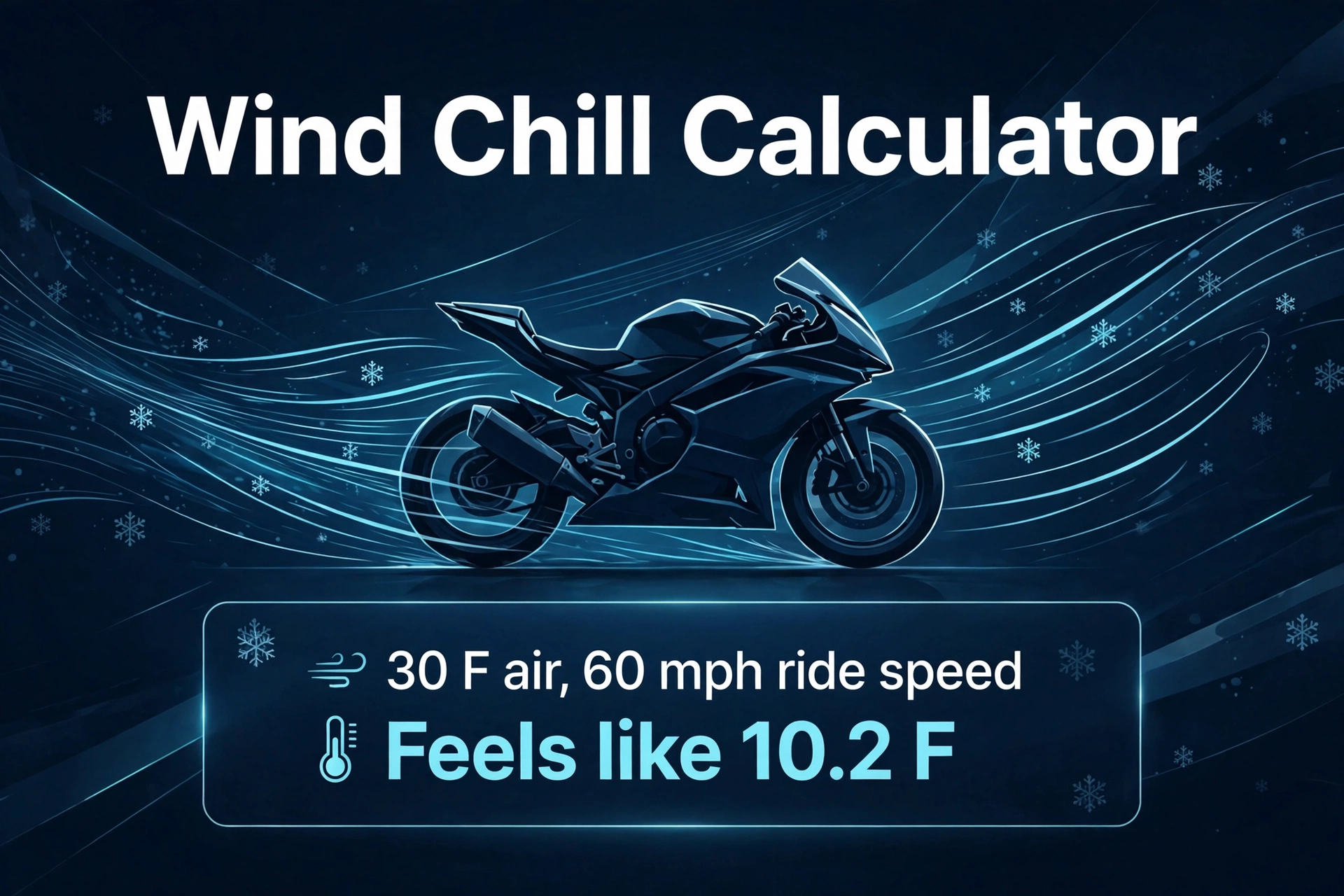
Temperature still sets the starting point, and it sets it firmly. At 60 mph, a 50 °F day feels like 39.1 °F, a 40 °F day feels like 24.7 °F, a 30 °F day feels like 10.2 °F, a 20 °F day feels like −4.2 °F, a 10 °F day feels like −18.6 °F and a 0 °F day feels like −33.1 °F. Each 10 °F fall in air temperature pulls the feels-like temperature down by roughly 14 °F at highway speed. Speed decides how much of that fall you feel; temperature decides where the fall starts. Both matter, and a cold day at high speed is where the two combine worst.
What does 40 °F feel like at 60 mph?
Take a common autumn ride: the air is 40 °F, you cruise at 60 mph, and a 10 mph headwind blows down the road toward you. The apparent wind is 60 plus 10, or 70 mph. Put 40 °F and 70 mph into the formula:
Wind chill = 35.74 + 0.6215 × 40 − 35.75 × (70^0.16) + 0.4275 × 40 × (70^0.16) = 23.8 °F
The ride feels like 23.8 °F, which is −4.6 °C, a drop of 16.2 °F from the air temperature. Without the headwind, at 60 mph alone, the same 40 °F day feels like 24.7 °F, so the 10 mph headwind costs about another degree. Either way the ride feels well below freezing even though the thermometer reads 40 °F.
The tested figures from this page tell the same story at other speeds. At 30 °F and 60 mph with no headwind, the feels-like temperature is 10.2 °F, a drop of 19.8 °F. At 20 °F and 40 mph it is −0.9 °F, a drop of 20.9 °F, and the frostbite band for exposed skin at that level is about 30 minutes. At 0 °F and 30 mph it is −25.9 °F, a drop of 25.9 °F, with frostbite possible in about 10 minutes. These are the numbers the calculator produces, and they match the published NWS chart cells: 0 °F at 15 mph is −19 °F on the chart and −19.4 °F from the formula, and 30 °F at 60 mph is 10 °F on the chart and 10.2 °F from the formula.
How fast can frostbite set in at highway speed?
Frostbite is what happens when body tissue freezes, and the parts that freeze first are the ones with the least insulation and the most exposure: fingers, toes, ear lobes and the tip of the nose. The National Weather Service publishes frostbite times beside its wind chill chart, and they are tied to the wind chill value rather than to the air temperature alone.
The published bands for exposed skin are: a wind chill from 0 °F down to −15 °F gives frostbite in about 30 minutes; from −15 °F down to −30 °F gives frostbite in about 10 minutes; below −30 °F gives frostbite in 5 minutes or less. NOAA gives the same idea as a single example: at 0 °F air temperature with no wind, exposed skin can take over 30 minutes to freeze, while a 15 mph wind drops the wind chill to −19 °F and exposed skin can freeze in a few minutes.
For a rider, the useful translation is that frostbite time depends on the feels-like temperature at riding speed, not on the forecast temperature. A 20 °F day at 40 mph feels like −0.9 °F, which sits in the 30-minute band. A 0 °F day at 30 mph feels like −25.9 °F, which sits in the 10-minute band. A 0 °F day at 60 mph feels like −33.1 °F, which sits in the 5-minutes-or-less band. The same air temperature can mean three different bands depending on speed, which is why the calculator shows the frostbite band next to every result.
These times describe exposed skin. Covered skin is protected for longer, and wet skin, poor circulation and fatigue shorten the time. The bands are planning figures from a published chart, not a promise about any one person on any one ride.
What should you wear for the feels-like temperature, not the forecast?
Cold-weather riding gear is built around the same fact the formula describes: moving air carries heat away, so the job of clothing is to slow that loss. Riders commonly dress for the feels-like temperature the calculator shows rather than the air temperature on the forecast, because that is the temperature their skin has to deal with at speed.
Layers work by trapping still air. A base layer sits against the skin, a middle layer holds warm air, and an outer layer blocks the wind. The outer layer does the job the formula cares about most, because windproof material stops moving air from sweeping the warm layer away. Gaps matter as much as thickness: the neck, the wrists and the ankles are the places where cold air commonly gets in, and gloves, neck coverings and boots that overlap the sleeves and trouser legs close those gaps.
Hands deserve separate thought because they sit out in the airflow on the handlebars and they do the fine work of braking and steering. Heated grips and hand guards reduce the airflow over them, and thick gloves keep them warm at the cost of some feel. Feet sit in a similar position, low and forward, with steady airflow and little movement to generate warmth. A full-face helmet covers the face and ears, which are the parts the wind chill model itself was built around, since the 2001 trials measured cooling on volunteers' faces.
Wet clothing changes the picture sharply, because water carries heat away from skin far faster than air. Rain, sweat or damp gloves make the same feels-like temperature feel colder and bring frostbite times closer. Dry layers, windproof outers and covered skin are the standard pattern for cold rides, and the calculator result is the number to plan around: if it reads 10 °F, the ride calls for the clothing that suits 10 °F, whatever the thermometer on the garage wall reads.
Does wind chill cool down your motorcycle engine or battery?
No, and this is one of the most repeated misunderstandings about wind chill. Wind chill describes heat loss from living skin. A motorcycle engine, a battery, fuel and tyres are inanimate objects. Wind can cool them down to the air temperature faster, but it cannot take them below it. A bike parked in 30 °F air with a 40 mph wind stays at 30 °F.
What wind does change for a machine is the rate of cooling, not the final temperature. An engine that is switched off cools to the air temperature sooner in a strong wind. An engine that is running makes its own heat and holds its own temperature. Cold air itself, rather than wind chill, is what makes a battery weaker and an engine harder to start on a winter morning: chemical reactions in a battery slow down as the temperature falls, and oil thickens. Those effects follow the air temperature on the thermometer, not the wind chill number. Riders who confuse the two sometimes worry about a bike that is perfectly fine, or miss the real cold-weather issue, which is their own skin and hands at speed.
What are the most common mistakes riders make with wind chill?
The first mistake is trusting the forecast temperature. A weather app reports the air temperature and, at best, a wind chill based on the natural wind. Neither number includes riding speed. A rider who dresses for 45 °F and then cruises at 65 mph is riding in a feels-like temperature near 30 °F, and the gap only grows as the speed rises.
The second mistake is using peak speed instead of cruising speed. The wind chill that matters is the one at the speed held for most of the ride. A short burst to 80 mph matters less than thirty minutes at a steady 60 mph, because heat loss adds up over time and frostbite times are measured in minutes of exposure.
The third mistake is forgetting the headwind. A 10 mph headwind at highway speed adds a degree or two to the chill, and a 20 mph headwind adds more. On an out-and-back ride the return leg often has the headwind, so the coldest part of the ride can be the way home, when the rider is already tired and the light is fading.
The fourth mistake is leaving skin exposed. A short gap at the neck or wrist is a small area, but it is exposed to the full airflow for the whole ride, and the face, ears and fingers are exactly the parts that freeze first. A gap that feels fine at a standstill becomes a stream of cold air at 60 mph.
The fifth mistake is treating a mild day as a safe day. At 50 °F and 60 mph the feels-like temperature is 39.1 °F, and at 50 °F and 70 mph with a headwind it drops further still. A 50 °F day does not sound like winter, but at highway speed it is cold enough for numb hands, and numb hands react more slowly. The calculator exists for days like that, when the thermometer looks friendly and the airflow is not.
How do you use the quick-reference table before a ride?
Read the table by finding your air temperature in the left column and your cruising speed across the top. The cell where they meet is the feels-like temperature. Add your expected headwind to your speed first if you are riding into the wind: a 50 mph cruise into a 10 mph headwind reads in the 60 mph column.
The table below was computed with the same NWS formula as the calculator, so the two always agree. Use the table for a fast check before leaving, and use the calculator for an exact figure with your own numbers, including metric units.
| Air temp (°F) | 30 mph | 40 mph | 50 mph | 60 mph | 70 mph |
|---|---|---|---|---|---|
| 50 | 42.0 | 40.9 | 39.9 | 39.1 | 38.4 |
| 40 | 28.5 | 26.9 | 25.7 | 24.7 | 23.8 |
| 30 | 14.9 | 13.0 | 11.5 | 10.2 | 9.1 |
| 20 | 1.3 | −0.9 | −2.7 | −4.2 | −5.5 |
| 10 | −12.3 | −14.8 | −16.9 | −18.6 | −20.2 |
| 0 | −25.9 | −28.8 | −31.1 | −33.1 | −34.8 |
| −10 | −39.4 | −42.7 | −45.3 | −47.5 | −49.5 |
All values are wind chill in °F. The table covers the riding speeds most riders actually use, from town speeds to highway cruising, and the temperatures where wind chill matters. Above 50 °F wind chill is not defined, so the table starts there.
A rider planning a morning commute can use the same routine every time: check the air temperature, pick the cruising speed, read the feels-like temperature, and compare it with the frostbite bands. At 30 °F and 60 mph the table reads 10.2 °F, which is above the 30-minute frostbite band but cold enough to need full coverage. At 10 °F and 50 mph it reads −16.9 °F, which sits in the 10-minute band for exposed skin. At 0 °F and 60 mph it reads −33.1 °F, which sits in the 5-minutes-or-less band. Those three readings describe three very different rides, all from the same table.
For longer trips, the same check works leg by leg. A route that climbs into colder air or turns into a headwind changes the feels-like temperature even when the speed stays the same. Planning a ride around distance and time helps here: the Time Distance Speed Calculator works out how long each leg takes at a given speed, and that time can be set against the frostbite band for the leg. A 45-minute leg at a feels-like temperature in the 30-minute band is a different proposition from a 15-minute leg at the same temperature. Related tools for the rest of your planning: the Minutes Calculator, the Steps to Calories Calculator, and the Lease Mileage Calculator.
Wind chill is a simple idea with a sharp edge: the air temperature tells you how cold the day is, and your speed tells you how cold the ride is. The calculator above puts the two together in one number, and the table puts that number within reach before every ride. You can also browse more calculators.
How do you calculate wind chill on a motorcycle?
Use the National Weather Service wind chill formula with your apparent wind as the wind speed. Apparent wind is your riding speed plus any headwind. The formula is wind chill (°F) = 35.74 + 0.6215T − 35.75(V^0.16) + 0.4275T(V^0.16), where T is the air temperature in °F and V is the apparent wind in mph. The calculator above does this in one step: enter the air temperature, your riding speed and any headwind.
What does 40 °F feel like at 60 mph on a motorcycle?
At 40 °F and 60 mph with no headwind, the wind chill is 24.7 °F, a drop of 15.3 °F from the air temperature. With a 10 mph headwind the apparent wind becomes 70 mph and the feels-like temperature falls to 23.8 °F. A 40 °F day feels well below freezing at highway speed.
At what wind chill does frostbite happen?
Frostbite times on the National Weather Service wind chill chart are tied to the wind chill value for exposed skin: from 0 °F down to −15 °F, frostbite in about 30 minutes; from −15 °F down to −30 °F, frostbite in about 10 minutes; below −30 °F, frostbite in 5 minutes or less. Covered skin is protected for longer, and wet skin, poor circulation and fatigue shorten the time.
Is wind chill the same as the air temperature?
No. The air temperature is what a thermometer reads in still air. Wind chill is the temperature exposed skin feels when wind carries heat away from it, expressed as a temperature. On a motorcycle the two differ by 15–25 °F at highway speeds in cold air. Above 50 °F wind chill is not defined, and at wind speeds of 3 mph or less the air counts as calm, so the feels-like temperature equals the air temperature.
Does wind chill affect my motorcycle engine?
No. Wind chill describes heat loss from living skin, not from machines. Wind can cool an engine, battery or fuel down to the air temperature faster, but it cannot take them below it. Cold air itself makes a battery weaker and an engine harder to start, and those effects follow the air temperature on the thermometer, not the wind chill number.
What is apparent wind for a motorcycle rider?
Apparent wind is the wind a rider actually feels: riding speed plus headwind. Riding at 60 mph on a calm day means 60 mph of airflow. Riding at 60 mph into a 10 mph headwind means 70 mph of airflow. A tailwind subtracts from your speed, and a crosswind changes the direction of the airflow. The calculator above adds your riding speed and headwind together to get the apparent wind before applying the wind chill formula.